

Guide for parents and teachers | Read this first
The Firefly Ed Grade 2 English lessons are a full year of English for children aged about 7. They follow the IB Primary Years Programme (PYP), and each lesson also links to the national curriculum for England (Year 2) and the US Common Core (Grade 2). Every lesson is free to use online, and printable PDFs are free after you subscribe.
Who the lessons are written for
Each lesson is written for the child. Everything from the goal at the top down to Next Steps speaks to the learner, so you can hand over a printed lesson without crossing anything out.
Guidance for you sits at the end of each lesson, in two closed sections:
- Notes for Parents and Teachers: what is particular to that lesson, such as what to point to, which part you read or play, and which sentences to read out for a dictation.
- Answer Key: answers and sample answers. Many tasks have a Look for note about what a good answer includes.
Each lesson page ends with For Teachers: IB Details, a short summary of the lesson’s IB theme, central idea, key concepts and lessons. The full standards for every lesson, from the IB PYP, the national curriculum for England (Year 2) and the US Common Core (Grade 2), are in the Grade 2 Curriculum Map.
This page covers everything that is the same in every lesson, so it is not repeated in each one.
What is in the Grade 2 lessons
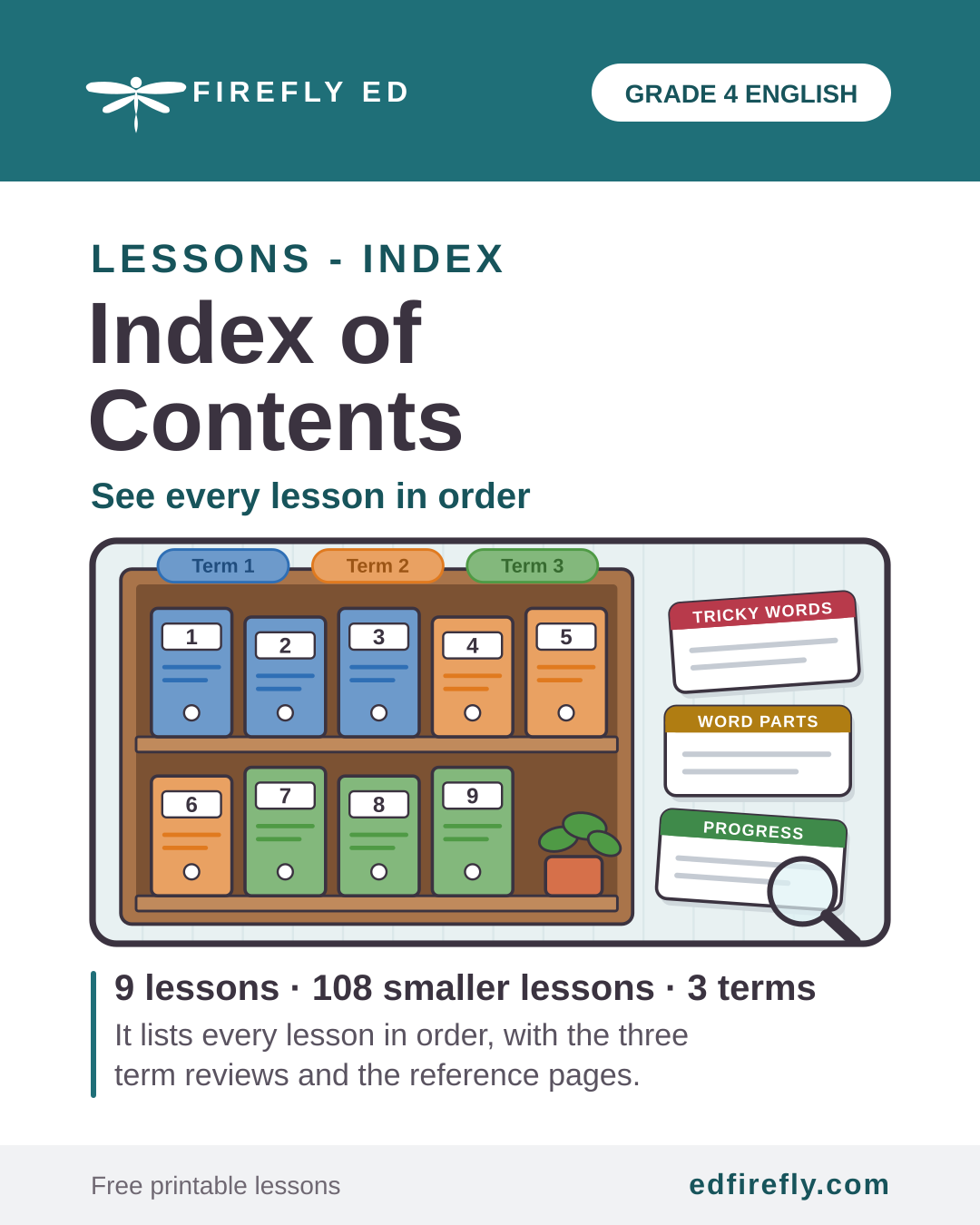
There are 3 terms, 9 lessons and 108 smaller lessons. Each lesson is one IB unit of inquiry with 12 smaller lessons, such as Lessons 1.1 to 1.12. Each term ends with a four-part review.
| Term | Lessons | Reading level | Review |
|---|---|---|---|
| Term 1 | Lesson 1: Growing and Changing Lesson 2: Rules, Routines and Jobs Lesson 3: Tales From Around the World | Level 1: texts of about 150 to 250 words | Term 1 Review |
| Term 2 | Lesson 4: Plants and Growing Lesson 5: Homes Around the World Lesson 6: Toys and Games Then and Now | Level 2: texts of about 250 to 350 words | Term 2 Review |
| Term 3 | Lesson 7: Day, Night and the Sky Lesson 8: Keeping Healthy Lesson 9: Caring for Our Planet | Level 3: texts of about 350 to 500 words | Term 3 Review: End of Year |
The reading texts get longer and the questions ask for more thinking as the year goes on. The levels are a guide used to plan the lessons. They are not an official standard.
There are also three reference pages to use all year: the Tricky Word List, the Phonics Sound Chart and My Progress Chart.
The 12 smaller lessons in each lesson
| Lessons | Strand | What children do |
|---|---|---|
| 1 and 2 | Reading | read stories, poems and information texts, and answer questions |
| 3 and 4 | Writing | plan and write, such as letters, reports, recipes and stories |
| 5 and 6 | Oral language | speak and listen, such as giving talks, debating and asking questions |
| 7 and 8 | Visual language | read and make pictures, charts, maps, diagrams and posters |
| 9, 10 and 11 | Phonics and spelling | learn spelling patterns, word endings and tricky words |
| 12 | Review | one task from each strand, and a short dictation |
After the review (such as Lesson 1.12), each lesson has an optional Challenge: a read-aloud story with harder words and a grammar task.
How a lesson runs
Every lesson has the same parts, in the same order, so children know what to expect. Work through them in order.
| Part | What happens | How to help |
|---|---|---|
| Goal | an “I can” sentence that says what the lesson is for | Read it together. Ask the child to say it in their own words. |
| Words to know | the key words for the lesson | Check the child can say each word. They are explained in Let’s Learn. |
| Wonder | a big question to start the child thinking | Accept every idea without correcting it. Write the child’s answer down, because they come back to it in Reflect. |
| Let’s Learn | the new idea, explained simply, with pictures | Read it aloud together. Stop at each picture and talk about it. |
| See How It’s Done | a worked example, with a character’s thinking shown in thought bubbles | Read the example, then read the thoughts together. Point to the words or pictures that each thought is about. |
| Now Try It | two short questions, some with a hint | Talk them through aloud. Read the hint only if the child is stuck. |
| Time To Practise | the main tasks | Let the child work as independently as possible. For speaking tasks, you are the other speaker. For dictation tasks, read the words or sentences from the Answer Key. |
| Reflect | a return to the Wonder question, a learner profile sentence and an action to take at home | Talk about the questions together. Help the child find a real moment from the lesson for the learner profile sentence. |
| Next Steps | what to try if the lesson was easy, and what to go back to if it was hard | Choose one, or skip it if the lesson went well. |
Each lesson also has its own page. It shows what the lesson is about, a Before you start activity, the questions the lesson explores, ideas for Try it at home, and the IB details. Open a smaller lesson from that page to work on it.
Hints, pictures and checklists
- Hints are written for the child. Read them aloud if the child is stuck.
- When a task depends on naming a picture, the lesson notes give you the words to say first, so that the child is not confused by a picture.
- Checklists with tick boxes help you and the child notice what went well in speaking and writing tasks.
How long does it take?
Most lessons take about 20 minutes. Writing and speaking lessons can take longer if the child enjoys them, and you can split a lesson over two days. A good pace is three lessons a week. At that pace, one lesson, such as Lesson 1, takes about four weeks, and all the lessons take one school year.
Working on paper
The lessons are worksheets. The child can work on paper next to the screen, or you can print the page. Lines such as ______ show where to write.
The IB PYP words
| Word | What it means |
|---|---|
| Transdisciplinary theme | one of six big themes, such as Who we are or Sharing the planet. Each lesson is one unit of inquiry under one theme. |
| Central idea | the big idea of the unit, shown on each lesson page |
| Key concept | a question that guides thinking, such as Form (What is it like?) or Causation (Why is it as it is?) |
| Learner profile | qualities such as inquirer, thinker, communicator and caring |
| ATL skills | approaches to learning: thinking, research, communication, social and self-management skills |
Where to start
Most children can start at Lesson 1. If you are not sure, try the Placement Check first. It takes about 20 minutes and tells you whether to start Grade 2, or to review some Grade 1 lessons first.
You can see every lesson on the Grade 2 English index page.
All Grade 2 English lessons | Download lesson PDFs
© 2026 Firefly Ed. All rights reserved. This page may be printed for personal, home and classroom use. It may not be sold, shared online or reproduced for commercial use without written permission. edfirefly.com


Share your thoughts or ask something..