

Term 3 | Level 3 | Phonics focus: contractions, apostrophes for owning, and -tion words
What Lesson 7 is about
The movement of the Earth and the Moon causes patterns that we can see in the sky.
Theme: How the world works. This theme is about the natural world and its laws: how the Earth, the Sun and the Moon move, and how people find out about the world around them.
Before you start
Before Lesson 7.1, look at the sky with an adult on a clear evening. If you can see the Moon, notice its shape. Where does the Sun go at night? Why does the Moon look different on different nights? What do you notice about the stars?
Write down your ideas, or ask an adult to write them for you. Keep them. You will look at them again at the end of Lesson 7.
Questions we explore
- Why we have day and night
- How the Moon, the Sun and shadows seem to change
- How people have described and explained the sky
How each lesson works
Every lesson starts with a Wonder question to think about. Next, you learn something new, see how it is done, try it, and practise on your own. Each lesson ends with Reflect, where you go back to the Wonder question, think about how you learned, and choose something to do at home.
Lessons
Each strand of Lesson 7 has its own page. Open a page to see its lessons.
Download all of Lesson 7 as a PDF (free after you subscribe)
Reading: Read an Explanation of Day and Night and Two Moon Poems
In Lessons 7.1 and 7.2, you put the steps of an explanation in order, and find similes, rhymes and sound words in two moon poems.
Writing: Write an Explanation of Shadows and a Night Sky Poem
In Lessons 7.3 and 7.4, you write an explanation of how shadows change during the day, and write a night sky poem with a repeated line and similes.
Listening and Speaking: Perform a Poem Together and Answer How and Why Questions
In Lessons 7.5 and 7.6, you mark and perform a poem with a group, and use a model to explain day and night in full sentences with because.
Viewing and Presenting: Read a Moon Chart and Invent a Constellation
In Lessons 7.7 and 7.8, you find patterns in a Moon chart set out like a calendar, and design a constellation with a key and a story.
Phonics: Contractions, Apostrophes for Owning and -tion Words
In Lessons 7.9, 7.10 and 7.11, you write contractions, use ‘s to show owning, tell its from it’s, and read and spell words ending in -tion.
Review
Lesson 7.12 reviews the whole of Lesson 7. An optional Challenge with a story and a grammar task follows it. Select a section to go straight to it. Each section ends with a link back to the top of the page.
Lesson 7.12: Lesson 7 Review
All strands | About 20 minutes
Term 3 | Level 3
Goal
“I can show what I learned in Lesson 7 in reading, writing, speaking, looking and phonics.”
Words to know
explanation, simile, perform, Moon phase, constellation, apostrophe, -tion
Wonder
Think about this question before you start. Say your ideas. You will come back to it at the end of the lesson.
What patterns can we see in the sky, and what causes them?
Let’s Learn
This lesson checks what you learned in Lesson 7.
There is one task for each part: reading, writing, oral, visual and phonics. The last task is a spelling check.
Read each task with an adult. Do your best on your own first.
See How It’s Done
Now Try It
1. Listen as an adult says “motion”. What sound does -tion make?
Hint: Think of motion and fiction.
2. Write “motion” in the air with your finger.
Hint: mo, then tion.
Time To Practise
Name: ______________________
1. Reading: Where do the stars go in the day?
At night, we can see hundreds of stars. But where do they go in the daytime? The answer is that they do not go anywhere. The stars are still in the sky during the day. We cannot see them because the Sun is so bright. Its light fills the sky and hides the much fainter light of the stars. First, the Sun sets in the evening. Then the sky gets darker and darker. Finally, the stars appear, one by one. They were there all along!
a) Are the stars still in the sky during the day? ______
b) Why can we not see them in the day? ______________________________
c) Write the three time words the writer uses to show the order. ______________________________
2. Writing: Similes and explanations
a) Finish the simile: The stars sparkled like ______________________________
b) Join with so: The Sun was high in the sky. My shadow was short.
__________________________________________________________________
3. Oral: Perform and explain
a) How would you say this line in a poem? The fox creeps softly through the dark. Write loud or soft, and fast or slow. ______________
b) Answer in a full sentence with because: Why is it night on one half of the Earth?
__________________________________________________________________
4. Visual: Moon shapes and star patterns
a) Which picture shows a full Moon? ______
b) Which two pictures show a half Moon? ______ and ______
c) In Leo’s diary in Lesson 7.7, the Moon grew bigger on the right side. Which picture shows a waxing crescent? ______
d) What is a constellation? ______________________________
5. Phonics: Apostrophes, -tion and tricky words
a) Write the contractions. could not → ______________ they are → ______________
b) Write it the short way. the light of the Moon → ______________________
c) Circle the correct word. The cat licked (its / it’s) paw.
d) Add -ion. invent → ______________ celebrate → ______________
e) Circle the tricky words. Who would like to eat the whole cake?
6. Spelling check
1. ______________
2. ______________
3. ______________
__________________________________________________________________
Reflect
Think about these questions. Talk about them with someone at home or at school.
1. Go back to the Wonder question: “What patterns can we see in the sky, and what causes them?” What do you think now?
2. I was reflective today when I ______________________________.
Being reflective means looking back at your work and thinking how to make it better. For example: I was reflective today when I looked back at what I learned in Lesson 7.
Take action: Look back at the ideas you had in “Before you start” at the start of Lesson 7. Tell someone at home one thing you now know about the Sun, the Moon or the stars.
Next Steps
If this was easy, try: Start Lesson 8: Keeping Healthy. It begins with Lesson 8.1, Eat Well: Text and Diagram.
If this was hard, go back to: The lesson named next to each missed task in the answer key. Redo the Time To Practise tasks from that lesson, then try this review again.
Notes for Parents and Teachers
Show notes for parents and teachers
These notes cover this lesson only. How every lesson runs is explained in How to Use This Material.
Let’s Learn
There are six short tasks. Do them in one sitting or split them over two days.
See How It’s Done
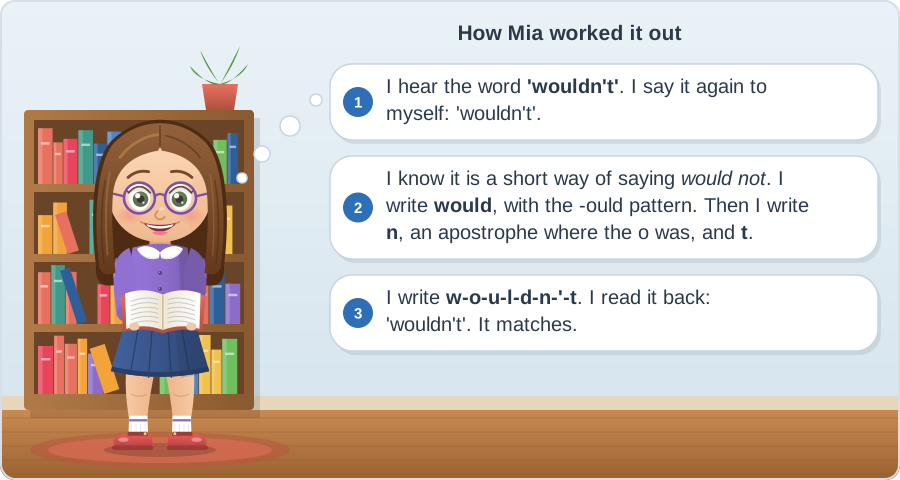
Mia’s thoughts show how the spelling check in Task 6 works, using the word ‘wouldn’t’.
Time To Practise
- Task 6: The words and the sentence are in the Answer Key. Say each word twice, then say the sentence twice. Do not stretch the sounds for the learner.
Answer Key
Reveal Answers
Now Try It
1. shun
2. m o t i o n
1. Reading (Lessons 7.1 and 7.2)
a) Yes
b) Because the Sun is so bright that its light hides the fainter light of the stars.
c) First, Then, Finally
2. Writing (Lessons 7.3 and 7.4)
a) Sample answer: …tiny diamonds on a black blanket.
b) The Sun was high in the sky, so my shadow was short.
3. Oral (Lessons 7.5 and 7.6)
a) Sample answer: soft and slow, because the fox is creeping quietly.
b) Sample answer: It is night on one half of the Earth because that half is facing away from the Sun.
4. Visual (Lessons 7.7 and 7.8)
a) B
b) A and D
c) C
d) A group of stars that people imagine as a picture.
5. Phonics (Lessons 7.9, 7.10 and 7.11)
a) couldn’t, they’re
b) the Moon’s light
c) its
d) invention, celebration
e) Who, would, whole
6. Spelling check (Lessons 7.9, 7.10 and 7.11)
1. couldn’t
2. station
3. whole
Who could see the Moon’s light? It’s shining on the station.
Look for: the apostrophe where the o was in couldn’t, -tion in station, wh in whole and who, -ould in could, the owning apostrophe in Moon’s, and the contraction it’s.
For any task the learner missed, repeat the lesson shown in brackets before starting Lesson 8.
Reflect
2. Any real moment from the lesson that shows the learner was reflective. Examples: “I was reflective today when I looked back at what I learned in Lesson 7.” “I was reflective today when I found the tasks I need to practise again.”
Challenge: Read-Aloud Story and Grammar
Optional | About 20 minutes
This Challenge is optional. It has a story to listen to and a grammar task.
Part 1: Read-Aloud Story
Listen as an adult reads the story aloud. Then talk about it.
The Astronomer Next Door
Mia’s new neighbour, Mr Hassan, was an astronomer. He studied the stars for his job. One clear evening, he invited Mia and her mum to look through his telescope.
“Be patient,” he said. “Our eyes need time to get used to the darkness.”
Mia waited. Slowly, more and more stars appeared, until the sky was crowded with them.
Mr Hassan pointed the telescope at the Moon. Mia gasped. She could see craters, like tiny bowls pressed into its surface. “Rocks from space crashed into the Moon long ago and made those,” he explained.
Then he showed her a faint, fuzzy smudge of light. “That is a galaxy,” he said. “It is made of billions of stars. It is so far away that its light has travelled for millions of years to reach us.”
Mia stared in wonder. That night, she wrote in her diary: When I grow up, I want to be an explorer of the sky.
Talk about the story
1. What was Mr Hassan’s job?
2. Why did Mia have to be patient before she could see lots of stars?
3. What do you think craters are? Which words in the story help you?
Hint: Look at what the craters are compared to.
4. Why does light from the galaxy take so long to reach us?
5. How do you think Mia felt that night? Find two clues in the story.
Hint: Look at what Mia did and what she wrote.
Part 2: Making Nouns (Grammar)
In Grade 1, you learned that a noun names a person, place or thing. We can make new nouns in three ways.
- Add -ness to a describing word to name a feeling or an idea, as in Lesson 6.10: dark → darkness, kind → kindness.
- Add -er to a doing word to name the person who does it: teach → teacher, garden → gardener. If the word ends in e, just add r: explore → explorer.
- Join two nouns to make a compound noun: sun + light → sunlight, star + fish → starfish.
1. Make a noun by adding -ness or -er.
a) bright → ______________ b) farm → ______________ c) bake → ______________
d) soft → ______________ e) paint → ______________ f) cold → ______________
2. Join the words to make compound nouns.
a) moon + light = ______________ b) sun + set = ______________
c) space + ship = ______________ d) day + time = ______________
3. Find two made nouns in the story: one that ends in -ness and one that names a person and ends in -er.
-ness: ______________ -er: ______________
Notes for Parents and Teachers
Show notes for parents and teachers
These notes cover this section only. How every lesson runs is explained in How to Use This Material.
Use the Challenge when the lessons feel easy, or to stretch the learner after Lesson 7.12. The story is for you to read aloud. It uses some harder words on purpose, so talk about them as you read.
Part 1: Read-Aloud Story
Read the story aloud twice. The first time, just enjoy it. The second time, stop at the words in bold and talk about what they mean.
Answer Key
Reveal Answers
Part 1: Talk about the story
1. He was an astronomer. He studied the stars.
2. Because her eyes needed time to get used to the darkness.
3. Round hollows or dents in the Moon’s surface. The clue is “like tiny bowls pressed into its surface”.
4. Because the galaxy is so far away.
5. Example: Amazed and excited. Clues: she gasped, she stared in wonder, and she wrote that she wants to be an explorer of the sky.
Part 2: Grammar
1. a) brightness b) farmer c) baker d) softness e) painter f) coldness
2. a) moonlight b) sunset c) spaceship d) daytime
3. -ness: darkness -er: explorer (explore + r)
Try it at home
By the end of Lesson 7, you could:
- Keep a Moon diary for two weeks: draw the shape of the Moon each night you can see it.
- Go outside at three different times on a sunny day and draw around your shadow with chalk.
- Turn off the lights you do not need in the evening, so you save energy and can see more stars.
Lesson 7.12 reviews Lesson 7. Look back at the ideas from “Before you start” and talk about how they have changed.
Notes for Parents and Teachers
Show notes for parents and teachers
the Lesson 7 page and the lessons are written for the learner. How every lesson runs is explained once in How to Use This Material. Each lesson also has its own short notes, after Next Steps.
- The lessons are worksheets. The learner opens a lesson and works on paper next to the screen, or on a printout. Printable PDFs are free to download after you subscribe.
- Before you start: help the learner write down their ideas before Lesson 7.1, and keep them. In Lesson 7.12, look at them together and talk about how they have changed.
For Teachers: IB Details
Show IB and curriculum details
IB theme: How the world works. This theme is about the natural world and its laws: how the Earth, the Sun and the Moon move, and how people find out about the world around them.
Central idea: The movement of the Earth and the Moon causes patterns that we can see in the sky.
Key concepts: Causation (why is it like it is?), Change (how is it changing?), Form (what is it like?). Related concepts: patterns, space, observation.
Lines of inquiry:
- Why we have day and night
- How people have described and explained the sky
- How the Moon, the Sun and shadows seem to change
What each lesson covers
| Lesson | Title | Strand | Key concept |
|---|---|---|---|
| 7.1 | Why Do We Have Day and Night? | Reading | Causation |
| 7.2 | Moon Poems: Similes and Sounds | Reading | Form |
| 7.3 | Write an Explanation: How Shadows Change | Writing | Change |
| 7.4 | Write a Night Sky Poem | Writing | Form |
| 7.5 | Perform a Poem Together | Listening and speaking | Form |
| 7.6 | Explain It: How and Why Questions | Listening and speaking | Causation |
| 7.7 | Read a Moon Chart | Viewing | Change |
| 7.8 | Star Patterns: Invent a Constellation | Viewing and presenting | Form |
| 7.9 | Contractions and Tricky Words | Reading and spelling | Form |
| 7.10 | Apostrophes for Owning | Reading and spelling | Form |
| 7.11 | -tion Words | Reading and spelling | Form |
| 7.12 | Lesson 7 Review | All strands | Causation, Change and Form |
Each lesson also matches the national curriculum for England (Year 2) and the US Common Core (Grade 2). The Grade 2 Curriculum Map lists the full standards for every lesson.
← Previous: Lesson 6, Toys and Games Then and Now | Lessons – Index | Next: Lesson 8, Keeping Healthy →
© 2026 Firefly Ed. All rights reserved. This page may be printed for personal, home and classroom use. It may not be sold, shared online or reproduced for commercial use without written permission. edfirefly.com

Share your thoughts or ask something..