

Term 1 | Level 1 | Phonics focus: -dge and -ge, soft c and g, silent letters kn, gn, wr
What Lesson 2 is about
Rules, routines and jobs help people live, learn and work well together.
Theme: How we organize ourselves. This theme is about the systems people make and how they work: how people live and work together, share jobs and make decisions.
Before you start
Before Lesson 2.1, look at something at home that organises people: a calendar, a bin collection day, a list on the fridge or a school timetable. What would happen if nobody knew the plan? Who decides the rules and jobs at home? Are they fair?
Write down your ideas and keep them. You will look at them again at the end of Lesson 2.
Questions we explore
- Why groups of people make rules
- How routines help us organise our time
- How people share jobs and work together
How each lesson works
Every lesson starts with a Wonder question to think about. Next, you learn something new, see how it is done, try it, and practise on your own. Each lesson ends with Reflect, where you go back to the Wonder question, think about how you learned, and choose something to do at home.
Lessons
Each strand of Lesson 2 has its own page. Open a page to see its lessons.
Download all of Lesson 2 as a PDF (free after you subscribe)
Reading: Read Class Rules and a Day in the Life of a Baker
In Lessons 2.1 and 2.2, you match rules to their reasons, and put the events of a working day in order using times and clues from the text.
Writing: Write Instructions and a Job Profile
In Lessons 2.3 and 2.4, you write instructions with numbered steps and bossy verbs, and write an information text about a job.
Listening and Speaking: Follow Three-Step Instructions and Agree on a Job Rota
In Lessons 2.5 and 2.6, you follow and give three-step instructions, and take turns in a discussion to agree on a fair family job rota.
Viewing and Presenting: Read a Job Chart and Draw a Flow Chart
In Lessons 2.7 and 2.8, you read a chart with rows and columns, decide if jobs are shared fairly, and draw a flow chart for the steps of a job.
Phonics: -dge and -ge, Soft c and g, and Silent kn, gn, wr
In Lessons 2.9, 2.10 and 2.11, you choose dge or ge, read words where c and g change their sound before e, i and y, and spell words with silent kn, gn and wr.
Review
Lesson 2.12 reviews the whole of Lesson 2. An optional Challenge with a story and a grammar task follows it. Select a section to go straight to it. Each section ends with a link back to the top of the page.
Lesson 2.12: Lesson 2 Review
All strands | About 20 minutes
Term 1 | Level 1
Goal
“I can show what I learned in Lesson 2 in reading, writing, speaking, looking and phonics.”
Words to know
rule, reason, bossy verb, job profile, chart, flow chart, silent letter
Wonder
Think about this question before you start. Say your ideas. You will come back to it at the end of the lesson.
How do rules, routines and jobs help people live and work together?
Let’s Learn
This lesson checks what you learned in Lesson 2.
There is one task for each part: reading, writing, oral, visual and phonics. The last task is a spelling check.
Read each task with an adult. Do your best on your own first.
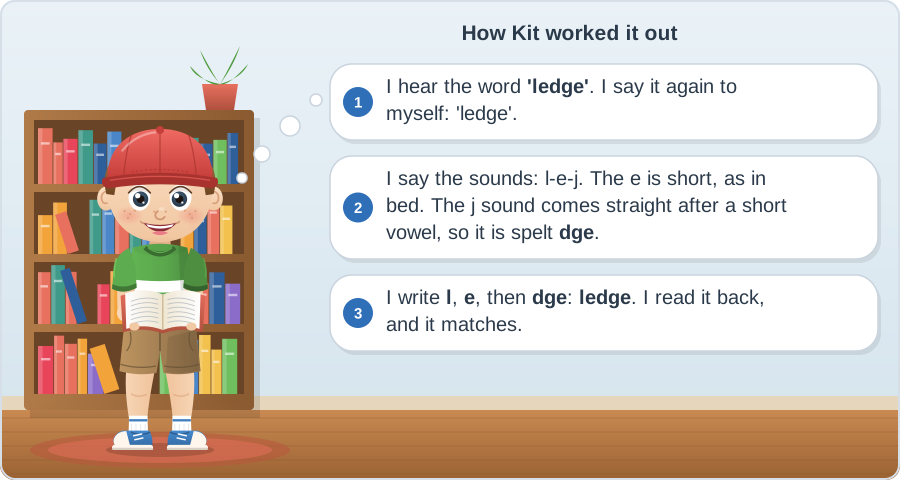
See How It’s Done
Now Try It
1. Listen as an adult says “page”. Is it spelt with dge or ge?
Hint: Is the a short, as in cat, or long?
2. Write “page” in the air with your finger.
Hint: p, a, then the ending.
Time To Practise
Name: ______________________
1. Reading: A working morning
Mrs Okafor is a bus driver. She starts work at six o’clock in the morning. First, she walks all the way round her bus. She checks that the tyres are full of air and that every light works. At half past six, she drives out of the bus station. At each stop, she waits until everyone has sat down before she drives off. At nine o’clock, she stops for a cup of tea. “Driving a bus is a big job,” she says. “Lots of people need to get to work and school on time.”
a) What time does Mrs Okafor drive out of the bus station? ______________
b) Number these in order, 1 to 3.
____ She stops for a cup of tea. ____ She checks the tyres. ____ She drives out of the bus station.
c) A sign on the bus says: Please stay in your seat while the bus is moving. The text does not give a reason. Write a reason for this rule.
__________________________________________________________________
d) Does Mrs Okafor think her job is important? Write a clue from the text.
__________________________________________________________________
2. Writing: Instructions and a job profile
a) Make these notes into two clear steps. Start each step with a bossy verb.
notes: seeds in the bird feeder, feeder on the hook
1. ______________________________________________________________
2. ______________________________________________________________
b) Use facts from the text in Task 1. Write an opening sentence for a profile of a bus driver, and one fact with a reason using because.
__________________________________________________________________
__________________________________________________________________
3. Oral: Instructions and discussion
a) Read the instruction: “Before you put on your shoes, put on your socks. Then tie your laces.” Write the three steps in the order you do them.
1. ______________________ 2. ______________________ 3. ______________________
b) Someone says: “We should play tag every break time.” You would like to play something else sometimes. Write a polite reply.
__________________________________________________________________
4. Visual: A chart and a flow chart
a) Who wipes the tables on Wednesday? ______________
b) Which child has two jobs in one day? Which day? ______________ on ______________
c) Write the missing step in box 2 of the flow chart.
Hint: What do you put on the brush before you start?
Box 2: ______________________________________________________
5. Phonics: Spelling patterns and tricky words
a) Write dge or ge. bri ________ hu ________ sta ________ fu ________
b) Circle the words with a soft c or g. city coat gem gate pencil girl
c) Cross out the silent letter. knee wrap gnome climb
d) Circle the right word. Please (write / right) a card for Gran.
e) Circle the tricky words. Both children saw a wild fox, but only one could climb the tree.
6. Spelling check
Listen as an adult says each word twice. Write it. Then listen to a sentence, and write it.
1. ______________
2. ______________
3. ______________
__________________________________________________________________
Reflect
Think about these questions. Talk about them with someone at home or at school.
1. Go back to the Wonder question: “How do rules, routines and jobs help people live and work together?” What do you think now?
2. I was reflective today when I ______________________________.
Being reflective means looking back at your work and thinking how to make it better. For example: I was reflective today when I looked back at what I learned in Lesson 2.
Take action: Look back at the ideas you had in “Before you start” at the start of Lesson 2. Tell someone at home one rule, routine or job you now understand better.
Next Steps
If this was easy, try: Start Lesson 3: Tales From Around the World. It begins with Lesson 3.1, Read a Fable: The Lion and the Mouse.
If this was hard, go back to: The lesson named next to each missed task in the answer key. Redo the Time To Practise tasks from that lesson, then try this review again.
Notes for Parents and Teachers
Show notes for parents and teachers
These notes cover this lesson only. How every lesson runs is explained in How to Use This Material.
Let’s Learn
There are six short tasks. Do them in one sitting, or split them over two days.
See How It’s Done
Kit’s thoughts show how the spelling check in Task 6 works, using the word ‘ledge’.
Time To Practise
- Task 6: The words and the sentence are in the Answer Key. Say each word twice, then say the sentence twice. Do not stretch the sounds for the learner.
Answer Key
Reveal Answers
Now Try It
1. ge, because the a is long.
2. p a g e
1. Reading (Lessons 2.1 and 2.2)
a) Half past six
b) 3 She stops for a cup of tea. 1 She checks the tyres. 2 She drives out of the bus station.
c) Sample answer: So that nobody falls over and gets hurt if the bus stops suddenly.
d) Yes. Clue: she says “Driving a bus is a big job” and “Lots of people need to get to work and school on time.”
2. Writing (Lessons 2.3 and 2.4)
a) Sample answer: 1. Pour the seeds into the bird feeder. 2. Hang the feeder on the hook.
b) Sample answer: A bus driver drives people to work and school. Bus drivers check the tyres every morning because a flat tyre is not safe.
Look for: in a), each step starts with a verb such as pour, put, fill or hang. In b), the opening sentence says what the job is, and the fact is in the present tense.
3. Oral (Lessons 2.5 and 2.6)
a) 1. Put on your socks. 2. Put on your shoes. 3. Tie your laces.
b) Sample answer: I see what you mean, but could we play a different game on Fridays?
Look for: in b), the reply is polite and makes a suggestion.
4. Visual (Lessons 2.7 and 2.8)
a) Leo
b) Ava on Tuesday
c) Sample answer: Put toothpaste on the brush.
Look for: in b), the learner looks down each day’s column to find the same name twice.
5. Phonics (Lessons 2.9, 2.10 and 2.11)
a) bridge, huge, stage, fudge
b) city, gem, pencil
c) knee (k), wrap (w), gnome (g), climb (b)
d) write
e) Both, children, wild, only, climb
Look for: in b), girl is not circled, because its g is hard even before i.
6. Spelling check (Lessons 2.9, 2.10 and 2.11)
1. badge
2. city
3. knock
Most children know the way to the bridge.
Look for: dge in badge and bridge, soft c in city, kn in knock and know, and the tricky words most and children spelt correctly.
For any task the learner missed, repeat the lesson shown in brackets before starting Lesson 3.
Reflect
2. Any real moment from the lesson that shows the learner was reflective. Examples: “I was reflective today when I looked back at what I learned in Lesson 2.” “I was reflective today when I found the tasks I need to practise again.”
Challenge: Read-Aloud Story and Grammar
Optional | About 20 minutes
This Challenge is optional. It has a story to listen to and a grammar task.
Part 1: Read-Aloud Story
Listen as an adult reads the story aloud. Then talk about it.
Before the Shop Opens
Leo’s Aunt Bea is a baker. One Saturday, Leo was allowed to help in the bakery before it opened. They arrived when the street was still dark and silent.
First, Aunt Bea tied a long apron round Leo. “Rules first,” she said. “Wash your hands, tie back your hair and never touch the ovens.” Leo nodded. He did not want to break a rule on his very first day.
The kitchen smelled warm and sweet. Leo’s job was to shape the rolls. He pressed and rolled the dough, but his rolls came out lumpy and lopsided. Aunt Bea did not laugh. “Everyone’s first rolls look like that,” she said. “Mine looked like potatoes.”
When the sun came up, the shelves were full of golden loaves. A queue of people was already waiting outside the door. Leo felt exhausted, but proud. He had never realised how much work happened before he even woke up.
Talk about the story
1. Where does Aunt Bea work, and what is her job?
2. Why do you think there is a rule about tying back your hair in a bakery?
Hint: Think about what a baker is making.
3. Leo’s rolls were lopsided. What do you think lopsided means? What clue tells you?
Hint: Look at the word just before it, and at what Aunt Bea says her rolls looked like.
4. Why did Aunt Bea say her first rolls looked like potatoes?
5. Why did Leo feel proud at the end? What did he learn about a baker’s job?
Part 2: Joining Words: when, if, because (Grammar)
In Lesson 1.3, you joined sentences with and, but, so and or. Some other joining words tell the reader more about when, why or under what condition something happens.
- when tells us the time: They arrived when the street was still dark.
- because tells us the reason: Leo was tired because he got up early.
- if tells us what must happen first: You can help if you wash your hands.
The joining word can also come at the start. Then we put a comma after the first part: When the sun came up, the shelves were full.
1. Underline the joining word in each sentence.
a) The bread is ready when it turns golden.
b) Tie back your hair because it could fall in the dough.
c) If you touch the oven, you will burn your hand.
d) Leo smiled because the customers liked the rolls.
2. Join each pair of sentences with when, if or because. Use each word once.
a) Leo yawned. He got up very early. → ______________________________________________
b) You can have a roll. You say please. → ______________________________________________
c) The shop opens. The sun comes up. → ______________________________________________
Hint: Read your sentence aloud. Does it make sense?
3. Finish each sentence about a job or routine at your home.
a) I wash my hands because ______________________________________________
b) If it rains at the weekend, ______________________________________________
c) When I get home from school, ______________________________________________
Notes for Parents and Teachers
Show notes for parents and teachers
These notes cover this section only. How every lesson runs is explained in How to Use This Material.
Use the Challenge when the lessons feel easy, or to stretch the learner after Lesson 2.12. The story is for you to read aloud. It uses some harder words on purpose, so talk about them as you read.
Part 1: Read-Aloud Story
Read the story aloud twice. The first time, just enjoy it. The second time, stop at the words in bold and talk about what they mean.
Answer Key
Reveal Answers
Part 1: Talk about the story
1. She works in a bakery. She is a baker.
2. Example: so that no hair falls into the bread or the dough, because people are going to eat it.
3. Lopsided means bigger or higher on one side than the other, not even. The clues are “lumpy” just before it, and that Aunt Bea says her rolls looked like potatoes.
4. Example: to show Leo that everyone makes mistakes at first, so he would not feel bad about his rolls.
5. Example: He had worked hard and helped to fill the shelves. He learned that bakers start work very early, before most people wake up. Encourage a “because” sentence.
Part 2: Grammar
1. a) when b) because c) If d) because
2. a) Leo yawned because he got up very early.
b) You can have a roll if you say please.
c) The shop opens when the sun comes up.
Accept the joining word at the start with a comma, for example: If you say please, you can have a roll.
3. Any sensible endings, for example: a) I wash my hands because it gets rid of germs. b) If it rains at the weekend, we will play board games. c) When I get home from school, I feed the cat.
Try it at home
By the end of Lesson 2, you could:
- Agree a fair job rota with your family and put it on the wall.
- Write clear instructions for a routine at home, such as feeding a pet or packing a school bag.
- Thank someone whose job helps you, such as a cleaner, a bus driver or a shop worker.
Lesson 2.12 reviews Lesson 2. Look back at the ideas from “Before you start” and talk about how they have changed.
Notes for Parents and Teachers
Show notes for parents and teachers
the Lesson 2 page and the lessons are written for the learner. How every lesson runs is explained once in How to Use This Material. Each lesson also has its own short notes, after Next Steps.
- The lessons are worksheets. The learner opens a lesson and works on paper next to the screen, or on a printout. Printable PDFs are free to download after you subscribe.
- Before you start: help the learner write down their ideas before Lesson 2.1, and keep them. In Lesson 2.12, look at them together and talk about how they have changed.
For Teachers: IB Details
Show IB and curriculum details
IB theme: How we organize ourselves. This theme is about the systems people make and how they work: how people live and work together, share jobs and make decisions.
Central idea: Rules, routines and jobs help people live, learn and work well together.
Key concepts: Function (how does it work?), Responsibility (what is our responsibility?), Connection (how is it linked to other things?). Related concepts: rules, routines, roles.
Lines of inquiry:
- Why groups of people make rules
- How routines help us organise our time
- How people share jobs and work together
What each lesson covers
| Lesson | Title | Strand | Key concept |
|---|---|---|---|
| 2.1 | Read the Class Rules | Reading | Function |
| 2.2 | A Day in the Life of a Baker | Reading | Function |
| 2.3 | How to Brush Your Teeth | Writing | Function |
| 2.4 | Write a Job Profile | Writing | Function |
| 2.5 | Three-Step Instructions | Listening and speaking | Responsibility |
| 2.6 | Let’s Agree: A Family Job Rota | Listening and speaking | Responsibility |
| 2.7 | Read a Class Job Chart | Viewing | Responsibility |
| 2.8 | Draw a Flow Chart | Viewing and presenting | Function |
| 2.9 | -dge and -ge | Reading and spelling | Connection |
| 2.10 | c and g Before e, i and y | Reading and spelling | Connection |
| 2.11 | Silent Letters: kn, gn, wr | Reading and spelling | Connection |
| 2.12 | Lesson 2 Review | All strands | Function, Responsibility and Connection |
Each lesson also matches the national curriculum for England (Year 2) and the US Common Core (Grade 2). The Grade 2 Curriculum Map lists the full standards for every lesson.
← Previous: Lesson 1, Growing and Changing | Lessons – Index | Next: Lesson 3, Tales From Around the World →
© 2026 Firefly Ed. All rights reserved. This page may be printed for personal, home and classroom use. It may not be sold, shared online or reproduced for commercial use without written permission. edfirefly.com


Share your thoughts or ask something..