

Term 2 | Level 2 | Phonics focus: s as in treasure, suffixes -ment, -ness, -ful, -less and -ly
What Lesson 6 is about
Toys and games change over time, but people have always played and learned through play.
Theme: Where we are in place and time. This theme is about our place in space and time: personal histories, and how things in our lives have changed and stayed the same over time.
Before you start
Before Lesson 6.1, ask a grandparent or another older person what toys and games they played with as a child. If they have a photo or an old toy, look at it together. How is it different from your toys? How is it the same? Why do you think toys have changed?
Write down your ideas and keep them. You will look at them again at the end of Lesson 6.
Questions we explore
- How toys and games from the past are alike and different from toys today
- Why toys and games change over time
- How we can find out about the past from people, objects and pictures
How each lesson works
Every lesson starts with a Wonder question to think about. Next, you learn something new, see how it is done, try it, and practise on your own. Each lesson ends with Reflect, where you go back to the Wonder question, think about how you learned, and choose something to do at home.
Lessons
Each strand of Lesson 6 has its own page. Open a page to see its lessons.
Download all of Lesson 6 as a PDF (free after you subscribe)
Reading: Read About Toys Long Ago and Track a Character’s Feelings
In Lessons 6.1 and 6.2, you find how toys have changed in a history text, and track how a character’s feelings change in a story.
Writing: Write a Comparison and a Game Review
In Lessons 6.3 and 6.4, you write a then and now comparison in two paragraphs, and write a review of a game with reasons and a rating.
Listening and Speaking: Explain the Rules of a Game and Have a Friendly Debate
In Lessons 6.5 and 6.6, you explain the rules of a game so someone else can play it, and take a side in a friendly debate about old and new toys.
Viewing and Presenting: Read a Timeline and Compare Then and Now Pictures
In Lessons 6.7 and 6.8, you read a timeline and count the years between events, and compare a picture from long ago with one from today.
Phonics: s as in Treasure, and Suffixes -ment, -ness, -ful, -less and -ly
In Lessons 6.9, 6.10 and 6.11, you read and spell words where s sounds as in treasure, and add the suffixes -ment, -ness, -ful, -less and -ly.
Review
Lesson 6.12 reviews the whole of Lesson 6. An optional Challenge with a story and a grammar task follows it. Select a section to go straight to it. Each section ends with a link back to the top of the page.
Lesson 6.12: Lesson 6 Review
All strands | About 20 minutes
Term 2 | Level 2
Goal
“I can show what I learned in Lesson 6 in reading, writing, speaking, looking and phonics.”
Words to know
then and now, compare, review, rules, debate, timeline, suffix
Wonder
Think about this question before you start. Say your ideas. You will come back to it at the end of the lesson.
How have toys and games changed, and what has stayed the same?
Let’s Learn
This lesson checks what you learned in Lesson 6.
There is one task for each part: reading, writing, oral, visual and phonics. The last task is a spelling check.
Read each task with an adult. Do your best on your own first.
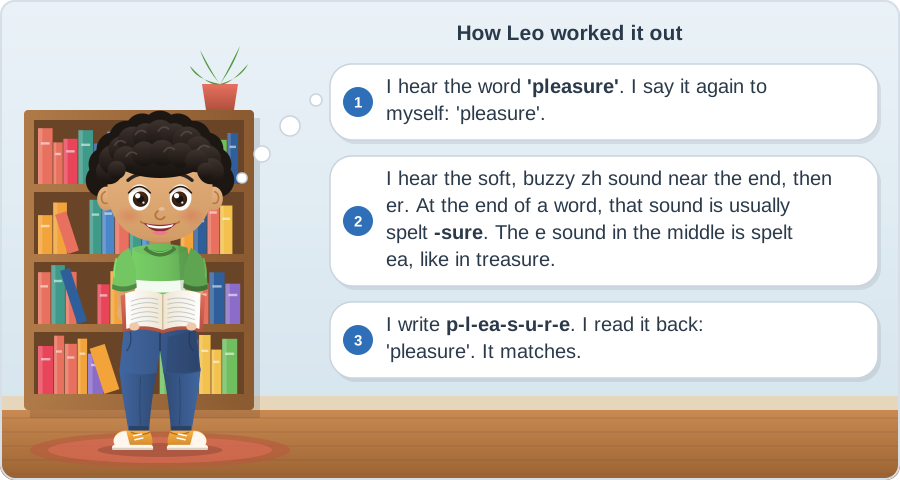
See How It’s Done
Now Try It
1. Listen as an adult says “kindness”. What is the root word? What is the suffix?
Hint: Cover the end of the word.
2. Write “kindness” in the air with your finger.
Hint: Just add the suffix. Do not change kind.
Time To Practise
Name: ______________________
1. Reading: Kites then and now
Long ago, most children made their own kites. They tied two thin sticks into a cross, covered them with paper and added a long tail made of rags. If the paper tore, they patched it and flew it again.
Today, most kites are bought in shops. They are made of light plastic cloth, so they do not tear easily. Some can do tricks in the air. However, one thing has not changed. Children still run across fields, holding the string tightly and laughing as their kites climb into the sky.
a) What were kites made of long ago? ______________________________
b) Write one way kites have changed. ______________________________
c) Which word in the text shows that the writer is going to say something different? ______________
d) What has stayed the same? ______________________________
2. Writing: Compare and review
a) Join the two sentences with whereas: Old kites were made of paper. New kites are made of plastic cloth.
__________________________________________________________________
b) Write one sentence for a review of a game you like. Give your opinion and a reason.
__________________________________________________________________
3. Oral: Rules and debates
a) Finish this rule for a game of tag: If someone touches you, then …
__________________________________________________________________
b) In a debate, Ava says: “Old toys are better because they last a long time.” Write what you would say first, to show you listened, before you reply.
__________________________________________________________________
4. Visual: Timelines and old pictures
Hint: Use the scale. Count on in tens.
a) What is the earliest event on the timeline? ______________
b) How old was Grandpa when he got his first bike? ______ years old
c) Which events happened in the 1960s? ______________________________
d) An old photo of Grandpa has no colour, only browns and greys. What does that clue tell you?
__________________________________________________________________
5. Phonics: s as in treasure, suffixes and tricky words
a) Circle the words where s says zh. usual sun measure sure television
b) Add the suffix. enjoy + ment = ______________ lazy + ness = ______________
c) Write the opposite. hopeful → ______________ careless → ______________
d) Add -ly. quiet → ______________ happy → ______________
e) Circle the tricky words. I am sure it will take an hour to move the sugar.
6. Spelling check
1. ______________
2. ______________
3. ______________
__________________________________________________________________
Reflect
Think about these questions. Talk about them with someone at home or at school.
1. Go back to the Wonder question: “How have toys and games changed, and what has stayed the same?” What do you think now?
2. I was reflective today when I ______________________________.
Being reflective means looking back at your work and thinking how to make it better. For example: I was reflective today when I looked back at what I learned in Lesson 6.
Take action: Look back at the ideas you had in “Before you start” at the start of Lesson 6. Tell someone at home one way toys have changed and one way play has stayed the same.
Next Steps
If this was easy, try: Start Lesson 7: Day, Night and the Sky. It begins with Lesson 7.1, Why Do We Have Day and Night?
If this was hard, go back to: The lesson named next to each missed task in the answer key. Redo the Time To Practise tasks from that lesson, then try this review again.
Notes for Parents and Teachers
Show notes for parents and teachers
These notes cover this lesson only. How every lesson runs is explained in How to Use This Material.
Let’s Learn
There are six short tasks. Do them in one sitting, or split them over two days.
See How It’s Done
Leo’s thoughts show how the spelling check in Task 6 works, using the word ‘pleasure’.
Time To Practise
- Task 6: The words and the sentence are in the Answer Key. Say each word twice, then say the sentence twice. Do not stretch the sounds for the learner.
Answer Key
Reveal Answers
Now Try It
1. Root word: kind. Suffix: -ness.
2. k i n d n e s s
1. Reading (Lessons 6.1 and 6.2)
a) Two thin sticks, paper and a tail made of rags.
b) Sample answer: Today most kites are bought in shops and made of plastic cloth.
c) However
d) Children still run across fields and laugh as their kites fly.
2. Writing (Lessons 6.3 and 6.4)
a) Old kites were made of paper, whereas new kites are made of plastic cloth.
b) Sample answer: I think Snakes and Ladders is a great game because anyone can win, even the youngest player.
3. Oral (Lessons 6.5 and 6.6)
a) Sample answer: If someone touches you, then you are it, and you chase the others.
b) Sample answer: You said that old toys are better because they last a long time.
4. Visual (Lessons 6.7 and 6.8)
a) Grandpa was born (1954).
b) 12 years old
c) The wooden train (1960) and his first bike (1966).
d) Sample answer: The photo is probably from long ago, because most very old photos have no colour.
5. Phonics (Lessons 6.9, 6.10 and 6.11)
a) usual, measure, television
b) enjoyment, laziness
c) hopeless, careful
d) quietly, happily
e) sure, hour, move, sugar
6. Spelling check (Lessons 6.9, 6.10 and 6.11)
1. treasure
2. kindness
3. beautiful
Are you sure you can move the heavy treasure chest carefully?
Look for: -sure in treasure, kind kept whole in kindness, y changed to i and one l in beautiful, ll in carefully, and the tricky words sure and move.
For any task the learner missed, repeat the lesson shown in brackets before starting Lesson 7.
Reflect
2. Any real moment from the lesson that shows the learner was reflective. Examples: “I was reflective today when I looked back at what I learned in Lesson 6.” “I was reflective today when I found the tasks I need to practise again.”
Challenge: Read-Aloud Story and Grammar
Optional | About 20 minutes
This Challenge is optional. It has a story to listen to and a grammar task.
Part 1: Read-Aloud Story
Listen as an adult reads the story aloud. Then talk about it.
The Rocking Horse in the Attic
Last spring, Mia helped Grandpa tidy his attic. It was dusty and dim, and full of boxes that had not been opened for years.
In the corner, under an old sheet, Mia found a wooden rocking horse. Its paint was faded, and one ear was chipped, but its glass eyes still shone.
“That was mine when I was your age,” said Grandpa softly. “My father made it for me. I rode it every day.”
Mia climbed on carefully. The horse creaked, then rocked gently back and forth.
“Could we fix it?” she asked.
That summer, they worked on it together every weekend. Grandpa mended the ear, and Mia sanded the old paint away patiently. Then they painted it a bright, cheerful red.
When it was finished, Grandpa admired it for a long time. “It looks just like it did long ago,” he said.
Mia grinned. “Now it is a treasure for both of us.”
Talk about the story
1. Where did Mia find the rocking horse?
2. Who made the rocking horse, and who was it for?
3. Mia sanded the paint away patiently. What does patiently mean? Why do you think it took patience?
Hint: Think about how long the job took.
4. How do you think Grandpa felt when he saw the finished horse? What clue tells you?
Hint: Look at what he did and what he said.
5. Why does Mia call the horse “a treasure for both of us”?
Part 2: Adverbs That Tell How, When and Where (Grammar)
In Grade 1, you learned that verbs are doing words. In Lesson 6.11, you added -ly to make words like slowly and happily.
An adverb tells us more about a verb. Adverbs can tell us:
- how: Grandpa spoke softly. The horse rocked gently. Many of these end in -ly.
- when: We will paint it tomorrow. I will help you later. Other examples: now, then, soon, today, yesterday.
- where: Mia climbed up. The box was here. Other examples: there, outside, inside, everywhere.
Ask a question about the verb: How? When? Where? The word that answers it is the adverb.
1. Underline the adverb in each sentence. Write how, when or where.
a) Mia climbed on carefully. ______________
b) We will fix the horse tomorrow. ______________
c) The children played outside. ______________
d) Grandpa smiled proudly. ______________
2. Add an adverb to make each sentence more interesting. Use a different kind each time.
a) The top spun ______________. (how)
b) ______________, we played marbles. (when)
c) Sam looked ______________ for his lost yo-yo. (where)
3. Write a sentence about a toy you love. Use one adverb that tells how and one that tells when.
______________________________________________
Notes for Parents and Teachers
Show notes for parents and teachers
These notes cover this section only. How every lesson runs is explained in How to Use This Material.
Use the Challenge when the lessons feel easy, or to stretch the learner after Lesson 6.12. The story is for you to read aloud. It uses some harder words on purpose, so talk about them as you read.
Part 1: Read-Aloud Story
Read the story aloud twice. The first time, just enjoy it. The second time, stop at the words in bold and talk about what they mean.
Answer Key
Reveal Answers
Part 1: Talk about the story
1. In Grandpa’s attic, in the corner under an old sheet.
2. Grandpa’s father made it for Grandpa, when Grandpa was a child.
3. Patiently means calmly, without hurrying or getting cross. It took patience because sanding old paint is slow work, and they worked every weekend all summer.
4. Example: He felt happy and proud. The clue is that he admired it for a long time and said it looked just like it did long ago.
5. Example: It is special to Grandpa because it was his as a child, and special to Mia because she helped to fix it with him.
Part 2: Grammar
1. a) carefully: how b) tomorrow: when c) outside: where d) proudly: how
2. Sample answers: a) The top spun quickly. b) Yesterday, we played marbles. c) Sam looked everywhere for his lost yo-yo.
3. Any sentence with an adverb of how and an adverb of when, for example: Today, I hugged my teddy tightly.
Try it at home
By the end of Lesson 6, you could:
- Learn a playground game from an older family member and teach it to your friends.
- Make a simple toy from long ago, such as a cup and ball or a paper spinner, from things at home.
- Give a toy you no longer play with to a charity shop or a younger child, so it can be played with again.
Lesson 6.12 reviews Lesson 6. Look back at the ideas from “Before you start” and talk about how they have changed.
Notes for Parents and Teachers
Show notes for parents and teachers
the Lesson 6 page and the lessons are written for the learner. How every lesson runs is explained once in How to Use This Material. Each lesson also has its own short notes, after Next Steps.
- The lessons are worksheets. The learner opens a lesson and works on paper next to the screen, or on a printout. Printable PDFs are free to download after you subscribe.
- Before you start: help the learner write down their ideas before Lesson 6.1, and keep them. In Lesson 6.12, look at them together and talk about how they have changed.
For Teachers: IB Details
Show IB and curriculum details
IB theme: Where we are in place and time. This theme is about our place in space and time: personal histories, and how things in our lives have changed and stayed the same over time.
Central idea: Toys and games change over time, but people have always played and learned through play.
Key concepts: Change (how is it changing?), Connection (how is it linked to other things?), Perspective (what are the points of view?). Related concepts: history, invention, evidence.
Lines of inquiry:
- How toys and games from the past are alike and different from toys today
- How we can find out about the past from people, objects and pictures
- Why toys and games change over time
What each lesson covers
| Lesson | Title | Strand | Key concept |
|---|---|---|---|
| 6.1 | Toys Long Ago | Reading | Change |
| 6.2 | Gran’s Spinning Top | Reading | Change |
| 6.3 | Then and Now: Write a Comparison | Writing | Change |
| 6.4 | Write a Review of a Game | Writing | Perspective |
| 6.5 | Teach a Game: Explain the Rules | Listening and speaking | Connection |
| 6.6 | Old Toys or New Toys? A Friendly Debate | Listening and speaking | Perspective |
| 6.7 | Read a Timeline | Viewing | Change |
| 6.8 | Then and Now: Compare Two Pictures | Viewing | Change |
| 6.9 | s as in treasure, and Tricky Words | Reading and spelling | Connection |
| 6.10 | Suffixes -ment and -ness | Reading and spelling | Connection |
| 6.11 | Suffixes -ful, -less and -ly | Reading and spelling | Connection |
| 6.12 | Lesson 6 Review | All strands | Change, Connection and Perspective |
Each lesson also matches the national curriculum for England (Year 2) and the US Common Core (Grade 2). The Grade 2 Curriculum Map lists the full standards for every lesson.
← Previous: Lesson 5, Homes Around the World | Lessons – Index | Next: Lesson 7, Day, Night and the Sky →
© 2026 Firefly Ed. All rights reserved. This page may be printed for personal, home and classroom use. It may not be sold, shared online or reproduced for commercial use without written permission. edfirefly.com

Share your thoughts or ask something..