

Term 2 | Level 2 | Phonics focus: adding -ing, -ed, -er and -est: drop the e, double the letter, y to i
What Lesson 4 is about
Plants are living things that need the right conditions to grow, change and make new plants.
Theme: How the world works. This theme is about the natural world and its laws: how living things grow and change, and how people find out about the world around them.
Before you start
Before Lesson 4.1, plant a bean or a few cress seeds in a pot or on damp cotton wool, with an adult. What do you think the seed needs to grow? What will happen first? How long will it take?
Write down your ideas and keep them. At the end of Lesson 4, check them against what the seed did.
Questions we explore
- What plants need to grow
- How plants change during their life cycle
- How we can find out about plants and share what we learn
How each lesson works
Every lesson starts with a Wonder question to think about. Next, you learn something new, see how it is done, try it, and practise on your own. Each lesson ends with Reflect, where you go back to the Wonder question, think about how you learned, and choose something to do at home.
Lessons
Each strand of Lesson 4 has its own page. Open a page to see its lessons.
Download all of Lesson 4 as a PDF (free after you subscribe)
Reading: Use Headings and a Glossary and Read a Plant Diary
In Lessons 4.1 and 4.2, you find facts with headings, bold words and a glossary, and read a sunflower diary to see how a plant changes.
Writing: Write a Plant Fact File and an Explanation
In Lessons 4.3 and 4.4, you sort facts under headings in a plant fact file, and write an explanation of what plants need using because, so and if … then.
Listening and Speaking: Give a Plant Fact Talk and Make Plant Riddles
In Lessons 4.5 and 4.6, you give a short talk from cue cards, and describe a fruit or vegetable with exact words to make a riddle.
Viewing and Presenting: Read a Life Cycle Diagram and Label a Plant
In Lessons 4.7 and 4.8, you follow the arrows in a life cycle diagram, and draw a labelled plant diagram with captions.
Phonics: Adding -ing, -ed, -er and -est: Drop the e, Double the Letter, y to i
In Lessons 4.9, 4.10 and 4.11, you add -ing, -ed, -er and -est by dropping the e, doubling the last letter or changing y to i, and spell six tricky words.
Review
Lesson 4.12 reviews the whole of Lesson 4. An optional Challenge with a story and a grammar task follows it. Select a section to go straight to it. Each section ends with a link back to the top of the page.
Lesson 4.12: Lesson 4 Review
All strands | About 20 minutes
Term 2 | Level 2
Goal
“I can show what I learned in Lesson 4 in reading, writing, speaking, looking and phonics.”
Words to know
glossary, fact, opinion, because, cue card, life cycle, suffix
Wonder
Think about this question before you start. Say your ideas. You will come back to it at the end of the lesson.
What do plants need, and how do they change as they grow?
Let’s Learn
This lesson checks what you learned in Lesson 4.
There is one task for each part: reading, writing, oral, visual and phonics. The last task is a spelling check.
Read each task with an adult. Do your best on your own first.
See How It’s Done
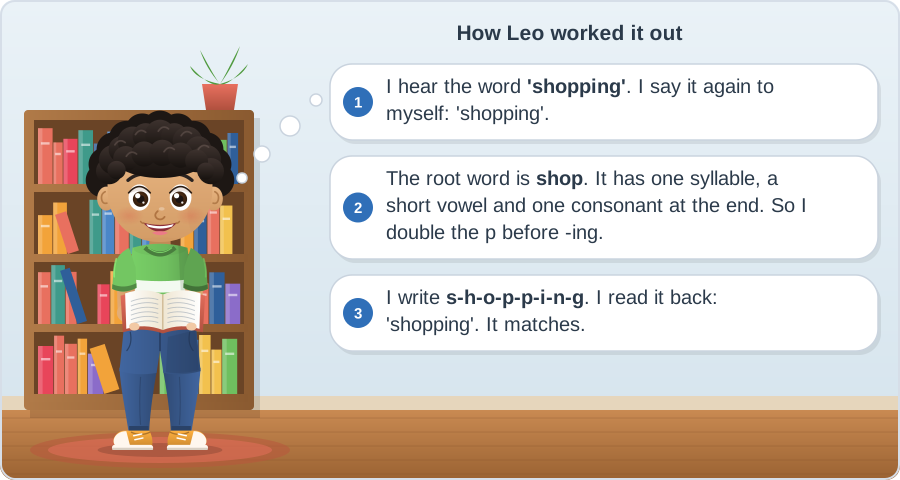
Now Try It
1. Listen as an adult says “smiling”. What is the root word? Does it drop an e, double a letter or change a y?
Hint: Say the root word without -ing.
2. Write “smiling” in the air with your finger.
Hint: s, m, i, l, then the suffix.
Time To Practise
Name: ______________________
1. Reading: An information text
How Do Seeds Travel?
Blowing in the wind
Some seeds are very light. Dandelion seeds have tiny parachutes, so the wind can carry them a long way.
Hitching a ride
Some seeds have little hooks. They stick to an animal’s fur and fall off somewhere new.
Inside fruit
Birds eat berries, but the seeds inside are not broken down. They pass through the bird and land far away in its droppings.
| Glossary | |
|---|---|
| droppings | an animal’s poo |
| hooks | tiny curved spikes that catch on things |
a) Which heading would you read to find out about dandelion seeds? ______________________________
b) Use the glossary. What are hooks? ______________________________
c) Why is it good for a plant if its seeds land far away from it?
Hint: Think about space, water and light, from Mia’s Sunflower Diary.
__________________________________________________________________
2. Writing: Facts and reasons
a) Tick the opinion. ☐ Dandelions have yellow flowers. ☐ Dandelions are the prettiest weeds. ☐ Dandelion seeds float on the wind.
b) Join with so: The seeds are very light. The wind can carry them.
__________________________________________________________________
3. Oral: Talks and riddles
a) Write key words for a cue card: Birds eat berries and drop the seeds far away.
______________________________________________
b) Write a riddle about a pumpkin with three clues. Do not say its name.
__________________________________________________________________
4. Visual: Life cycles and diagrams
a) Write the letters in order to show the life cycle, starting with the seed.
Hint: Look at how big each plant is.
______ ______ ______ ______
b) On a labelled diagram, which part of a plant should the label “roots” point to, and what do roots do?
__________________________________________________________________
5. Phonics: Adding suffixes and tricky words
a) bake + ing = ______________ b) sit + ing = ______________ c) carry + ed = ______________
d) play + ing = ______________ e) big + est = ______________ f) happy + er = ______________
g) Circle the tricky words. After the break, we saw a great, beautiful garden.
6. Spelling check
1. ______________
2. ______________
3. ______________
__________________________________________________________________
Reflect
Think about these questions. Talk about them with someone at home or at school.
1. Go back to the Wonder question: “What do plants need, and how do they change as they grow?” What do you think now?
2. I was reflective today when I ______________________________.
Being reflective means looking back at your work and thinking how to make it better. For example: I was reflective today when I looked back at what I learned in Lesson 4.
Take action: Look back at the ideas you had in “Before you start” at the start of Lesson 4. Did your seed grow the way you predicted? Tell someone at home what happened.
Next Steps
If this was easy, try: Start Lesson 5: Homes Around the World. It begins with Lesson 5.1, Homes Around the World: Compare Two Texts.
If this was hard, go back to: The lesson named next to each missed task in the answer key. Redo the Time To Practise tasks from that lesson, then try this review again.
Notes for Parents and Teachers
Show notes for parents and teachers
These notes cover this lesson only. How every lesson runs is explained in How to Use This Material.
Let’s Learn
There are six short tasks. Do them in one sitting, or split them over two days.
See How It’s Done
Leo’s thoughts show how the spelling check in Task 6 works, using the word ‘shopping’.
Time To Practise
- Task 6: The words and the sentence are in the Answer Key. Say each word twice, then say the sentence twice. Do not stretch the sounds for the learner.
Answer Key
Reveal Answers
Now Try It
1. smile. It drops the e.
2. s m i l i n g
1. Reading (Lessons 4.1 and 4.2)
a) Blowing in the wind
b) Tiny curved spikes that catch on things.
c) Sample answer: The new plant will have more space, water and light, because it is not growing right next to its parent plant.
2. Writing (Lessons 4.3 and 4.4)
a) Dandelions are the prettiest weeds.
b) The seeds are very light, so the wind can carry them.
3. Oral (Lessons 4.5 and 4.6)
a) Sample answer: birds, berries, seeds far away
b) Sample answer: I am big, round and orange. I grow on the ground on a long vine. People carve faces in me. What am I?
4. Visual (Lessons 4.7 and 4.8)
a) B, D, A, C
b) It should point to the roots under the soil. Roots hold the plant in place and take in water.
5. Phonics (Lessons 4.9, 4.10 and 4.11)
a) baking
b) sitting
c) carried
d) playing
e) biggest
f) happier
g) After, break, great, beautiful
6. Spelling check (Lessons 4.9, 4.10 and 4.11)
1. hiking
2. hopped
3. babies
After lunch, we planted the prettiest seeds in a great big pot.
Look for: the dropped e in hiking, the double p in hopped, y to i in babies and prettiest, and the tricky words after, pretty and great.
For any task the learner missed, repeat the lesson shown in brackets before starting Lesson 5.
Reflect
2. Any real moment from the lesson that shows the learner was reflective. Examples: “I was reflective today when I looked back at what I learned in Lesson 4.” “I was reflective today when I found the tasks I need to practise again.”
Challenge: Read-Aloud Story and Grammar
Optional | About 20 minutes
This Challenge is optional. It has a story to listen to and a grammar task.
Part 1: Read-Aloud Story
Listen as an adult reads the story aloud. Then talk about it.
The Biggest Pumpkin
Every year, the village held a pumpkin competition. This year, Leo and Grandpa decided to enter.
They planted one seed in rich, dark soil. Leo watered it every evening, pulled out the weeds and checked for slugs. By midsummer, a fat orange pumpkin was growing steadily bigger. Leo named it Big Bob.
One night, a storm blew in. Rain lashed the garden, and the wind bent the leaves flat. Leo could not sleep. In the morning, he ran outside, expecting the worst.
The pumpkin was unharmed. Grandpa had tucked a thick sack around it before bed.
On competition day, pumpkins were lined up on long tables. The judge measured every pumpkin. Leo held his breath. Their pumpkin came second, beaten by Mrs Patel’s enormous one.
Leo felt disappointed for a moment. Then Grandpa winked. “Second prize, and we grew it together,” he said. “That is a triumph to me.”
Talk about the story
1. Name three things Leo did to look after the pumpkin.
2. Why could Leo not sleep on the night of the storm?
Hint: What was he worried might happen to the pumpkin?
3. The pumpkin was unharmed. What does unharmed mean? Which clue in the story helps you?
Hint: Look at the letters un at the start, and at what Grandpa did before bed.
4. Why do you think Grandpa called coming second a triumph?
5. Have you ever felt proud of something even though you did not win? Tell the story.
Part 2: Commas in Lists (Grammar)
When we write a list of three or more things in a sentence, we put a comma between the items. Before the last item, we write and (or or) instead of a comma.
- Leo watered it, pulled out the weeds and checked for slugs.
- Plants need water, light, air and warmth.
The comma tells the reader to pause briefly between the items.
1. Add the missing commas.
a) We grew peas carrots beans and potatoes.
b) The judge looked at the size colour and shape of each pumpkin.
c) Grandpa brought a spade a rake a sack and some string.
2. Write each list as one sentence with commas and and.
a) Things in a seed packet: seeds, a label, instructions
______________________________________________
b) What Leo did on Saturday: watered the plants, fed the cat, read a book
______________________________________________
Hint: No comma before and.
3. Write a sentence that lists four things you would grow in your own garden.
______________________________________________
Notes for Parents and Teachers
Show notes for parents and teachers
These notes cover this section only. How every lesson runs is explained in How to Use This Material.
Use the Challenge when the lessons feel easy, or to stretch the learner after Lesson 4.12. The story is for you to read aloud. It uses some harder words on purpose, so talk about them as you read.
Part 1: Read-Aloud Story
Read the story aloud twice. The first time, just enjoy it. The second time, stop at the words in bold and talk about what they mean.
Answer Key
Reveal Answers
Part 1: Talk about the story
1. Any three of: he watered it every evening, pulled out the weeds, checked for slugs, planted it in rich soil.
2. He was worried that the storm would damage or break the pumpkin.
3. Unharmed means not hurt or damaged. The clues are un at the start (not), and that Grandpa had tucked a sack around it to protect it.
4. Example: Because he and Leo had worked hard and grown it together, and that mattered more to him than winning.
5. Any personal story. Encourage a “because” sentence.
Part 2: Grammar
1. a) We grew peas, carrots, beans and potatoes.
b) The judge looked at the size, colour and shape of each pumpkin.
c) Grandpa brought a spade, a rake, a sack and some string.
2. a) A seed packet has seeds, a label and instructions.
b) On Saturday, Leo watered the plants, fed the cat and read a book.
3. Any sentence with four items, commas between the first three and and before the last, for example: I would grow tomatoes, strawberries, sunflowers and peas.
Try it at home
By the end of Lesson 4, you could:
- Grow a plant from a seed and keep a growing diary with dates and drawings.
- Look after a plant at home: water it, turn it to the light and notice how it changes.
- Save seeds from a fruit or vegetable you eat, such as a pepper or an apple, and try to grow them.
Lesson 4.12 reviews Lesson 4. Look back at the ideas from “Before you start” and talk about how they have changed.
Notes for Parents and Teachers
Show notes for parents and teachers
the Lesson 4 page and the lessons are written for the learner. How every lesson runs is explained once in How to Use This Material. Each lesson also has its own short notes, after Next Steps.
- The lessons are worksheets. The learner opens a lesson and works on paper next to the screen, or on a printout. Printable PDFs are free to download after you subscribe.
- Before you start: help the learner write down their ideas before Lesson 4.1, and keep them. In Lesson 4.12, look at them together and talk about how they have changed.
For Teachers: IB Details
Show IB and curriculum details
IB theme: How the world works. This theme is about the natural world and its laws: how living things grow and change, and how people find out about the world around them.
Central idea: Plants are living things that need the right conditions to grow, change and make new plants.
Key concepts: Function (how does it work?), Change (how is it changing?), Causation (why is it like it is?). Related concepts: life cycles, growth, investigation.
Lines of inquiry:
- How plants change during their life cycle
- How we can find out about plants and share what we learn
- What plants need to grow
What each lesson covers
| Lesson | Title | Strand | Key concept |
|---|---|---|---|
| 4.1 | From Seed to Plant: Headings and a Glossary | Reading | Change |
| 4.2 | Mia’s Sunflower Diary | Reading | Change |
| 4.3 | Write a Plant Fact File | Writing | Function |
| 4.4 | Explain Why: What Plants Need | Writing | Causation |
| 4.5 | Present a Plant Fact Talk | Listening and speaking | Function |
| 4.6 | Plant Riddles: Describe and Guess | Listening and speaking | Function |
| 4.7 | Read a Life Cycle Diagram | Viewing | Change |
| 4.8 | Draw a Labelled Plant Diagram | Viewing and presenting | Function |
| 4.9 | Adding Endings to Words Ending in e | Reading and spelling | Change |
| 4.10 | Doubling the Last Letter | Reading and spelling | Change |
| 4.11 | y to i, and Tricky Words | Reading and spelling | Change |
| 4.12 | Lesson 4 Review | All strands | Function, Change and Causation |
Each lesson also matches the national curriculum for England (Year 2) and the US Common Core (Grade 2). The Grade 2 Curriculum Map lists the full standards for every lesson.
← Previous: Lesson 3, Tales From Around the World | Lessons – Index | Next: Lesson 5, Homes Around the World →
© 2026 Firefly Ed. All rights reserved. This page may be printed for personal, home and classroom use. It may not be sold, shared online or reproduced for commercial use without written permission. edfirefly.com


Share your thoughts or ask something..