

Term 1 | Level 1 | Phonics focus: long and short vowels, vowel teams review
What Lesson 1 is about
People grow and change over time, and we can share the story of how we have changed.
Theme: Who we are. It covers our bodies and feelings, our families and friends, where we belong, and how we learn and grow.
Before you start
Before Lesson 1.1, find two or three photos of you as a baby or a toddler, or of someone in your family. How were you different then? What could you do then, and what can you do now? What do you think you will be able to do next year?
Write down your ideas and keep them. You will look at them again at the end of Lesson 1.
Questions we explore
- How our bodies change as we grow
- How the things we can do change over time
- How we share the story of our lives with others
How each lesson works
Every lesson starts with a Wonder question to think about. Next, you learn something new, see how it is done, try it, and practise on your own. Each lesson ends with Reflect, where you go back to the Wonder question, think about how you learned, and choose something to do at home.
Lessons
Each strand of Lesson 1 has its own page. Open a page to see its lessons.
Download all of Lesson 1 as a PDF (free after you subscribe)
Reading: Use a Blurb and Contents Page and Read a Recount
In Lessons 1.1 and 1.2, you use a blurb and a contents page to find out about a book, and read a recount to find time words and past tense verbs.
Writing: Join Ideas with And, But, Or, So and Write Four Kinds of Sentences
In Lessons 1.3 and 1.4, you join ideas with and, but, or and so in a Then and Now paragraph, and write statements, questions, commands and exclamations.
Listening and Speaking: Introduce a Friend and Give a Talk About a Photo
In Lessons 1.5 and 1.6, you ask questions to introduce a friend, and give a short talk about a photo from when they were little.
Viewing and Presenting: Put Life Pictures in Order and Read a Height Chart
In Lessons 1.7 and 1.8, you put pictures of a person in order from youngest to oldest, make a life timeline, and read a height chart.
Phonics: Long and Short Vowels, Vowel Teams and Tricky Words
In Lessons 1.9, 1.10 and 1.11, you hear long and short vowel sounds, spell vowel teams such as ai, ee, oa and igh, and spell tricky words such as door and behind.
Review
Lesson 1.12 reviews the whole of Lesson 1. An optional Challenge with a story and a grammar task follows it. Select a section to go straight to it. Each section ends with a link back to the top of the page.
Lesson 1.12: Lesson 1 Review
All strands | About 20 minutes
Term 1 | Level 1
Goal
“I can show what I learned in Lesson 1 in reading, writing, speaking, looking and phonics.”
Words to know
contents page, clue, joining word, end mark, follow-up question, vowel team, tricky word
Wonder
Think about this question before you start. Say your ideas. You will come back to it at the end of the lesson.
How have you grown and changed, and how can you share your story?
Let’s Learn
This lesson checks what you learned in Lesson 1.
There is one task for each part: reading, writing, oral, visual and phonics. The last task is a spelling check.
Read each task with an adult. Do your best on your own first.
See How It’s Done

Now Try It
1. Listen as an adult says “boat”. Which vowel team makes the middle sound?
Hint: Is it oa, ai or ee?
2. Write “boat” in the air with your finger.
Hint: b, then the team, then t.
Time To Practise
Name: ______________________
1. Reading: Contents and a page
a) Which pages are about wobbly teeth? From page ______ to page ______
b) Read this part of page 12. Then answer the question.
Mia sat in the big chair. The dentist shone a bright light into her mouth and counted her teeth. “Your front tooth is wobbly,” she said. Mia smiled. She had been waiting for that tooth to come out for weeks.
How did Mia feel about her wobbly tooth? How do you know?
__________________________________________________________________
2. Writing: Join and punctuate
a) Join each pair with but, so or or.
I was hungry. I made a sandwich. → ______________________________________________
I could not swim last year. Now I can swim a length. → ______________________________________________
Do you want an apple? Do you want a pear? → ______________________________________________
b) Add capital letters and end marks. Write it again.
what a big cake that is can I have a piece please pass me a plate
__________________________________________________________________
3. Oral: Follow-up questions
Sam says: “I went to my cousin’s house at the weekend.” Write two follow-up questions you could ask Sam.
1. ______________________________________________?
2. ______________________________________________?
4. Visual: Youngest to oldest
Hint: Look at size, hair and what each person holds.
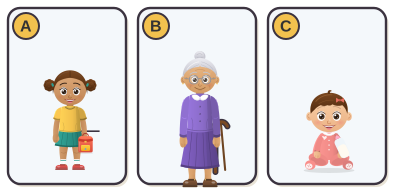
a) Write the letters in order, from youngest to oldest. ______ ______ ______
b) Write one clue that shows card B is older than card A.
__________________________________________________________________
5. Phonics: Sounds and tricky words
a) Circle the two words with the same long vowel sound. boat bike home hot
b) Split into syllables. sunshine: ________ | ________ inside: ________ | ________
c) Write ai or ay. tr ___ ___ n d ___ ___ p ___ ___ nt
d) Circle the tricky words. The poor dog was behind the door.
6. Spelling check
Listen as an adult says each word twice. Write it. Then listen to a sentence, and write it.
1. ______________
2. ______________
3. ______________
__________________________________________________________________
Reflect
Think about these questions. Talk about them with someone at home or at school.
1. Go back to the Wonder question: “How have you grown and changed, and how can you share your story?” What do you think now?
2. I was reflective today when I ______________________________.
Being reflective means looking back at your work and thinking how to make it better. For example: I was reflective today when I looked back at what I learned in Lesson 1.
Take action: Look back at the ideas you had in “Before you start” at the start of Lesson 1. Tell someone at home one idea that has changed.
Next Steps
If this was easy, try: Start Lesson 2: Rules, Routines and Jobs. It begins with Lesson 2.1, Read the Class Rules.
If this was hard, go back to: The lesson named next to each missed task in the answer key. Redo the Time To Practise tasks from that lesson, then try this review again.
Notes for Parents and Teachers
Show notes for parents and teachers
These notes cover this lesson only. How every lesson runs is explained in How to Use This Material.
Let’s Learn
There are six short tasks. Do them in one sitting, or split them over two days.
See How It’s Done
Mia’s thoughts show how the spelling check in Task 6 works, using the word ‘cake’.
Time To Practise
- Task 6: The words and the sentence are in the Answer Key. Say each word twice, then say the sentence twice. Do not stretch the sounds for the learner.
Answer Key
Reveal Answers
Now Try It
1. oa
2. b o a t
1. Reading (Lessons 1.1 and 1.2)
a) From page 5 to page 8
b) Sample answer: She felt happy or excited about it. I know because she smiled, and she had been waiting for it to come out for weeks.
2. Writing (Lessons 1.3 and 1.4)
a) I was hungry so I made a sandwich.
I could not swim last year but now I can swim a length.
Do you want an apple or a pear?
b) What a big cake that is! Can I have a piece? Please pass me a plate.
Look for: in a), accept “Do you want an apple or do you want a pear?” In b), accept a full stop or an exclamation mark at the end.
3. Oral (Lesson 1.5)
Sample answers: What did you do at your cousin’s house? Where does your cousin live? How old is your cousin?
Look for: both questions are about the cousin, the cousin’s house or the weekend.
4. Visual (Lesson 1.7)
a) C, A, B
b) Sample answer: Card B has grey hair and a walking stick, but card A is a child with a school bag.
5. Phonics (Lessons 1.9, 1.10 and 1.11)
a) boat, home
b) sun | shine, in | side
c) train, day, paint
d) poor, behind, door
6. Spelling check (Lessons 1.9, 1.10 and 1.11)
1. snake
2. light
3. toast
The kind girl found her coat behind the door.
Look for: the split digraph in snake, igh in light, oa in toast and coat, and kind, behind and door spelt correctly.
For any task the learner missed, repeat the lesson shown in brackets before starting Lesson 2.
Reflect
2. Any real moment from the lesson that shows the learner was reflective. Examples: “I was reflective today when I looked back at what I learned in Lesson 1.” “I was reflective today when I found the tasks I need to practise again.”
Challenge: Read-Aloud Story and Grammar
Optional | About 20 minutes
This Challenge is optional. It has a story to listen to and a grammar task.
Part 1: Read-Aloud Story
Listen as an adult reads the story aloud. Then talk about it.
The Growing Wall
Every year on his birthday, Sam stands against the kitchen wall. Dad presses a pencil flat on the top of his head and draws a neat line. Then Sam writes the date next to it.
This year, Sam stood very still and stretched his neck as high as it would go. “No cheating!” laughed Dad.
When Sam stepped away, he stared at the wall. His new line was a whole finger above last year’s line. “I grew!” he announced.
Then he noticed some faint lines much lower down, almost hidden under the paint. “Whose are these?” he asked.
“Those are mine,” said Dad. “Grandpa drew them when I was a boy and we lived in this house. I was just as impatient to grow as you are.”
Sam put his hand on a tiny line marked “Age 3”. It was hard to imagine his tall dad ever being so small.
Talk about the story
1. What does Dad do every year on Sam’s birthday?
2. Why did Dad say, “No cheating!”?
Hint: What did Sam do with his neck?
3. The old lines were faint. What do you think faint means? What clue tells you?
Hint: Look at the words “almost hidden under the paint”.
4. Why were there lines for Dad on the same wall?
5. Why was it hard for Sam to imagine his dad being so small? Would you like a growing wall at home? Say why.
Part 2: Expanded Noun Phrases (Grammar)
A noun names a person, a place or a thing. A noun phrase is a group of words built around a noun, such as the line.
When we add describing words (adjectives), we make an expanded noun phrase. It gives the reader a clearer picture: the line becomes the neat pencil line.
In the story, the kitchen wall, some faint lines and a tiny line are expanded noun phrases.
1. Underline the expanded noun phrase in each sentence.
a) Sam has a shiny red bike.
b) Gran gave me a soft woolly hat.
c) We found an old photo in the drawer.
d) A tiny brown mouse ran under the door.
Hint: Find the noun first. Then look for the describing words in front of it.
2. Make each noun phrase longer. Add two describing words from the word bank.
Word bank: fluffy | tall | green | little | noisy | old
a) the ____________ ____________ cat
b) a ____________ ____________ tree
c) the ____________ ____________ baby
3. Write one sentence about a baby photo of you. Use an expanded noun phrase and underline it.
______________________________________________
Notes for Parents and Teachers
Show notes for parents and teachers
These notes cover this section only. How every lesson runs is explained in How to Use This Material.
Use the Challenge when the lessons feel easy, or to stretch the learner after Lesson 1.12. The story is for you to read aloud. It uses some harder words on purpose, so talk about them as you read.
Part 1: Read-Aloud Story
Read the story aloud twice. The first time, just enjoy it. The second time, stop at the words in bold and talk about what they mean.
Answer Key
Reveal Answers
Part 1: Talk about the story
1. Sam stands against the kitchen wall, and Dad draws a line at the top of his head. Sam writes the date next to it.
2. Sam stretched his neck to look taller than he really was.
3. Faint means very pale and hard to see. The clue is that the lines were almost hidden under the paint.
4. Grandpa measured Dad on the same wall when Dad was a boy and lived in the house.
5. Example: Dad is tall now, so it is hard to picture him as a tiny boy. Any answer about a growing wall with a reason. Encourage a “because” sentence.
Part 2: Grammar
1. a) a shiny red bike b) a soft woolly hat c) an old photo d) A tiny brown mouse
2. Any two fitting words, for example: the fluffy little cat, a tall green tree, the noisy little baby.
3. Any sentence with an expanded noun phrase underlined, for example: I am wearing a big yellow sun hat.
Try it at home
By the end of Lesson 1, you could:
- Make a “Then and Now” book about yourself with photos or drawings and a sentence for each page.
- Ask an older family member what they could do at your age, and share what you found out.
- Choose one new thing to learn this term and keep track of how you get better at it.
Lesson 1.12 reviews Lesson 1. Look back at the ideas from “Before you start” and talk about how they have changed.
Notes for Parents and Teachers
Show notes for parents and teachers
the Lesson 1 page and the lessons are written for the learner. How every lesson runs is explained once in How to Use This Material. Each lesson also has its own short notes, after Next Steps.
- The lessons are worksheets. The learner opens a lesson and works on paper next to the screen, or on a printout. Printable PDFs are free to download after you subscribe.
- Before you start: help the learner write down their ideas before Lesson 1.1, and keep them. In Lesson 1.12, look at them together and talk about how they have changed.
For Teachers: IB Details
Show IB and curriculum details
IB theme: Who we are. It covers our bodies and feelings, our families and friends, where we belong, and how we learn and grow.
Central idea: People grow and change over time, and we can share the story of how we have changed.
Key concepts: Change (how is it changing?), Form (what is it like?), Connection (how is it linked to other things?). Related concepts: growth, time, identity.
Lines of inquiry:
- How we share the story of our lives with others
- How the things we can do change over time
- How our bodies change as we grow
What each lesson covers
| Lesson | Title | Strand | Key concept |
|---|---|---|---|
| 1.1 | A Book About Growing Up: Blurb and Contents | Reading | Form |
| 1.2 | When I Was Little | Reading | Change |
| 1.3 | Then and Now Sentences | Writing | Change |
| 1.4 | Four Kinds of Sentences | Writing | Form |
| 1.5 | Introduce a Friend | Listening and speaking | Connection |
| 1.6 | Tell Me About This Photo | Speaking | Change |
| 1.7 | Baby to Grandparent: Life in Pictures | Viewing | Change |
| 1.8 | Read a Height Chart | Viewing | Form |
| 1.9 | Long or Short? Vowel Sounds | Reading and spelling | Form |
| 1.10 | Vowel Teams Review: ai, ay, ee, ea, oa, ow, igh | Reading and spelling | Form |
| 1.11 | Tricky Words: door, floor, poor, find, kind, behind | Reading and spelling | Form |
| 1.12 | Lesson 1 Review | All strands | Change, Form and Connection |
Each lesson also matches the national curriculum for England (Year 2) and the US Common Core (Grade 2). The Grade 2 Curriculum Map lists the full standards for every lesson.
Lessons – Index | Next: Lesson 2, Rules, Routines and Jobs →
© 2026 Firefly Ed. All rights reserved. This page may be printed for personal, home and classroom use. It may not be sold, shared online or reproduced for commercial use without written permission. edfirefly.com

Share your thoughts or ask something..