
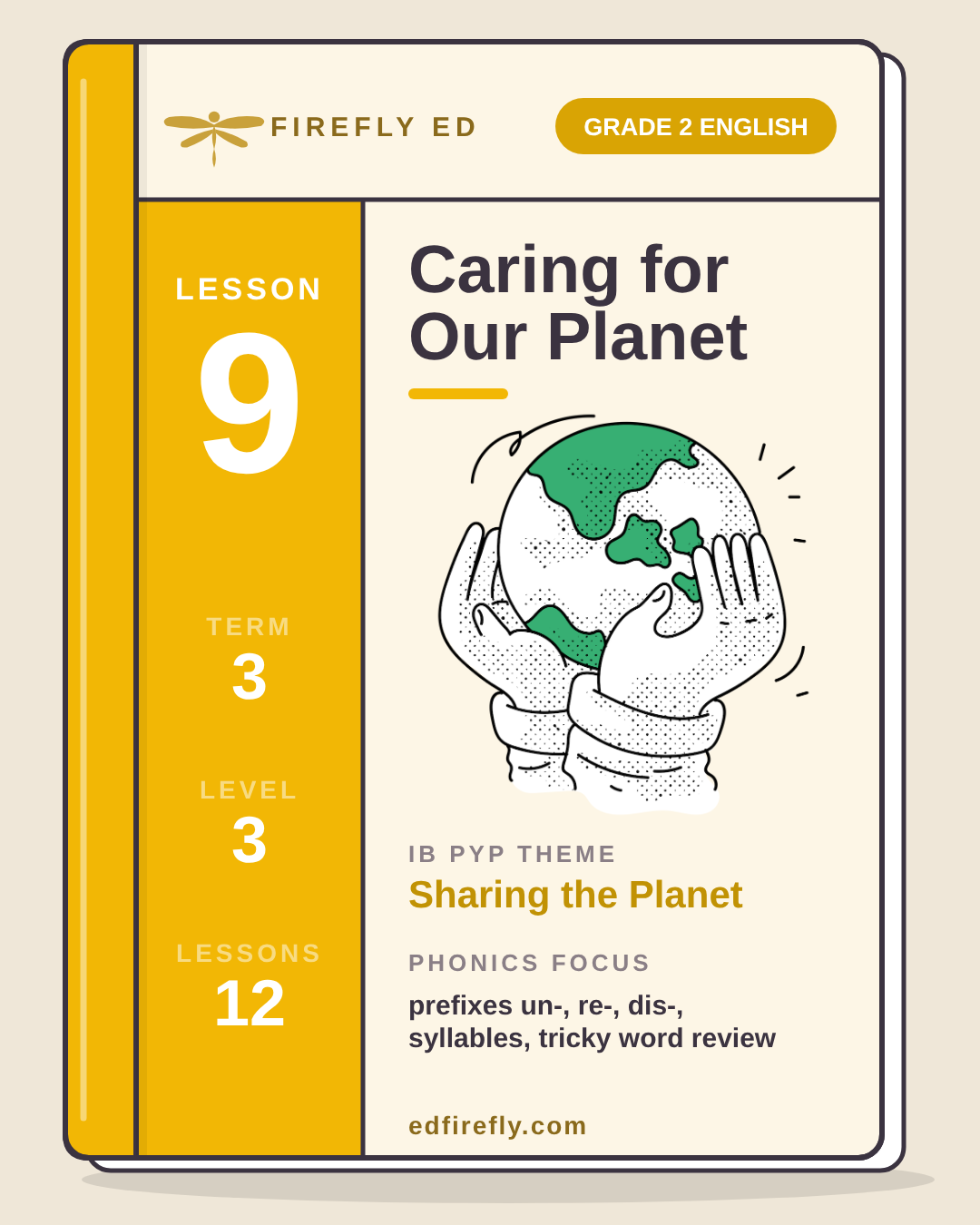
Term 3 | Level 3 | Phonics focus: prefixes un-, re- and dis-, three-syllable words, and a review of the year’s tricky words
What Lesson 9 is about
People’s actions affect the planet, and we can make choices that help to protect it.
Theme: Sharing the planet. This theme is about our rights and responsibilities, how we share the Earth’s resources with other people and living things, and how we can look after them.
Before you start
Before Lesson 9.1, look in your kitchen bin and recycling box with an adult. You can wear gloves if you like. What do we throw away? Where do you think it goes after the bin lorry takes it? Could any of it be used again?
Write down your ideas, or ask an adult to write them for you. Keep them. You will look at them again at the end of Lesson 9.
Questions we explore
- How our rubbish and the water we use affect the planet
- How people’s actions can harm or protect animals and places
- What we can do, at home and together, to care for the planet
How each lesson works
Every lesson starts with a Wonder question to think about. Next, you learn something new, see how it is done, try it, and practise on your own. Each lesson ends with Reflect, where you go back to the Wonder question, think about how you learned, and choose something to do at home.
Lessons
Each strand of Lesson 9 has its own page. Open a page to see its lessons.
Download all of Lesson 9 as a PDF (free after you subscribe)
Reading: Read About Where Rubbish Goes and a Turtle Story
In Lessons 9.1 and 9.2, you follow a process in a flow diagram about rubbish, and find the message of a story about a turtle and a plastic bag.
Writing: Write a Formal Letter and a Report on an Animal in Danger
In Lessons 9.3 and 9.4, you write a formal letter asking to save a park, and write a report with headings about an animal in danger.
Listening and Speaking: Give an Earth Day Speech and Plan in a Group
In Lessons 9.5 and 9.6, you plan and give a one-minute speech for Earth Day, and share and build on ideas in a group talk.
Viewing and Presenting: Read and Make an Infographic
In Lessons 9.7 and 9.8, you read an infographic about water using its icons, numbers and key, and turn facts into a new infographic.
Phonics: Prefixes un-, re- and dis-, Three-Syllable Words and a Year Review
In Lessons 9.9, 9.10 and 9.11, you add the prefixes un-, re- and dis-, spell three-syllable words one syllable at a time, and review the year’s tricky words.
Review
Lesson 9.12 reviews the whole of Lesson 9. An optional Challenge with a story and a grammar task follows it. Select a section to go straight to it. Each section ends with a link back to the top of the page.
Lesson 9.12: Lesson 9 Review
All strands | About 20 minutes
Term 3 | Level 3
Goal
“I can show what I learned in Lesson 9 in reading, writing, speaking, looking and phonics.”
Words to know
cause and effect, message, formal letter, report, speech, infographic, prefix
Wonder
Think about this question before you start. Say your ideas. You will come back to it at the end of the lesson.
What can we do to care for our planet?
Let’s Learn
This lesson checks what you learned in Lesson 9.
There is one task for each part: reading, writing, oral, visual and phonics. The last task is a spelling check.
Read each task with an adult. Do your best on your own first.
See How It’s Done

Now Try It
1. Listen as an adult says “unhappy”. What is the prefix? What does it mean?
Hint: Cover the root word happy.
2. Write “unhappy” in the air with your finger.
Hint: The prefix, then the root word, with no change.
Time To Practise
Name: ______________________
1. Reading: Bees need flowers
Bees are very important to our planet. When a bee visits a flower to drink its sweet nectar, it picks up pollen. Then it carries the pollen to the next flower. This helps plants make seeds and fruit. Many of the foods we eat, such as apples and strawberries, need bees to grow. However, in many places there are fewer wild flowers than there used to be, so bees cannot find enough food. As a result, there are fewer bees. We can help by planting flowers in gardens, in pots and on balconies.
a) Why do bees visit flowers? ______________________________
b) Find one cause and its effect in the text. Cause: ______________________ Effect: ______________________
c) What message does the writer want you to remember? ______________________________
2. Writing: Letters and reports
a) Write a polite request to the council asking for more bins. Start with Please could you …
__________________________________________________________________
b) Write a heading and one fact sentence for a report about bees.
__________________________________________________________________
3. Oral: Speeches and group talk
a) Write a call to action for a speech about planting flowers for bees.
__________________________________________________________________
b) Someone says: “Let’s plant some sunflowers.” Build on the idea, starting with Yes, and …
__________________________________________________________________
4. Visual: Infographics
a) What did the class pick up the most of? ______________
b) How many things did they pick up altogether? ______
c) Why are the numbers so big? ______________________________
d) What is the message of the infographic? ______________________________
5. Phonics: Prefixes, syllables and tricky words
a) Add a prefix: un-, re- or dis-. ______fill ______agree ______kind
b) Clap and write the number of syllables. elephant ____ planet ____ together ____
c) Circle the correct spelling. (parents / parunts) (Christmas / Crismas) (Mrs / mrs)
6. Spelling check
1. ______________
2. ______________
3. ______________
__________________________________________________________________
Reflect
Think about these questions. Talk about them with someone at home or at school.
1. Go back to the Wonder question: “What can we do to care for our planet?” What do you think now?
2. I was reflective today when I ______________________________.
Being reflective means looking back at your work and thinking how to make it better. For example: I was reflective today when I looked back at what I learned this year.
Take action: Look back at the ideas you had in “Before you start” at the start of Lesson 9. Tell someone at home one thing you will do to care for the planet.
Next Steps
If this was easy, try: Try the Term 3 review, then look back at your work from the whole year. Choose the piece you are proudest of and tell someone why.
If this was hard, go back to: The lesson named next to each missed task in the answer key. Redo the Time To Practise tasks from that lesson, then try this review again.
Notes for Parents and Teachers
Show notes for parents and teachers
These notes cover this lesson only. How every lesson runs is explained in How to Use This Material.
Let’s Learn
There are six short tasks. Do them in one sitting or split them over two days.
See How It’s Done
Mia’s thoughts show how the spelling check in Task 6 works, using the word ‘recycle’.
Time To Practise
- Task 6: The words and the sentence are in the Answer Key. Say each word twice, then say the sentence twice. Do not stretch the sounds for the learner.
Answer Key
Reveal Answers
Now Try It
1. un-. It means not, or the opposite.
2. u n h a p p y
1. Reading (Lessons 9.1 and 9.2)
a) To drink their sweet nectar.
b) Sample answer: Cause: there are fewer wild flowers. Effect: bees cannot find enough food, so there are fewer bees.
c) Sample answer: Bees are important, and we can help them by planting flowers.
2. Writing (Lessons 9.3 and 9.4)
a) Sample answer: Please could you put more bins in Elm Park, so people do not drop litter?
b) Sample answer: What do bees eat? Bees drink nectar from flowers.
3. Oral (Lessons 9.5 and 9.6)
a) Sample answer: So this weekend, plant one flower for the bees!
b) Sample answer: Yes, and we could plant lavender too, because bees love it.
4. Visual (Lessons 9.7 and 9.8)
a) plastic bottles
b) 25 (12 + 8 + 5)
c) So you notice the most important facts at a glance.
d) Picking up litter helps to keep plastic out of the sea.
5. Phonics (Lessons 9.9, 9.10 and 9.11)
a) refill, disagree, unkind
b) elephant 3, planet 2, together 3
c) parents, Christmas, Mrs
6. Spelling check (Lessons 9.9, 9.10 and 9.11)
1. recycle
2. unhappy
3. parents
Mrs Lee and our parents helped us to reuse old jars at Christmas.
Look for: the prefixes re- and un- with no change to the root word, Mrs with a capital M and no full stop, capital C in Christmas, and parents with a.
Well done for finishing Grade 2 English! For any task the learner missed, repeat the lesson shown in brackets, then try the Term 3 review.
Reflect
2. Any real moment from the lesson that shows the learner was reflective. Examples: “I was reflective today when I looked back at what I learned this year.” “I was reflective today when I chose the piece of work I am proudest of.”
Challenge: Read-Aloud Story and Grammar
Optional | About 20 minutes
This Challenge is optional. It has a story to listen to and a grammar task.
Part 1: Read-Aloud Story
Listen as an adult reads the story aloud. Then talk about it.
The Repair Café
Sam’s bike had a wobbly wheel and a broken bell. “It’s no good now,” he sighed. “We’ll have to throw it away.”
“Not yet,” said Dad. “Let’s take it to the Repair Café.”
Every Saturday, the village hall was transformed. Long tables were covered in tools, and volunteers mended anything that people brought in: lamps, toasters, torn coats and old toys.
A man called Mr Okafor looked at Sam’s bike. “This wheel just needs to be adjusted,” he said. He showed Sam how to tighten the bolts, and he found a spare bell in a box of parts.
Sam watched a lady sew a button onto a jacket, and a teenager fix a radio. Nothing was thrown away.
By lunchtime, Sam’s bike was as good as new. He rang the bell all the way home.
“Mending things is better than buying new ones,” said Dad. “It saves money, and it is kinder to the planet.”
Sam grinned. “Next week, can we take my broken robot?”
Talk about the story
1. What was wrong with Sam’s bike?
2. What is a Repair Café? Use clues from the story.
3. The hall was transformed. What do you think transformed means?
Hint: How did the hall look different on Saturdays?
4. Why does Dad say mending things is kinder to the planet?
Hint: Think about Lesson 9.1 and where rubbish goes.
5. How has Sam changed from the beginning of the story to the end?
Part 2: Joining Ideas With and, but, or and that (Grammar)
In Lesson 1.3, you joined ideas with and, but, so and or. In Lesson 2, you learned when, if and because. Here are and, but and or again, with one more joining word:
- and adds another idea: He tightened the bolts and found a spare bell.
- but shows something different or surprising: The bike was old, but it worked well.
- or gives a choice: We can mend it or recycle it.
- that adds more information about what someone says, thinks or knows: Dad said that mending is kinder to the planet.
1. Join each pair with and, but or or.
a) We could walk to school. We could cycle. ______________________________
b) The jacket was torn. The lady sewed it. ______________________________
c) The toaster was old. It still worked. ______________________________
2. Finish each sentence with that and an idea.
a) Sam knew that ______________________________
b) I think that ______________________________
3. Write one sentence about caring for the planet that uses but.
______________________________________________
Notes for Parents and Teachers
Show notes for parents and teachers
These notes cover this section only. How every lesson runs is explained in How to Use This Material.
Use the Challenge when the lessons feel easy, or to stretch the learner after Lesson 9.12. The story is for you to read aloud. It uses some harder words on purpose, so talk about them as you read.
Part 1: Read-Aloud Story
Read the story aloud twice. The first time, just enjoy it. The second time, stop at the words in bold and talk about what they mean.
Answer Key
Reveal Answers
Part 1: Talk about the story
1. It had a wobbly wheel and a broken bell.
2. A place where volunteers mend things that people bring in, so they do not get thrown away.
3. Changed a lot, so it looked very different.
4. Because mended things do not go to landfill, and we do not need to make new ones.
5. At the beginning, he thought his bike was no good and wanted to throw it away. At the end, he is happy and wants to mend his robot too.
Part 2: Grammar
1. a) We could walk to school or we could cycle. b) The jacket was torn, but the lady sewed it. (accept and) c) The toaster was old, but it still worked.
2. Sample answers: a) Sam knew that his bike could be mended. b) I think that everyone should recycle.
3. Sample answer: Plastic bags are useful, but they can harm sea animals.
Try it at home
By the end of Lesson 9, you could:
- Set up a recycling station at home, with a label for each kind of rubbish.
- Turn off the tap while you brush your teeth, and remind your family to do the same.
- Join or organise a litter pick in your local park, with gloves and an adult.
Lesson 9.12 reviews Lesson 9. Look back at the ideas from “Before you start” and talk about how they have changed.
Notes for Parents and Teachers
Show notes for parents and teachers
the Lesson 9 page and the lessons are written for the learner. How every lesson runs is explained once in How to Use This Material. Each lesson also has its own short notes, after Next Steps.
- The lessons are worksheets. The learner opens a lesson and works on paper next to the screen, or on a printout. Printable PDFs are free to download after you subscribe.
- Before you start: help the learner write down their ideas before Lesson 9.1, and keep them. In Lesson 9.12, look at them together and talk about how they have changed.
For Teachers: IB Details
Show IB and curriculum details
IB theme: Sharing the planet. This theme is about our rights and responsibilities, how we share the Earth’s resources with other people and living things, and how we can look after them.
Central idea: People’s actions affect the planet, and we can make choices that help to protect it.
Key concepts: Causation (why is it like it is?), Responsibility (what is our responsibility?), Connection (how is it linked to other things?). Related concepts: environment, resources, conservation.
Lines of inquiry:
- How our rubbish and the water we use affect the planet
- How people’s actions can harm or protect animals and places
- What we can do, at home and together, to care for the planet
What each lesson covers
| Lesson | Title | Strand | Key concept |
|---|---|---|---|
| 9.1 | Where Does Our Rubbish Go? | Reading | Causation |
| 9.2 | The Turtle and the Plastic Bag | Reading | Responsibility |
| 9.3 | Write a Letter to Save Our Park | Writing | Responsibility |
| 9.4 | Write a Report: An Animal in Danger | Writing | Causation |
| 9.5 | Make a Speech for Earth Day | Listening and speaking | Responsibility |
| 9.6 | Group Plan: Make Our Home Greener | Listening and speaking | Responsibility |
| 9.7 | Read an Infographic: Water We Use | Viewing | Responsibility |
| 9.8 | Make an Infographic | Viewing and presenting | Connection |
| 9.9 | Prefixes un-, re- and dis- | Reading and spelling | Connection |
| 9.10 | Three-Syllable Words | Reading and spelling | Connection |
| 9.11 | Tricky Words: Year Review | Reading and spelling | Connection |
| 9.12 | Lesson 9 Review | All strands | Causation, Responsibility and Connection |
Each lesson also matches the national curriculum for England (Year 2) and the US Common Core (Grade 2). The Grade 2 Curriculum Map lists the full standards for every lesson.
← Previous: Lesson 8, Keeping Healthy | Lessons – Index
© 2026 Firefly Ed. All rights reserved. This page may be printed for personal, home and classroom use. It may not be sold, shared online or reproduced for commercial use without written permission. edfirefly.com

Share your thoughts or ask something..