
Term 1 | Level 1 | Phonics focus: -le, -el, -al, -il and -ey endings
What Lesson 3 is about
People all over the world tell stories to share ideas, feelings and lessons about life.
Theme: How we express ourselves. This theme is about the ways in which we discover and express ideas, feelings, beliefs and values, and how we enjoy and share stories and art.
Before you start
Before Lesson 3.1, ask an older person in your family to tell you a story they heard as a child. It might be a folk tale, a fable or a family story. Where does this story come from? Who told it to them? What is it trying to teach us?
Write down your ideas and keep them. You will look at them again at the end of Lesson 3.
Questions we explore
- How stories from different places are alike and different
- How stories carry a message or a lesson
- How we can retell and tell our own stories
How each lesson works
Every lesson starts with a Wonder question to think about. Next, you learn something new, see how it is done, try it, and practise on your own. Each lesson ends with Reflect, where you go back to the Wonder question, think about how you learned, and choose something to do at home.
Lessons
Each strand of Lesson 3 has its own page. Open a page to see its lessons.
Download all of Lesson 3 as a PDF (free after you subscribe)
Reading: Read a Fable and a Folk Tale From India
In Lessons 3.1 and 3.2, you find the characters, setting, problem and moral of a fable, and compare two stories from different countries.
Writing: Plan a Story and Retell a Tale in the Past Tense
In Lessons 3.3 and 3.4, you plan and write a fable with a beginning, middle and end, and retell a tale using past tense verbs such as ran, saw and thought.
Listening and Speaking: Retell a Tale With Expression and Speak as a Character
In Lessons 3.5 and 3.6, you retell a tale with voices, volume and pauses, and answer questions in the hot seat as a story character.
Viewing and Presenting: Read a Comic Strip and Picture a Setting
In Lessons 3.7 and 3.8, you read a comic strip with speech bubbles and captions, and draw and describe a story setting.
Phonics: -le, -el, -al, -il and -ey Endings
In Lessons 3.9, 3.10 and 3.11, you spell words ending in le, el, al and il, tell ey and y endings apart, and spell eight tricky words.
Review
Lesson 3.12 reviews the whole of Lesson 3. An optional Challenge with a story and a grammar task follows it. Select a section to go straight to it. Each section ends with a link back to the top of the page.
Lesson 3.12: Lesson 3 Review
All strands | About 20 minutes
Term 1 | Level 1
Goal
“I can show what I learned in Lesson 3 in reading, writing, speaking, looking and phonics.”
Words to know
fable, moral, story map, past tense, open question, comic, setting
Wonder
Think about this question before you start. Say your ideas. You will come back to it at the end of the lesson.
Why do people all over the world tell stories, and what can we learn from them?
Let’s Learn
This lesson checks what you learned in Lesson 3.
There is one task for each part: reading, writing, oral, visual and phonics. The last task is a spelling check.
Read each task with an adult. Do your best on your own first.
See How It’s Done
Now Try It
1. Listen as an adult says “camel”. Does it end in le or el?
Hint: Which letter comes just before the “ul” sound?
2. Write “camel” in the air with your finger.
Hint: c, a, m, then the ending.
Time To Practise
Name: ______________________
1. Reading: A fable
The Ant and the Dove (a fable by Aesop)
One summer day, a thirsty ant went down to a river to drink. A wave washed over her, and she was swept into the water. A dove sitting in a tree saw her struggling. Quickly, the dove pulled a leaf off a branch and dropped it into the river. The ant climbed onto the leaf and floated safely to the bank.
A few days later, a hunter crept towards the tree with a net to catch the dove. The ant saw him. She ran over and bit his ankle hard. “Ouch!” shouted the hunter. The dove heard him and flew away to safety.
a) What is the setting at the start of the fable? ______________________________
b) Why did the dove drop a leaf into the river?
__________________________________________________________________
c) Why did the ant bite the hunter, when she could have stayed away?
__________________________________________________________________
d) This fable is like The Lion and the Mouse. Write one way they are alike.
__________________________________________________________________
2. Writing: Story map and past tense
a) These notes for The Ant and the Dove are muddled. Write B for beginning, M for middle and E for end.
____ The ant bites the hunter, and the dove flies away. ____ The ant falls into the river. ____ A hunter comes to catch the dove.
b) Write each verb in the past tense.
see ______________ run ______________ fly ______________ drop ______________
3. Oral: Telling and asking
a) How would you say “Ouch!” in the story: loud or quiet? Why?
__________________________________________________________________
b) Change this closed question for the ant into an open question: “Were you scared in the river?”
__________________________________________________________________?
4. Visual: Comics and settings
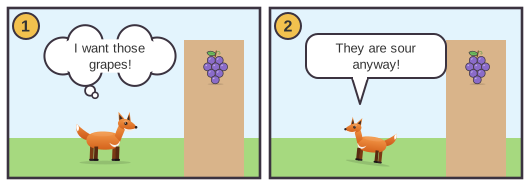
a) Look at the comic. In which panel does the fox think something? How do you know?
__________________________________________________________________
b) Read this setting: “Waves crashed on the rocks, and seagulls cried above the sand.” Where is this story set? Write two clue words.
Setting: ______________________ Clues: ______________________ ______________________
5. Phonics: Endings, y and tricky words
a) Write le, el, al or il. app ______ cam ______ penc ______ anim ______
b) Circle the right spelling. (litle / little) (table / tabble) (candle / canddle)
c) Write y or ey. monk ______ funn ______ donk ______
d) Circle the tricky words. Everybody was told to hold the gold coins.
6. Spelling check
Listen as an adult says each word twice. Write it. Then listen to a sentence, and write it.
1. ______________
2. ______________
3. ______________
__________________________________________________________________
Reflect
Think about these questions. Talk about them with someone at home or at school.
1. Go back to the Wonder question: “Why do people all over the world tell stories, and what can we learn from them?” What do you think now?
2. I was reflective today when I ______________________________.
Being reflective means looking back at your work and thinking how to make it better. For example: I was reflective today when I looked back at what I learned in Lesson 3.
Take action: Look back at the ideas you had in “Before you start” at the start of Lesson 3. Tell someone at home which tale from Lesson 3 you liked best, and why.
Next Steps
If this was easy, try: Start Lesson 4: Plants and Growing. It begins with Lesson 4.1, From Seed to Plant: Headings and a Glossary.
If this was hard, go back to: The lesson named next to each missed task in the answer key. Redo the Time To Practise tasks from that lesson, then try this review again.
Notes for Parents and Teachers
Show notes for parents and teachers
These notes cover this lesson only. How every lesson runs is explained in How to Use This Material.
Let’s Learn
There are six short tasks. Do them in one sitting, or split them over two days.
See How It’s Done
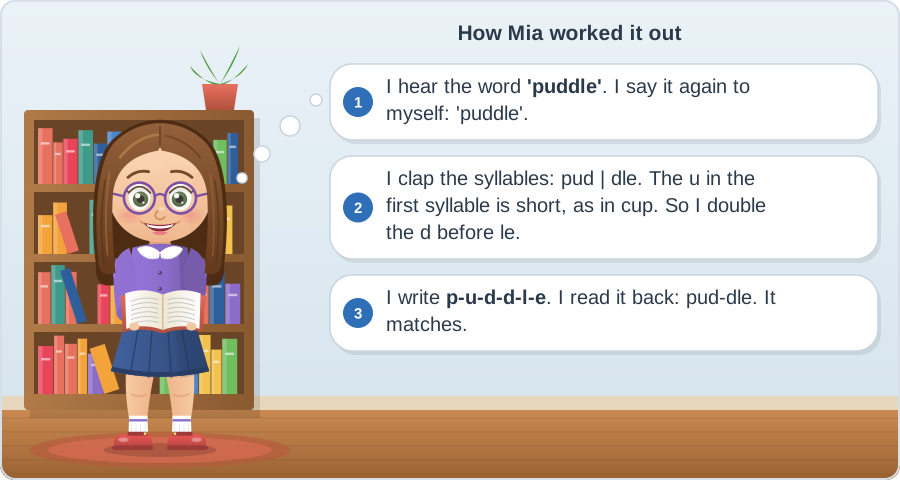
Mia’s thoughts show how the spelling check in Task 6 works, using the word ‘puddle’.
Time To Practise
- Task 6: The words and the sentence are in the Answer Key. Say each word twice, then say the sentence twice. Do not stretch the sounds for the learner.
Answer Key
Reveal Answers
Now Try It
1. el, because the letter before the “ul” sound is m.
2. c a m e l
1. Reading (Lessons 3.1 and 3.2)
a) A river, on a summer day
b) So the ant could climb onto it and float to safety, instead of drowning.
c) Sample answer: The dove had saved her life, so she wanted to help the dove in return.
d) Sample answer: In both stories, a small animal helps a bigger animal that was kind to it.
2. Writing (Lessons 3.3 and 3.4)
a) E The ant bites the hunter, and the dove flies away. B The ant falls into the river. M A hunter comes to catch the dove.
b) saw, ran, flew, dropped
Look for: in b), dropped has a double p. Accept “droped” as a near miss and point out the double letter.
3. Oral (Lessons 3.5 and 3.6)
a) Loud, because the hunter is shouting in pain and surprise.
b) Sample answer: How did you feel when you were swept into the river?
4. Visual (Lessons 3.7 and 3.8)
a) Panel 1. The words are in a thought bubble, which looks like a cloud with small circles.
b) Setting: the seaside, or a beach. Clues: any two of waves, rocks, seagulls, sand.
5. Phonics (Lessons 3.9, 3.10 and 3.11)
a) apple, camel, pencil, animal
b) little, table, candle
c) monkey, funny, donkey
d) Everybody, told, hold, gold
6. Spelling check (Lessons 3.9, 3.10 and 3.11)
1. bottle
2. tunnel
3. donkey
Everybody told the old turtle to try again.
Look for: double t with le in bottle, el in tunnel, ey in donkey, and the tricky words everybody, told and old.
For any task the learner missed, repeat the lesson shown in brackets before starting Lesson 4.
Reflect
2. Any real moment from the lesson that shows the learner was reflective. Examples: “I was reflective today when I looked back at what I learned in Lesson 3.” “I was reflective today when I found the tasks I need to practise again.”
Challenge: Read-Aloud Story and Grammar
Optional | About 20 minutes
This Challenge is optional. It has a story to listen to and a grammar task.
Part 1: Read-Aloud Story
Listen as an adult reads the story aloud. Then talk about it.
Anansi and the Pot of Wisdom
A folk tale from Ghana, in West Africa
Long ago, Anansi the spider decided to collect all the wisdom in the world. He went from village to village and gathered every clever idea into a clay pot.
“If I keep it all, I will be the wisest creature alive,” he said greedily. “Nobody else will have any.”
He decided to hide the pot at the top of a tall tree. He tied it to his front with a rope and began to climb, but the pot kept bumping against the trunk. Anansi grew more and more frustrated.
His young son was watching from below. “Father,” he called, “why not tie the pot to your back? Then you could climb easily.”
Anansi stopped. His son was right. Anansi felt so ashamed that he let go of the pot. It smashed on the ground, and the wisdom scattered across the whole world.
That is why, they say, everybody has a little wisdom, and nobody has it all.
Talk about the story
1. What did Anansi want to collect, and where did he keep it?
2. Why did Anansi want to hide the pot at the top of a tree?
Hint: Think about what he said he did not want other people to have.
3. Anansi felt ashamed. What does ashamed mean? Why did he feel that way?
Hint: He had all the wisdom in the world, but who had the clever idea?
4. This tale explains why something is the way it is. What does it explain?
5. Do you think it is a good thing that everybody has a little wisdom? Why?
Part 2: Actions in Progress: was and were with ing (Grammar)
In Lesson 3.4, you used the past tense: Anansi climbed the tree. We can also show that an action was still going on in the past. We use was or were, and a verb ending in ing.
- His son was watching from below. (one person: was)
- The villagers were sleeping when Anansi came. (more than one: were)
This form is useful when one thing is happening and something else interrupts it: Anansi was climbing when his son called out.
1. Underline the action in progress in each sentence.
a) Anansi was carrying a clay pot.
b) The birds were singing in the tree.
c) His son was laughing at the bottom.
d) The children were playing when the pot smashed.
2. Write was or were.
a) The spider ________ climbing slowly.
b) The villagers ________ talking about Anansi.
c) I ________ reading a folk tale.
d) We ________ listening to Gran.
Hint: Is it one person or thing, or more than one? Use was with I.
3. Finish each sentence with an action in progress.
a) When the phone rang, I ______________________________________________
b) At breakfast time, my family ______________________________________________
Notes for Parents and Teachers
Show notes for parents and teachers
These notes cover this section only. How every lesson runs is explained in How to Use This Material.
Use the Challenge when the lessons feel easy, or to stretch the learner after Lesson 3.12. The story is for you to read aloud. It uses some harder words on purpose, so talk about them as you read.
Part 1: Read-Aloud Story
Read the story aloud twice. The first time, just enjoy it. The second time, stop at the words in bold and talk about what they mean.
Answer Key
Reveal Answers
Part 1: Talk about the story
1. All the wisdom in the world. He kept it in a clay pot.
2. So that nobody else could reach it. He wanted to be the only wise creature.
3. Ashamed means feeling bad and embarrassed about something you did. He felt ashamed because his young son had a cleverer idea than he did, even though Anansi had collected all the wisdom.
4. It explains why everybody has a little wisdom and nobody has all of it.
5. Example: Yes, because then we can all learn from each other. Encourage a “because” sentence.
Part 2: Grammar
1. a) was carrying b) were singing c) was laughing d) were playing
2. a) was b) were c) was d) were
3. Any sensible endings with was or were and an ing verb, for example: a) When the phone rang, I was brushing my teeth. b) At breakfast time, my family was eating toast. Accept “were eating” for family.
Try it at home
By the end of Lesson 3, you could:
- Ask a family member to tell you a story from their childhood, and retell it to someone else.
- Make a small book of your favourite tale with your own pictures.
- Visit a library and borrow a folk tale from a country you have never read about.
Lesson 3.12 reviews Lesson 3. Look back at the ideas from “Before you start” and talk about how they have changed.
Notes for Parents and Teachers
Show notes for parents and teachers
the Lesson 3 page and the lessons are written for the learner. How every lesson runs is explained once in How to Use This Material. Each lesson also has its own short notes, after Next Steps.
- The lessons are worksheets. The learner opens a lesson and works on paper next to the screen, or on a printout. Printable PDFs are free to download after you subscribe.
- Before you start: help the learner write down their ideas before Lesson 3.1, and keep them. In Lesson 3.12, look at them together and talk about how they have changed.
For Teachers: IB Details
Show IB and curriculum details
IB theme: How we express ourselves. This theme is about the ways in which we discover and express ideas, feelings, beliefs and values, and how we enjoy and share stories and art.
Central idea: People all over the world tell stories to share ideas, feelings and lessons about life.
Key concepts: Form (what is it like?), Perspective (what are the points of view?), Connection (how is it linked to other things?). Related concepts: culture, storytelling, values.
Lines of inquiry:
- How stories carry a message or a lesson
- How stories from different places are alike and different
- How we can retell and tell our own stories
What each lesson covers
| Lesson | Title | Strand | Key concept |
|---|---|---|---|
| 3.1 | Read a Fable: The Lion and the Mouse | Reading | Form |
| 3.2 | The Clever Hare: A Tale From India | Reading | Connection |
| 3.3 | Plan a Story: Beginning, Middle and End | Writing | Form |
| 3.4 | Past Tense: Retell a Tale | Writing | Form |
| 3.5 | Retell a Tale With Expression | Listening and speaking | Form |
| 3.6 | Hot Seat: Speak as a Character | Listening and speaking | Perspective |
| 3.7 | Read a Comic Strip | Viewing | Form |
| 3.8 | Picture the Setting | Viewing and presenting | Perspective |
| 3.9 | -le Endings | Reading and spelling | Form |
| 3.10 | -el, -al and -il Endings | Reading and spelling | Form |
| 3.11 | ey and y Endings, and Tricky Words | Reading and spelling | Form |
| 3.12 | Lesson 3 Review | All strands | Form, Perspective and Connection |
Each lesson also matches the national curriculum for England (Year 2) and the US Common Core (Grade 2). The Grade 2 Curriculum Map lists the full standards for every lesson.
← Previous: Lesson 2, Rules, Routines and Jobs | Lessons – Index | Next: Lesson 4, Plants and Growing →
© 2026 Firefly Ed. All rights reserved. This page may be printed for personal, home and classroom use. It may not be sold, shared online or reproduced for commercial use without written permission. edfirefly.com


Share your thoughts or ask something..