
Term 3 | Level 3 | Phonics focus: homophones, and the tricky words any, many, clothes, busy, people, water, again, half and money
What Lesson 8 is about
The choices we make each day about food, exercise, rest and hygiene help us to stay healthy.
Theme: Who we are. It covers our bodies and feelings, our families and friends, where we belong, and how we learn and grow.
Before you start
Before Lesson 8.1, think about a normal day. What did you eat today? How did you move your body? How much did you sleep last night? What do you think keeps a body healthy?
Write down your ideas, or ask an adult to write them for you. Keep them. You will look at them again at the end of Lesson 8.
Questions we explore
- What our bodies need to stay healthy
- How our everyday choices affect our health
- How we can find out about and share healthy habits
How each lesson works
Every lesson starts with a Wonder question to think about. Next, you learn something new, see how it is done, try it, and practise on your own. Each lesson ends with Reflect, where you go back to the Wonder question, think about how you learned, and choose something to do at home.
Lessons
Each strand of Lesson 8 has its own page. Open a page to see its lessons.
Download all of Lesson 8 as a PDF (free after you subscribe)
Reading: Read a Healthy Eating Diagram and a Sports Day Story
In Lessons 8.1 and 8.2, you use a key to read a healthy eating diagram, and find what makes a character’s feelings change in a sports day story.
Writing: Write a Persuasive Paragraph and a Recipe
In Lessons 8.3 and 8.4, you write a persuasive paragraph about playing outside, and write a recipe for a healthy snack with amounts and numbered steps.
Listening and Speaking: Ask Questions to Clarify and Present a Healthy Habit
In Lessons 8.5 and 8.6, you listen to advice and ask questions to check and clarify, and give a short talk about a healthy habit with a prop.
Viewing and Presenting: Read a Bar Chart and a Health Poster
In Lessons 8.7 and 8.8, you read and make a bar chart from a tally, and explain how a health poster tries to persuade.
Phonics: Homophones and Tricky Words: Any, Many, Busy, People
In Lessons 8.9, 8.10 and 8.11, you choose between there, their and they’re and other homophones, and spell tricky words such as any, many, busy and people.
Review
Lesson 8.12 reviews the whole of Lesson 8. An optional Challenge with a story and a grammar task follows it. Select a section to go straight to it. Each section ends with a link back to the top of the page.
Lesson 8.12: Lesson 8 Review
All strands | About 20 minutes
Term 3 | Level 3
Goal
“I can show what I learned in Lesson 8 in reading, writing, speaking, looking and phonics.”
Words to know
diagram, feelings, persuade, recipe, clarify, bar chart, homophone
Wonder
Think about this question before you start. Say your ideas. You will come back to it at the end of the lesson.
What choices help us to stay healthy?
Let’s Learn
This lesson checks what you learned in Lesson 8.
There is one task for each part: reading, writing, oral, visual and phonics. The last task is a spelling check.
Read each task with an adult. Do your best on your own first.
See How It’s Done
Now Try It
1. Listen as an adult says a word that means “also”, as in I want some ___. Which spelling is it?
Hint: It means also.
2. Write “too” in the air with your finger.
Hint: It has one o too many.
Time To Practise
Name: ______________________
1. Reading: Why do we need water?
More than half of your body is made of water. You lose some water every day when you breathe, sweat and go to the toilet, so you need to drink more to replace it. Water helps your body in many ways. It carries food to every part of you, it keeps you cool, and it helps you think clearly. If you do not drink enough, you may feel tired or get a headache. However, it is easy to stay healthy: just drink water with your meals and whenever you feel thirsty.
a) How much of your body is made of water? ______________________________
b) Write two ways water helps your body. ______________________________
c) What might happen if you do not drink enough water? ______________________________
2. Writing: Persuade and instruct
a) Write one persuasive sentence that tells people to drink water. Use a strong word such as should or best.
__________________________________________________________________
b) Write a recipe step for making a glass of fruity water. Start with an exact verb.
__________________________________________________________________
3. Oral: Clarify and present
a) A coach says: “Warm up before you run.” Write a question to clarify what she means.
__________________________________________________________________
b) You are giving a talk about drinking water. What prop could you use? When would you show it?
__________________________________________________________________
4. Visual: Charts and posters
Hint: Read across from the top of each bar to the scale.
a) How many children walked? ______
b) How many more children walked than came by car? ______
c) Which way did the fewest children travel? ______________
d) Write a slogan for a poster that tells children to walk to school. ______________________________
5. Phonics: Homophones and tricky words
a) Write there, their or they’re. ______________ coming to the park with ______________ dog.
b) Circle the correct word. I can (hear / here) the birds. We have (to / too / two) cats.
c) Circle the correct word. We swam in the (see / sea). Mia (one / won) a medal.
d) Circle the tricky words. Many people were busy, so they drank half a bottle of water.
6. Spelling check
1. ______________
2. ______________
3. ______________
__________________________________________________________________
Reflect
Think about these questions. Talk about them with someone at home or at school.
1. Go back to the Wonder question: “What choices help us to stay healthy?” What do you think now?
2. I was reflective today when I ______________________________.
Being reflective means looking back at your work and thinking how to make it better. For example: I was reflective today when I looked back at what I learned in Lesson 8.
Take action: Look back at the ideas you had in “Before you start” at the start of Lesson 8. Tell someone at home one healthy habit you will keep.
Next Steps
If this was easy, try: Start Lesson 9: Caring for Our Planet. It begins with Lesson 9.1, Where Does Our Rubbish Go?
If this was hard, go back to: The lesson named next to each missed task in the answer key. Redo the Time To Practise tasks from that lesson, then try this review again.
Notes for Parents and Teachers
Show notes for parents and teachers
These notes cover this lesson only. How every lesson runs is explained in How to Use This Material.
Let’s Learn
There are six short tasks. Do them in one sitting or split them over two days.
See How It’s Done
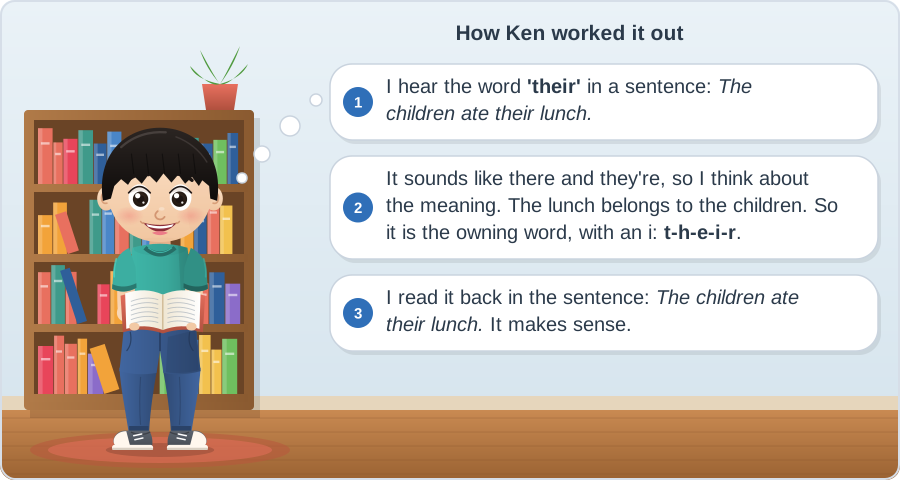
Ken’s thoughts show how the spelling check in Task 6 works, using the word ‘their’.
Time To Practise
- Task 6: The words and the sentence are in the Answer Key. Say each word twice, then say the sentence twice. Do not stretch the sounds for the learner.
Answer Key
Reveal Answers
Now Try It
1. too
2. t o o
1. Reading (Lessons 8.1 and 8.2)
a) More than half.
b) Any two of: it carries food to every part of you, it keeps you cool, it helps you think clearly.
c) You may feel tired or get a headache.
2. Writing (Lessons 8.3 and 8.4)
a) Sample answer: Everyone should drink water, because it is the best drink for your body!
b) Sample answer: Slice a lemon with an adult’s help, and drop one slice into a glass of cold water.
3. Oral (Lessons 8.5 and 8.6)
a) Sample answers: What does warm up mean? How long should I warm up for?
b) Sample answer: A water bottle. I would hold it up when I say what the habit is.
4. Visual (Lessons 8.7 and 8.8)
a) 8
b) 3
c) bus
d) Sample answers: Feet first! Walk to school, it’s cool!
5. Phonics (Lessons 8.9, 8.10 and 8.11)
a) They’re, their
b) hear, two
c) sea, won
d) Many, people, busy, half, water
6. Spelling check (Lessons 8.9, 8.10 and 8.11)
1. they’re
2. people
3. water
Their friends are busy, so they drink water too.
Look for: they’re with an apostrophe, their for owning, too for also, and the tricky words people, water and busy.
For any task the learner missed, repeat the lesson shown in brackets before starting Lesson 9.
Reflect
2. Any real moment from the lesson that shows the learner was reflective. Examples: “I was reflective today when I looked back at what I learned in Lesson 8.” “I was reflective today when I found the tasks I need to practise again.”
Challenge: Read-Aloud Story and Grammar
Optional | About 20 minutes
This Challenge is optional. It has a story to listen to and a grammar task.
Part 1: Read-Aloud Story
Listen as an adult reads the story aloud. Then talk about it.
Grandpa’s Allotment
Every Saturday, Leo helps Grandpa at his allotment, a small patch of land where he grows food.
This morning, the ground is still damp with dew. Grandpa hands Leo a fork, and together they dig up potatoes. Leo is surprised. Each plant has a whole cluster of potatoes hiding under the soil, like eggs in a nest.
Next, they pick runner beans and pull up a few carrots. Leo’s arms ache, and he feels exhausted. But Grandpa says that digging is exercise too, and that fresh air is good for both of them.
At lunchtime, they cook everything in Grandpa’s kitchen. The carrots are sweet and crunchy, much tastier than shop ones.
“Food you grow yourself is the most delicious food of all,” says Grandpa.
Leo nods, with his mouth full. He is already planning which seeds to plant next spring. He feels satisfied, tired and happy all at once.
Talk about the story
1. What is an allotment?
2. Why is Leo surprised when they dig up the potatoes?
3. Leo feels exhausted. What does exhausted mean? Which clue helps you?
Hint: Look at what is happening to Leo’s arms.
4. Name two ways that Leo is keeping healthy in this story.
5. Would you like to grow your own food? What would you grow, and why?
Part 2: Present Tense, and Keeping to One Tense (Grammar)
In Grade 1, you learned that the past tense tells us what has already happened: Leo dug, Leo picked.
The present tense tells us what is happening now, or what happens often. This story is written in the present tense. There are two forms:
- simple present: Leo helps Grandpa every Saturday. They dig up potatoes.
- present progressive, with am, is or are and an -ing verb: Leo is planning what to plant. We are picking beans.
A piece of writing should usually stay in one tense. Mixing tenses by mistake confuses the reader.
Wrong: Leo digs up the potatoes and then he picked the beans. Right: Leo digs up the potatoes and then he picks the beans.
1. Underline the verbs. Write present or past.
a) Grandpa hands Leo a fork. ______________
b) We walked to the park. ______________
c) The carrots are crunchy. ______________
d) Mia is drinking a glass of water. ______________
2. Each sentence mixes tenses. Rewrite it in the present tense.
a) Sam runs to the gate and jumped over the puddle.
______________________________________________
b) Every morning, I brush my teeth and washed my face.
______________________________________________
3. Write two sentences about what you are doing right now. Use the present progressive: I am …
______________________________________________
______________________________________________
Notes for Parents and Teachers
Show notes for parents and teachers
These notes cover this section only. How every lesson runs is explained in How to Use This Material.
Use the Challenge when the lessons feel easy, or to stretch the learner after Lesson 8.12. The story is for you to read aloud. It uses some harder words on purpose, so talk about them as you read.
Part 1: Read-Aloud Story
Read the story aloud twice. The first time, just enjoy it. The second time, stop at the words in bold and talk about what they mean.
Answer Key
Reveal Answers
Part 1: Talk about the story
1. A small patch of land where people grow food.
2. Because each plant has a whole cluster of potatoes hiding under the soil.
3. Very, very tired. The clue is that his arms ache after all the digging.
4. Any two of: he is digging, which is exercise; he is in the fresh air; he eats fresh vegetables.
5. Answers will vary.
Part 2: Grammar
1. a) hands: present b) walked: past c) are: present d) is drinking: present
2. a) Sam runs to the gate and jumps over the puddle. b) Every morning, I brush my teeth and wash my face.
3. Sample answers: I am writing in my book. I am sitting at the kitchen table.
Try it at home
By the end of Lesson 8, you could:
- Help to plan and make a healthy snack or lunch for your family.
- Make a poster about washing hands and put it up next to a sink at home.
- Play outside or walk somewhere instead of going by car, at least once a week.
Lesson 8.12 reviews Lesson 8. Look back at the ideas from “Before you start” and talk about how they have changed.
Notes for Parents and Teachers
Show notes for parents and teachers
the Lesson 8 page and the lessons are written for the learner. How every lesson runs is explained once in How to Use This Material. Each lesson also has its own short notes, after Next Steps.
- The lessons are worksheets. The learner opens a lesson and works on paper next to the screen, or on a printout. Printable PDFs are free to download after you subscribe.
- Before you start: help the learner write down their ideas before Lesson 8.1, and keep them. In Lesson 8.12, look at them together and talk about how they have changed.
For Teachers: IB Details
Show IB and curriculum details
IB theme: Who we are. It covers our bodies and feelings, our families and friends, where we belong, and how we learn and grow.
Central idea: The choices we make each day about food, exercise, rest and hygiene help us to stay healthy.
Key concepts: Function (how does it work?), Causation (why is it like it is?), Responsibility (what is our responsibility?). Related concepts: wellbeing, choices, habits.
Lines of inquiry:
- What our bodies need to stay healthy
- How our everyday choices affect our health
- How we can find out about and share healthy habits
What each lesson covers
| Lesson | Title | Strand | Key concept |
|---|---|---|---|
| 8.1 | Eat Well: Text and Diagram | Reading | Function |
| 8.2 | Sami’s Sports Day | Reading | Causation |
| 8.3 | Persuade Me: Play Outside | Writing | Causation |
| 8.4 | Write a Recipe for a Healthy Snack | Writing | Function |
| 8.5 | Ask the Doctor: Questions to Clarify | Listening and speaking | Responsibility |
| 8.6 | Present a Healthy Habit | Listening and speaking | Responsibility |
| 8.7 | Read a Bar Chart: Our Favourite Fruits | Viewing | Function |
| 8.8 | What Does This Poster Want You to Do? | Viewing | Responsibility |
| 8.9 | Homophones: there, their, they’re | Reading and spelling | Function |
| 8.10 | More Homophones | Reading and spelling | Function |
| 8.11 | Tricky Words: any, many, busy, people | Reading and spelling | Function |
| 8.12 | Lesson 8 Review | All strands | Function, Causation and Responsibility |
Each lesson also matches the national curriculum for England (Year 2) and the US Common Core (Grade 2). The Grade 2 Curriculum Map lists the full standards for every lesson.
← Previous: Lesson 7, Day, Night and the Sky | Lessons – Index | Next: Lesson 9, Caring for Our Planet →
© 2026 Firefly Ed. All rights reserved. This page may be printed for personal, home and classroom use. It may not be sold, shared online or reproduced for commercial use without written permission. edfirefly.com

Share your thoughts or ask something..