
Term 1 | Level 1 | Phonics focus: -le, -el, -al, -il and -ey endings
Lesson 3 – Tales From Around the World | Lessons – Index
Lessons
This page has the two viewing and presenting lessons of Lesson 3, Tales From Around the World: Lessons 3.7 and 3.8. The Lesson 3 page has the Lesson 3 overview, the Lesson 3 review and the PDF download.
Select a lesson to go straight to it. Each lesson ends with a link back to the top of the page.
Lesson 3.7: Read a Comic Strip
Visual | About 20 minutes
Term 1 | Level 1
Goal
“I can read a comic strip in the right order, explain what captions, speech bubbles, thought bubbles and sound words show, and make my own comic.”
Words to know
comic strip, panel, caption, speech bubble, thought bubble, sound word
Wonder
Think about this question before you start. Say your ideas. You will come back to it at the end of the lesson.
How can pictures and a few words tell a whole story?
Let’s Learn
A comic strip tells a story in a row of pictures called panels. You read the panels in order: left to right, then top to bottom.
| Comic part | What it does |
|---|---|
| panel | one picture in the story |
| caption | a box with words from the storyteller, often at the top |
| speech bubble | shows what a character says. Its tail points to the speaker. |
| thought bubble | shows what a character thinks. It looks like a cloud with small circles. |
| sound word | shows a noise, such as BANG, WHOOSH or Zzz |
| motion lines | show that something is moving fast |
Pictures in a comic tell us things the words do not, such as how characters feel and where they are.
See How It’s Done
Use the comic in Time To Practise.
Now Try It
Use the comic in Time To Practise.
1. Which panel comes after panel 2? How do you know?
Hint: Read left to right, then top to bottom.
2. In panel 1, what does the tortoise say?
Hint: Follow the tail of each speech bubble.
Time To Practise
Name: ______________________
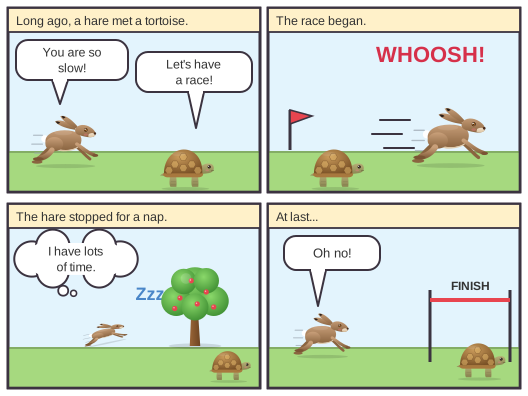
1. Read the comic strip.
This is a fable by Aesop called The Tortoise and the Hare.
2. Answer the questions.
a) Which panel has a thought bubble? Panel ______
b) What does the sound word Zzz tell you? ______________________________
c) In panel 3, why did the hare think he had lots of time?
__________________________________________________________________
d) Look at panel 4. Who won the race? How do you know, when no caption says so?
__________________________________________________________________
e) The tortoise never stopped. What is the moral of this fable?
__________________________________________________________________
3. Match each part to its job. Write the letter.
1. caption ____ 2. speech bubble ____ 3. thought bubble ____ 4. motion lines ____
a) what a character thinks b) something is moving fast c) words from the storyteller d) what a character says
4. Make your own comic strip.
Draw The Lion and the Mouse or The Fox and the Grapes as a comic in three panels. Use at least one caption, one speech bubble and one thought bubble.
Reflect
Think about these questions. Talk about them with someone at home or at school.
1. Go back to the Wonder question: “How can pictures and a few words tell a whole story?” What do you think now?
2. I was a communicator today when I ______________________________.
A communicator shares ideas clearly by talking, writing or drawing. For example: I was a communicator today when I explained what the caption, speech bubble and thought bubble show.
Take action: Find a comic or a picture book at home. Show someone the captions, speech bubbles and sound words you find.
Next Steps
If this was easy, try: Make a six-panel comic of your own fable from Lesson 3.3. Add a sound word and motion lines.
If this was hard, go back to: Task 1. Cover all the panels except one. Talk about that panel: who is there, what they say and how they feel. Then uncover the next.
Notes for Parents and Teachers
Show notes for parents and teachers
These notes cover this lesson only. How every lesson runs is explained in How to Use This Material.
Let’s Learn
Point to each part in the comic in Time To Practise.
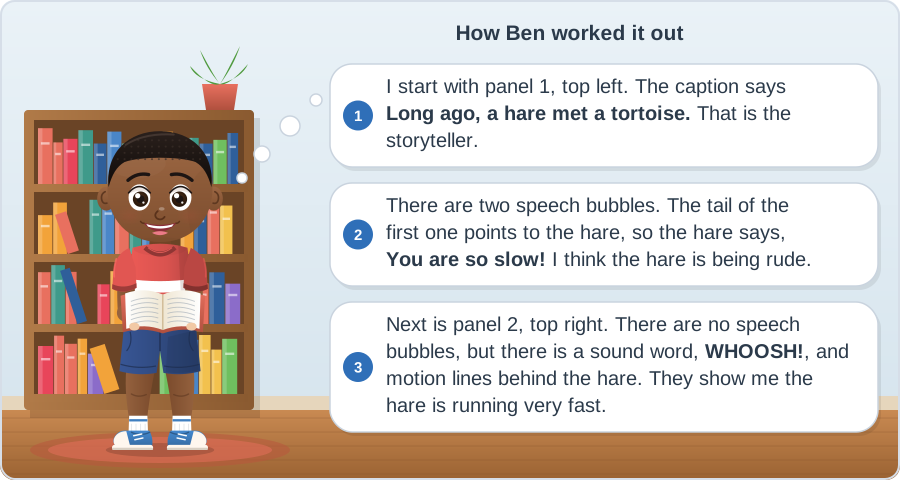
See How It’s Done
Point to each panel and bubble as you go through Ben’s thoughts.
Answer Key
Reveal Answers
Now Try It
1. Panel 3, bottom left. After the top row, we go down to the next row and start on the left again.
2. “Let’s have a race!”
2. Answer the questions
a) Panel 3
b) The hare is asleep.
c) Sample answer: He was much faster than the tortoise and he was far ahead, so he thought the tortoise could never catch up.
d) The tortoise won. He is crossing the finish line, and the hare is behind him saying “Oh no!”
e) Sample answer: Slow and steady wins the race. Keep going and do not give up.
Look for: in d), the learner uses the picture, not just the words, as evidence.
3. Match
1. c
2. d
3. a
4. b
4. Your comic
Answers will vary. Look for: three panels in the right order, a caption, a speech bubble with a tail pointing to the speaker, and a cloud-shaped thought bubble.
Reflect
2. Any real moment from the lesson that shows the learner was a communicator. Examples: “I was a communicator today when I explained what the caption, speech bubble and thought bubble show.” “I was a communicator today when I told The Lion and the Mouse in my own comic strip.”
Lesson 3.8: Picture the Setting
Visual | About 20 minutes
Term 1 | Level 1
Goal
“I can match descriptions to setting pictures using clue words, draw a setting from a description and describe a setting of my own.”
Words to know
setting, place, time, weather, senses, clue words
Wonder
Think about this question before you start. Say your ideas. You will come back to it at the end of the lesson.
How can a few words make a whole place appear in your mind?
Let’s Learn
The setting is where and when a story happens. Folk tales from different countries often have very different settings: a hot desert, a snowy forest, a busy market or a deep jungle.
Writers describe a setting with words. Illustrators show it with pictures. Look for:
- place words: forest, desert, river, village, castle
- time words: at night, in winter, one summer morning, long ago
- weather words: freezing, scorching, stormy, misty
- senses: what you could see, hear, smell or feel there
The setting can change how the characters feel and what they do. A character lost in a dark forest might feel scared. A character in a sunny meadow might feel happy.
See How It’s Done
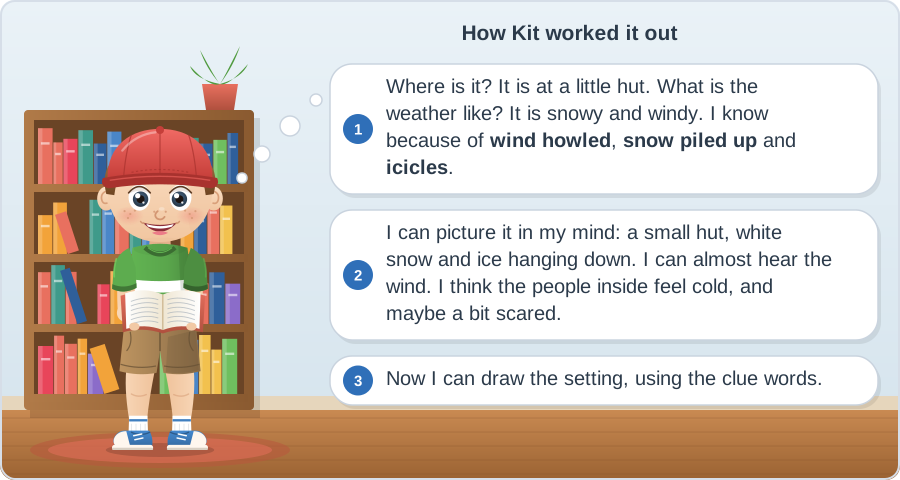
Read the setting slowly, or listen as an adult reads it. Close your eyes and picture it.
The setting: “The wind howled around the little hut. Snow piled up against the door, and icicles hung from the roof like sharp teeth.”
Now Try It
1. Read this setting: “The sun beat down on the dusty road. There was no shade anywhere.” Is this a hot place or a cold place? Which words tell you?
Hint: Find the words about the sun and the shade.
2. How might a character feel walking along that road?
Hint: How would you feel with no shade on a hot day?
Time To Practise
Name: ______________________
1. Match each description to a picture.
Read each description. Write A or B. One description has no picture. Write X for that one.
1. “The moon shone on the frozen trees. Inside the tiny cottage, a fire crackled, and smoke curled out of the chimney.” ____
2. “Stalls were piled high with mangoes and bright cloth. People shouted prices, and a bicycle bell rang.” ____
3. “Under the burning sun, a camel plodded across the golden sand. Nothing grew except one spiky plant.” ____
2. Find the clue words.
For description 3, write two words that tell you it is hot, and one word that tells you about a plant.
Hot: ______________________ ______________________ Plant: ______________________
3. Picture the setting.
a) Which setting, A or B, would make a character feel cosy? Why?
__________________________________________________________________
b) Description 2 has no picture. Draw it. Put in at least four things from the description.
4. Describe a setting.
Choose a setting for a new folk tale. Write three sentences about it. Use a place word, a time word, a weather word and one sense.
__________________________________________________________________
__________________________________________________________________
__________________________________________________________________
Reflect
Think about these questions. Talk about them with someone at home or at school.
1. Go back to the Wonder question: “How can a few words make a whole place appear in your mind?” What do you think now?
2. I was a thinker today when I ______________________________.
A thinker thinks carefully to work things out. For example: I was a thinker today when I used the clue words to match each description to its picture.
Take action: Next time you read a picture book, cover the pictures on one page. Read the words and picture the setting. Then uncover it. Was it like your picture?
Next Steps
If this was easy, try: Write a setting description for a scary folk tale and a happy folk tale in the same place, such as a forest by day and by night.
If this was hard, go back to: Task 1. Read each description with an adult. Point to each thing it names in the pictures before you choose A, B or X.
Notes for Parents and Teachers
Show notes for parents and teachers
These notes cover this lesson only. How every lesson runs is explained in How to Use This Material.
Let’s Learn
Name one setting from a story the learner knows.
See How It’s Done
Read the setting aloud slowly. Ask the learner to close their eyes and picture it.
Answer Key
Reveal Answers
Now Try It
1. A hot place. The words “sun beat down” and “no shade” tell us.
2. Sample answer: Hot, tired and thirsty.
1. Match
1. B
2. X
3. A
2. Clue words
Hot: burning, sun (also accept golden sand)
Plant: spiky
3. Picture the setting
a) Sample answer: B, because the cottage has a warm fire and yellow lights in the windows, even though it is cold outside.
b) Look for: four or more of: stalls, mangoes, bright cloth, people, a bicycle.
4. Describe a setting
Sample answer: Long ago, there was a village beside a wide, muddy river. Every afternoon, heavy rain drummed on the roofs. You could smell wet earth and hear frogs singing.
Look for: a place word, a time word, a weather word and a sense.
Reflect
2. Any real moment from the lesson that shows the learner was a thinker. Examples: “I was a thinker today when I used the clue words to match each description to its picture.” “I was a thinker today when I worked out that one description had no picture.”
For Teachers: IB Details
Show IB and curriculum details
IB theme: How we express ourselves. This theme is about the ways in which we discover and express ideas, feelings, beliefs and values, and how we enjoy and share stories and art.
Central idea: People all over the world tell stories to share ideas, feelings and lessons about life.
| Lesson | Title | Strand | Key concept |
|---|---|---|---|
| 3.7 | Read a Comic Strip | Viewing | Form |
| 3.8 | Picture the Setting | Viewing and presenting | Perspective |
Each lesson also matches the national curriculum for England (Year 2) and the US Common Core (Grade 2). The Grade 2 Curriculum Map lists the full standards for every lesson.
← Back to Lesson 3 – Tales From Around the World | Lessons – Index
© 2026 Firefly Ed. All rights reserved. This page may be printed for personal, home and classroom use. It may not be sold, shared online or reproduced for commercial use without written permission. edfirefly.com


Share your thoughts or ask something..