

Term 1 | Level 1 | Phonics focus: -le, -el, -al, -il and -ey endings
Lesson 3 – Tales From Around the World | Lessons – Index
Lessons
This page has the two reading lessons of Lesson 3, Tales From Around the World: Lessons 3.1 and 3.2. The Lesson 3 page has the Lesson 3 overview, the Lesson 3 review and the PDF download.
Select a lesson to go straight to it. Each lesson ends with a link back to the top of the page.
Lesson 3.1: Read a Fable: The Lion and the Mouse
Reading | About 20 minutes
Term 1 | Level 1
Goal
“I can read a fable, find the characters, setting, problem and solution, and explain the moral in my own words.”
Words to know
fable, character, setting, problem, solution, moral
Wonder
Think about this question before you start. Say your ideas. You will come back to it at the end of the lesson.
Why do people all over the world tell stories with animals in them?
Let’s Learn
A fable is a short story that teaches a lesson. Fables have been told for thousands of years, in many countries.
- The characters are often animals that talk and act like people.
- Something goes wrong. This is the problem.
- The problem is sorted out. This is the solution.
- The story ends with a lesson about how to behave. This is called the moral.
When you read a story, look for:
| Story part | Question to ask |
|---|---|
| characters | Who is in the story? |
| setting | Where and when does it happen? |
| problem | What goes wrong? |
| solution | How is the problem sorted out? |
| moral | What lesson does the story teach? |
The moral is not always written down. Often you have to work it out from what the characters do and say.
See How It’s Done
Read the first paragraph of the story in Time To Practise. Then read Ava’s thoughts.
The first paragraph: “One hot afternoon, a great lion lay asleep under a tree. A little mouse ran across his paw by mistake. The lion woke up with a roar and trapped the mouse under his huge paw.”

Now Try It
Use the story in Time To Practise. Read it aloud with an adult first.
1. What promise does the mouse make to the lion?
Hint: Look at what the mouse says in the second paragraph.
2. How did the lion feel when he was caught in the net? Which words tell you?
Hint: Look at what the lion did: pulled, twisted, roared.
Time To Practise
Name: ______________________
1. Read the fable.
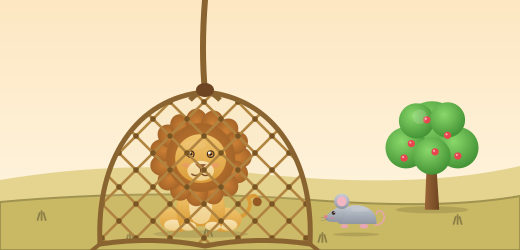
The Lion and the Mouse
A fable from Ancient Greece
One hot afternoon, a great lion lay asleep under a tree. A little mouse ran across his paw by mistake. The lion woke up with a roar and trapped the mouse under his huge paw.
“Please let me go!” squeaked the mouse. “If you do, one day I will help you.”
The lion laughed. “How could a tiny mouse ever help a lion like me?” But he was not hungry, so he lifted his paw, and the mouse ran away.
A few days later, some hunters set a trap. The lion walked into it, and a strong rope net fell on top of him. He pulled and twisted, but the net only grew tighter. He roared so loudly that the whole forest heard him.
The little mouse heard him too. She ran to the lion as fast as she could. Without a word, she began to chew the ropes with her sharp teeth. She chewed and chewed until one rope broke, then another, and another. At last, the lion was free.
“You laughed at me,” said the mouse, “but now you know that even a little mouse can help a lion.”
2. Find the answers in the story.
a) Where was the lion sleeping? ______________________________
b) Who set the trap? ______________________________
c) How did the mouse set the lion free? ______________________________
3. Number the events 1 to 5.
____ The lion walked into a trap.
____ The mouse ran across the lion’s paw.
____ The mouse chewed the ropes.
____ The lion lifted his paw and let the mouse go.
____ The lion was free.
4. Think about the story.
a) Why did the lion laugh at the mouse?
__________________________________________________________________
b) The mouse helped the lion, even though he had laughed at her. Why do you think she helped him? Write two or three sentences.
Hint: Think about the promise she made, and what the lion did for her.
__________________________________________________________________
__________________________________________________________________
c) “The net only grew tighter.” What does this tell you about the lion’s problem?
__________________________________________________________________
5. What is the moral?
Tick the best moral for this fable.
☐ Big animals are always the strongest.
☐ Never sleep under a tree.
☐ Be kind to others, even small ones. One day they may help you.
Write about a time when someone smaller or younger than you helped you, or when you helped someone bigger. Write three sentences.
__________________________________________________________________
__________________________________________________________________
__________________________________________________________________
Reflect
Think about these questions. Talk about them with someone at home or at school.
1. Go back to the Wonder question: “Why do people all over the world tell stories with animals in them?” What do you think now?
2. I was caring today when I ______________________________.
Being caring means being kind and helping others. For example: I was caring today when I thought about why the mouse helped the lion even though he laughed at her.
Take action: Do one kind thing this week for someone younger or smaller than you. Notice how they respond.
Next Steps
If this was easy, try: Read another fable by Aesop, such as The Ant and the Grasshopper. Write its characters, problem, solution and moral.
If this was hard, go back to: Time To Practise, Task 1. Read the story one paragraph at a time. After each paragraph, say in one sentence what happened.
Notes for Parents and Teachers
Show notes for parents and teachers
These notes cover this lesson only. How every lesson runs is explained in How to Use This Material.
Let’s Learn
Talk about a fable or folk tale the learner already knows.
Answer Key
Reveal Answers
Now Try It
1. If the lion lets her go, one day she will help him.
2. Sample answer: He felt angry and frightened. He pulled and twisted, and he roared so loudly that the whole forest heard him.
2. Find the answers
a) Under a tree
b) Some hunters
c) She chewed the ropes with her sharp teeth until they broke.
3. Number the events
3 The lion walked into a trap.
1 The mouse ran across the lion’s paw.
4 The mouse chewed the ropes.
2 The lion lifted his paw and let the mouse go.
5 The lion was free.
4. Think about the story
a) He thought a tiny mouse was too small to ever help a big lion.
b) Sample answer: She had made a promise, and she wanted to keep it. The lion had been kind to her when he let her go. She wanted to show him that small animals can help too.
c) Sample answer: The more he fought, the worse it got. He could not get out on his own, so he needed help.
Look for: in b), at least one reason linked to the story, such as the promise or the lion’s kindness.
5. Moral
Be kind to others, even small ones. One day they may help you.
Sample answer: My little sister found my lost shoe when we were late for school. I was surprised, because she is only three. Now I know that small people can be a big help.
Reflect
2. Any real moment from the lesson that shows the learner was caring. Examples: “I was caring today when I thought about why the mouse helped the lion even though he laughed at her.” “I was caring today when I said I would be kind to someone younger, just like the lion was to the mouse.”
Lesson 3.2: The Clever Hare: A Tale From India
Reading | About 20 minutes
Term 1 | Level 1
Goal
“I can read a folk tale from India, work out what a character is really thinking, and compare two stories from different countries.”
Words to know
folk tale, compare, alike, different, trick, reflection
Wonder
Think about this question before you start. Say your ideas. You will come back to it at the end of the lesson.
How can two stories from faraway countries be so alike?
Let’s Learn
A folk tale is a story that people told aloud for a very long time before anyone wrote it down. Every country has its own folk tales.
- Aesop’s fables come from Ancient Greece. People were telling them more than 2,500 years ago.
- The Panchatantra is a very old collection of animal stories from India. It was written down more than 1,500 years ago.
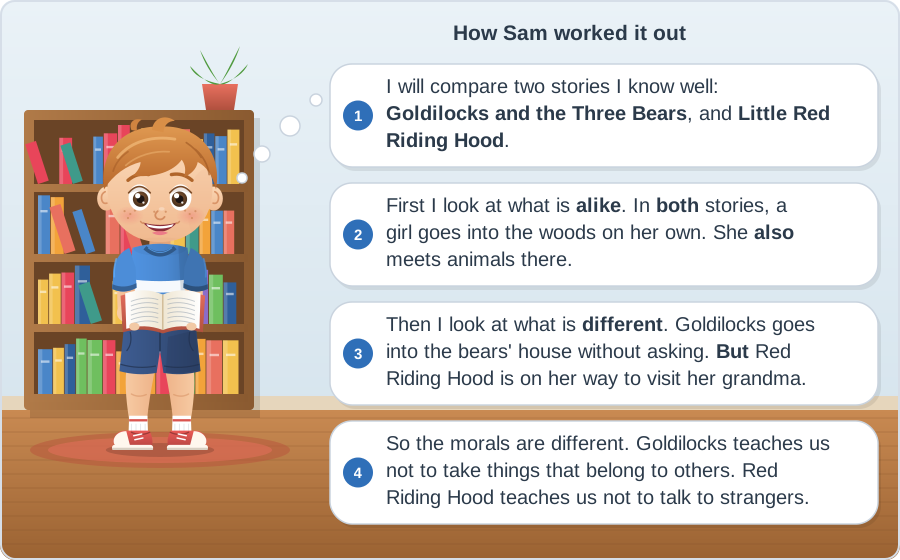
Stories from different places are often alike in some ways and different in others. When we compare two stories, we look at the characters, the problem, how it is solved and the moral.
These words help us compare:
| To show things are alike | To show things are different |
|---|---|
| both, also, the same, too | but, however, instead, only one |
See How It’s Done
Now Try It
Use the story in Time To Practise. Read it aloud with an adult first.
1. Why did the animals agree to send the lion one animal every day?
Hint: Look at the first paragraph. What was the lion doing before?
2. The hare “thought very hard”. What do you think she was thinking about?
Hint: What did she not want to happen?
Time To Practise
Name: ______________________
1. Read the folk tale.

The Clever Hare
A tale from India
Long ago, a fierce lion lived in a forest. Every day, he caught far more animals than he could eat. The other animals were afraid, so they made a plan. “Lion,” they said, “if you stay in your den, we will send one animal to you every day for your dinner.” The lion agreed.
One day, it was the turn of a small hare. The hare did not want to be eaten, so she thought very hard. Then she walked slowly to the lion’s den and arrived late.
The lion was hungry and furious. “Why are you so late?” he roared.
“I am sorry,” said the hare. “On the way, another lion stopped me. He said that he is the king of this forest, not you.”
“Another king?” growled the lion. “Show me where he is!”
The hare led the lion to a deep well. “He lives down there,” she said.
The lion looked over the edge. In the still water, he saw a lion glaring back at him. He roared, and the lion in the water seemed to roar back. He was so angry that he leapt into the well to fight.
Splash! The lion found only cold water. He struggled out at last, soaking wet and ashamed, and ran far away from that forest. The hare hopped home, and the animals were never afraid again.
2. Answer the questions.
a) Why did the hare walk slowly to the lion’s den?
__________________________________________________________________
b) The hare said she had met another lion. Was this true? How do you know?
__________________________________________________________________
c) What did the lion really see in the water?
Hint: What do you see when you look into still water or a mirror?
__________________________________________________________________
d) Find two words in the story that show the lion was angry.
______________________ and ______________________
3. Compare the two stories.
Hint: Look back at The Lion and the Mouse in Lesson 3.1.
| The Lion and the Mouse | The Clever Hare | |
|---|---|---|
| Where it comes from | ______________ | ______________ |
| The small animal | ______________ | ______________ |
| What the small animal does to the lion | ______________ | ______________ |
| The moral | ______________ | ______________ |
4. Write about the stories.
Write one sentence about how the stories are alike. Use both. Then write one sentence about how they are different. Use but.
__________________________________________________________________
__________________________________________________________________
Which story do you like more? Write two sentences to explain why.
__________________________________________________________________
__________________________________________________________________
Reflect
Think about these questions. Talk about them with someone at home or at school.
1. Go back to the Wonder question: “How can two stories from faraway countries be so alike?” What do you think now?
2. I was open-minded today when I ______________________________.
Being open-minded means listening to other ideas and other ways of doing things. For example: I was open-minded today when I listened to a tale from India and compared it with a tale from Greece.
Take action: Ask someone at home if they know a folk tale from the place where they grew up. Compare it with one of the stories from Lesson 3.
Next Steps
If this was easy, try: Find another tale where a small animal tricks a bigger one, such as Anansi or Brer Rabbit. Compare it with The Clever Hare.
If this was hard, go back to: Time To Practise, Task 1. Read the story in three parts with an adult: the plan, the trick and the ending. Say what happens in each part before you compare.
Notes for Parents and Teachers
Show notes for parents and teachers
These notes cover this lesson only. How every lesson runs is explained in How to Use This Material.
Let’s Learn
If you can, find India and Greece on a map or globe together.
See How It’s Done
If the learner does not know these stories, compare two stories they do know.
Answer Key
Reveal Answers
Now Try It
1. The lion was catching far more animals than he could eat, and they were afraid. They hoped the plan would keep most of them safe.
2. Sample answer: She was thinking of a way to stop the lion from eating her.
2. Answer the questions
a) Sample answer: She wanted to arrive late, so the lion would be angry and ask why. Then she could tell him her story.
b) No. There was no other lion. She made it up to trick the lion. We know because the “lion” in the well was only the lion’s own face in the water.
c) He saw his own reflection.
d) Any two of: fierce, furious, roared, growled, glaring, angry.
Look for: in a), the learner sees that arriving late was part of the hare’s plan.
3. Compare
Where it comes from: Ancient Greece; India
The small animal: a mouse; a hare
What the small animal does: helps the lion; tricks the lion
The moral: Be kind to others, even small ones; Being clever can beat being strong.
Look for: accept any moral in the learner’s own words that fits, such as “Use your brain, not your muscles”.
4. Write
Sample answer: Both stories have a big lion and a small animal. The mouse helps the lion, but the hare tricks the lion. I like The Clever Hare more, because the trick with the well made me laugh. The hare was small, but she saved all the animals.
Reflect
2. Any real moment from the lesson that shows the learner was open-minded. Examples: “I was open-minded today when I listened to a tale from India and compared it with a tale from Greece.” “I was open-minded today when I said what I liked about a story from a country I do not know well.”
For Teachers: IB Details
Show IB and curriculum details
IB theme: How we express ourselves. This theme is about the ways in which we discover and express ideas, feelings, beliefs and values, and how we enjoy and share stories and art.
Central idea: People all over the world tell stories to share ideas, feelings and lessons about life.
| Lesson | Title | Strand | Key concept |
|---|---|---|---|
| 3.1 | Read a Fable: The Lion and the Mouse | Reading | Form |
| 3.2 | The Clever Hare: A Tale From India | Reading | Connection |
Each lesson also matches the national curriculum for England (Year 2) and the US Common Core (Grade 2). The Grade 2 Curriculum Map lists the full standards for every lesson.
← Back to Lesson 3 – Tales From Around the World | Lessons – Index
© 2026 Firefly Ed. All rights reserved. This page may be printed for personal, home and classroom use. It may not be sold, shared online or reproduced for commercial use without written permission. edfirefly.com


Share your thoughts or ask something..