

Term 1 | Level 1 | Phonics focus: -le, -el, -al, -il and -ey endings
Lesson 3 – Tales From Around the World | Lessons – Index
Lessons
This page has the two listening and speaking lessons of Lesson 3, Tales From Around the World: Lessons 3.5 and 3.6. The Lesson 3 page has the Lesson 3 overview, the Lesson 3 review and the PDF download.
Select a lesson to go straight to it. Each lesson ends with a link back to the top of the page.
Lesson 3.5: Retell a Tale With Expression
Oral | About 20 minutes
Term 1 | Level 1
Goal
“I can retell a tale in my own words, in the right order, using story language, voices, volume, speed and pauses.”
Words to know
retell, expression, volume, speed, pause, character voice
Wonder
Think about this question before you start. Say your ideas. You will come back to it at the end of the lesson.
What makes a story exciting to listen to?
Let’s Learn
Before books, stories were passed on by telling them. A good storyteller makes listeners want to hear what happens next.
| Storyteller’s tool | How to use it |
|---|---|
| story language | Start with an opener (Once upon a time). Use time words (then, suddenly). Finish with an ending (And from that day on…). |
| volume | Speak loudly for exciting parts and quietly for secret or scary parts. |
| speed | Speak fast when characters rush. Slow down for important moments. |
| pause | Stop for a moment before something surprising happens. |
| character voices | Give each character a different voice: deep, high, squeaky, grumpy. |
| face and hands | Show feelings on your face. Use your hands to show size or movement. |
You do not need to remember the exact words. Retell the story in your own words, in the right order.
See How It’s Done
Read this part of The Clever Hare aloud with expression. Follow the notes in brackets.
“The lion looked over the edge of the well…” (slowly, leaning forward)
“…and in the water, he saw…” (pause) “…another lion!” (loudly, with wide eyes)
“GRRR!” (deep, growly lion voice)
“And the lion in the water roared back.” (quietly, as if telling a secret)
“SPLASH!” (loudly, hands thrown up)

Now Try It
1. Say the mouse’s words, “Please let me go!”, in a small, squeaky, scared voice. Then say the lion’s words, “How could a tiny mouse ever help a lion like me?”, in a big, deep, proud voice.
Hint: Think about how each character feels, and how big they are.
2. In The Lion and the Mouse, which part would you say slowly and quietly? Why?
Hint: Think about the most worrying moment for the lion.
Time To Practise
Name: ______________________
1. Plan how to say it.
Read this part of The Lion and the Mouse. For each line, write how you would say it: L for loud, Q for quiet, F for fast or S for slow. Write P where you would pause.
| Line | How |
|---|---|
| The lion walked through the forest, not looking where he was going. | ______ |
| Suddenly, a net fell on top of him! | ______ |
| “ROAR!” He pulled and twisted, but he could not get out. | ______ |
| Far away, a little mouse heard him. | ______ |
| She ran and ran and ran, as fast as her legs could go. | ______ |
Choose one line. Explain why you chose that way to say it.
__________________________________________________________________
2. Retell a tale.
Choose The Lion and the Mouse, The Clever Hare or The Fox and the Grapes. Retell it to someone at home without reading it. Use your story map from Lesson 3.3 if it helps.
Ask an adult to listen to your whole story. Then tick each one you did.
☐ I used a story opener. ☐ I told the events in the right order. ☐ I used time words. ☐ I changed my volume. ☐ I paused before a surprise. ☐ I used a voice for each character. ☐ I showed feelings on my face. ☐ I gave a clear ending.
3. Two stars and a wish.
Ask your listener for two things you did well (stars) and one thing to do better next time (wish). Write them down.
★ ______________________________________________________________
★ ______________________________________________________________
Wish: ______________________________________________________________
Now tell the story again and try your wish.
Reflect
Think about these questions. Talk about them with someone at home or at school.
1. Go back to the Wonder question: “What makes a story exciting to listen to?” What do you think now?
2. I was a communicator today when I ______________________________.
A communicator shares ideas clearly by talking, writing or drawing. For example: I was a communicator today when I used a deep voice for the lion and a squeaky voice for the mouse.
Take action: Tell a tale at bedtime to a younger child, a grandparent or a toy. Use one new storytelling tool each time.
Next Steps
If this was easy, try: Record yourself telling a tale. Listen back and choose one place to add a pause or a new voice. Record it again.
If this was hard, go back to: Task 1. Practise just two tools: a voice for each character, and one loud part. Retell only the beginning and the end of the story.
Notes for Parents and Teachers
Show notes for parents and teachers
These notes cover this lesson only. How every lesson runs is explained in How to Use This Material.
Let’s Learn
Try each tool together: say “Once upon a time” loudly, then quietly, then slowly.
See How It’s Done
Act out the passage with expression first, following the notes in brackets. Then let the learner try it.
Time To Practise
- Task 2: Listen to the whole story first. Then tick the checklist together.
Answer Key
Reveal Answers
Now Try It
1. Look for: a clear change between the two voices. The mouse’s voice is high and small. The lion’s voice is low and slow.
2. Sample answer: The part where the net falls and the lion cannot get out. It is worrying, so a slow, quiet voice makes listeners feel worried too.
1. Plan how to say it
Sample answers:
Line 1: S (calm, before anything happens)
Line 2: P then L (pause before “Suddenly”, then loud for the surprise)
Line 3: L (the lion is angry and roaring)
Line 4: Q (it is far away and quiet)
Line 5: F (the mouse is rushing)
Look for: any choice the learner can explain. There is more than one good way to tell a story.
2. Retell
Look for: six or more ticks. The events are in the right order, even if the words are different from the book.
3. Stars and a wish
Sample answer: Star: You used a great deep voice for the lion. Star: You paused before the splash. Wish: Look at your listener more.
Reflect
2. Any real moment from the lesson that shows the learner was a communicator. Examples: “I was a communicator today when I used a deep voice for the lion and a squeaky voice for the mouse.” “I was a communicator today when I paused before the surprise so my listener wanted to know what happened next.”
Lesson 3.6: Hot Seat: Speak as a Character
Oral | About 20 minutes
Term 1 | Level 1
Goal
“I can ask open questions, and answer as a character using I, feelings and reasons that fit the story.”
Words to know
hot seat, character, open question, closed question, in role
Wonder
Think about this question before you start. Say your ideas. You will come back to it at the end of the lesson.
What would a story character say if we could ask them questions?
Let’s Learn
In a hot seat game, one person pretends to be a character from a story. The others ask the character questions.
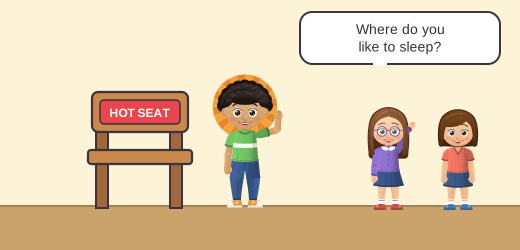
When you are in the hot seat:
- Speak as the character. Say I and me, not he or she.
- Say how you felt, and give a reason with because.
- Stick to what happened in the story. You can add ideas that fit.
When you ask questions:
| Closed question | Open question |
|---|---|
| can be answered with yes or no | needs a longer answer |
| Were you scared? | How did you feel when the net fell on you? |
| Did you like the mouse? | Why did you let the mouse go? |
Open questions start with words like why, how, what and what if. They get the best answers.
See How It’s Done
Pam is in the hot seat as the hare from The Clever Hare.
Question: “How did you feel when it was your turn to go to the lion?”
Hare: “I felt very frightened, because I knew the lion wanted to eat me. My ears were shaking!”
Question: “Why did you tell the lion about another lion?”
Hare: “I wanted to make him angry, because angry animals do not think carefully. I knew he would see his reflection in the well.”

Now Try It
1. Change this closed question into an open question: “Were you hungry, lion?”
Hint: Start with why, how or what.
2. You are the mouse. Answer this question: “How did you feel when the lion laughed at you?”
Hint: Say I felt… because…
Time To Practise
Name: ______________________
1. Open or closed? Write O or C.
a) Did you chew the ropes? ____
b) Why did you jump into the well? ____
c) What did you think when you saw the grapes? ____
d) Are you a fox? ____
e) How did you get out of the well? ____
2. Write three open questions for the lion in The Lion and the Mouse.
1. ______________________________________________________________?
2. ______________________________________________________________?
3. ______________________________________________________________?
3. Answer in role.
You are the fox in The Fox and the Grapes. Answer this question in two or three sentences. Use I, a feeling and because.
“Why did you say the grapes were sour?”
__________________________________________________________________
__________________________________________________________________
4. Play the hot seat game.
Take turns with someone at home. One person chooses a character from Lesson 3 and sits in the hot seat. The other asks at least three open questions. Then swap.
Tick each one you did when you were in the hot seat.
☐ I spoke as the character, using I. ☐ I named a feeling. ☐ I gave a reason with because. ☐ My answers fitted the story. ☐ I asked open questions when it was my turn.
Reflect
Think about these questions. Talk about them with someone at home or at school.
1. Go back to the Wonder question: “What would a story character say if we could ask them questions?” What do you think now?
2. I was a risk-taker today when I ______________________________.
A risk-taker tries something new, even when it feels hard. For example: I was a risk-taker today when I sat in the hot seat and answered as the fox, even though I felt a bit shy.
Take action: Next time you read a story, think of one open question you would ask a character. Ask someone at home how they think the character would answer.
Next Steps
If this was easy, try: Sit in the hot seat as a character who does not speak in the story, such as one of the hunters. What might they say?
If this was hard, go back to: Task 1. Practise with just two question words, why and how. Answer each question as the character with I felt… because…
Notes for Parents and Teachers
Show notes for parents and teachers
These notes cover this lesson only. How every lesson runs is explained in How to Use This Material.
Let’s Learn
Practise turning two closed questions into open ones together.
See How It’s Done
You could act out the hot seat first: sit in a chair and answer the questions as the hare, using a hare voice.
Time To Practise
- Task 4: Tick the checklist together after the learner has been in the hot seat.
Answer Key
Reveal Answers
Now Try It
1. Sample answers: Why did you not eat the mouse? How hungry were you?
2. Sample answer: I felt upset, because he thought I was too small to help anyone. I wanted to prove him wrong.
1. Open or closed
a) C
b) O
c) O
d) C
e) O
2. Questions for the lion
Sample answers: Why did you laugh at the mouse? How did you feel when the net fell on you? What did you say to the mouse after she set you free?
Look for: each question starts with why, how, what or what if, and cannot be answered with yes or no.
3. Answer in role
Sample answer: I said they were sour because I felt silly. I had jumped and jumped, and I could not reach them. Saying they were sour made me feel better.
4. Hot seat
Look for: four or five ticks. Answers stay true to the story.
Reflect
2. Any real moment from the lesson that shows the learner was a risk-taker. Examples: “I was a risk-taker today when I sat in the hot seat and answered as the fox, even though I felt a bit shy.” “I was a risk-taker today when I tried a new voice for my character in front of my family.”
For Teachers: IB Details
Show IB and curriculum details
IB theme: How we express ourselves. This theme is about the ways in which we discover and express ideas, feelings, beliefs and values, and how we enjoy and share stories and art.
Central idea: People all over the world tell stories to share ideas, feelings and lessons about life.
| Lesson | Title | Strand | Key concept |
|---|---|---|---|
| 3.5 | Retell a Tale With Expression | Listening and speaking | Form |
| 3.6 | Hot Seat: Speak as a Character | Listening and speaking | Perspective |
Each lesson also matches the national curriculum for England (Year 2) and the US Common Core (Grade 2). The Grade 2 Curriculum Map lists the full standards for every lesson.
← Back to Lesson 3 – Tales From Around the World | Lessons – Index
© 2026 Firefly Ed. All rights reserved. This page may be printed for personal, home and classroom use. It may not be sold, shared online or reproduced for commercial use without written permission. edfirefly.com


Share your thoughts or ask something..