

Term 1 | Level 1 | Phonics focus: -le, -el, -al, -il and -ey endings
Lesson 3 – Tales From Around the World | Lessons – Index
Lessons
This page has the two writing lessons of Lesson 3, Tales From Around the World: Lessons 3.3 and 3.4. The Lesson 3 page has the Lesson 3 overview, the Lesson 3 review and the PDF download.
Select a lesson to go straight to it. Each lesson ends with a link back to the top of the page.
Lesson 3.3: Plan a Story: Beginning, Middle and End
Writing | About 20 minutes
Term 1 | Level 1
Goal
“I can plan a story with a story map, then write a fable with a beginning, middle and end, time words and a moral.”
Words to know
story map, beginning, middle, end, story opener, time words
Wonder
Think about this question before you start. Say your ideas. You will come back to it at the end of the lesson.
How do storytellers keep a story in the right order?
Let’s Learn
Before you write a story, make a plan. A story map helps you plan the three parts of a story.
| Part | What it tells the reader | Useful words |
|---|---|---|
| Beginning | who the characters are, where and when the story happens | Once upon a time, Long ago, One day |
| Middle | the problem, and what the characters do about it | Then, Next, Suddenly, After that |
| End | how the problem is solved, how the characters feel, and the moral | At last, In the end, From that day on |
A good plan uses notes, not full sentences. You turn the notes into sentences when you write.
See How It’s Done
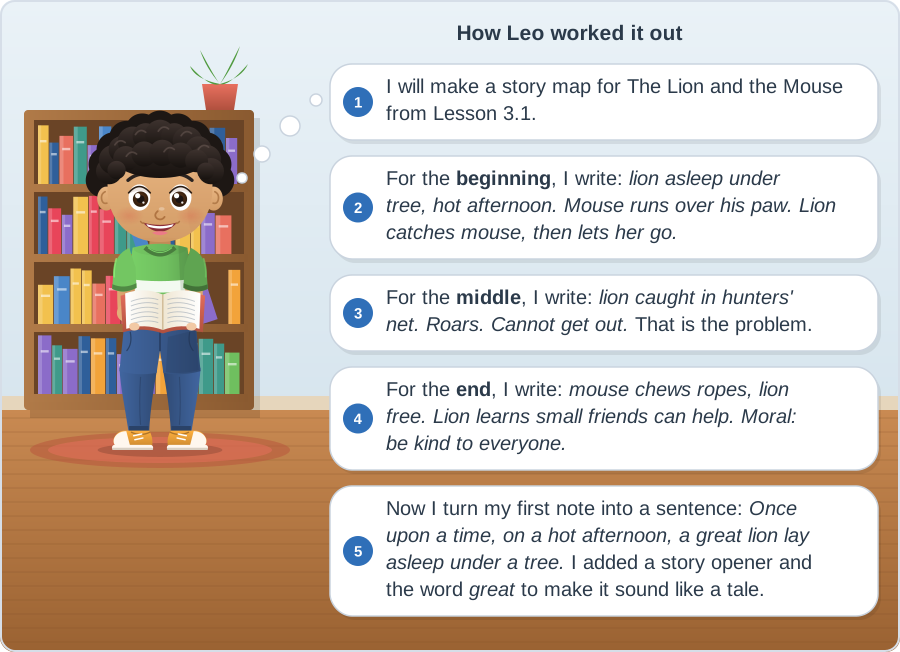
Now Try It
1. “The hare tricked the lion with the well.” Which part of The Clever Hare is this: beginning, middle or end?
Hint: Look at the story map table. Which part tells how the problem is solved?
2. Why do we write notes, not full sentences, on a story map?
Hint: Think about how long a plan should take.
Time To Practise
Name: ______________________
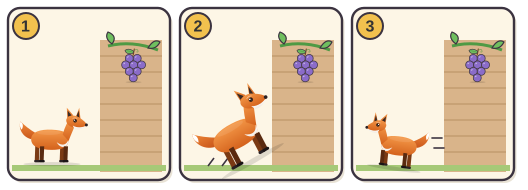
1. Write a sentence for each picture.
This is a fable from Ancient Greece called The Fox and the Grapes. Look at the three pictures. Write one sentence for each. Use a story opener for picture 1.
Hint: In picture 3, think about what the fox might be saying to make himself feel better.
1. ______________________________________________________________
2. ______________________________________________________________
3. ______________________________________________________________
2. Plan your own fable.
Choose two animals: one big and one small. Give them a problem. Fill in the story map with notes.
| Part | My notes |
|---|---|
| Characters | ______________________________________________ |
| Setting (where and when) | ______________________________________________ |
| Beginning | ______________________________________________ |
| Middle: the problem | ______________________________________________ |
| End: the solution | ______________________________________________ |
| Moral | ______________________________________________ |
3. Write your fable.
Use your story map. Write at least six sentences. Use a story opener, two time words and an ending phrase. Give your fable a title.
Title: ______________________________________________
__________________________________________________________________
__________________________________________________________________
__________________________________________________________________
__________________________________________________________________
__________________________________________________________________
__________________________________________________________________
Check your work. Tick each one you did.
☐ I wrote a title. ☐ I used a story opener. ☐ I wrote a clear problem. ☐ I used two time words. ☐ I wrote a solution. ☐ I wrote a moral at the end. ☐ I used capital letters and full stops.
Reflect
Think about these questions. Talk about them with someone at home or at school.
1. Go back to the Wonder question: “How do storytellers keep a story in the right order?” What do you think now?
2. I was a thinker today when I ______________________________.
A thinker thinks carefully to work things out. For example: I was a thinker today when I planned my fable on a story map before I started writing.
Take action: Read your fable to someone at home. Ask them to say the moral in their own words. Did they understand it?
Next Steps
If this was easy, try: Write a second version of your fable set in a different country. Change the animals and setting to fit that place.
If this was hard, go back to: Task 1. Say each sentence aloud before you write it. Then plan your fable by drawing three pictures before you write notes.
Notes for Parents and Teachers
Show notes for parents and teachers
These notes cover this lesson only. How every lesson runs is explained in How to Use This Material.
Let’s Learn
Say the useful words together in a storytelling voice.
See How It’s Done
Write the three notes on paper as you go through Leo’s thoughts.
Time To Practise
- Task 3: Read the fable, and tick the checklist together.
Answer Key
Reveal Answers
Now Try It
1. The end (the trick solves the animals’ problem).
2. Notes are quick to write. They help you remember your ideas without spending a long time on the plan.
1. The Fox and the Grapes
Sample answer:
1. One hot day, a hungry fox saw a bunch of juicy grapes high up on a wall.
2. He jumped as high as he could, again and again, but he could not reach them.
3. At last, he walked away with his nose in the air and said, “Those grapes were probably sour anyway.”
Look for: a story opener in sentence 1, and a sentence 3 that shows the fox pretending he did not want the grapes.
2. Story map
Sample answer: Characters: an elephant and an ant. Setting: a dry forest, long ago. Beginning: elephant laughs at the tiny ant. Middle: elephant gets a thorn in his foot and cannot walk. End: ant climbs in and pulls the thorn out. Moral: everyone has something to give.
3. Fable
Answers will vary. Look for: five or more ticks, and events that follow the plan in order.
Reflect
2. Any real moment from the lesson that shows the learner was a thinker. Examples: “I was a thinker today when I planned my fable on a story map before I started writing.” “I was a thinker today when I thought of a clear problem and a solution for my animals.”
Lesson 3.4: Past Tense: Retell a Tale
Writing | About 20 minutes
Term 1 | Level 1
Goal
“I can use the past tense correctly, including irregular verbs like ran, saw and thought, and keep a retelling in the past tense.”
Words to know
past tense, verb, ed, irregular verb, retell
Wonder
Think about this question before you start. Say your ideas. You will come back to it at the end of the lesson.
How do we show in our writing that a story has already happened?
Let’s Learn
The past tense tells us that something has already happened. Stories are usually told in the past tense.
Most verbs add ed to make the past tense:
- jump → jumped, walk → walked, laugh → laughed
- If the verb ends in e, just add d: smile → smiled, chase → chased
Some verbs change in a different way. These are called irregular verbs. You have to learn them.
| Now | Past | Now | Past |
|---|---|---|---|
| run | ran | go | went |
| see | saw | come | came |
| say | said | find | found |
| catch | caught | think | thought |
| take | took | tell | told |
| eat | ate | fall | fell |
When you write a story, keep all the verbs in the past tense. Do not switch between now and then.
See How It’s Done
Sentences in the present tense: The lion sleeps under a tree. A mouse runs over his paw. The lion catches her.
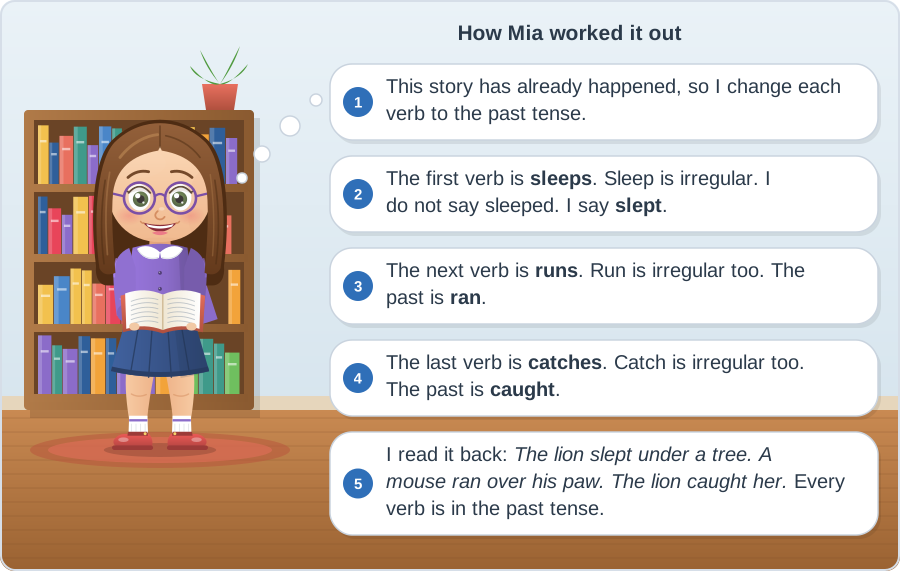
Now Try It
1. What is the past tense of laugh? And of see?
Hint: One adds ed. One is irregular.
2. Which is right? “The hare thinked hard.” or “The hare thought hard.”
Hint: Look at the table in Let’s Learn.
Time To Practise
Name: ______________________
1. Write the past tense.
| Now | Past | Now | Past |
|---|---|---|---|
| jump | ______________ | go | ______________ |
| roar | ______________ | eat | ______________ |
| chase | ______________ | come | ______________ |
| find | ______________ | tell | ______________ |
2. Circle the right verb.
a) Long ago, a fox (see / saw) some grapes on a wall.
b) He (jumped / jumps) as high as he could.
c) The mouse (taked / took) a deep breath and began to chew.
d) The lion (fell / falled) into the cold water.
e) At last, the hare (goed / went) home.
3. Fix the retelling.
Sam retold The Fox and the Grapes. He forgot to keep to the past tense. Six verbs are in the wrong tense. Find them and write the story again correctly.
One hot day, a hungry fox walked along a wall. He sees some juicy grapes. He jumped up, but he cannot reach them. He tries again and again. At last, he gave up. He goes away and says, “Those grapes were sour anyway.” Then he thinks about his dinner.
__________________________________________________________________
__________________________________________________________________
__________________________________________________________________
__________________________________________________________________
4. Retell The Clever Hare.
Retell the tale from Lesson 3.2 in five sentences. Use the past tense. Use at least three verbs from the box. Underline them.
Verb box: went | saw | said | thought | came | ran | told
__________________________________________________________________
__________________________________________________________________
__________________________________________________________________
__________________________________________________________________
__________________________________________________________________
Reflect
Think about these questions. Talk about them with someone at home or at school.
1. Go back to the Wonder question: “How do we show in our writing that a story has already happened?” What do you think now?
2. I was knowledgeable today when I ______________________________.
Being knowledgeable means knowing things and using what you know. For example: I was knowledgeable today when I knew that ran, saw and thought are the past tense of run, see and think.
Take action: At dinner, tell your family about your day using the past tense. Listen for any verbs that sound wrong and fix them.
Next Steps
If this was easy, try: Find ten more irregular verbs in a storybook, such as swam, flew and wrote. Make your own past tense table.
If this was hard, go back to: Let’s Learn. Learn four irregular verbs first: ran, saw, said and went. Use each one in a spoken sentence before you write.
Notes for Parents and Teachers
Show notes for parents and teachers
These notes cover this lesson only. How every lesson runs is explained in How to Use This Material.
Let’s Learn
Say each pair in the table: run, ran; see, saw.
See How It’s Done
Write the three present tense sentences on paper. Change each verb as you go through Mia’s thoughts.
Answer Key
Reveal Answers
Now Try It
1. laughed, saw
2. “The hare thought hard.”
1. Past tense
jump: jumped go: went
roar: roared eat: ate
chase: chased come: came
find: found tell: told
2. Circle the right verb
a) saw
b) jumped
c) took
d) fell
e) went
3. Fix the retelling
One hot day, a hungry fox walked along a wall. He saw some juicy grapes. He jumped up, but he could not reach them. He tried again and again. At last, he gave up. He went away and said, “Those grapes were sour anyway.” Then he thought about his dinner.
Look for: the six changes are sees, cannot, tries, goes, says and thinks. Accept “couldn’t” for “could not”. “were” in the fox’s words is already past.
4. Retell
Sample answer: A fierce lion ran after the animals every day. The animals said they would send him one animal a day. A clever hare thought of a trick. She told the lion about another lion in a well. The lion saw his reflection, jumped in and never came back to that forest.
Look for: five sentences, every verb in the past tense, and three or more verbs from the box underlined.
Reflect
2. Any real moment from the lesson that shows the learner was knowledgeable. Examples: “I was knowledgeable today when I knew that ran, saw and thought are the past tense of run, see and think.” “I was knowledgeable today when I found the verbs in Sam’s retelling that were in the wrong tense.”
For Teachers: IB Details
Show IB and curriculum details
IB theme: How we express ourselves. This theme is about the ways in which we discover and express ideas, feelings, beliefs and values, and how we enjoy and share stories and art.
Central idea: People all over the world tell stories to share ideas, feelings and lessons about life.
| Lesson | Title | Strand | Key concept |
|---|---|---|---|
| 3.3 | Plan a Story: Beginning, Middle and End | Writing | Form |
| 3.4 | Past Tense: Retell a Tale | Writing | Form |
Each lesson also matches the national curriculum for England (Year 2) and the US Common Core (Grade 2). The Grade 2 Curriculum Map lists the full standards for every lesson.
← Back to Lesson 3 – Tales From Around the World | Lessons – Index
© 2026 Firefly Ed. All rights reserved. This page may be printed for personal, home and classroom use. It may not be sold, shared online or reproduced for commercial use without written permission. edfirefly.com

Share your thoughts or ask something..