
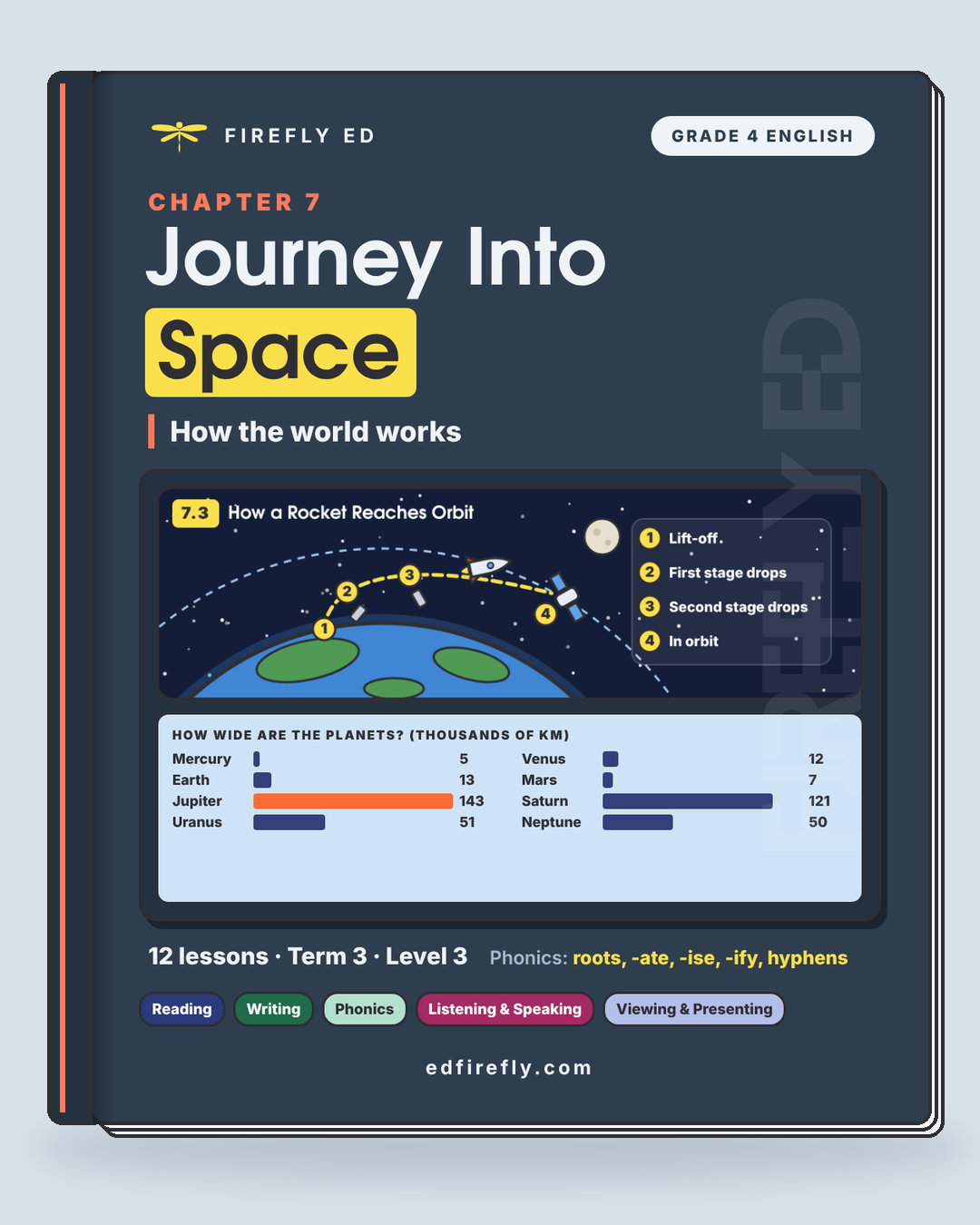
Term 3 | Level 3 | Phonics focus: word roots from the sky, the verb endings -ate, -ise and -ify, and prefixes with hyphens
What this chapter is about
People use science and teamwork to explore space, and what they learn there helps us understand Earth.
Theme: How the world works. It covers the first Moon landing, names from myths, how rockets reach orbit, stories set on other planets, mission logs, planet fact files, rocket diagrams and planet charts.
Before you start
Before Lesson 7.1, look at the night sky, or at a photo of the Moon. What would you take with you on a journey into space? What would you want to find out?
Write down your ideas and keep them. You will look at them again at the end of the chapter.
Questions we explore
- How people have explored space, step by step
- How rockets, planets and the Moon work
- How stories, names and words connect us to the sky
How each lesson works
Every lesson starts with a Wonder question to think about. Next, you learn something new, see how it is done, try it, and practise on your own. Each lesson ends with Reflect, where you go back to the Wonder question, think about how you learned, and choose something to do at home.
Lessons
Each strand of this chapter has its own page. Open a page to see its lessons.
Download the full chapter as a PDF (free after you subscribe)
Reading: The First Moon Landing and Names From Myths
In Lessons 7.1 and 7.2, you explain the events of the first Moon landing in order, and work out the meaning of space words and names that come from myths.
Writing: Explain How a Rocket Reaches Orbit and Write a Space Story
In Lessons 7.3 and 7.4, you explain a process in order with precise science words, and write a story set on another planet.
Listening and Speaking: Tell a Mission Log Story and Present a Planet Fact File
In Lessons 7.5 and 7.6, you tell a story aloud in an organised way, and present a planet fact file with a visual.
Viewing and Presenting: Read a Rocket Diagram and Make a Planet Bar Chart
In Lessons 7.7 and 7.8, you read a labelled diagram of the stages of a rocket, and show planet facts in a table and a bar chart.
Phonics: astro, lunar, solar, -ate, -ise, -ify and Hyphens
In Lessons 7.9, 7.10 and 7.11, you use the roots astro, lun and sol, make verbs with -ate, -ise and -ify, and decide when a prefix needs a hyphen.
Chapter review
Lesson 7.12 reviews the whole chapter. An optional Challenge with a story and a grammar task follows it. Tap a lesson to open it. Tap the lesson title again, or use the link at the end of the lesson, to close it.
Lesson 7.12: Chapter 7 Review | All strands | About 20 minutes
Term 3 | Level 3
Goal
“I can show what I have learned about space history, explanations, stories, presentations, diagrams, charts and space words in Chapter 7.”
Words to know
sequence, allusion, explanation, dialogue, fact file, diagram, scale, root, suffix, hyphen
Wonder
Think about this question before you start. Say your ideas. You will come back to it at the end of the lesson.
What is the most surprising thing you learned about space in this chapter?
Let’s Learn
This review has six tasks. Here is a reminder of what each one checks.
1. Read each task carefully.
2. Try it on your own first.
3. Check your work with the Answer Key.
4. Mark any task that felt hard. Go back to that lesson and try again.
See How It’s Done
Now Try It
1. What does the root sol mean? ______________
2. Hyphen or not? re + enter ______________
Time To Practise
Name: ______________________
1. Reading.
On 1 April 2026, four astronauts lifted off from Florida on the Artemis II mission. First, they circled the Earth to test their spacecraft, Orion. Then they set off for the Moon. On the sixth day, they swung around the far side of the Moon, where no one on Earth could see them. Because of this path, they travelled farther from Earth than any humans before them. Finally, on 10 April, their capsule splashed down in the Pacific Ocean, slowed by giant parachutes.
a) Put these in order: ____ splashdown ____ test the spacecraft ____ lift-off ____ swing around the Moon
b) Why did they travel farther from Earth than anyone before? ______________________________
c) The mission is named after Artemis. Who was she in the myth? ______________________________
2. Writing.
a) Make this more precise: The parachutes made the thing go slower. ______________________________
b) Write one line of dialogue for an astronaut seeing the far side of the Moon, with correct quotation marks.
__________________________________________________________________
3. Oral.
Tell the Artemis II story to an adult in four sentences, using first, then, on the sixth day and finally.
An adult listens and ticks each one they hear: ☐ events in order ☐ time connectives ☐ clear voice ☐ looked up at the listener
4. Visual.
a) In the rocket diagram in Lesson 7.7, which part held the crew? ______________
b) A bar chart shows numbers from 0 to 90. Which scale is best: counting in 1s, 10s or 100s? ______________
5. Phonics.
a) Write the meaning of each root: astro ______ lun ______ sol ______
b) Make verbs: solid + ify ______________ memory + ise ______________ active + ate ______________
c) Add a hyphen if needed: co + operate ______________ re + build ______________ self + confident ______________
6. Spelling.
a) Circle the correct spelling.
equipment / equiptment curiousity / curiosity system / sistem sufficient / suficient
b) Write from dictation.
Listen as an adult reads a sentence aloud. Write it.
__________________________________________________________________
Reflect
Think about these questions. Talk about them with someone at home or at school.
1. Go back to the Wonder question: “What is the most surprising thing you learned about space in this chapter?” What do you think now?
2. I was reflective today when I ______________________________.
Being reflective means looking back at your work and thinking how to make it better. For example: I was reflective today when I looked back at a task that was hard and tried again.
Take action: Teach your family three things you learned about space this chapter, using a diagram or a chart to help.
Next Steps
If this was easy, try: Write a short news report about the Artemis II splashdown, with a headline, a lead and a quotation you invent for the commander.
If this was hard, go back to: Let’s Learn. Look at the reminder chart, find the lesson for the task that felt hard, and try that lesson again.
Notes for Parents and Teachers
Show notes for parents and teachers
These notes cover this lesson only. How every lesson runs is explained in How to Use This Material.
Let’s Learn
Read Let’s Learn aloud together. It reminds the learner what Chapter 7 covered. Look back at any lesson if the learner needs to.
See How It’s Done
Leo’s thoughts show one way to check the order of events.
Time To Practise
- Task 3: Tick each one you hear.
- Task 6: Read the sentence from the Answer Key aloud slowly. The learner writes it.
Answer Key
Reveal Answers
Now Try It
1. Sun 2. re-enter
1. Reading
a) 4 splashdown, 2 test the spacecraft, 1 lift-off, 3 swing around the Moon b) Because their path took them around the far side of the Moon. c) the goddess of the Moon, Apollo’s twin sister
If it was hard, go back to Lessons 7.1 and 7.2.
2. Writing
a) Sample answer: The parachutes slowed the capsule down before it reached the ocean. b) Sample answer: “I can see craters no one has ever seen with their own eyes,” said the commander.
If it was hard, go back to Lessons 7.3 and 7.4.
3. Oral
Look for: three or more ticks.
If it was hard, go back to Lessons 7.5 and 7.6.
4. Visual
a) the command module b) 10s
If it was hard, go back to Lessons 7.7 and 7.8.
5. Phonics
a) star, Moon, Sun b) solidify, memorise, activate c) co-operate, rebuild, self-confident
If it was hard, go back to Lessons 7.9 to 7.11.
6. Spelling
a) equipment, curiosity, system, sufficient b) Dictation sentence: The crew checked their equipment, especially the parachutes, before the capsule could re-enter the atmosphere.
If it was hard, go back to Lesson 7.11.
Reflect
2. Any real moment from the lesson that shows the learner was reflective. Examples: “I was reflective today when I looked back at a task that was hard and tried again.” “I was reflective today when I checked my answers and fixed a mistake.”
Challenge: Read-Aloud Story and Grammar | Optional | About 20 minutes
This Challenge is optional. It has a story to listen to and a grammar task.
Part 1: Read-Aloud Story
Listen as an adult reads the story aloud. Then talk about it.
The Night at the Observatory
Ava had waited all term for the night when the observatory opened its doors to the public. The observatory (a white building with a round, silver roof) stood on the hill where the town lights could not spoil the view.
Dr Mensah, the astronomer, met Ava and her friend Sam at the door. “You picked a perfect night,” she said. “No clouds, and Saturn is high in the sky.”
Inside, the roof slid open with a low rumble, and a long strip of stars appeared above them. The telescope – bigger than a car – turned slowly towards the gap. Sam climbed the steps and pressed his eye to the eyepiece.
For a moment he said nothing. Then he gasped. “It has rings! Real rings! It looks just like the pictures, but it’s actually there.”
Ava took her turn. Saturn floated in the darkness, pale gold, with its rings tilted like the brim of a hat. She understood, at last, the reason why people had spent thousands of years staring at the sky. When it was time to leave, she walked down the hill slowly, looking up the whole way.
Talk about the story
1. Why was the observatory built on a hill?
2. Why was it a perfect night to visit?
3. How did Sam feel when he first saw Saturn? Which words tell you?
Hint: Look at what he did before he spoke.
4. What does the writer compare Saturn’s rings to?
5. “She walked down the hill slowly, looking up the whole way.” What does this tell you about how Ava felt?
Part 2: Relative Adverbs, and Adding Extra Information (Grammar)
A relative adverb joins extra information to a noun. Use where for places, when for times, and why for reasons.
the hill where the town lights could not spoil the view the night when the observatory opened the reason why people stare at the sky
We can add extra information to a sentence with brackets, dashes or a pair of commas. The sentence still makes sense if you take the extra part out.
The observatory (a white building with a round roof) stood on the hill.
The telescope – bigger than a car – turned slowly.
Dr Mensah, the astronomer, met them at the door.
1. Choose where, when or why.
a) This is the room ______ the telescope is kept.
b) Do you remember the day ______ we saw a shooting star?
c) Nobody knows the reason ______ the light went out.
2. Add the extra information in brackets, with dashes or with commas. Use each one once.
a) Saturn ______ the planet with the biggest rings ______ was high in the sky.
b) Sam ______ who had never used a telescope ______ climbed the steps.
c) The roof ______ made of silver metal ______ slid open.
3. Write your own sentence about the night sky that uses where or when, and a pair of commas.
______________________________________________
Notes for Parents and Teachers
Show notes for parents and teachers
These notes cover this section only. How every lesson runs is explained in How to Use This Material.
Use the Challenge when the lessons feel easy, or to stretch the learner after Lesson 7.12. The story is for you to read aloud. It uses some harder words on purpose, so talk about them as you read.
Part 1: Read-Aloud Story
Read the story aloud twice. The first time, just enjoy it. The second time, stop at the words in bold and talk about what they mean.
Answer Key
Reveal Answers
Part 1: Talk about the story
1. So that the town lights could not spoil the view of the stars.
2. There were no clouds, and Saturn was high in the sky.
3. Amazed and excited. He said nothing at first, then gasped, and said “It has rings! Real rings!”
4. the brim of a hat
5. She was full of wonder and did not want to stop looking at the stars.
Part 2: Grammar
1. a) where b) when c) why
2. Sample answers: a) Saturn (the planet with the biggest rings) was high in the sky. b) Sam, who had never used a telescope, climbed the steps. c) The roof – made of silver metal – slid open. Any order of brackets, dashes and commas is correct if each is used once and in pairs.
3. Sample answer: The hill, which is just outside our town, is the place where we watch the stars.
Look for: a relative adverb that fits (place, time or reason), and extra information marked off with a matching pair.
Try it at home
By the end of this chapter, you could:
- Look for the Moon each evening for a week. Draw its shape each time and talk about how it changes.
- Find a planet in the evening sky with an app or a sky chart, and look at it together.
- Tell each other a short story about a journey to a planet, taking turns to add a sentence.
Lesson 7.12 reviews the chapter. Look back at the ideas from “Before you start” and talk about how they have changed.
Notes for Parents and Teachers
Show notes for parents and teachers
The chapter page and the lessons are written for the learner. How every lesson runs is explained once in How to Use This Material. Each lesson also has its own short notes, after Next Steps.
- The lessons are worksheets. The learner opens a lesson and works on paper next to the screen, or on a printout. Printable PDFs are free to download after you subscribe.
- Before you start: help the learner write down their ideas before Lesson 7.1, and keep them. In Lesson 7.12, look at them together and talk about how they have changed.
For Teachers: IB Details
Show IB and curriculum details
IB theme: How the world works. This theme is about the natural world and its laws, how people and nature affect each other, and how people use science to understand the world.
Central idea: People use science and teamwork to explore space, and what they learn there helps us understand Earth.
Key concepts: Function (how does it work?), Connection (how is it linked to other things?), Change (how is it changing?). Related concepts: exploration, teamwork, science, myths.
Lines of inquiry:
- How people have explored space, step by step
- How stories, names and words connect us to the sky
- How rockets, planets and the Moon work
What each lesson covers
| Lesson | Title | Strand | Key concept |
|---|---|---|---|
| 7.1 | One Small Step: The First Moon Landing | Reading | Change |
| 7.2 | Names From Myths: Planets, Rockets and Words | Reading | Connection |
| 7.3 | Explain It: How a Rocket Reaches Orbit | Writing | Function |
| 7.4 | Write a Story Set on Another Planet | Writing | Connection |
| 7.5 | Tell a Story Aloud: The Mission Log | Speaking | Connection |
| 7.6 | Present a Planet Fact File | Speaking | Function |
| 7.7 | Read a Diagram: Stages of a Rocket | Viewing | Function |
| 7.8 | Make a Table and a Bar Chart: Planet Facts | Presenting | Function |
| 7.9 | Roots From the Sky: astro, lunar and solar | Reading and spelling | Connection |
| 7.10 | Verb Endings: -ate, -ise and -ify | Reading and spelling | Function |
| 7.11 | Prefixes and Hyphens, and Tricky Words | Reading and spelling | Connection |
| 7.12 | Chapter 7 Review | All strands | Function, Connection and Change |
Each lesson also matches the national curriculum for England (Year 4) and the US Common Core (Grade 4). The Grade 4 Curriculum Map lists the full standards for every lesson.
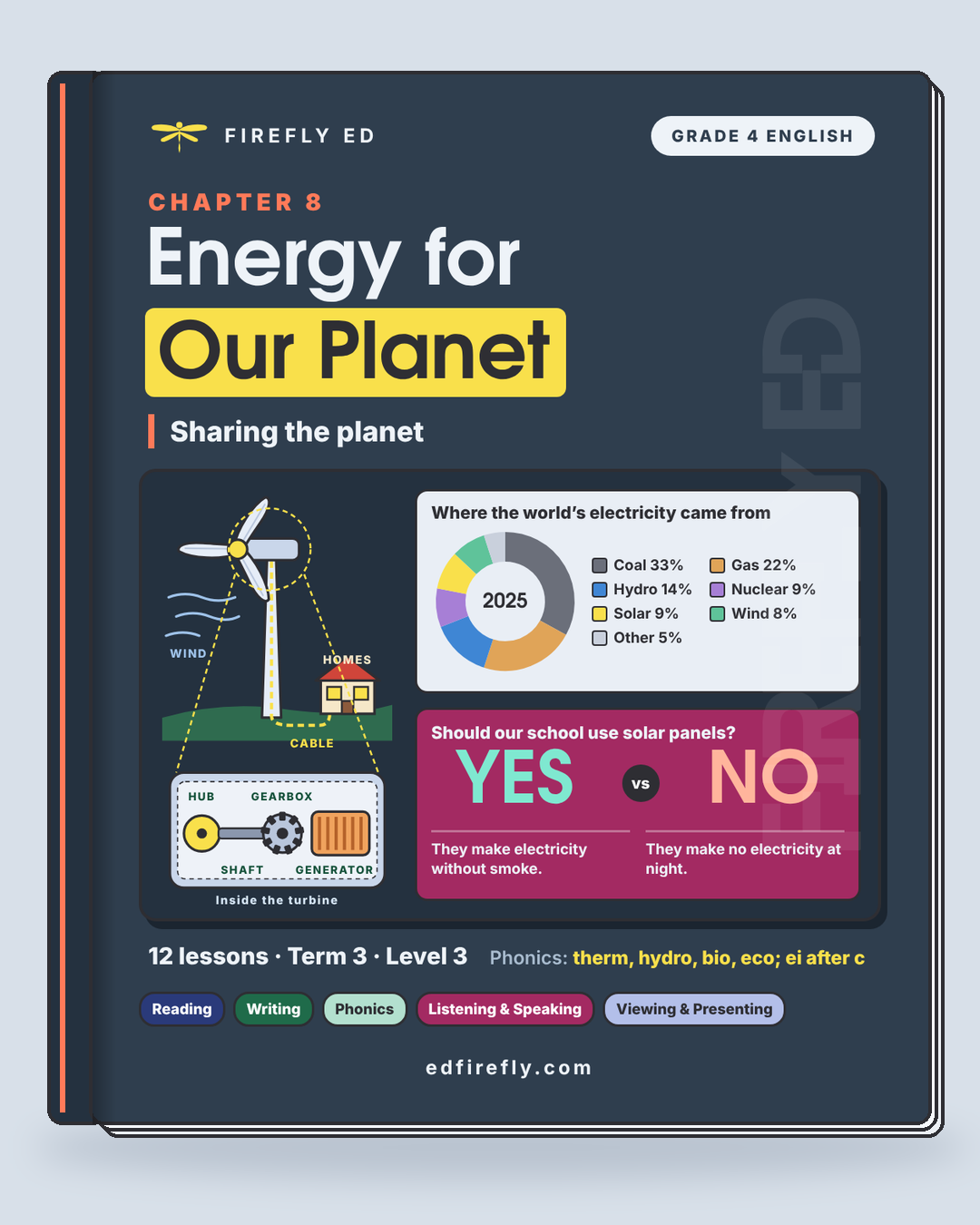
Chapters – Index | Next: Chapter 8: Energy for Our Planet →
© 2026 Firefly Ed. All rights reserved. This page may be printed for personal, home and classroom use. It may not be sold, shared online or reproduced for commercial use without written permission. edfirefly.com


Share your thoughts or ask something..