

Term 3 | Level 3 | Phonics focus: word roots from the sky, the verb endings -ate, -ise and -ify, and prefixes with hyphens
Chapter 7 – Journey Into Space | Chapters – Index
Lessons
This page has the two reading lessons of Chapter 7, Journey Into Space: Lessons 7.1 and 7.2. The chapter page has the chapter overview, the chapter review and the PDF download.
Tap a lesson to open it. Tap the lesson title again, or use the link at the end of the lesson, to close it.
Lesson 7.1: One Small Step: The First Moon Landing | Reading | About 20 minutes
Term 3 | Level 3
Goal
“I can explain the events of the first Moon landing in order, and say what happened and why.”
Words to know
astronaut, launch, lunar module, mission, orbit, sequence, time connective
Wonder
Think about this question before you start. Say your ideas. You will come back to it at the end of the lesson.
Why do you think people wanted to go to the Moon?
Let’s Learn
A history text tells us what happened in the past. It usually tells the events in the order they happened. This is called the sequence. Writers use dates and time connectives, such as first, next, a few hours later, then and finally, to show the order. They also explain why things happened.
One Small Step: The First Moon Landing
For thousands of years, people looked up at the Moon and wondered what it would be like to stand on it. In July 1969, three astronauts set out to find out.
Lift-off
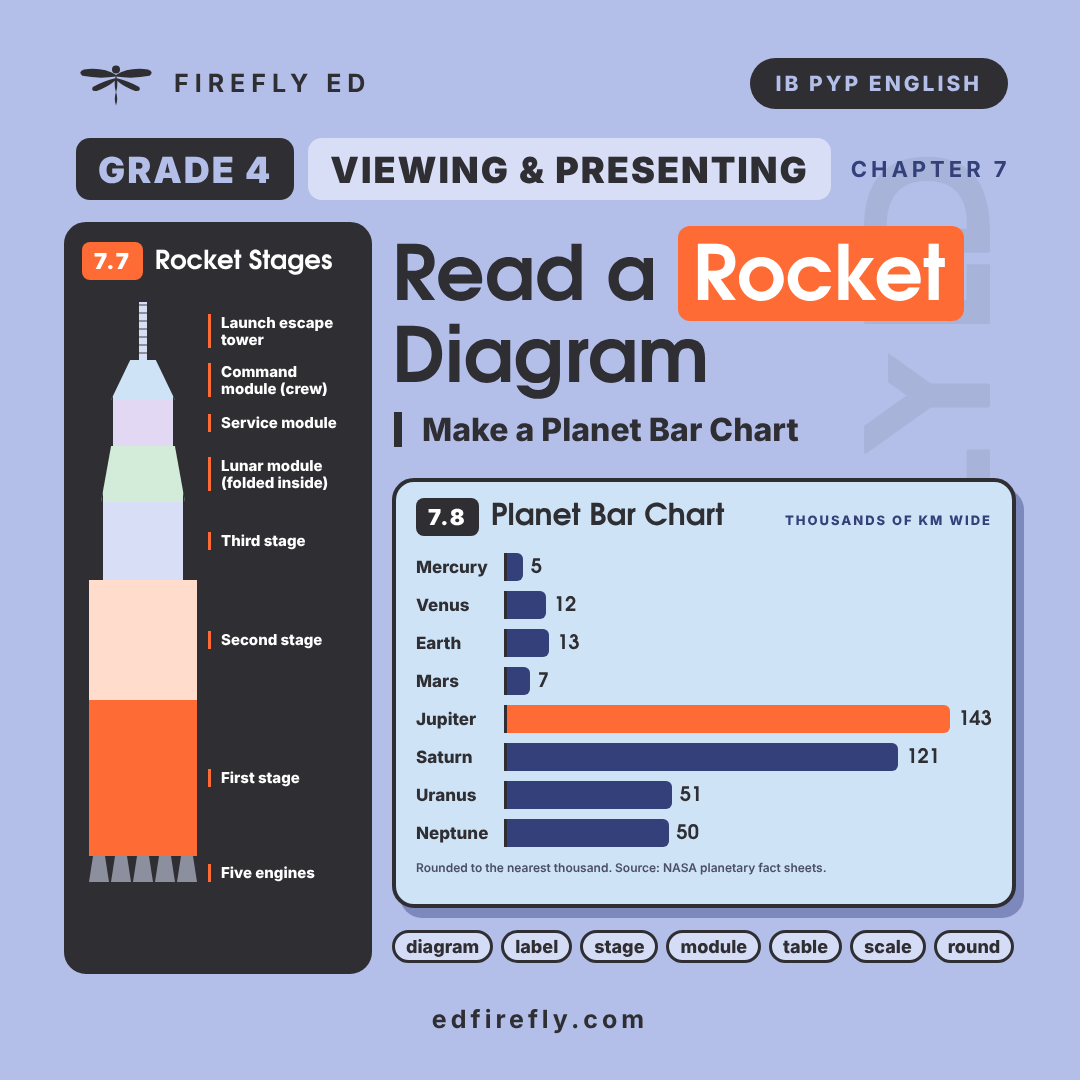
On 16 July 1969, a giant rocket called Saturn V stood on a launch pad in Florida, in the United States. It was about 110 metres tall, taller than a 30-storey building. At the top sat a small spacecraft with three astronauts inside: Neil Armstrong, Buzz Aldrin and Michael Collins. The engines roared, and the rocket rose slowly into the sky. As each part of the rocket used up its fuel, it dropped away, and the rest of the rocket flew on.
The journey
The astronauts travelled for three days. They ate, slept and checked their instruments in a cabin about the size of a car. On 19 July, they arrived at the Moon and began to circle it.
The landing
The next day, 20 July, Armstrong and Aldrin climbed into the lunar module, called Eagle. Collins stayed behind in the command module, Columbia, which kept circling the Moon. As Eagle came down, Armstrong saw that the computer was taking them towards a field of large rocks. He took control and flew the lander himself until he found a flat, safe place. Then he radioed to Earth: “The Eagle has landed.” The place was a dry, flat plain called the Sea of Tranquility.
The first steps
A few hours later, Armstrong climbed down the ladder. As he stepped onto the dusty ground, he said, “That’s one small step for a man, one giant leap for mankind.” About 20 minutes later, Aldrin joined him. Over the next two and a half hours, they collected rocks and soil, set up experiments, put up a flag and took photographs. Their boots left footprints in the fine grey dust. Because there is no wind on the Moon, those footprints may still be there today.
Coming home
Next, the two astronauts flew Eagle back up to Columbia, and all three crew members began the journey home. Finally, on 24 July, the spacecraft splashed down in the Pacific Ocean. The mission had lasted eight days.
About 400,000 people worked on the Moon missions, from engineers to the people who sewed the spacesuits. Since then, astronauts from other countries have travelled into space, and in 2026, the crew of Artemis II, including the Canadian astronaut Jeremy Hansen, flew around the Moon and travelled farther from Earth than anyone before them.
See How It’s Done
Now Try It
1. Which happened first: the splashdown or the first steps? ______________
2. Why did Armstrong fly Eagle himself?
__________________________________________________________________
Time To Practise
Name: ______________________
1. Put the events in order.
Number them from 1 to 6.
____ Aldrin joins Armstrong on the Moon. ____ Saturn V lifts off. ____ The spacecraft splashes down.
____ Eagle lands on the Sea of Tranquility. ____ The spacecraft begins to circle the Moon. ____ Armstrong steps onto the Moon.
2. Find the facts.
a) Who stayed in Columbia? ______________ b) How long did the mission last? ______________
c) Name two things the astronauts did on the Moon. ______________ ______________
3. Why did it happen?
a) Why did parts of the rocket drop away? ______________________________
b) Why may the footprints still be there today? ______________________________
4. Time connectives.
Find four words or phrases in the text that show when something happened.
______________ ______________ ______________ ______________
5. Explain it.
Explain what happened on 20 July in three sentences. Use first, then and a few hours later.
__________________________________________________________________
__________________________________________________________________
Reflect
Think about these questions. Talk about them with someone at home or at school.
1. Go back to the Wonder question: “Why do you think people wanted to go to the Moon?” What do you think now?
2. I was a thinker today when I ______________________________.
A thinker thinks carefully to work things out. For example: I was a thinker today when I used dates and time connectives to put events in order.
Take action: Ask an older family member what they know about the first Moon landing, and add one new fact to your timeline.
Next Steps
If this was easy, try: Write a diary entry as Michael Collins, circling the Moon alone while Armstrong and Aldrin are on the surface.
If this was hard, go back to: Let’s Learn. Read one section at a time. After each one, say in one sentence what happened.
Notes for Parents and Teachers
Show notes for parents and teachers
These notes cover this lesson only. How every lesson runs is explained in How to Use This Material.
Let’s Learn
Read Let’s Learn aloud together. Read the history text together, one section at a time.
Answer Key
Reveal Answers
Now Try It
1. the first steps 2. The computer was taking them towards a field of large rocks, so he flew it himself to find a flat, safe place.
1. Put the events in order
5 Aldrin joins Armstrong. 1 Saturn V lifts off. 6 The spacecraft splashes down. 3 Eagle lands. 2 The spacecraft begins to circle the Moon. 4 Armstrong steps onto the Moon.
2. Find the facts
a) Michael Collins b) eight days c) Any two of: collected rocks and soil, set up experiments, put up a flag, took photographs.
3. Why did it happen?
a) Each part had used up its fuel. b) There is no wind on the Moon to blow the dust.
4. Time connectives
Any four of: for thousands of years, in July 1969, on 16 July 1969, on 19 July, the next day, a few hours later, about 20 minutes later, over the next two and a half hours, next, finally, since then.
5. Explain it
Sample answer: First, Armstrong and Aldrin climbed into Eagle and flew down to the Moon. Then Armstrong steered around the rocks and landed on a flat plain. A few hours later, he climbed down the ladder and took the first step.
Reflect
2. Any real moment from the lesson that shows the learner was a thinker. Examples: “I was a thinker today when I used dates and time connectives to put events in order.” “I was a thinker today when I explained why an event happened.”
Lesson 7.2: Names From Myths: Planets, Rockets and Words | Reading | About 20 minutes
Term 3 | Level 3
Goal
“I can work out the meaning of words and names that come from myths, and explain the story behind them.”
Words to know
myth, allusion, god, goddess, hero, origin
Wonder
Think about this question before you start. Say your ideas. You will come back to it at the end of the lesson.
Why do you think scientists choose names from old stories?
Let’s Learn
A myth is a very old story about gods, goddesses or heroes. An allusion is a word or name that points to one of these stories. When we know the story, we can work out what the word means.
Names From Myths
Long ago, people in many parts of the world told myths: stories about gods, goddesses and heroes. Many of the names we use for things in the sky come from these stories.
The planets
The ancient Romans named the planets they could see after their gods. The fastest planet, which races around the Sun, is Mercury, named after the messenger of the gods, who wore wings on his sandals. The brightest planet, shining like a jewel in the evening sky, is Venus, the goddess of love and beauty. The red planet is Mars, the god of war, whose colour reminded people of fire and battle. The biggest planet of all is Jupiter, named after the king of the gods. Much later, when telescopes found more planets, the names continued: Neptune, the god of the sea, was a good name for a deep blue planet.
Missions and spacecraft
Space missions often borrow names from myths too. The first Moon landings were part of the Apollo programme, named after the Greek god of the Sun and light. The new missions to the Moon are called Artemis, after Apollo’s twin sister, the goddess of the Moon. China’s Moon missions are named Chang’e, after the goddess who, in a Chinese legend, flew to the Moon and lives there still. India’s Moon missions are called Chandrayaan, which means “Moon vehicle”, from Chandra, the Moon in Hindu stories.
Everyday words
Some myths are hidden inside words we use every day. When someone calls a job Herculean, they mean it is huge and very hard, like the twelve impossible tasks of the Greek hero Hercules. An echo is named after a nymph called Echo, who could only repeat the last words other people said. A book of maps is an atlas, after the giant Atlas, who held up the sky on his shoulders. Your breakfast cereal is named after Ceres, the Roman goddess of farming and grain.
When a word points to a story or a character from long ago, we call it an allusion. If you know the story, you understand the word better.
See How It’s Done
Now Try It
1. Why is the red planet named after the god of war? ______________________________
2. What does Chandrayaan mean? ______________________________
Time To Practise
Name: ______________________
1. Match the name to the myth.
Draw a line from each name to its story.
Mercury • • the goddess of the Moon
Neptune • • the messenger with winged sandals
Artemis • • the giant who held up the sky
Atlas • • the god of the sea
2. Why does the name fit?
a) Jupiter ______________________________ b) Venus ______________________________
3. Use the allusion.
Explain what each underlined word means in the sentence.
a) Moving all the books to the new library was a Herculean task. ______________________________
b) My shout made an echo in the empty hall. ______________________________
c) We looked up Peru in the atlas. ______________________________
4. Find the story.
Which goddess gave her name to China’s Moon missions, and what is her story?
__________________________________________________________________
5. Name it.
Invent a name for a new spacecraft going to Mars. Choose a character from any myth you know, and explain why the name fits.
__________________________________________________________________
Reflect
Think about these questions. Talk about them with someone at home or at school.
1. Go back to the Wonder question: “Why do you think scientists choose names from old stories?” What do you think now?
2. I was an inquirer today when I ______________________________.
An inquirer asks questions and finds things out. For example: I was an inquirer today when I looked for a story inside a word.
Take action: Find one more word that comes from a myth, such as panic, titanic or January, and tell your family its story.
Next Steps
If this was easy, try: Write a short myth of your own that explains how a planet or star got its name.
If this was hard, go back to: Let’s Learn. Read one paragraph at a time. For each name, say who it was in the myth.
Notes for Parents and Teachers
Show notes for parents and teachers
These notes cover this lesson only. How every lesson runs is explained in How to Use This Material.
Let’s Learn
Read Let’s Learn aloud together. Read the article together.
Answer Key
Reveal Answers
Now Try It
1. Its red colour reminded people of fire and battle. 2. Moon vehicle
1. Match
Mercury: the messenger with winged sandals. Neptune: the god of the sea. Artemis: the goddess of the Moon. Atlas: the giant who held up the sky.
2. Why does the name fit?
a) Jupiter was the king of the gods, and it is the biggest planet. b) Venus was the goddess of beauty, and it is the brightest, most beautiful planet in the evening sky.
3. Use the allusion
a) a huge, very hard task b) a sound that bounced back c) a book of maps
4. Chang’e, the goddess who flew to the Moon in a Chinese legend and lives there still.
5. Answers will vary. Look for: a character from a myth and a reason that links the story to the mission.
Reflect
2. Any real moment from the lesson that shows the learner was an inquirer. Examples: “I was an inquirer today when I looked for a story inside a word.” “I was an inquirer today when I checked my meaning in the sentence.”
For Teachers: IB Details
Show IB and curriculum details
IB theme: How the world works. This theme is about the natural world and its laws, how people and nature affect each other, and how people use science to understand the world.
Central idea: People use science and teamwork to explore space, and what they learn there helps us understand Earth.
| Lesson | Title | Strand | Key concept |
|---|---|---|---|
| 7.1 | One Small Step: The First Moon Landing | Reading | Change |
| 7.2 | Names From Myths: Planets, Rockets and Words | Reading | Connection |
Each lesson also matches the national curriculum for England (Year 4) and the US Common Core (Grade 4). The Grade 4 Curriculum Map lists the full standards for every lesson.
← Back to Chapter 7 – Journey Into Space | Chapters – Index
© 2026 Firefly Ed. All rights reserved. This page may be printed for personal, home and classroom use. It may not be sold, shared online or reproduced for commercial use without written permission. edfirefly.com


Share your thoughts or ask something..