
Term 3 | Level 3 | Phonics focus: word roots from the sky, the verb endings -ate, -ise and -ify, and prefixes with hyphens
Chapter 7 – Journey Into Space | Chapters – Index
Lessons
This page has the three phonics lessons of Chapter 7, Journey Into Space: Lessons 7.9, 7.10 and 7.11. The chapter page has the chapter overview, the chapter review and the PDF download.
Tap a lesson to open it. Tap the lesson title again, or use the link at the end of the lesson, to close it.
Lesson 7.9: Roots From the Sky: astro, lunar and solar | Phonics | About 20 minutes
Term 3 | Level 3
Goal
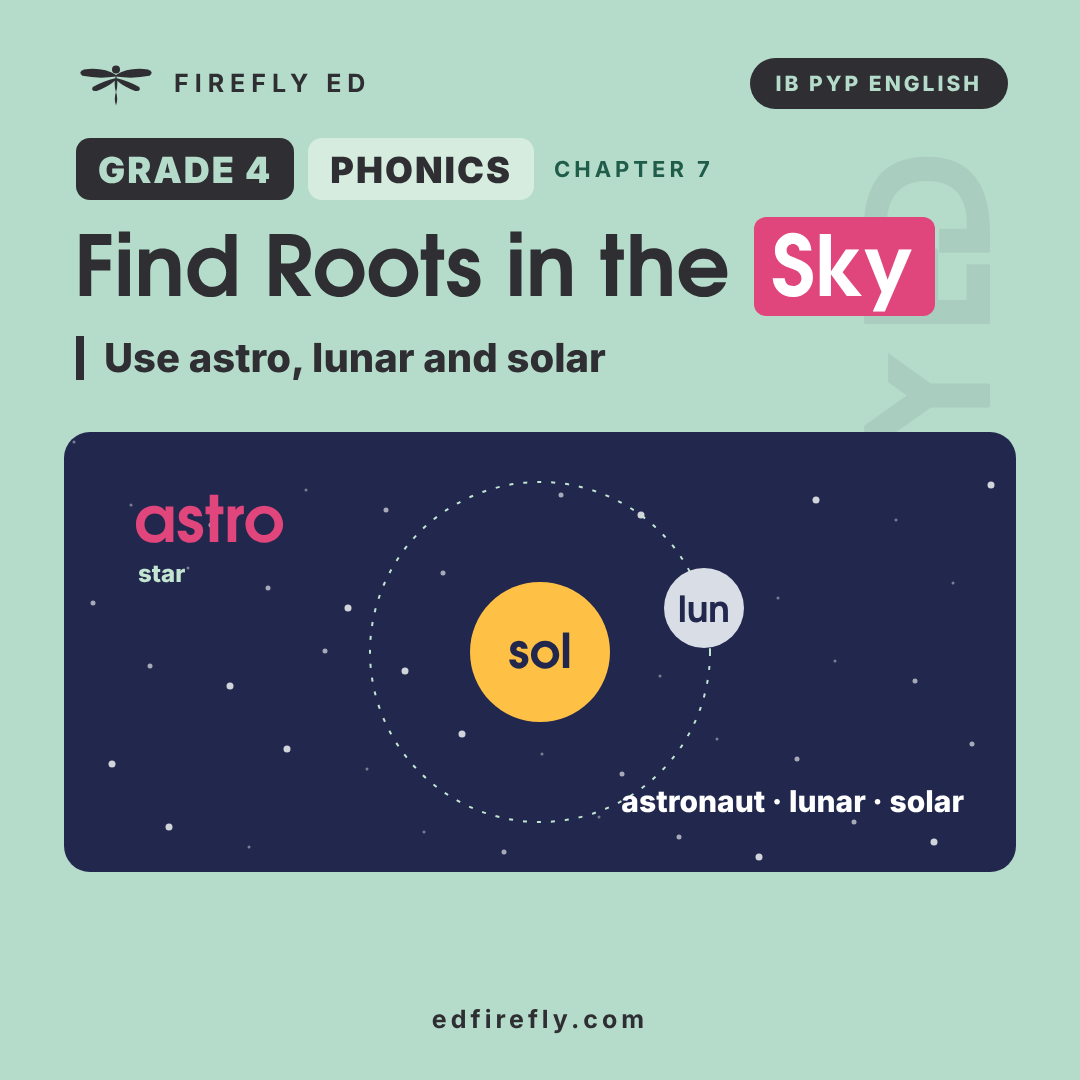
“I can use the roots astro, lun and sol to read, spell and work out the meaning of words.”
Words to know
root, Greek, Latin, astro, lunar, solar
Wonder
Think about this question before you start. Say your ideas. You will come back to it at the end of the lesson.
What do the words astronaut and asteroid have in common?
Let’s Learn
A root is the main part of a word that carries its meaning. Many space words have roots from Greek and Latin, the languages of ancient Greece and Rome. If you know the root, you can often work out a word you have never seen.
Spelling tip: the root keeps its spelling inside a longer word. Astro is always spelled a-s-t-r-o, even when we say it quickly in astronomy.
See How It’s Done
Now Try It
1. Underline the root: astronomy lunar solar
2. What do you think a lunar month is? ______________________________
Time To Practise
Name: ______________________
1. Find the root.
Write the root and its meaning.
astrology ______ ______ solarium ______ ______ lunatic ______ ______ asterisk ______ ______
2. Choose the word.
astronaut astronomer lunar solar asteroid
a) The ______________ studied the planets through a telescope.
b) A ______________ eclipse happens when the Earth’s shadow falls on the Moon.
c) The ______________ floated outside the space station.
d) An ______________ is a rock that travels around the Sun.
e) Our ______________ panels make electricity on sunny days.
3. Word sums.
astro + naut = ______________ para + sol = ______________ aster + oid = ______________
4. Work it out.
The root naut means sailor. What might an aquanaut do? (Hint: aqua means water.)
__________________________________________________________________
5. Write from dictation.
Listen as an adult reads a sentence aloud. Write it.
__________________________________________________________________
Reflect
Think about these questions. Talk about them with someone at home or at school.
1. Go back to the Wonder question: “What do the words astronaut and asteroid have in common?” What do you think now?
2. I was an inquirer today when I ______________________________.
An inquirer asks questions and finds things out. For example: I was an inquirer today when I used a root to guess what a new word means.
Take action: Look for sky roots on food labels, signs and in books at home, such as solar, lunar or asterisk.
Next Steps
If this was easy, try: Invent three new space words using astro, lun and sol, and write a definition for each.
If this was hard, go back to: Let’s Learn. Say each root and its meaning three times. Then find it in each word on the cards.
Notes for Parents and Teachers
Show notes for parents and teachers
These notes cover this lesson only. How every lesson runs is explained in How to Use This Material.
Let’s Learn
Read Let’s Learn aloud together. Say each word together and point to the root.
Time To Practise
- Task 5: Read the sentence from the Answer Key aloud slowly. The learner writes it.
Answer Key
Reveal Answers
Now Try It
1. astronomy, lunar, solar 2. Sample answer: a month measured by the Moon, from one new moon to the next.
1. Find the root
astrology: astro, star; solarium: sol, Sun; lunatic: lun, Moon; asterisk: aster, star (it is shaped like a star)
2. Choose the word
a) astronomer b) lunar c) astronaut d) asteroid e) solar
3. Word sums
astronaut, parasol, asteroid
4. Sample answer: An aquanaut is a water sailor: someone who explores or works under the sea.
5. Write from dictation
Dictation sentence: The astronomer saw an asteroid during the lunar eclipse.
Reflect
2. Any real moment from the lesson that shows the learner was an inquirer. Examples: “I was an inquirer today when I used a root to guess what a new word means.” “I was an inquirer today when I checked my guess in a dictionary.”
Lesson 7.10: Verb Endings: -ate, -ise and -ify | Phonics | About 20 minutes
Term 3 | Level 3
Goal
“I can turn nouns and adjectives into verbs by adding -ate, -ise or -ify, and spell them correctly.”
Words to know
suffix, verb, noun, adjective, -ate, -ise, -ify
Wonder
Think about this question before you start. Say your ideas. You will come back to it at the end of the lesson.
How can the word solid become an action?
Let’s Learn
The endings -ate, -ise and -ify turn a noun or an adjective into a verb, a doing word. Solid is an adjective; solidify is a verb: The lava will solidify as it cools.
Spelling rules: If the word ends in y or e, drop it before adding the ending: memory → memorise, active → activate. Words ending in -le drop just the e before -ify: simple → simplify. In British English, we usually write -ise; American English uses -ize (visualize).
See How It’s Done
Now Try It
1. Add -ify: solid → ______________
2. Add -ise: memory → ______________
Time To Practise
Name: ______________________
1. Make the verb.
Add -ate, -ise or -ify.
pure ______________ magnet ______________ class ______________ origin ______________ real ______________
2. Drop the e or y.
active + ate ______________ memory + ise ______________ apology + ise ______________ simple + ify ______________
3. Choose the verb.
rotate separate visualise magnify solidify
a) The first stage will ______________ from the rocket.
b) The Earth takes 24 hours to ______________ once.
c) A telescope can ______________ the craters on the Moon.
d) Close your eyes and ______________ the surface of Mars.
e) When lava cools, it starts to ______________.
4. Write a sentence.
Write a space sentence using one -ate verb and one -ify verb.
__________________________________________________________________
5. Write from dictation.
Listen as an adult reads a sentence aloud. Write it.
__________________________________________________________________
Reflect
Think about these questions. Talk about them with someone at home or at school.
1. Go back to the Wonder question: “How can the word solid become an action?” What do you think now?
2. I was reflective today when I ______________________________.
Being reflective means looking back at your work and thinking how to make it better. For example: I was reflective today when I checked whether to drop the e or y.
Take action: Explain the British -ise and American -ize spellings to someone at home, and look for both in books or online.
Next Steps
If this was easy, try: Write a short set of instructions for building a model rocket, using five -ate, -ise or -ify verbs.
If this was hard, go back to: Let’s Learn. Read each word sum aloud. Say what was dropped, if anything, before the ending was added.
Notes for Parents and Teachers
Show notes for parents and teachers
These notes cover this lesson only. How every lesson runs is explained in How to Use This Material.
Let’s Learn
Read Let’s Learn aloud together. Say each word together and clap its syllables.
Time To Practise
- Task 5: Read the sentence from the Answer Key aloud slowly. The learner writes it.
Answer Key
Reveal Answers
Now Try It
1. solidify 2. memorise
1. Make the verb
purify, magnetise, classify, originate, realise
2. Drop the e or y
activate, memorise, apologise, simplify
3. Choose the verb
a) separate b) rotate c) magnify d) visualise e) solidify
4. Sample answer: When the astronauts activate the camera, it will magnify the craters.
5. Write from dictation
Dictation sentence: Try to memorise the planets and visualise how they rotate around the Sun.
Reflect
2. Any real moment from the lesson that shows the learner was reflective. Examples: “I was reflective today when I checked whether to drop the e or y.” “I was reflective today when I chose the right ending by saying the word aloud.”
Lesson 7.11: Prefixes and Hyphens, and Tricky Words | Phonics | About 20 minutes
Term 3 | Level 3
Goal
“I can decide when a prefix needs a hyphen, and spell six tricky words using memory aids.”
Words to know
prefix, hyphen, vowel, root word, tricky word, memory aid
Wonder
Think about this question before you start. Say your ideas. You will come back to it at the end of the lesson.
Why might a hyphen change what a word means?
Let’s Learn
A prefix is added to the start of a word to change its meaning: re- means again, co- means together. Usually we join a prefix straight on: rebuild, cosign. Sometimes we need a hyphen (-) between the prefix and the word.
These six words are often spelled wrongly. The tricky letters are in pink. Use the memory aid, then look, say, cover, write and check.
See How It’s Done
Now Try It
1. Add the prefix and a hyphen if needed: co + operate ______________ re + build ______________
2. In which tricky word does y say i? ______________
Time To Practise
Name: ______________________
1. Hyphen or no hyphen?
re + enter ______________ re + turn ______________ co + pilot ______________ pre + existing ______________ self + control ______________ re + write ______________
2. Which meaning?
a) After the long mission, the crew needed time to (recover / re-cover).
b) The old book was torn, so Mia had to (recover / re-cover) it.
c) Please (resign / re-sign) the form, because your first signature was smudged.
3. Tricky words.
Look, say, cover, write, check. Write each word twice.
equipment ______________ ______________ especially ______________ ______________
curiosity ______________ ______________ existence ______________ ______________
system ______________ ______________ sufficient ______________ ______________
4. Fix the spelling.
a) The astronauts checked their equiptment. ______________
b) The rover called Curiosity was named after our curiousity. ______________
c) The solar sistem has eight planets. ______________
5. Write from dictation.
Listen as an adult reads a sentence aloud. Write it.
__________________________________________________________________
Reflect
Think about these questions. Talk about them with someone at home or at school.
1. Go back to the Wonder question: “Why might a hyphen change what a word means?” What do you think now?
2. I was reflective today when I ______________________________.
Being reflective means looking back at your work and thinking how to make it better. For example: I was reflective today when I checked whether a hyphen changed the meaning.
Take action: Look for hyphenated words in a newspaper or a book at home. Sort them into the three rules.
Next Steps
If this was easy, try: Write a short report about a spacewalk that uses three hyphenated words and four of the tricky words.
If this was hard, go back to: Let’s Learn. Say each prefix and word separately, then together. Listen for two vowels meeting.
Notes for Parents and Teachers
Show notes for parents and teachers
These notes cover this lesson only. How every lesson runs is explained in How to Use This Material.
Let’s Learn
Read Let’s Learn aloud together. Look at where the hyphen goes in each word.
Time To Practise
- Task 5: Read the sentence from the Answer Key aloud slowly. The learner writes it.
Answer Key
Reveal Answers
Now Try It
1. co-operate, rebuild 2. system
1. Hyphen or no hyphen?
re-enter, return, co-pilot, pre-existing, self-control, rewrite
2. Which meaning?
a) recover b) re-cover c) re-sign
3. Look for: each word spelled correctly twice.
4. Fix the spelling
a) equipment b) curiosity c) system
5. Write from dictation
Dictation sentence: The co-pilot checked that the equipment had sufficient power, especially the system that helps the capsule re-enter the atmosphere.
Reflect
2. Any real moment from the lesson that shows the learner was reflective. Examples: “I was reflective today when I checked whether a hyphen changed the meaning.” “I was reflective today when I used a memory aid for a tricky word.”
For Teachers: IB Details
Show IB and curriculum details
IB theme: How the world works. This theme is about the natural world and its laws, how people and nature affect each other, and how people use science to understand the world.
Central idea: People use science and teamwork to explore space, and what they learn there helps us understand Earth.
| Lesson | Title | Strand | Key concept |
|---|---|---|---|
| 7.9 | Roots From the Sky: astro, lunar and solar | Reading and spelling | Connection |
| 7.10 | Verb Endings: -ate, -ise and -ify | Reading and spelling | Function |
| 7.11 | Prefixes and Hyphens, and Tricky Words | Reading and spelling | Connection |
Each lesson also matches the national curriculum for England (Year 4) and the US Common Core (Grade 4). The Grade 4 Curriculum Map lists the full standards for every lesson.
← Back to Chapter 7 – Journey Into Space | Chapters – Index
© 2026 Firefly Ed. All rights reserved. This page may be printed for personal, home and classroom use. It may not be sold, shared online or reproduced for commercial use without written permission. edfirefly.com




Share your thoughts or ask something..