
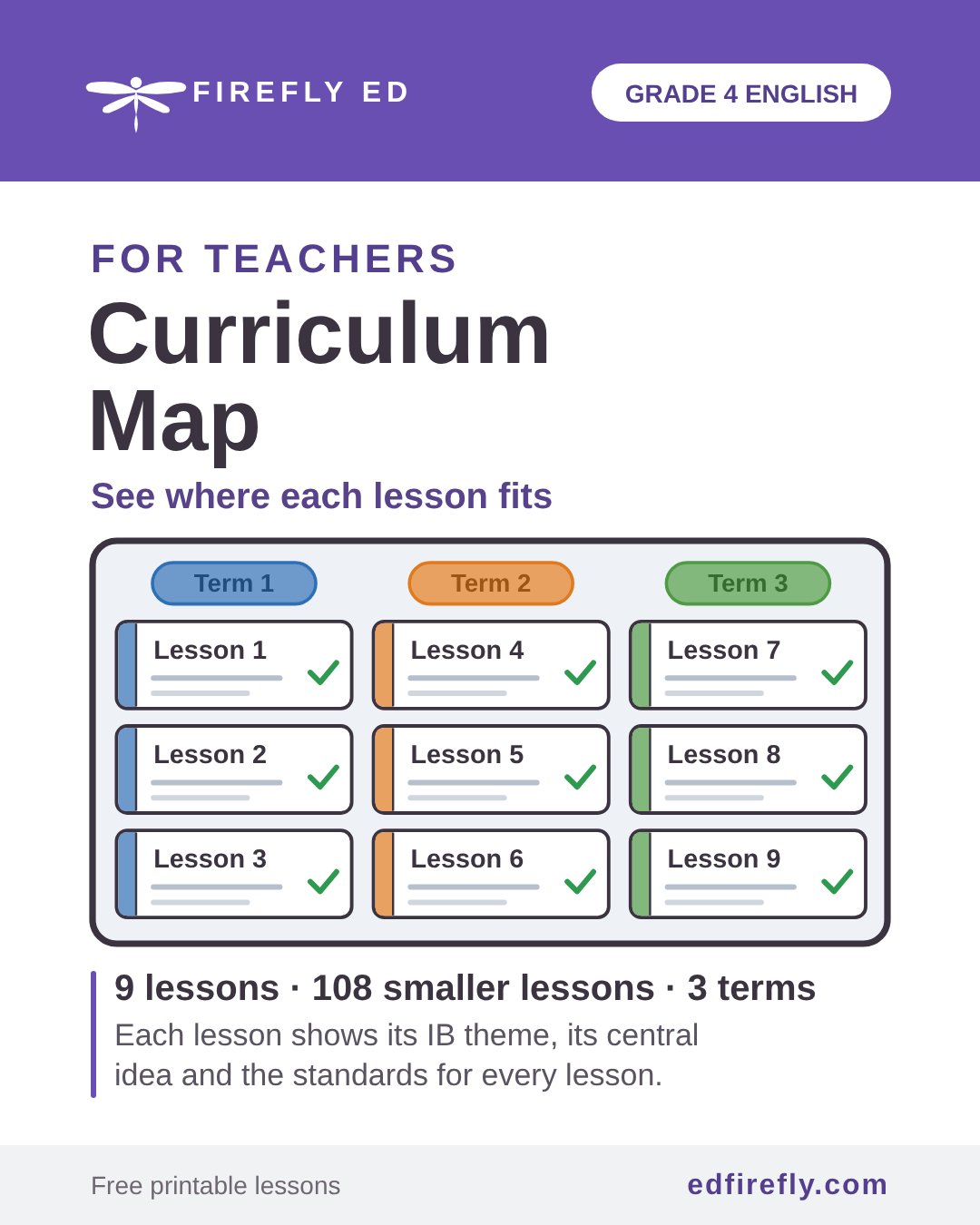
Guide for teachers | Curriculum links for the whole year.
The Grade 4 English lessons follow three curricula: the IB Primary Years Programme (PYP), the national curriculum for England (Year 4) and the US Common Core (Grade 4). This page shows where each lesson fits. Each lesson page keeps a short summary, and the full list of standards for every lesson is here.
Grade 4 English Lessons Mapped to the IB PYP, England and the Common Core
The year has 9 lessons, three in each term. Each lesson is one IB unit of inquiry with 12 smaller lessons, such as Lessons 1.1 to 1.12. A review at the end of each term covers its three lessons.
The year at a glance
| Term | Lesson | IB theme | Central idea |
|---|---|---|---|
| 1 | Lesson 1: Rights and Responsibilities | Who we are | Every child has rights, and everyone shares the responsibility to respect them. |
| 1 | Lesson 2: Explorers and Voyages | Where we are in place and time | Explorers travel for different reasons, and their journeys change what people know about the world. |
| 1 | Lesson 3: Poems and Plays | How we express ourselves | Poets and playwrights choose words, rhythm and structure to share feelings and ideas. |
| 2 | Lesson 4: Our Changing Earth | How the world works | Forces inside the Earth and on its surface change the land, and people can prepare for those changes. |
| 2 | Lesson 5: Choosing and Leading | How we organize ourselves | Groups make fair decisions in different ways, and leaders have responsibilities to the people they lead. |
| 2 | Lesson 6: News, Adverts and Media | How we express ourselves | People use words, pictures and sound to inform, persuade and entertain, and we can learn to judge what we read and see. |
| 3 | Lesson 7: Journey Into Space | How the world works | People use science and teamwork to explore space, and what they learn there helps us understand Earth. |
| 3 | Lesson 8: Energy for Our Planet | Sharing the planet | People get energy from different sources, and the choices we make about energy affect the planet and everyone who shares it. |
| 3 | Lesson 9: Protecting Wildlife | Sharing the planet | Human actions put many animals in danger, and people around the world work to protect them. |
The term reviews are Term 1 Review, Term 2 Review and Term 3 Review.
How each lesson is built
The IB PYP divides language into three strands. Oral language covers listening and speaking. Visual language covers pictures, charts, maps and signs. Written language covers reading and writing. Each strand has one side for understanding and one side for sharing ideas. Every lesson covers all three strands in the same order.
| Lessons | What the learner does | IB strand |
|---|---|---|
| 1 and 2 | Reads a text and answers questions about it. | Written language: reading |
| 3 and 4 | Plans, writes and checks a piece of writing. | Written language: writing |
| 5 and 6 | Listens, speaks, discusses and presents. | Oral language: listening and speaking |
| 7 and 8 | Reads a chart, map or picture, and then makes one. | Visual language: viewing and presenting |
| 9 to 11 | Learns word roots, prefixes, suffixes, spelling rules and tricky words. | Written language: reading and spelling |
| 12 | Reviews the whole lesson. | All strands |
Lesson by lesson
Each lesson shows its IB theme, central idea, key concepts and lines of inquiry. Open the box under a lesson to see the standards that each smaller lesson covers.
Lesson 1: Rights and Responsibilities
IB theme: Who we are. It covers our bodies and feelings, our families and friends, where we belong, our rights and responsibilities, and how we learn and grow.
Central idea: Every child has rights, and everyone shares the responsibility to respect them.
Key concepts: Responsibility (what is our responsibility?), Connection (how is it linked to other things?), Perspective (what are the points of view?). Related concepts: rights, fairness, opinion.
Lines of inquiry:
- How rights and responsibilities are connected
- What rights every child has
- How we listen to others and speak up for rights
Show the standards for Lessons 1.1 to 1.12
Lesson 1.1: A Library Card for Everyone: A Story in the First Person
Reading. Key concept: Perspective. Learner profile: Caring. Approach to learning: thinking skills.
IB PYP, Phase 4
- Reading: understand and respond to the ideas, feelings and attitudes expressed in various texts, showing empathy for characters
- Reading, Phase 4 (conceptual understanding): Reading and thinking work together to enable us to make meaning.
England, Year 4
- Draw inferences such as inferring characters’ feelings, thoughts and motives from their actions, and justify inferences with evidence
- Check that the text makes sense to them, discussing their understanding and explaining the meaning of words in context
Common Core, Grade 4
- RL.4.6: Compare and contrast the point of view from which different stories are narrated, including the difference between first- and third-person narrations
- RL.4.1: Refer to details and examples in a text when explaining what the text says explicitly and when drawing inferences from the text
- L.4.4a: Use context (e.g., definitions, examples, or restatements in text) as a clue to the meaning of a word or phrase
Lesson 1.2: What Are Children’s Rights? An Information Text
Reading. Key concept: Form. Learner profile: Inquirers. Approach to learning: research skills.
IB PYP, Phase 4
- Reading, Phase 4 (conceptual understanding): Identifying the main ideas in the text helps us to understand what is important.
- Reading: distinguish between fiction and non-fiction and select books appropriate to specific purposes
England, Year 4
Common Core, Grade 4
- RI.4.2: Determine the main idea of a text and explain how it is supported by key details; summarize the text
- RI.4.1: Refer to details and examples in a text when explaining what the text says explicitly and when drawing inferences from the text
Lesson 1.3: Complete Sentences: Fragments and Run-ons
Writing. Key concept: Form. Learner profile: Communicators. Approach to learning: communication skills.
IB PYP, Phase 4
- Writing, Phase 4 (conceptual understanding): Rereading and editing our own writing enables us to express what we want to say more clearly.
- Writing, Phase 4 (conceptual understanding): Writing and thinking work together to enable us to express ideas and convey meaning.
England, Year 4
- Assess the effectiveness of their own and others’ writing and suggest improvements
- Proof-read for spelling and punctuation errors
Common Core, Grade 4
- L.4.1f: Produce complete sentences, recognizing and correcting inappropriate fragments and run-ons
- W.4.5: With guidance and support from peers and adults, develop and strengthen writing as needed by planning, revising, editing, rewriting, or trying a new approach
Lesson 1.4: Write an Opinion: The Right I Would Protect First
Writing. Key concept: Perspective. Learner profile: Thinkers. Approach to learning: thinking skills.
IB PYP, Phase 4
- Writing, Phase 4 (conceptual understanding): The way we structure and organize our writing helps others to understand and appreciate it.
- Writing: write for a range of purposes, both creative and informative, using different types of structures and styles according to the purpose of the writing
England, Year 4
Common Core, Grade 4
- W.4.1: Write opinion pieces on topics or texts, supporting a point of view with reasons and information
- W.4.1b: Provide reasons that are supported by facts and details
- W.4.1c: Link opinion and reasons using words and phrases (e.g., for instance, in order to, in addition)
- W.4.1d: Provide a concluding statement or section related to the opinion presented
Lesson 1.5: Come Prepared: Rules and Roles for a Discussion
Listening and speaking. Key concept: Responsibility. Learner profile: Principled. Approach to learning: social skills.
IB PYP, Phase 4
- Oral language: participate appropriately as listener and speaker, in discussions, conversations, debates and group presentations
- Oral language: generate, develop and modify ideas and opinions through discussion
England, Year 4
- Maintain attention and participate actively in collaborative conversations, staying on topic and initiating and responding to comments
- Consider and evaluate different viewpoints, attending to and building on the contributions of others
Common Core, Grade 4
- SL.4.1a: Come to discussions prepared, having read or studied required material; explicitly draw on that preparation and other information known about the topic to explore ideas under discussion
- SL.4.1b: Follow agreed-upon rules for discussions and carry out assigned roles
Lesson 1.6: Ask and Follow Up: Rights and Responsibilities at School
Listening and speaking. Key concept: Connection. Learner profile: Open-minded. Approach to learning: communication skills.
IB PYP, Phase 4
- Oral language: listen and respond appropriately to instructions, questions and explanations
- Oral language, Phase 4 (conceptual understanding): Taking time to reflect on what we hear and say helps us to make informed judgments and form new opinions.
England, Year 4
- Ask relevant questions to extend their understanding and knowledge
- Listen and respond appropriately to adults and their peers
Common Core, Grade 4
- SL.4.1c: Pose and respond to specific questions to clarify or follow up on information, and make comments that contribute to the discussion and link to the remarks of others
- SL.4.3: Identify the reasons and evidence a speaker provides to support particular points
Lesson 1.7: Read a Chart: A Right and Its Responsibility
Viewing. Key concept: Connection. Learner profile: Knowledgeable. Approach to learning: research skills.
IB PYP, Phase 4
- Visual language: view, respond to and describe visual information, communicating understanding in oral, written and visual form
- Visual language, Phase 4 (conceptual understanding): Interpreting visual texts involves making an informed judgment about the intention of the message.
England, Year 4
Common Core, Grade 4
- RI.4.7: Interpret information presented visually, orally, or quantitatively (e.g., in charts, graphs, diagrams, time lines, animations, or interactive elements on Web pages) and explain how the information contributes to an understanding of the text in which it appears
- SL.4.2: Paraphrase portions of a text read aloud or information presented in diverse media and formats, including visually, quantitatively, and orally
Lesson 1.8: Design a Poster for a Right
Presenting. Key concept: Function. Learner profile: Risk-takers. Approach to learning: communication skills.
IB PYP, Phase 4
- Visual language: understand and explain how visual effects can be used to reflect a particular context
- Visual language, Phase 4 (conceptual understanding): Visual texts have the power to influence thinking and behaviour.
England, Year 4
Common Core, Grade 4
- SL.4.5: Add audio recordings and visual displays to presentations when appropriate to enhance the development of main ideas or themes
- SL.4.4: Report on a topic or text, tell a story, or recount an experience in an organized manner, using appropriate facts and relevant, descriptive details to support main ideas or themes; speak clearly at an understandable pace
Lesson 1.9: Syllables: Dividing Words in the Middle
Reading and spelling. Key concept: Form. Learner profile: Thinkers. Approach to learning: thinking skills.
IB PYP
- Written language, Phase 4 (conceptual understanding): Checking, rereading and correcting our own reading as we go enable us to read new and more complex texts.
- Written language, Phase 4 (conceptual understanding): Rereading and editing our own writing enables us to express what we want to say more clearly.
England, Year 4
- Write from memory simple sentences, dictated by the teacher, that include words and punctuation taught so far
Common Core, Grade 4
- RF.4.3a: Use combined knowledge of all letter-sound correspondences, syllabication patterns, and morphology (e.g., roots and affixes) to read accurately unfamiliar multisyllabic words in context and out of context
- L.4.2d: Spell grade-appropriate words correctly, consulting references as needed
Lesson 1.10: Syllables: Open and Closed
Reading and spelling. Key concept: Form. Learner profile: Inquirers. Approach to learning: thinking skills.
IB PYP
- Written language, Phase 4 (conceptual understanding): Checking, rereading and correcting our own reading as we go enable us to read new and more complex texts.
- Written language, Phase 4 (conceptual understanding): Reading and thinking work together to enable us to make meaning.
England, Year 4
- Write from memory simple sentences, dictated by the teacher, that include words and punctuation taught so far
Common Core, Grade 4
- RF.4.3a: Use combined knowledge of all letter-sound correspondences, syllabication patterns, and morphology (e.g., roots and affixes) to read accurately unfamiliar multisyllabic words in context and out of context
- L.4.2d: Spell grade-appropriate words correctly, consulting references as needed
Lesson 1.11: Consonant-le Endings, and Tricky Words
Reading and spelling. Key concept: Form. Learner profile: Knowledgeable. Approach to learning: self-management skills.
IB PYP
- Written language, Phase 4 (conceptual understanding): Rereading and editing our own writing enables us to express what we want to say more clearly.
- Written language, Phase 4 (conceptual understanding): Checking, rereading and correcting our own reading as we go enable us to read new and more complex texts.
England, Year 4
Common Core, Grade 4
- RF.4.3a: Use combined knowledge of all letter-sound correspondences, syllabication patterns, and morphology (e.g., roots and affixes) to read accurately unfamiliar multisyllabic words in context and out of context
- L.4.2d: Spell grade-appropriate words correctly, consulting references as needed
Lesson 1.12: Lesson 1 Review
All strands. Key concept: Responsibility, Connection and Perspective. Learner profile: Reflective. Approach to learning: self-management skills.
This review checks the outcomes from Lessons 1.1 to 1.11.
IB PYP, Phase 4
- Reading, Phase 4 (conceptual understanding): Identifying the main ideas in the text helps us to understand what is important.
- Writing, Phase 4 (conceptual understanding): The way we structure and organize our writing helps others to understand and appreciate it.
- Oral language, Phase 4 (conceptual understanding): Thinking about the perspective of our audience helps us to communicate more effectively and appropriately.
- Visual language, Phase 4 (conceptual understanding): Visual texts have the power to influence thinking and behaviour.
England, Year 4
- Identify main ideas drawn from more than one paragraph and summarise these
- Ask relevant questions to extend their understanding and knowledge
- Proof-read for spelling and punctuation errors
Common Core, Grade 4
- RL.4.6: Compare and contrast the point of view from which different stories are narrated, including the difference between first- and third-person narrations
- RI.4.2: Determine the main idea of a text and explain how it is supported by key details
- L.4.1f: Produce complete sentences, recognizing and correcting inappropriate fragments and run-ons
- RI.4.7: Interpret information presented visually, orally, or quantitatively (e.g., in charts, graphs, diagrams, time lines, animations, or interactive elements on Web pages)
- RF.4.3a: Use combined knowledge of all letter-sound correspondences, syllabication patterns, and morphology (e.g., roots and affixes) to read accurately unfamiliar multisyllabic words in context and out of context
- L.4.2d: Spell grade-appropriate words correctly, consulting references as needed
Lesson 2: Explorers and Voyages
IB theme: Where we are in place and time. This theme is about when and where things happen, how people lived in the past, and how discoveries and journeys have shaped the world.
Central idea: Explorers travel for different reasons, and their journeys change what people know about the world.
Key concepts: Change (how is it changing?), Causation (why is it like it is?), Perspective (what are the points of view?). Related concepts: exploration, navigation, evidence.
Lines of inquiry:
- How explorers find their way
- How journeys change what people know about the world
- Why people set out to explore
Show the standards for Lessons 2.1 to 2.12
Lesson 2.1: Sailing by the Stars: Polynesian Wayfinders
Reading. Key concept: Causation. Learner profile: Knowledgeable. Approach to learning: research skills.
IB PYP, Phase 4
- Reading: understand and respond to the ideas, feelings and attitudes expressed in various texts, showing empathy for characters
- Reading, Phase 4 (conceptual understanding): Identifying the main ideas in the text helps us to understand what is important.
England, Year 4
- Retrieve and record information from non-fiction
- Identify main ideas drawn from more than one paragraph and summarise these
Common Core, Grade 4
- RI.4.3: Explain events, procedures, ideas, or concepts in a historical, scientific, or technical text, including what happened and why, based on specific information in the text
- RI.4.5: Describe the overall structure (e.g., chronology, comparison, cause/effect, problem/solution) of events, ideas, concepts, or information in a text or part of a text
Lesson 2.2: Two Accounts of One Voyage: Firsthand and Secondhand
Reading. Key concept: Perspective. Learner profile: Open-minded. Approach to learning: thinking skills.
IB PYP, Phase 4
- Reading: understand and respond to the ideas, feelings and attitudes expressed in various texts, showing empathy for characters
- Reading, Phase 4 (conceptual understanding): Reading and thinking work together to enable us to make meaning.
England, Year 4
- Retrieve and record information from non-fiction
- Ask questions to improve their understanding of a text
Common Core, Grade 4
- RI.4.6: Compare and contrast a firsthand and secondhand account of the same event or topic; describe the differences in focus and the information provided
Lesson 2.3: Write a Ship’s Diary Entry
Writing. Key concept: Perspective. Learner profile: Communicators. Approach to learning: communication skills.
IB PYP, Phase 4
- Writing: write independently and with confidence, demonstrating a personal voice as a writer
- Writing, Phase 4 (conceptual understanding): Writing and thinking work together to enable us to express ideas and convey meaning.
England, Year 4
- Organise paragraphs around a theme
- In narratives, create settings, characters and plot
Common Core, Grade 4
- W.4.3a: Orient the reader by establishing a situation and introducing a narrator and/or characters; organize an event sequence that unfolds naturally
- W.4.3d: Use concrete words and phrases and sensory details to convey experiences and events precisely
Lesson 2.4: Write About an Explorer: Topic Sentences and Facts
Writing. Key concept: Change. Learner profile: Thinkers. Approach to learning: research skills.
IB PYP, Phase 4
- Writing: write for a range of purposes, both creative and informative, using different types of structures and styles according to the purpose of the writing
- Writing, Phase 4 (conceptual understanding): The way we structure and organize our writing helps others to understand and appreciate it.
England, Year 4
- Organise paragraphs around a theme
- In non-narrative material, use simple organisational devices
Common Core, Grade 4
- W.4.2a: Introduce a topic clearly and group related information in paragraphs and sections; include formatting (e.g., headings), illustrations, and multimedia when useful to aiding comprehension
- W.4.2b: Develop the topic with facts, definitions, concrete details, quotations, or other information and examples related to the topic
Lesson 2.5: Retell a Journey in Order
Speaking. Key concept: Change. Learner profile: Communicators. Approach to learning: communication skills.
IB PYP, Phase 4
- Oral language: identify and expand on main ideas in familiar oral texts
- Oral language, Phase 4 (conceptual understanding): Thinking about the perspective of our audience helps us to communicate more effectively and appropriately.
England, Year 4
- Articulate and justify answers, arguments and opinions
- Speak audibly and fluently with an increasing command of Standard English
Common Core, Grade 4
- SL.4.4: Report on a topic or text, tell a story, or recount an experience in an organized manner, using appropriate facts and relevant, descriptive details to support main ideas or themes; speak clearly at an understandable pace
Lesson 2.6: Paraphrase and Report: A Two-Minute Explorer Talk
Listening and speaking. Key concept: Perspective. Learner profile: Communicators. Approach to learning: communication skills.
IB PYP, Phase 4
- Oral language: listen and respond appropriately to instructions, questions and explanations
- Oral language: infer meanings, draw conclusions and make judgments about oral presentations
England, Year 4
- Listen and respond appropriately to adults and their peers
- Give well-structured descriptions, explanations and narratives for different purposes
Common Core, Grade 4
- SL.4.2: Paraphrase portions of a text read aloud or information presented in diverse media and formats, including visually, quantitatively, and orally
- SL.4.4: Report on a topic or text, tell a story, or recount an experience in an organized manner, using appropriate facts and relevant, descriptive details to support main ideas or themes; speak clearly at an understandable pace
Lesson 2.7: Read a Timeline of Voyages
Viewing. Key concept: Change. Learner profile: Thinkers. Approach to learning: thinking skills.
IB PYP, Phase 4
- Visual language: view, respond to and describe visual information, communicating understanding in oral, written and visual form
- Visual language: understand and explain how visual effects can be used to reflect a particular context
England, Year 4
- Retrieve and record information from non-fiction
Common Core, Grade 4
- RI.4.7: Interpret information presented visually, orally, or quantitatively (e.g., in charts, graphs, diagrams, time lines, animations, or interactive elements on Web pages) and explain how the information contributes to an understanding of the text in which it appears
Lesson 2.8: Read a Map: Scale, Compass and Key
Viewing. Key concept: Form. Learner profile: Inquirers. Approach to learning: research skills.
IB PYP, Phase 4
- Visual language: view, respond to and describe visual information, communicating understanding in oral, written and visual form
- Visual language, Phase 4 (conceptual understanding): Interpreting visual texts involves making an informed judgment about the intention of the message.
England, Year 4
- Retrieve and record information from non-fiction
Common Core, Grade 4
- RI.4.7: Interpret information presented visually, orally, or quantitatively (e.g., in charts, graphs, diagrams, time lines, animations, or interactive elements on Web pages) and explain how the information contributes to an understanding of the text in which it appears
Lesson 2.9: Greek Roots: tele, photo, graph
Reading and spelling. Key concept: Form. Learner profile: Inquirers. Approach to learning: thinking skills.
IB PYP
- Written language, Phase 4 (conceptual understanding): Checking, rereading and correcting our own reading as we go enable us to read new and more complex texts.
- Written language, Phase 4 (conceptual understanding): Reading and thinking work together to enable us to make meaning.
England, Year 4
Common Core, Grade 4
- L.4.4b: Use common, grade-appropriate Greek and Latin affixes and roots as clues to the meaning of a word (e.g., telegraph, photograph, autograph)
- RF.4.3a: Use combined knowledge of all letter-sound correspondences, syllabication patterns, and morphology (e.g., roots and affixes) to read accurately unfamiliar multisyllabic words in context and out of context
Lesson 2.10: Latin Roots: port and nav
Reading and spelling. Key concept: Form. Learner profile: Thinkers. Approach to learning: thinking skills.
IB PYP
- Written language, Phase 4 (conceptual understanding): Reading and thinking work together to enable us to make meaning.
- Written language, Phase 4 (conceptual understanding): Rereading and editing our own writing enables us to express what we want to say more clearly.
England, Year 4
Common Core, Grade 4
- L.4.4b: Use common, grade-appropriate Greek and Latin affixes and roots as clues to the meaning of a word (e.g., telegraph, photograph, autograph)
- L.4.4c: Consult reference materials (e.g., dictionaries, glossaries, thesauruses), both print and digital, to find the pronunciation and determine or clarify the precise meaning of key words and phrases
Lesson 2.11: Roots: geo and meter, and Tricky Words
Reading and spelling. Key concept: Form. Learner profile: Knowledgeable. Approach to learning: self-management skills.
IB PYP
- Written language, Phase 4 (conceptual understanding): Rereading and editing our own writing enables us to express what we want to say more clearly.
- Written language, Phase 4 (conceptual understanding): Checking, rereading and correcting our own reading as we go enable us to read new and more complex texts.
England, Year 4
Common Core, Grade 4
- L.4.4b: Use common, grade-appropriate Greek and Latin affixes and roots as clues to the meaning of a word (e.g., telegraph, photograph, autograph)
- L.4.2d: Spell grade-appropriate words correctly, consulting references as needed
Lesson 2.12: Lesson 2 Review
All strands. Key concept: Change, Causation and Perspective. Learner profile: Reflective. Approach to learning: self-management skills.
This review checks the outcomes from Lessons 2.1 to 2.11.
IB PYP, Phase 4
- Reading, Phase 4 (conceptual understanding): Identifying the main ideas in the text helps us to understand what is important.
- Writing, Phase 4 (conceptual understanding): The way we structure and organize our writing helps others to understand and appreciate it.
- Oral language, Phase 4 (conceptual understanding): Thinking about the perspective of our audience helps us to communicate more effectively and appropriately.
- Visual language, Phase 4 (conceptual understanding): Interpreting visual texts involves making an informed judgment about the intention of the message.
England, Year 4
- Retrieve and record information from non-fiction
- Organise paragraphs around a theme
- Use dictionaries to check the spelling and meaning of words
Common Core, Grade 4
- RI.4.6: Compare and contrast a firsthand and secondhand account of the same event or topic; describe the differences in focus and the information provided
- W.4.2a: Introduce a topic clearly and group related information in paragraphs and sections
- SL.4.2: Paraphrase portions of a text read aloud or information presented in diverse media and formats, including visually, quantitatively, and orally
- RI.4.7: Interpret information presented visually, orally, or quantitatively (e.g., in charts, graphs, diagrams, time lines, animations, or interactive elements on Web pages)
- L.4.4b: Use common, grade-appropriate Greek and Latin affixes and roots as clues to the meaning of a word
Lesson 3: Poems and Plays
IB theme: How we express ourselves. This theme is about the ways in which we discover and express ideas, feelings, beliefs and values, and how we enjoy and share stories, poems, plays and art.
Central idea: Poets and playwrights choose words, rhythm and structure to share feelings and ideas.
Key concepts: Form (what is it like?), Perspective (what are the points of view?), Connection (how is it linked to other things?). Related concepts: expression, rhythm, imagery, performance.
Lines of inquiry:
- How writers choose words to paint pictures and show feelings
- How poems, plays and stories are built differently
- How we bring poems and plays to life for an audience
Show the standards for Lessons 3.1 to 3.12
Lesson 3.1: Poems That Paint Pictures: Verse and Rhythm
Reading. Key concept: Form. Learner profile: Inquirers. Approach to learning: thinking skills.
IB PYP, Phase 4
- Reading: understand and respond to the ideas, feelings and attitudes expressed in various texts, showing empathy for characters
- Reading, Phase 4 (conceptual understanding): Reading and thinking work together to enable us to make meaning.
England, Year 4
- Recognise some different forms of poetry
- Discuss words and phrases that capture the reader’s interest and imagination
Common Core, Grade 4
- RL.4.5: Explain major differences between poems, drama, and prose, and refer to the structural elements of poems (e.g., verse, rhythm, meter) and drama (e.g., casts of characters, settings, descriptions, dialogue, stage directions) when writing or speaking about a text
- L.4.5a: Explain the meaning of simple similes and metaphors (e.g., as pretty as a picture) in context
Lesson 3.2: Poem, Play or Story? Three Texts, One Idea
Reading. Key concept: Form. Learner profile: Open-minded. Approach to learning: thinking skills.
IB PYP, Phase 4
- Reading: distinguish between fiction and non-fiction and select books appropriate to specific purposes
- Reading, Phase 4 (conceptual understanding): Reading and thinking work together to enable us to make meaning.
England, Year 4
- Read books that are structured in different ways and read for a range of purposes
- Prepare poems and play scripts to read aloud and to perform
Common Core, Grade 4
- RL.4.5: Explain major differences between poems, drama, and prose, and refer to the structural elements of poems (e.g., verse, rhythm, meter) and drama (e.g., casts of characters, settings, descriptions, dialogue, stage directions) when writing or speaking about a text
Lesson 3.3: Write a Poem With a Simile and a Metaphor
Writing. Key concept: Perspective. Learner profile: Risk-takers. Approach to learning: communication skills.
IB PYP, Phase 4
- Writing: write independently and with confidence, demonstrating a personal voice as a writer
- Writing, Phase 4 (conceptual understanding): Writing and thinking work together to enable us to express ideas and convey meaning.
England, Year 4
- Discuss words and phrases that capture the reader’s interest and imagination
- Compose and rehearse sentences orally (including dialogue), progressively building a varied and rich vocabulary
Common Core, Grade 4
- L.4.5a: Explain the meaning of simple similes and metaphors (e.g., as pretty as a picture) in context
- W.4.3d: Use concrete words and phrases and sensory details to convey experiences and events precisely
Lesson 3.4: Write a Scene: Dialogue and Stage Directions
Writing. Key concept: Form. Learner profile: Communicators. Approach to learning: communication skills.
IB PYP, Phase 4
- Writing: write for a range of purposes, both creative and informative, using different types of structures and styles according to the purpose of the writing
- Writing, Phase 4 (conceptual understanding): The way we structure and organize our writing helps others to understand and appreciate it.
England, Year 4
- In narratives, create settings, characters and plot
- Compose and rehearse sentences orally (including dialogue), progressively building a varied and rich vocabulary
Common Core, Grade 4
- W.4.3b: Use dialogue and description to develop experiences and events or show the responses of characters to situations
- RL.4.5: Explain major differences between poems, drama, and prose, and refer to the structural elements of drama (e.g., casts of characters, settings, descriptions, dialogue, stage directions)
Lesson 3.5: Read a Poem Aloud With Expression
Speaking. Key concept: Perspective. Learner profile: Risk-takers. Approach to learning: communication skills.
IB PYP, Phase 4
- Oral language, Phase 4 (conceptual understanding): Thinking about the perspective of our audience helps us to communicate more effectively and appropriately.
- Oral language: participate appropriately as listener and speaker, in discussions, conversations, debates and group presentations
England, Year 4
- Prepare poems and play scripts to read aloud and to perform, showing understanding through intonation, tone, volume and action
- Recognise some different forms of poetry
Common Core, Grade 4
- RF.4.4b: Read on-level prose and poetry orally with accuracy, appropriate rate, and expression on successive readings
- SL.4.4: Report on a topic or text, tell a story, or recount an experience in an organized manner; speak clearly at an understandable pace
Lesson 3.6: Perform a Scene as a Cast
Speaking. Key concept: Connection. Learner profile: Balanced. Approach to learning: social skills.
IB PYP, Phase 4
- Oral language: participate appropriately as listener and speaker, in discussions, conversations, debates and group presentations
- Oral language, Phase 4 (conceptual understanding): Thinking about the perspective of our audience helps us to communicate more effectively and appropriately.
England, Year 4
- Participate in discussions, presentations, performances, role play, improvisations and debates
- Prepare poems and play scripts to read aloud and to perform, showing understanding through intonation, tone, volume and action
Common Core, Grade 4
- SL.4.4: Report on a topic or text, tell a story, or recount an experience in an organized manner, using appropriate facts and relevant, descriptive details; speak clearly at an understandable pace
- SL.4.1b: Follow agreed-upon rules for discussions and carry out assigned roles
Lesson 3.7: Match a Poem to a Picture
Viewing. Key concept: Connection. Learner profile: Thinkers. Approach to learning: thinking skills.
IB PYP, Phase 4
- Visual language: view, respond to and describe visual information, communicating understanding in oral, written and visual form
- Visual language: describe personal reactions to visual messages; reflect on why others may perceive the images differently
England, Year 4
- Discuss words and phrases that capture the reader’s interest and imagination
- Draw inferences and justify inferences with evidence
Common Core, Grade 4
- RL.4.7: Make connections between the text of a story or drama and a visual or oral presentation of the text, identifying where each version reflects specific descriptions and directions in the text
Lesson 3.8: Design a Stage Set and a Programme
Presenting. Key concept: Function. Learner profile: Communicators. Approach to learning: communication skills.
IB PYP, Phase 4
- Visual language: design posters and charts, using shapes, colours, symbols, layout and fonts, to achieve particular effects
- Visual language: realize that cultural influences affect the way visual messages are presented
England, Year 4
- Prepare plays to read aloud and to perform
- Use simple organisational devices, such as headings, in non-narrative writing
Common Core, Grade 4
- SL.4.5: Add audio recordings and visual displays to presentations when appropriate to enhance the development of main ideas or themes
- RL.4.5: Refer to the structural elements of drama, such as casts of characters, settings, descriptions, dialogue and stage directions
Lesson 3.9: Latin Roots: dict and script
Reading and spelling. Key concept: Form. Learner profile: Inquirers. Approach to learning: research skills.
IB PYP
- Written language, Phase 4 (conceptual understanding): Checking, rereading and correcting our own reading as we go enable us to read new and more complex texts.
- Written language, Phase 4 (conceptual understanding): Reading and thinking work together to enable us to make meaning.
England, Year 4
Common Core, Grade 4
- L.4.4b: Use common, grade-appropriate Greek and Latin affixes and roots as clues to the meaning of a word
- RF.4.3a: Use combined knowledge of letter-sound correspondences, syllabication patterns and morphology to read unfamiliar multisyllabic words
Lesson 3.10: Latin Roots: aud and vis
Reading and spelling. Key concept: Form. Learner profile: Inquirers. Approach to learning: research skills.
IB PYP
- Written language, Phase 4 (conceptual understanding): Checking, rereading and correcting our own reading as we go enable us to read new and more complex texts.
- Written language, Phase 4 (conceptual understanding): Reading and thinking work together to enable us to make meaning.
England, Year 4
Common Core, Grade 4
- L.4.4b: Use common, grade-appropriate Greek and Latin affixes and roots as clues to the meaning of a word
- RF.4.3a: Use combined knowledge of letter-sound correspondences, syllabication patterns and morphology to read unfamiliar multisyllabic words
Lesson 3.11: Roots: rupt and struct, and Tricky Words
Reading and spelling. Key concept: Form. Learner profile: Reflective. Approach to learning: self-management skills.
IB PYP
- Written language, Phase 4 (conceptual understanding): Rereading and editing our own writing enables us to express what we want to say more clearly.
- Written language, Phase 4 (conceptual understanding): Checking, rereading and correcting our own reading as we go enable us to read new and more complex texts.
England, Year 4
Common Core, Grade 4
- L.4.4b: Use common, grade-appropriate Greek and Latin affixes and roots as clues to the meaning of a word (e.g., telegraph, photograph, autograph)
- L.4.2d: Spell grade-appropriate words correctly, consulting references as needed
Lesson 3.12: Lesson 3 Review
All strands. Key concept: Form, Perspective and Connection. Learner profile: Reflective. Approach to learning: self-management skills.
This review checks the outcomes from Lessons 3.1 to 3.11.
IB PYP, Phase 4
- Reading, Phase 4 (conceptual understanding): Reading and thinking work together to enable us to make meaning.
- Writing, Phase 4 (conceptual understanding): The way we structure and organize our writing helps others to understand and appreciate it.
- Oral language, Phase 4 (conceptual understanding): Thinking about the perspective of our audience helps us to communicate more effectively and appropriately.
- Visual language, Phase 4 (conceptual understanding): Interpreting visual texts involves making an informed judgment about the intention of the message.
England, Year 4
- Prepare poems and play scripts to read aloud and to perform, showing understanding through intonation, tone, volume and action
- Discuss words and phrases that capture the reader’s interest and imagination
- Use dictionaries to check the spelling and meaning of words
Common Core, Grade 4
- RL.4.5: Explain major differences between poems, drama, and prose, and refer to the structural elements of poems and drama when writing or speaking about a text
- L.4.5a: Explain the meaning of simple similes and metaphors in context
- RF.4.4b: Read on-level prose and poetry orally with accuracy, appropriate rate, and expression on successive readings
- RL.4.7: Make connections between the text of a story or drama and a visual or oral presentation of the text
- L.4.4b: Use common, grade-appropriate Greek and Latin affixes and roots as clues to the meaning of a word
Lesson 4: Our Changing Earth
IB theme: How the world works. This theme is about the natural world and its laws, how people and nature affect each other, and how people use science to understand the world.
Central idea: Forces inside the Earth and on its surface change the land, and people can prepare for those changes.
Key concepts: Causation (why is it like it is?), Change (how is it changing?), Responsibility (what is our responsibility?). Related concepts: cause and effect, forces, hazards, safety.
Lines of inquiry:
- How forces inside the Earth shape the land
- How water and weather change the land over time
- How people prepare for and respond to natural hazards
Show the standards for Lessons 4.1 to 4.12
Lesson 4.1: How a Volcano Erupts: Cause and Effect
Reading. Key concept: Causation. Learner profile: Inquirers. Approach to learning: thinking skills.
IB PYP, Phase 4
- Reading, Phase 4 (conceptual understanding): Identifying the main ideas in the text helps us to understand what is important.
- Reading: use several strategies to locate, select and record key information from texts
England, Year 4
- Retrieve and record information from non-fiction
- Identify how language, structure and presentation contribute to meaning
Common Core, Grade 4
- RI.4.3: Explain events, procedures, ideas, or concepts in a historical, scientific, or technical text, including what happened and why, based on specific information in the text
- RI.4.5: Describe the overall structure (e.g., chronology, comparison, cause/effect, problem/solution) of events, ideas, concepts, or information in a text or part of a text
- RI.4.4: Determine the meaning of general academic and domain-specific words or phrases in a text relevant to a grade 4 topic or subject area
Lesson 4.2: Two Volcano Legends: Pele and Vulcan
Reading. Key concept: Perspective. Learner profile: Open-minded. Approach to learning: thinking skills.
IB PYP, Phase 4
- Reading: understand and respond to the ideas, feelings and attitudes expressed in various texts, showing empathy for characters
- Reading, Phase 4 (conceptual understanding): Reading and thinking work together to enable us to make meaning.
England, Year 4
- Increase their familiarity with a wide range of books, including myths and legends, and retell some of these orally
- Identify themes and conventions in a wide range of books
Common Core, Grade 4
- RL.4.9: Compare and contrast the treatment of similar themes and topics (e.g., opposition of good and evil) and patterns of events (e.g., the quest) in stories, myths, and traditional literature from different cultures
Lesson 4.3: Explain It: How a River Changes the Land
Writing. Key concept: Change. Learner profile: Communicators. Approach to learning: communication skills.
IB PYP, Phase 4
- Writing, Phase 4 (conceptual understanding): The way we structure and organize our writing helps others to understand and appreciate it.
- Writing: write for a range of purposes, both creative and informative, using different types of structures and styles according to the purpose of the writing
England, Year 4
- Organise paragraphs around a theme
- Use conjunctions, adverbs and prepositions to express time and cause
Common Core, Grade 4
- W.4.2a: Introduce a topic clearly and group related information in paragraphs and sections
- W.4.2c: Link ideas within categories of information using words and phrases (e.g., another, for example, also, because)
- W.4.2e: Provide a concluding statement or section related to the information or explanation presented
Lesson 4.4: Write a Safety Leaflet: What to Do in an Earthquake
Writing. Key concept: Responsibility. Learner profile: Caring. Approach to learning: communication skills.
IB PYP, Phase 4
- Writing, Phase 4 (conceptual understanding): The way we structure and organize our writing helps others to understand and appreciate it.
- Writing: write for a range of purposes, both creative and informative, using different types of structures and styles according to the purpose of the writing
England, Year 4
- Use simple organisational devices, such as headings and sub-headings, in non-narrative material
- Assess the effectiveness of their own and others’ writing
Common Core, Grade 4
- W.4.2a: Introduce a topic clearly and group related information in paragraphs and sections; include formatting (e.g., headings), illustrations, and multimedia when useful to aiding comprehension
- W.4.2d: Use precise language and domain-specific vocabulary to inform about or explain the topic
Lesson 4.5: Listen for Reasons and Evidence
Listening. Key concept: Responsibility. Learner profile: Thinkers. Approach to learning: thinking skills.
IB PYP, Phase 4
- Oral language: listen for a specific purpose in a variety of situations
- Oral language: infer meanings, draw conclusions and make judgments about oral presentations
England, Year 4
- Listen and respond appropriately to adults and their peers
- Ask relevant questions to extend their understanding and knowledge
Common Core, Grade 4
- SL.4.3: Identify the reasons and evidence a speaker provides to support particular points
Lesson 4.6: Present Your Findings With a Visual Display
Speaking. Key concept: Change. Learner profile: Communicators. Approach to learning: communication skills.
IB PYP, Phase 4
- Oral language, Phase 4 (conceptual understanding): Thinking about the perspective of our audience helps us to communicate more effectively and appropriately.
- Oral language: deliver oral presentations individually and with others using appropriate language
England, Year 4
- Participate in discussions, presentations, performances, role play, improvisations and debates
- Speak audibly and fluently with an increasing command of Standard English
Common Core, Grade 4
- SL.4.4: Report on a topic or text in an organized manner, using appropriate facts and relevant, descriptive details to support main ideas or themes; speak clearly at an understandable pace
- SL.4.5: Add audio recordings and visual displays to presentations when appropriate to enhance the development of main ideas or themes
Lesson 4.7: Read a Cross-Section: Inside a Volcano
Viewing. Key concept: Form. Learner profile: Knowledgeable. Approach to learning: thinking skills.
IB PYP, Phase 4
- Visual language: view, respond to and describe visual information, communicating understanding in oral, written and visual form
- Visual language, Phase 4 (conceptual understanding): Interpreting visual texts involves making an informed judgment about the intention of the message.
England, Year 4
- Retrieve and record information from non-fiction
- Identify how language, structure and presentation contribute to meaning
Common Core, Grade 4
- RI.4.7: Interpret information presented visually, orally, or quantitatively (e.g., in charts, graphs, diagrams, time lines, animations, or interactive elements on Web pages) and explain how the information contributes to an understanding of the text in which it appears
Lesson 4.8: Read a Table and a Chart: Earthquake Facts
Viewing. Key concept: Causation. Learner profile: Thinkers. Approach to learning: research skills.
IB PYP, Phase 4
- Visual language: view, respond to and describe visual information, communicating understanding in oral, written and visual form
- Visual language, Phase 4 (conceptual understanding): Interpreting visual texts involves making an informed judgment about the intention of the message.
England, Year 4
- Retrieve and record information from non-fiction
- Interpret and present data using bar charts, pictograms and tables (Year 3 and 4 mathematics: statistics)
Common Core, Grade 4
- RI.4.7: Interpret information presented visually, orally, or quantitatively (e.g., in charts, graphs, diagrams, time lines, animations, or interactive elements on Web pages) and explain how the information contributes to an understanding of the text in which it appears
Lesson 4.9: -cious and -tious: delicious, cautious
Reading and spelling. Key concept: Form. Learner profile: Reflective. Approach to learning: self-management skills.
IB PYP
- Written language, Phase 4 (conceptual understanding): Rereading and editing our own writing enables us to express what we want to say more clearly.
- Written language, Phase 4 (conceptual understanding): Checking, rereading and correcting our own reading as we go enable us to read new and more complex texts.
England, Year 4
Common Core, Grade 4
- L.4.2d: Spell grade-appropriate words correctly, consulting references as needed
- RF.4.3a: Use combined knowledge of letter-sound correspondences, syllabication patterns and morphology to read unfamiliar multisyllabic words
Lesson 4.10: -cial and -tial: special, essential
Reading and spelling. Key concept: Form. Learner profile: Inquirers. Approach to learning: research skills.
IB PYP
- Written language, Phase 4 (conceptual understanding): Rereading and editing our own writing enables us to express what we want to say more clearly.
- Written language, Phase 4 (conceptual understanding): Checking, rereading and correcting our own reading as we go enable us to read new and more complex texts.
England, Year 4
Common Core, Grade 4
- L.4.2d: Spell grade-appropriate words correctly, consulting references as needed
- RF.4.3a: Use combined knowledge of letter-sound correspondences, syllabication patterns and morphology to read unfamiliar multisyllabic words
Lesson 4.11: Endings Review, and Tricky Words
Reading and spelling. Key concept: Form. Learner profile: Reflective. Approach to learning: self-management skills.
IB PYP
- Written language, Phase 4 (conceptual understanding): Rereading and editing our own writing enables us to express what we want to say more clearly.
- Written language, Phase 4 (conceptual understanding): Checking, rereading and correcting our own reading as we go enable us to read new and more complex texts.
England, Year 4
Common Core, Grade 4
- L.4.2d: Spell grade-appropriate words correctly, consulting references as needed
Lesson 4.12: Lesson 4 Review
All strands. Key concept: Causation, Change and Responsibility. Learner profile: Reflective. Approach to learning: self-management skills.
This review checks the outcomes from Lessons 4.1 to 4.11.
IB PYP, Phase 4
- Reading, Phase 4 (conceptual understanding): Identifying the main ideas in the text helps us to understand what is important.
- Writing, Phase 4 (conceptual understanding): The way we structure and organize our writing helps others to understand and appreciate it.
- Oral language, Phase 4 (conceptual understanding): Thinking about the perspective of our audience helps us to communicate more effectively and appropriately.
- Visual language, Phase 4 (conceptual understanding): Interpreting visual texts involves making an informed judgment about the intention of the message.
England, Year 4
- Retrieve and record information from non-fiction
- Use simple organisational devices, such as headings and sub-headings, in non-narrative material
- Use dictionaries to check the spelling and meaning of words
Common Core, Grade 4
- RI.4.3: Explain events, procedures, ideas, or concepts in a historical, scientific, or technical text, including what happened and why
- RL.4.9: Compare and contrast the treatment of similar themes and topics in stories, myths, and traditional literature from different cultures
- W.4.2c: Link ideas within categories of information using words and phrases
- SL.4.3: Identify the reasons and evidence a speaker provides to support particular points
- RI.4.7: Interpret information presented visually, orally, or quantitatively
- L.4.2d: Spell grade-appropriate words correctly, consulting references as needed
Lesson 5: Choosing and Leading
IB theme: How we organize ourselves. This theme is about how people work together in groups, how communities make decisions and share responsibilities, and how organisations are run.
Central idea: Groups make fair decisions in different ways, and leaders have responsibilities to the people they lead.
Key concepts: Function (how does it work?), Responsibility (what is our responsibility?), Perspective (what are the points of view?). Related concepts: fairness, leadership, democracy, cooperation.
Lines of inquiry:
- What makes a good leader
- How groups make decisions fairly
- How we take part in the decisions that affect us
Show the standards for Lessons 5.1 to 5.12
Lesson 5.1: Vote for Me! A Story of a Class Election
Reading. Key concept: Responsibility. Learner profile: Principled. Approach to learning: thinking skills.
IB PYP, Phase 4
- Reading: understand and respond to the ideas, feelings and attitudes expressed in various texts, showing empathy for characters
- Reading, Phase 4 (conceptual understanding): Reading and thinking work together to enable us to make meaning.
England, Year 4
- Draw inferences such as inferring characters’ feelings, thoughts and motives from their actions, and justifying inferences with evidence
- Discuss words and phrases that capture the reader’s interest and imagination
Common Core, Grade 4
- RL.4.3: Describe in depth a character, setting, or event in a story or drama, drawing on specific details in the text (e.g., a character’s thoughts, words, or actions)
Lesson 5.2: Why Do We Vote? Reasons and Evidence
Reading. Key concept: Function. Learner profile: Knowledgeable. Approach to learning: research skills.
IB PYP, Phase 4
- Reading, Phase 4 (conceptual understanding): Identifying the main ideas in the text helps us to understand what is important.
- Reading: use several strategies to locate, select and record key information from texts
England, Year 4
- Retrieve and record information from non-fiction
- Identify main ideas drawn from more than one paragraph and summarise these
Common Core, Grade 4
- RI.4.8: Explain how an author uses reasons and evidence to support particular points in a text
Lesson 5.3: Write a Speech: Why You Should Choose Me
Writing. Key concept: Perspective. Learner profile: Communicators. Approach to learning: communication skills.
IB PYP, Phase 4
- Writing: express a point of view with supporting evidence and detail
- Writing, Phase 4 (conceptual understanding): The way we structure and organize our writing helps others to understand and appreciate it.
England, Year 4
- Organise paragraphs around a theme
- Use conjunctions, adverbs and prepositions to express time and cause
Common Core, Grade 4
- W.4.1a: Introduce a topic or text clearly, state an opinion, and create an organizational structure in which related ideas are grouped to support the writer’s purpose
- W.4.1b: Provide reasons that are supported by facts and details
- W.4.1c: Link opinion and reasons using words and phrases (e.g., for instance, in order to, in addition)
- W.4.1d: Provide a concluding statement or section related to the opinion presented
Lesson 5.4: Write an Agenda and Minutes for a Class Meeting
Writing. Key concept: Function. Learner profile: Balanced. Approach to learning: self-management skills.
IB PYP, Phase 4
- Writing, Phase 4 (conceptual understanding): The way we structure and organize our writing helps others to understand and appreciate it.
- Writing: write for a range of purposes, both creative and informative, using different types of structures and styles according to the purpose of the writing
England, Year 4
- Use simple organisational devices, such as headings and sub-headings, in non-narrative material
- Organise paragraphs around a theme
Common Core, Grade 4
- W.4.2a: Introduce a topic clearly and group related information in paragraphs and sections; include formatting (e.g., headings)
- W.4.4: Produce clear and coherent writing in which the development and organization are appropriate to task, purpose, and audience
Lesson 5.5: Give a Speech in Formal English
Speaking. Key concept: Perspective. Learner profile: Communicators. Approach to learning: communication skills.
IB PYP, Phase 4
- Oral language, Phase 4 (conceptual understanding): Thinking about the perspective of our audience helps us to communicate more effectively and appropriately.
- Oral language: deliver oral presentations individually and with others using appropriate language
England, Year 4
- Speak audibly and fluently with an increasing command of Standard English
- Gain, maintain and monitor the interest of the listener(s)
Common Core, Grade 4
- SL.4.6: Differentiate between contexts that call for formal English (e.g., presenting ideas) and situations where informal discourse is appropriate (e.g., small-group discussion); use formal English when appropriate
- SL.4.4: Report on a topic or text in an organized manner; speak clearly at an understandable pace
Lesson 5.6: Hold a Class Council Meeting
Speaking and listening. Key concept: Responsibility. Learner profile: Open-minded. Approach to learning: social skills.
IB PYP, Phase 4
- Oral language: participate appropriately as listener and speaker, in discussions, conversations, debates and group presentations
- Oral language: listen appreciatively and responsively, presenting their own point of view and respecting the views of others
England, Year 4
- Participate in discussions, presentations, performances, role play, improvisations and debates
- Consider and evaluate different viewpoints, attending to and building on the contributions of others
Common Core, Grade 4
- SL.4.1b: Follow agreed-upon rules for discussions and carry out assigned roles
- SL.4.1c: Pose and respond to specific questions to clarify or follow up on information, and make comments that contribute to the discussion and link to the remarks of others
Lesson 5.7: Read a Bar Chart of Votes
Viewing. Key concept: Function. Learner profile: Thinkers. Approach to learning: thinking skills.
IB PYP, Phase 4
- Visual language: view, respond to and describe visual information, communicating understanding in oral, written and visual form
- Visual language, Phase 4 (conceptual understanding): Interpreting visual texts involves making an informed judgment about the intention of the message.
England, Year 4
- Retrieve and record information from non-fiction
- Interpret and present data using bar charts, pictograms and tables (Year 3 and 4 mathematics: statistics)
Common Core, Grade 4
- RI.4.7: Interpret information presented visually, orally, or quantitatively (e.g., in charts, graphs, diagrams, time lines) and explain how the information contributes to an understanding of the text in which it appears
Lesson 5.8: Design a Ballot Paper and a Campaign Poster
Presenting. Key concept: Function. Learner profile: Principled. Approach to learning: communication skills.
IB PYP, Phase 4
- Visual language: design posters and charts, using shapes, colours, symbols, layout and fonts, to achieve particular effects
- Visual language, Phase 4 (conceptual understanding): Interpreting visual texts involves making an informed judgment about the intention of the message.
England, Year 4
- Use simple organisational devices, such as headings and sub-headings, in non-narrative material
- Assess the effectiveness of their own and others’ writing
Common Core, Grade 4
- SL.4.5: Add audio recordings and visual displays to presentations when appropriate to enhance the development of main ideas or themes
- W.4.2a: Include formatting (e.g., headings), illustrations, and multimedia when useful to aiding comprehension
Lesson 5.9: -ant, -ance and -ancy
Reading and spelling. Key concept: Form. Learner profile: Inquirers. Approach to learning: research skills.
IB PYP
- Written language, Phase 4 (conceptual understanding): Rereading and editing our own writing enables us to express what we want to say more clearly.
- Written language, Phase 4 (conceptual understanding): Checking, rereading and correcting our own reading as we go enable us to read new and more complex texts.
England, Year 4
Common Core, Grade 4
- L.4.2d: Spell grade-appropriate words correctly, consulting references as needed
- RF.4.3a: Use combined knowledge of letter-sound correspondences, syllabication patterns and morphology to read unfamiliar multisyllabic words
Lesson 5.10: -ent, -ence and -ency
Reading and spelling. Key concept: Form. Learner profile: Thinkers. Approach to learning: thinking skills.
IB PYP
- Written language, Phase 4 (conceptual understanding): Rereading and editing our own writing enables us to express what we want to say more clearly.
- Written language, Phase 4 (conceptual understanding): Checking, rereading and correcting our own reading as we go enable us to read new and more complex texts.
England, Year 4
Common Core, Grade 4
- L.4.2d: Spell grade-appropriate words correctly, consulting references as needed
- RF.4.3a: Use combined knowledge of letter-sound correspondences, syllabication patterns and morphology to read unfamiliar multisyllabic words
Lesson 5.11: Choosing the Ending, and Tricky Words
Reading and spelling. Key concept: Form. Learner profile: Reflective. Approach to learning: self-management skills.
IB PYP
- Written language, Phase 4 (conceptual understanding): Rereading and editing our own writing enables us to express what we want to say more clearly.
- Written language, Phase 4 (conceptual understanding): Checking, rereading and correcting our own reading as we go enable us to read new and more complex texts.
England, Year 4
Common Core, Grade 4
- L.4.2d: Spell grade-appropriate words correctly, consulting references as needed
Lesson 5.12: Lesson 5 Review
All strands. Key concept: Function, Responsibility and Perspective. Learner profile: Reflective. Approach to learning: self-management skills.
This review checks the outcomes from Lessons 5.1 to 5.11.
IB PYP, Phase 4
- Reading, Phase 4 (conceptual understanding): Reading and thinking work together to enable us to make meaning.
- Writing, Phase 4 (conceptual understanding): The way we structure and organize our writing helps others to understand and appreciate it.
- Oral language, Phase 4 (conceptual understanding): Thinking about the perspective of our audience helps us to communicate more effectively and appropriately.
- Visual language, Phase 4 (conceptual understanding): Interpreting visual texts involves making an informed judgment about the intention of the message.
England, Year 4
- Draw inferences such as inferring characters’ feelings, thoughts and motives from their actions
- Speak audibly and fluently with an increasing command of Standard English
- Use dictionaries to check the spelling and meaning of words
Common Core, Grade 4
- RL.4.3: Describe in depth a character, drawing on specific details in the text
- RI.4.8: Explain how an author uses reasons and evidence to support particular points in a text
- W.4.1c: Link opinion and reasons using words and phrases
- SL.4.6: Differentiate between contexts that call for formal English and situations where informal discourse is appropriate
- RI.4.7: Interpret information presented visually, orally, or quantitatively
- L.4.2d: Spell grade-appropriate words correctly, consulting references as needed
Lesson 6: News, Adverts and Media
IB theme: How we express ourselves. This theme is about the ways we discover and express ideas, feelings and beliefs, and how we reflect on and enjoy what others create.
Central idea: People use words, pictures and sound to inform, persuade and entertain, and we can learn to judge what we read and see.
Key concepts: Form (what is it like?), Perspective (what are the points of view?), Responsibility (what is our responsibility?). Related concepts: media, persuasion, fairness, reliability.
Lines of inquiry:
- How news, adverts and stories have different purposes
- How words, pictures and sound are chosen to persuade us
- How we can check whether information is fair and reliable
Show the standards for Lessons 6.1 to 6.12
Lesson 6.1: Fact or Opinion? Reading a News Report
Reading. Key concept: Perspective. Learner profile: Thinkers. Approach to learning: thinking skills.
IB PYP, Phase 4
- Reading: distinguish between fact and opinion, and reach their own conclusions about what represents valid information
- Reading, Phase 4 (conceptual understanding): Reading and thinking work together to enable us to make meaning.
England, Year 4
- Retrieve and record information from non-fiction
- Distinguish between statements of fact and opinion (Years 5 and 6)
Common Core, Grade 4
- RI.4.8: Explain how an author uses reasons and evidence to support particular points in a text
- RI.4.1: Refer to details and examples in a text when explaining what the text says explicitly and when drawing inferences from the text
Lesson 6.2: Behind the Headline: A News Report and a Feature Article
Reading. Key concept: Form. Learner profile: Caring. Approach to learning: thinking skills.
IB PYP, Phase 4
- Reading: evaluate descriptions of particular characters and events in terms of the readers’ feelings
- Reading: recognize the author’s purpose, for example, to inform, entertain, persuade, instruct
England, Year 4
- Identify how language, structure and presentation contribute to meaning
- Retrieve and record information from non-fiction
Common Core, Grade 4
- RI.4.5: Describe the overall structure (e.g., chronology, comparison, cause/effect, problem/solution) of events, ideas, concepts, or information in a text or part of a text
- RI.4.6: Compare and contrast a firsthand and secondhand account of the same event or topic; describe the differences in focus and the information provided
Lesson 6.3: Write a News Report: Headline, Lead and Quotations
Writing. Key concept: Form. Learner profile: Communicators. Approach to learning: communication skills.
IB PYP, Phase 4
- Writing: write for a range of purposes, both creative and informative, using different types of structures and styles according to the purpose of the writing
- Writing, Phase 4 (conceptual understanding): The way we structure and organize our writing helps others to understand and appreciate it.
England, Year 4
- Use inverted commas and other punctuation to indicate direct speech
- Organise paragraphs around a theme
Common Core, Grade 4
- W.4.2a: Introduce a topic clearly and group related information in paragraphs and sections; include formatting (e.g., headings), illustrations, and multimedia when useful
- W.4.2b: Develop the topic with facts, definitions, concrete details, quotations, or other information and examples related to the topic
- L.4.2b: Use commas and quotation marks to mark direct speech and quotations from a text
Lesson 6.4: Write a Fair Review: A Game or a Film
Writing. Key concept: Perspective. Learner profile: Principled. Approach to learning: communication skills.
IB PYP, Phase 4
- Writing: express a point of view with supporting evidence and detail
- Writing, Phase 4 (conceptual understanding): The way we structure and organize our writing helps others to understand and appreciate it.
England, Year 4
- Organise paragraphs around a theme
- Use conjunctions, adverbs and prepositions to express time and cause
Common Core, Grade 4
- W.4.1a: Introduce a topic or text clearly, state an opinion, and create an organizational structure in which related ideas are grouped
- W.4.1b: Provide reasons that are supported by facts and details
- W.4.1c: Link opinion and reasons using words and phrases
- W.4.1d: Provide a concluding statement or section related to the opinion presented
Lesson 6.5: Interview for a News Story
Listening and speaking. Key concept: Perspective. Learner profile: Inquirers. Approach to learning: communication skills.
IB PYP, Phase 4
- Oral language: ask questions to gain information and respond to inquiries directed to themselves or to the class
- Oral language: listen for a specific purpose in a variety of situations
England, Year 4
- Ask relevant questions to extend their understanding and knowledge
- Listen and respond appropriately to adults and their peers
Common Core, Grade 4
- SL.4.1c: Pose and respond to specific questions to clarify or follow up on information
- SL.4.2: Paraphrase portions of a text read aloud or information presented in diverse media and formats, including visually, quantitatively, and orally
Lesson 6.6: Record a Radio News Bulletin
Speaking. Key concept: Form. Learner profile: Risk-takers. Approach to learning: communication skills.
IB PYP, Phase 4
- Oral language: deliver oral presentations individually and with others using appropriate language
- Oral language, Phase 4 (conceptual understanding): Thinking about the perspective of our audience helps us to communicate more effectively and appropriately.
England, Year 4
- Speak audibly and fluently with an increasing command of Standard English
- Participate in discussions, presentations, performances, role play, improvisations and debates
Common Core, Grade 4
- SL.4.5: Add audio recordings and visual displays to presentations when appropriate to enhance the development of main ideas or themes
- SL.4.4: Report on a topic or text in an organized manner; speak clearly at an understandable pace
Lesson 6.7: How Adverts Persuade: Pictures, Colour and Words
Viewing. Key concept: Perspective. Learner profile: Thinkers. Approach to learning: thinking skills.
IB PYP, Phase 4
- Visual language, Phase 4 (conceptual understanding): Visual texts have the power to influence thinking and behaviour.
- Visual language: identify the intended audience and purpose of a visual presentation; identify overt and covert audiences and purposes
England, Year 4
- Identify how language, structure and presentation contribute to meaning
- Distinguish between statements of fact and opinion (Years 5 and 6)
Common Core, Grade 4
- RI.4.7: Interpret information presented visually, orally, or quantitatively and explain how the information contributes to an understanding of the text in which it appears
- RI.4.8: Explain how an author uses reasons and evidence to support particular points in a text
Lesson 6.8: Is This Page Reliable? Check an Online Source
Viewing. Key concept: Responsibility. Learner profile: Principled. Approach to learning: research skills.
IB PYP, Phase 4
- Visual language, Phase 4 (conceptual understanding): To enhance learning we need to be efficient and constructive users of the internet.
- Reading: distinguish between fact and opinion, and reach their own conclusions about what represents valid information
England, Year 4
- Retrieve and record information from non-fiction
- Distinguish between statements of fact and opinion (Years 5 and 6)
Common Core, Grade 4
- RI.4.7: Interpret information presented visually, orally, or quantitatively (e.g., interactive elements on Web pages) and explain how the information contributes to an understanding of the text
- W.4.8: Recall relevant information from experiences or gather relevant information from print and digital sources; take notes and categorize information, and provide a list of sources
Lesson 6.9: -able and -ably
Reading and spelling. Key concept: Form. Learner profile: Reflective. Approach to learning: self-management skills.
IB PYP
- Written language, Phase 4 (conceptual understanding): Rereading and editing our own writing enables us to express what we want to say more clearly.
- Written language, Phase 4 (conceptual understanding): Checking, rereading and correcting our own reading as we go enable us to read new and more complex texts.
England, Year 4
Common Core, Grade 4
- L.4.2d: Spell grade-appropriate words correctly, consulting references as needed
- RF.4.3a: Use combined knowledge of letter-sound correspondences, syllabication patterns and morphology to read unfamiliar multisyllabic words
Lesson 6.10: -ible and -ibly
Reading and spelling. Key concept: Form. Learner profile: Inquirers. Approach to learning: research skills.
IB PYP
- Written language, Phase 4 (conceptual understanding): Rereading and editing our own writing enables us to express what we want to say more clearly.
- Written language, Phase 4 (conceptual understanding): Checking, rereading and correcting our own reading as we go enable us to read new and more complex texts.
England, Year 4
Common Core, Grade 4
- L.4.2d: Spell grade-appropriate words correctly, consulting references as needed
- RF.4.3a: Use combined knowledge of letter-sound correspondences, syllabication patterns and morphology to read unfamiliar multisyllabic words
Lesson 6.11: Suffixes on -fer Words, and Tricky Words
Reading and spelling. Key concept: Form. Learner profile: Reflective. Approach to learning: self-management skills.
IB PYP
- Written language, Phase 4 (conceptual understanding): Rereading and editing our own writing enables us to express what we want to say more clearly.
- Written language, Phase 4 (conceptual understanding): Checking, rereading and correcting our own reading as we go enable us to read new and more complex texts.
England, Year 4
Common Core, Grade 4
- L.4.2d: Spell grade-appropriate words correctly, consulting references as needed
Lesson 6.12: Lesson 6 Review
All strands. Key concept: Form, Perspective and Responsibility. Learner profile: Reflective. Approach to learning: self-management skills.
This review checks the outcomes from Lessons 6.1 to 6.11.
IB PYP, Phase 4
- Reading: distinguish between fact and opinion, and reach their own conclusions about what represents valid information
- Writing, Phase 4 (conceptual understanding): The way we structure and organize our writing helps others to understand and appreciate it.
- Oral language, Phase 4 (conceptual understanding): Thinking about the perspective of our audience helps us to communicate more effectively and appropriately.
- Visual language, Phase 4 (conceptual understanding): Visual texts have the power to influence thinking and behaviour.
England, Year 4
- Distinguish between statements of fact and opinion (Years 5 and 6)
- Use inverted commas and other punctuation to indicate direct speech
- Use dictionaries to check the spelling and meaning of words
Common Core, Grade 4
- RI.4.5: Describe the overall structure of events, ideas, concepts, or information in a text
- RI.4.8: Explain how an author uses reasons and evidence to support particular points in a text
- L.4.2b: Use commas and quotation marks to mark direct speech and quotations from a text
- SL.4.1c: Pose and respond to specific questions to clarify or follow up on information
- RI.4.7: Interpret information presented visually, orally, or quantitatively
- L.4.2d: Spell grade-appropriate words correctly, consulting references as needed
Lesson 7: Journey Into Space
IB theme: How the world works. This theme is about the natural world and its laws, how people and nature affect each other, and how people use science to understand the world.
Central idea: People use science and teamwork to explore space, and what they learn there helps us understand Earth.
Key concepts: Function (how does it work?), Connection (how is it linked to other things?), Change (how is it changing?). Related concepts: exploration, teamwork, science, myths.
Lines of inquiry:
- How people have explored space, step by step
- How stories, names and words connect us to the sky
- How rockets, planets and the Moon work
Show the standards for Lessons 7.1 to 7.12
Lesson 7.1: One Small Step: The First Moon Landing
Reading. Key concept: Change. Learner profile: Thinkers. Approach to learning: thinking skills.
IB PYP, Phase 4
- Reading, Phase 4 (conceptual understanding): Identifying the main ideas in the text helps us to understand what is important.
- Reading: use several strategies to locate, select and record key information from texts
England, Year 4
- Identify how language, structure and presentation contribute to meaning
- Retrieve and record information from non-fiction
Common Core, Grade 4
- RI.4.3: Explain events, procedures, ideas, or concepts in a historical, scientific, or technical text, including what happened and why, based on specific information in the text
- RI.4.5: Describe the overall structure (e.g., chronology, comparison, cause/effect, problem/solution) of events, ideas, concepts, or information in a text or part of a text
Lesson 7.2: Names From Myths: Planets, Rockets and Words
Reading. Key concept: Connection. Learner profile: Inquirers. Approach to learning: research skills.
IB PYP, Phase 4
- Reading, Phase 4 (conceptual understanding): Reading and thinking work together to enable us to make meaning.
- Reading: distinguish between fiction and non-fiction and select books appropriate to specific purposes
England, Year 4
- Discuss words and phrases that capture the reader’s interest and imagination
- Increase their familiarity with a wide range of books, including myths and legends
Common Core, Grade 4
- RL.4.4: Determine the meaning of words and phrases as they are used in a text, including those that allude to significant characters found in mythology (e.g., Herculean)
- RI.4.4: Determine the meaning of general academic and domain-specific words or phrases in a text relevant to a grade 4 topic or subject area
Lesson 7.3: Explain It: How a Rocket Reaches Orbit
Writing. Key concept: Function. Learner profile: Communicators. Approach to learning: communication skills.
IB PYP, Phase 4
- Writing, Phase 4 (conceptual understanding): The way we structure and organize our writing helps others to understand and appreciate it.
- Writing: write for a range of purposes, both creative and informative, using different types of structures and styles according to the purpose of the writing
England, Year 4
- In non-narrative material, use simple organisational devices such as headings and sub-headings
- Use conjunctions, adverbs and prepositions to express time and cause
Common Core, Grade 4
- W.4.2d: Use precise language and domain-specific vocabulary to inform about or explain the topic
- W.4.2c: Link ideas within categories of information using words and phrases (e.g., another, for example, also, because)
Lesson 7.4: Write a Story Set on Another Planet
Writing. Key concept: Connection. Learner profile: Risk-takers. Approach to learning: communication skills.
IB PYP, Phase 4
- Writing: write independently and with confidence, demonstrating a personal voice as a writer
- Writing, Phase 4 (conceptual understanding): Writing and thinking work together to enable us to express ideas and convey meaning.
England, Year 4
- In narratives, create settings, characters and plot
- Use inverted commas and other punctuation to indicate direct speech
Common Core, Grade 4
- W.4.3a: Orient the reader by establishing a situation and introducing a narrator and/or characters; organize an event sequence that unfolds naturally
- W.4.3b: Use dialogue and description to develop experiences and events or show the responses of characters to situations
- W.4.3d: Use concrete words and phrases and sensory details to convey experiences and events precisely
- W.4.3e: Provide a conclusion that follows from the narrated experiences or events
Lesson 7.5: Tell a Story Aloud: The Mission Log
Speaking. Key concept: Connection. Learner profile: Communicators. Approach to learning: communication skills.
IB PYP, Phase 4
- Oral language: deliver oral presentations individually and with others using appropriate language
- Oral language, Phase 4 (conceptual understanding): Thinking about the perspective of our audience helps us to communicate more effectively and appropriately.
England, Year 4
- Speak audibly and fluently with an increasing command of Standard English
- Use spoken language to develop understanding through speculating, imagining and exploring ideas
Common Core, Grade 4
- SL.4.4: Report on a topic or text, tell a story, or recount an experience in an organized manner, using appropriate facts and relevant, descriptive details to support main ideas or themes; speak clearly at an understandable pace
Lesson 7.6: Present a Planet Fact File
Speaking. Key concept: Function. Learner profile: Knowledgeable. Approach to learning: communication skills.
IB PYP, Phase 4
- Oral language: deliver oral presentations individually and with others using appropriate language
- Oral language, Phase 4 (conceptual understanding): Thinking about the perspective of our audience helps us to communicate more effectively and appropriately.
England, Year 4
- Give well-structured descriptions, explanations and narratives for different purposes
- Speak audibly and fluently with an increasing command of Standard English
Common Core, Grade 4
- SL.4.4: Report on a topic or text in an organized manner, using appropriate facts and relevant, descriptive details to support main ideas or themes; speak clearly at an understandable pace
- SL.4.5: Add audio recordings and visual displays to presentations when appropriate to enhance the development of main ideas or themes
Lesson 7.7: Read a Diagram: Stages of a Rocket
Viewing. Key concept: Function. Learner profile: Thinkers. Approach to learning: thinking skills.
IB PYP, Phase 4
- Visual language: view, respond to and describe visual information, communicating understanding in oral, written and visual form
- Visual language, Phase 4 (conceptual understanding): Interpreting visual texts involves making an informed judgment about the intention of the message.
England, Year 4
- Retrieve and record information from non-fiction
- Identify how language, structure and presentation contribute to meaning
Common Core, Grade 4
- RI.4.7: Interpret information presented visually, orally, or quantitatively (e.g., in charts, graphs, diagrams, time lines, animations, or interactive elements on Web pages) and explain how the information contributes to an understanding of the text in which it appears
Lesson 7.8: Make a Table and a Bar Chart: Planet Facts
Presenting. Key concept: Function. Learner profile: Thinkers. Approach to learning: thinking skills.
IB PYP, Phase 4
- Visual language: view, respond to and describe visual information, communicating understanding in oral, written and visual form
- Visual language: design posters and charts, using shapes, colours, symbols, layout and fonts, to achieve particular effects
England, Year 4
- Retrieve and record information from non-fiction
- Present information in tables and charts (mathematics, Year 4: interpret and present data using bar charts)
Common Core, Grade 4
- RI.4.7: Interpret information presented visually, orally, or quantitatively and explain how the information contributes to an understanding of the text in which it appears
- W.4.2a: Introduce a topic clearly and group related information in paragraphs and sections; include formatting (e.g., headings), illustrations, and multimedia when useful to aiding comprehension
Lesson 7.9: Roots From the Sky: astro, lunar and solar
Reading and spelling. Key concept: Connection. Learner profile: Inquirers. Approach to learning: research skills.
IB PYP
- Written language, Phase 4 (conceptual understanding): Checking, rereading and correcting our own reading as we go enable us to read new and more complex texts.
- Written language, Phase 4 (conceptual understanding): Rereading and editing our own writing enables us to express what we want to say more clearly.
England, Year 4
- Use further prefixes and suffixes and understand how to add them
- Use dictionaries to check the spelling and meaning of words
Common Core, Grade 4
- L.4.4b: Use common, grade-appropriate Greek and Latin affixes and roots as clues to the meaning of a word (e.g., telegraph, photograph, autograph)
- RF.4.3a: Use combined knowledge of letter-sound correspondences, syllabication patterns and morphology to read unfamiliar multisyllabic words
Lesson 7.10: Verb Endings: -ate, -ise and -ify
Reading and spelling. Key concept: Function. Learner profile: Reflective. Approach to learning: self-management skills.
IB PYP
- Written language, Phase 4 (conceptual understanding): Rereading and editing our own writing enables us to express what we want to say more clearly.
- Written language, Phase 4 (conceptual understanding): Checking, rereading and correcting our own reading as we go enable us to read new and more complex texts.
England, Year 4
Common Core, Grade 4
- L.4.2d: Spell grade-appropriate words correctly, consulting references as needed
- RF.4.3a: Use combined knowledge of letter-sound correspondences, syllabication patterns and morphology to read unfamiliar multisyllabic words
Lesson 7.11: Prefixes and Hyphens, and Tricky Words
Reading and spelling. Key concept: Connection. Learner profile: Reflective. Approach to learning: self-management skills.
IB PYP
- Written language, Phase 4 (conceptual understanding): Rereading and editing our own writing enables us to express what we want to say more clearly.
- Written language, Phase 4 (conceptual understanding): Checking, rereading and correcting our own reading as we go enable us to read new and more complex texts.
England, Year 4
Common Core, Grade 4
- L.4.2d: Spell grade-appropriate words correctly, consulting references as needed
Lesson 7.12: Lesson 7 Review
All strands. Key concept: Function, Connection and Change. Learner profile: Reflective. Approach to learning: self-management skills.
This review checks the outcomes from Lessons 7.1 to 7.11.
IB PYP, Phase 4
- Reading, Phase 4 (conceptual understanding): Identifying the main ideas in the text helps us to understand what is important.
- Writing, Phase 4 (conceptual understanding): The way we structure and organize our writing helps others to understand and appreciate it.
- Oral language, Phase 4 (conceptual understanding): Thinking about the perspective of our audience helps us to communicate more effectively and appropriately.
- Visual language, Phase 4 (conceptual understanding): Interpreting visual texts involves making an informed judgment about the intention of the message.
England, Year 4
- Retrieve and record information from non-fiction
- Use inverted commas and other punctuation to indicate direct speech
- Use dictionaries to check the spelling and meaning of words
Common Core, Grade 4
- RI.4.3: Explain events, procedures, ideas, or concepts in a historical, scientific, or technical text, including what happened and why
- RL.4.4: Determine the meaning of words and phrases as they are used in a text, including those that allude to significant characters found in mythology
- W.4.2d: Use precise language and domain-specific vocabulary to inform about or explain the topic
- SL.4.4: Report on a topic or text, tell a story, or recount an experience in an organized manner
- RI.4.7: Interpret information presented visually, orally, or quantitatively
- L.4.2d: Spell grade-appropriate words correctly, consulting references as needed
Lesson 8: Energy for Our Planet
IB theme: Sharing the planet. This theme is about the rights and responsibilities we have as we share the planet’s resources with other people and other living things.
Central idea: People get energy from different sources, and the choices we make about energy affect the planet and everyone who shares it.
Key concepts: Causation (why is it like it is?), Responsibility (what is our responsibility?), Perspective (what are the points of view?). Related concepts: energy, resources, choices, sustainability.
Lines of inquiry:
- Where our energy comes from
- How we can use less energy and use it wisely
- How energy choices affect the planet and other people
Show the standards for Lessons 8.1 to 8.12
Lesson 8.1: Where Does Our Energy Come From? Comparing Sources
Reading. Key concept: Causation. Learner profile: Thinkers. Approach to learning: thinking skills.
IB PYP, Phase 4
- Reading, Phase 4 (conceptual understanding): Identifying the main ideas in the text helps us to understand what is important.
- Reading: use several strategies to locate, select and record key information from texts
England, Year 4
- Identify how language, structure and presentation contribute to meaning
- Retrieve and record information from non-fiction
Common Core, Grade 4
- RI.4.5: Describe the overall structure (e.g., chronology, comparison, cause/effect, problem/solution) of events, ideas, concepts, or information in a text or part of a text
- RI.4.9: Integrate information from two texts on the same topic in order to write or speak about the subject knowledgeably
Lesson 8.2: The Night of the Power Cut: A Story
Reading. Key concept: Perspective. Learner profile: Reflective. Approach to learning: thinking skills.
IB PYP, Phase 4
- Reading: understand and respond to the ideas, feelings and attitudes expressed in various texts, showing empathy for characters
- Reading, Phase 4 (conceptual understanding): Reading and thinking work together to enable us to make meaning.
England, Year 4
- Identify main ideas drawn from more than one paragraph and summarise these
- Draw inferences such as inferring characters’ feelings, thoughts and motives from their actions
Common Core, Grade 4
- RL.4.2: Determine a theme of a story, drama, or poem from details in the text; summarize the text
- RL.4.3: Describe in depth a character, setting, or event in a story or drama, drawing on specific details in the text
Lesson 8.3: Write a Persuasive Letter: Please Switch It Off
Writing. Key concept: Responsibility. Learner profile: Communicators. Approach to learning: communication skills.
IB PYP, Phase 4
- Writing: express a point of view with supporting evidence and detail
- Writing, Phase 4 (conceptual understanding): The way we structure and organize our writing helps others to understand and appreciate it.
England, Year 4
- In non-narrative material, use simple organisational devices
- Use conjunctions and adverbs to express cause and to link ideas
Common Core, Grade 4
- W.4.1a: Introduce a topic or text clearly, state an opinion, and create an organizational structure in which related ideas are grouped to support the writer’s purpose
- W.4.1b: Provide reasons that are supported by facts and details
- W.4.1c: Link opinion and reasons using words and phrases (e.g., for instance, in order to, in addition)
- W.4.1d: Provide a concluding statement or section related to the opinion presented
Lesson 8.4: Explain It: How a Wind Turbine Makes Electricity
Writing. Key concept: Causation. Learner profile: Communicators. Approach to learning: communication skills.
IB PYP, Phase 4
- Writing, Phase 4 (conceptual understanding): The way we structure and organize our writing helps others to understand and appreciate it.
- Writing: write for a range of purposes, both creative and informative, using different types of structures and styles according to the purpose of the writing
England, Year 4
- In non-narrative material, use simple organisational devices such as headings and sub-headings
- Use conjunctions, adverbs and prepositions to express time and cause
Common Core, Grade 4
- W.4.2a: Introduce a topic clearly and group related information in paragraphs and sections; include formatting (e.g., headings), illustrations, and multimedia when useful
- W.4.2c: Link ideas within categories of information using words and phrases (e.g., another, for example, also, because)
- W.4.2d: Use precise language and domain-specific vocabulary to inform about or explain the topic
Lesson 8.5: Debate: Should Our School Use Solar Panels?
Listening and speaking. Key concept: Perspective. Learner profile: Open-minded. Approach to learning: social skills.
IB PYP, Phase 4
- Oral language: listen appreciatively and responsively, presenting their own point of view and respecting the views of others
- Oral language: participate appropriately as listener and speaker, in discussions, conversations, debates and group presentations
England, Year 4
- Participate in discussions, presentations, performances, role play, improvisations and debates
- Consider and evaluate different viewpoints, attending to and building on the contributions of others
Common Core, Grade 4
- SL.4.1: Engage effectively in a range of collaborative discussions with diverse partners on grade 4 topics and texts, building on others’ ideas and expressing their own clearly
- SL.4.3: Identify the reasons and evidence a speaker provides to support particular points
Lesson 8.6: Present an Energy-Saving Plan
Speaking. Key concept: Responsibility. Learner profile: Caring. Approach to learning: communication skills.
IB PYP, Phase 4
- Oral language: deliver oral presentations individually and with others using appropriate language
- Oral language, Phase 4 (conceptual understanding): Thinking about the perspective of our audience helps us to communicate more effectively and appropriately.
England, Year 4
- Give well-structured descriptions, explanations and narratives for different purposes
- Speak audibly and fluently with an increasing command of Standard English
Common Core, Grade 4
- SL.4.4: Report on a topic or text in an organized manner, using appropriate facts and relevant, descriptive details to support main ideas or themes; speak clearly at an understandable pace
- SL.4.5: Add audio recordings and visual displays to presentations when appropriate to enhance the development of main ideas or themes
Lesson 8.7: Read a Pie Chart and a Bar Chart: Where Electricity Comes From
Viewing. Key concept: Causation. Learner profile: Thinkers. Approach to learning: thinking skills.
IB PYP, Phase 4
- Visual language: view, respond to and describe visual information, communicating understanding in oral, written and visual form
- Visual language, Phase 4 (conceptual understanding): Interpreting visual texts involves making an informed judgment about the intention of the message.
England, Year 4
- Retrieve and record information from non-fiction
- Interpret and present data using bar charts and pie charts (mathematics)
Common Core, Grade 4
- RI.4.7: Interpret information presented visually, orally, or quantitatively (e.g., in charts, graphs, diagrams, time lines) and explain how the information contributes to an understanding of the text in which it appears
Lesson 8.8: Keep an Energy Diary and Make a Chart
Presenting. Key concept: Responsibility. Learner profile: Inquirers. Approach to learning: research skills.
IB PYP, Phase 4
- Visual language: design posters and charts, using shapes, colours, symbols, layout and fonts, to achieve particular effects
- Visual language: view, respond to and describe visual information, communicating understanding in oral, written and visual form
England, Year 4
- Retrieve and record information from non-fiction
- Interpret and present data using bar charts (mathematics, Year 4)
Common Core, Grade 4
- W.4.8: Recall relevant information from experiences or gather relevant information from print and digital sources; take notes and categorize information
- RI.4.7: Interpret information presented visually, orally, or quantitatively and explain how the information contributes to an understanding of the text
Lesson 8.9: Roots: therm and hydro
Reading and spelling. Key concept: Causation. Learner profile: Inquirers. Approach to learning: research skills.
IB PYP
- Written language, Phase 4 (conceptual understanding): Checking, rereading and correcting our own reading as we go enable us to read new and more complex texts.
- Written language, Phase 4 (conceptual understanding): Rereading and editing our own writing enables us to express what we want to say more clearly.
England, Year 4
- Use further prefixes and suffixes and understand how to add them
- Use dictionaries to check the spelling and meaning of words
Common Core, Grade 4
- L.4.4b: Use common, grade-appropriate Greek and Latin affixes and roots as clues to the meaning of a word
- RF.4.3a: Use combined knowledge of letter-sound correspondences, syllabication patterns and morphology to read unfamiliar multisyllabic words
Lesson 8.10: Roots: bio and eco
Reading and spelling. Key concept: Responsibility. Learner profile: Caring. Approach to learning: research skills.
IB PYP
- Written language, Phase 4 (conceptual understanding): Checking, rereading and correcting our own reading as we go enable us to read new and more complex texts.
- Written language, Phase 4 (conceptual understanding): Rereading and editing our own writing enables us to express what we want to say more clearly.
England, Year 4
- Use further prefixes and suffixes and understand how to add them
- Use dictionaries to check the spelling and meaning of words
Common Core, Grade 4
- L.4.4b: Use common, grade-appropriate Greek and Latin affixes and roots as clues to the meaning of a word
- RF.4.3a: Use combined knowledge of letter-sound correspondences, syllabication patterns and morphology to read unfamiliar multisyllabic words
Lesson 8.11: ei After c, and Tricky Words
Reading and spelling. Key concept: Responsibility. Learner profile: Reflective. Approach to learning: self-management skills.
IB PYP
- Written language, Phase 4 (conceptual understanding): Rereading and editing our own writing enables us to express what we want to say more clearly.
- Written language, Phase 4 (conceptual understanding): Checking, rereading and correcting our own reading as we go enable us to read new and more complex texts.
England, Year 4
Common Core, Grade 4
- L.4.2d: Spell grade-appropriate words correctly, consulting references as needed
Lesson 8.12: Lesson 8 Review
All strands. Key concept: Causation, Responsibility and Perspective. Learner profile: Reflective. Approach to learning: self-management skills.
This review checks the outcomes from Lessons 8.1 to 8.11.
IB PYP, Phase 4
- Reading, Phase 4 (conceptual understanding): Identifying the main ideas in the text helps us to understand what is important.
- Writing: express a point of view with supporting evidence and detail
- Oral language: listen appreciatively and responsively, presenting their own point of view and respecting the views of others
- Visual language: view, respond to and describe visual information, communicating understanding in oral, written and visual form
England, Year 4
- Identify how language, structure and presentation contribute to meaning
- Spell words with the /ee/ sound spelt ei after c
- Use dictionaries to check the spelling and meaning of words
Common Core, Grade 4
- RI.4.5: Describe the overall structure of events, ideas, concepts, or information in a text
- RL.4.2: Determine a theme of a story from details in the text
- W.4.1b: Provide reasons that are supported by facts and details
- SL.4.3: Identify the reasons and evidence a speaker provides to support particular points
- RI.4.7: Interpret information presented visually, orally, or quantitatively
- L.4.2d: Spell grade-appropriate words correctly, consulting references as needed
Lesson 9: Protecting Wildlife
IB theme: Sharing the planet. This theme is about the rights and responsibilities we have as we share the planet’s resources with other people and other living things.
Central idea: Human actions put many animals in danger, and people around the world work to protect them.
Key concepts: Causation (why is it like it is?), Responsibility (what is our responsibility?), Connection (how is it linked to other things?). Related concepts: wildlife, habitats, conservation, research.
Lines of inquiry:
- Why some animals are in danger
- How people around the world protect wildlife
- How we can research and share what we learn
Show the standards for Lessons 9.1 to 9.12
Lesson 9.1: Tigers in Danger: Causes and Solutions
Reading. Key concept: Causation. Learner profile: Caring. Approach to learning: thinking skills.
IB PYP, Phase 4
- Reading, Phase 4 (conceptual understanding): Identifying the main ideas in the text helps us to understand what is important.
- Reading: use several strategies to locate, select and record key information from texts
England, Year 4
- Identify how language, structure and presentation contribute to meaning
- Retrieve and record information from non-fiction
Common Core, Grade 4
- RI.4.5: Describe the overall structure (e.g., chronology, comparison, cause/effect, problem/solution) of events, ideas, concepts, or information in a text or part of a text
- RI.4.3: Explain events, procedures, ideas, or concepts in a historical, scientific, or technical text, including what happened and why
Lesson 9.2: Two Texts, One Animal: Putting the Facts Together
Reading. Key concept: Connection. Learner profile: Knowledgeable. Approach to learning: research skills.
IB PYP, Phase 4
- Reading, Phase 4 (conceptual understanding): Knowing what we aim to achieve helps us to select useful reference material to conduct research.
- Reading: use several strategies to locate, select and record key information from texts
England, Year 4
- Retrieve and record information from non-fiction
- Identify main ideas drawn from more than one paragraph and summarise these
Common Core, Grade 4
- RI.4.9: Integrate information from two texts on the same topic in order to write or speak about the subject knowledgeably
Lesson 9.3: Research and Take Notes: Choose an Endangered Animal
Writing. Key concept: Connection. Learner profile: Inquirers. Approach to learning: research skills.
IB PYP, Phase 4
- Reading, Phase 4 (conceptual understanding): Knowing what we aim to achieve helps us to select useful reference material to conduct research.
- Writing: write for a range of purposes, both creative and informative, using different types of structures and styles according to the purpose of the writing
England, Year 4
- Retrieve and record information from non-fiction
- Note and develop initial ideas, drawing on reading and research where necessary
Common Core, Grade 4
- W.4.7: Conduct short research projects that build knowledge through investigation of different aspects of a topic
- W.4.8: Recall relevant information from experiences or gather relevant information from print and digital sources; take notes and categorize information, and provide a list of sources
Lesson 9.4: Write a Fact Page From Your Notes
Writing. Key concept: Connection. Learner profile: Communicators. Approach to learning: communication skills.
IB PYP, Phase 4
- Writing, Phase 4 (conceptual understanding): The way we structure and organize our writing helps others to understand and appreciate it.
- Writing: write for a range of purposes, both creative and informative, using different types of structures and styles according to the purpose of the writing
England, Year 4
- In non-narrative material, use simple organisational devices such as headings and sub-headings
- Organise paragraphs around a theme
Common Core, Grade 4
- W.4.2a: Introduce a topic clearly and group related information in paragraphs and sections; include formatting (e.g., headings), illustrations, and multimedia when useful
- W.4.2b: Develop the topic with facts, definitions, concrete details, quotations, or other information and examples related to the topic
- W.4.2c: Link ideas within categories of information using words and phrases
- W.4.2e: Provide a concluding statement or section related to the information or explanation presented
Lesson 9.5: Report on Your Research
Speaking. Key concept: Responsibility. Learner profile: Communicators. Approach to learning: communication skills.
IB PYP, Phase 4
- Oral language: deliver oral presentations individually and with others using appropriate language
- Oral language, Phase 4 (conceptual understanding): Thinking about the perspective of our audience helps us to communicate more effectively and appropriately.
England, Year 4
- Give well-structured descriptions, explanations and narratives for different purposes
- Speak audibly and fluently with an increasing command of Standard English
Common Core, Grade 4
- SL.4.4: Report on a topic or text, tell a story, or recount an experience in an organized manner, using appropriate facts and relevant, descriptive details to support main ideas or themes; speak clearly at an understandable pace
Lesson 9.6: Questions and Answers After a Report
Listening and speaking. Key concept: Connection. Learner profile: Open-minded. Approach to learning: social skills.
IB PYP, Phase 4
- Oral language: ask questions to gain information and respond to inquiries directed to themselves or to the class
- Oral language: listen appreciatively and responsively, presenting their own point of view and respecting the views of others
England, Year 4
- Ask relevant questions to extend their understanding and knowledge
- Participate in discussions, presentations, performances, role play, improvisations and debates
Common Core, Grade 4
- SL.4.1c: Pose and respond to specific questions to clarify or follow up on information, and make comments that contribute to the discussion and link to the remarks of others
- SL.4.3: Identify the reasons and evidence a speaker provides to support particular points
Lesson 9.7: Read a Range Map: Where Do Tigers Live?
Viewing. Key concept: Connection. Learner profile: Thinkers. Approach to learning: thinking skills.
IB PYP, Phase 4
- Visual language: view, respond to and describe visual information, communicating understanding in oral, written and visual form
- Visual language, Phase 4 (conceptual understanding): Interpreting visual texts involves making an informed judgment about the intention of the message.
England, Year 4
- Retrieve and record information from non-fiction
- Use maps, atlases and globes to locate countries (geography)
Common Core, Grade 4
- RI.4.7: Interpret information presented visually, orally, or quantitatively (e.g., in charts, graphs, diagrams, time lines, animations, or interactive elements on Web pages) and explain how the information contributes to an understanding of the text in which it appears
Lesson 9.8: Make a Fact Poster With a Chart
Presenting. Key concept: Responsibility. Learner profile: Communicators. Approach to learning: communication skills.
IB PYP, Phase 4
- Visual language: design posters and charts, using shapes, colours, symbols, layout and fonts, to achieve particular effects
- Visual language, Phase 4 (conceptual understanding): Visual texts have the power to influence thinking and behaviour.
England, Year 4
- Present information in a range of ways, including posters and charts
- Retrieve and record information from non-fiction
Common Core, Grade 4
- RI.4.7: Interpret information presented visually, orally, or quantitatively and explain how the information contributes to an understanding of the text
- W.4.2a: Introduce a topic clearly and group related information in paragraphs and sections; include formatting (e.g., headings), illustrations, and multimedia when useful to aiding comprehension
Lesson 9.9: Homophones: past and passed, advice and advise
Reading and spelling. Key concept: Connection. Learner profile: Reflective. Approach to learning: self-management skills.
IB PYP
- Written language, Phase 4 (conceptual understanding): Rereading and editing our own writing enables us to express what we want to say more clearly.
- Written language, Phase 4 (conceptual understanding): Checking, rereading and correcting our own reading as we go enable us to read new and more complex texts.
England, Year 4
Common Core, Grade 4
- L.4.1g: Correctly use frequently confused words (e.g., to, too, two; there, their)
- L.4.2d: Spell grade-appropriate words correctly, consulting references as needed
Lesson 9.10: Words Often Mixed Up: to, too, two; there, their, they’re
Reading and spelling. Key concept: Connection. Learner profile: Reflective. Approach to learning: self-management skills.
IB PYP
- Written language, Phase 4 (conceptual understanding): Rereading and editing our own writing enables us to express what we want to say more clearly.
- Written language, Phase 4 (conceptual understanding): Checking, rereading and correcting our own reading as we go enable us to read new and more complex texts.
England, Year 4
- Homophones and other words that are often confused
- Use apostrophes to mark contraction and singular and plural possession
Common Core, Grade 4
- L.4.1g: Correctly use frequently confused words (e.g., to, too, two; there, their)
- L.4.2d: Spell grade-appropriate words correctly, consulting references as needed
Lesson 9.11: Silent Letters, and Tricky Words: Year Review
Reading and spelling. Key concept: Connection. Learner profile: Reflective. Approach to learning: self-management skills.
IB PYP
- Written language, Phase 4 (conceptual understanding): Rereading and editing our own writing enables us to express what we want to say more clearly.
- Written language, Phase 4 (conceptual understanding): Checking, rereading and correcting our own reading as we go enable us to read new and more complex texts.
England, Year 4
Common Core, Grade 4
- L.4.2d: Spell grade-appropriate words correctly, consulting references as needed
Lesson 9.12: Lesson 9 Review
All strands. Key concept: Causation, Responsibility and Connection. Learner profile: Reflective. Approach to learning: self-management skills.
This review checks the outcomes from Lessons 9.1 to 9.11.
IB PYP, Phase 4
- Reading, Phase 4 (conceptual understanding): Knowing what we aim to achieve helps us to select useful reference material to conduct research.
- Writing, Phase 4 (conceptual understanding): The way we structure and organize our writing helps others to understand and appreciate it.
- Oral language: ask questions to gain information and respond to inquiries directed to themselves or to the class
- Visual language: design posters and charts, using shapes, colours, symbols, layout and fonts, to achieve particular effects
England, Year 4
- Retrieve and record information from non-fiction
- Homophones and other words that are often confused
- Spell some words with silent letters
Common Core, Grade 4
- RI.4.5: Describe the overall structure of events, ideas, concepts, or information in a text
- W.4.8: Take notes and categorize information, and provide a list of sources
- SL.4.4: Report on a topic or text in an organized manner
- RI.4.7: Interpret information presented visually, orally, or quantitatively
- L.4.1g: Correctly use frequently confused words
- L.4.2d: Spell grade-appropriate words correctly, consulting references as needed
For how the lessons run, see How to Use This Material.
Lessons – Index | Download lesson PDFs
© 2026 Firefly Ed. All rights reserved. This page may be printed for personal, home and classroom use. It may not be sold, shared online or reproduced for commercial use without written permission. edfirefly.com
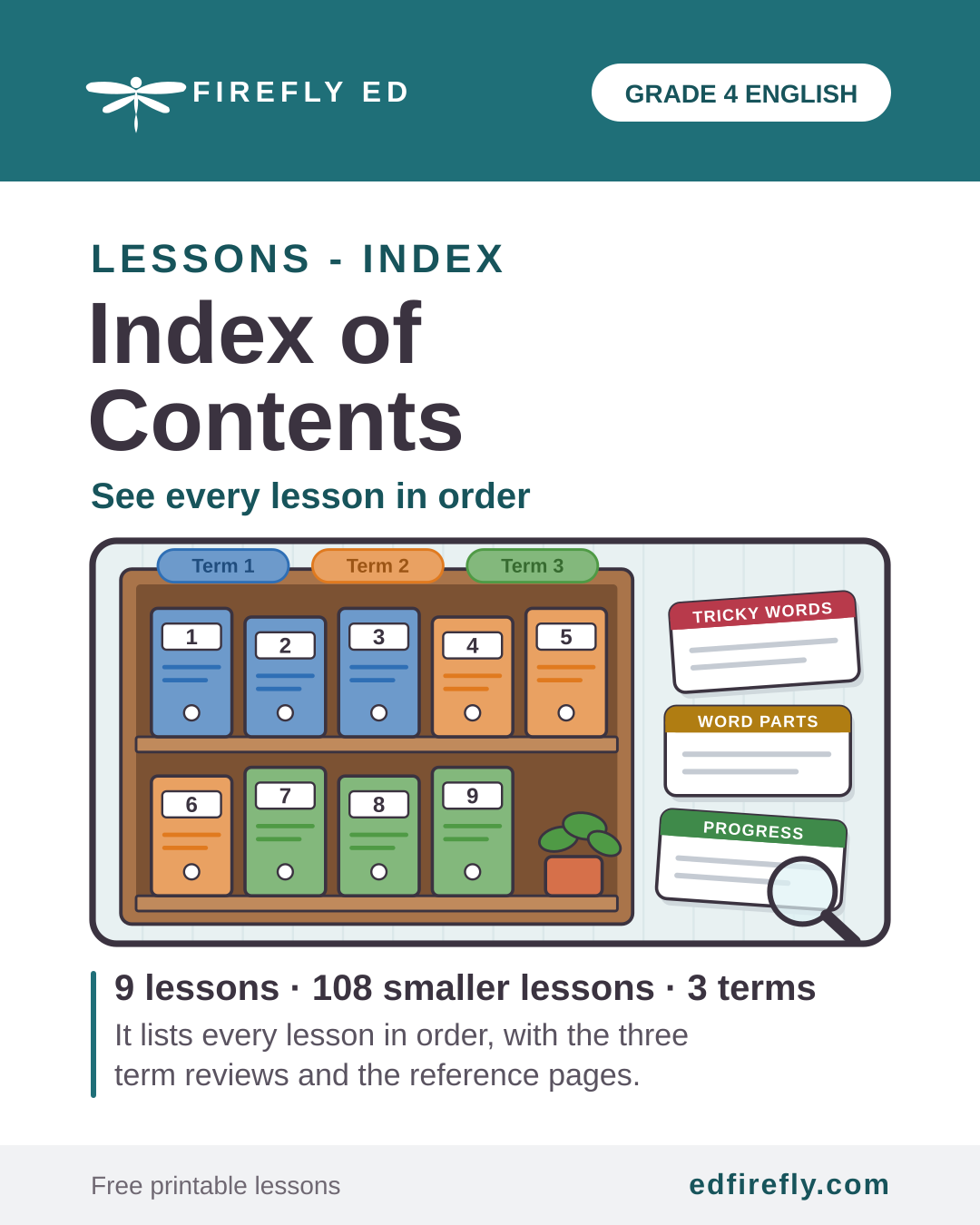
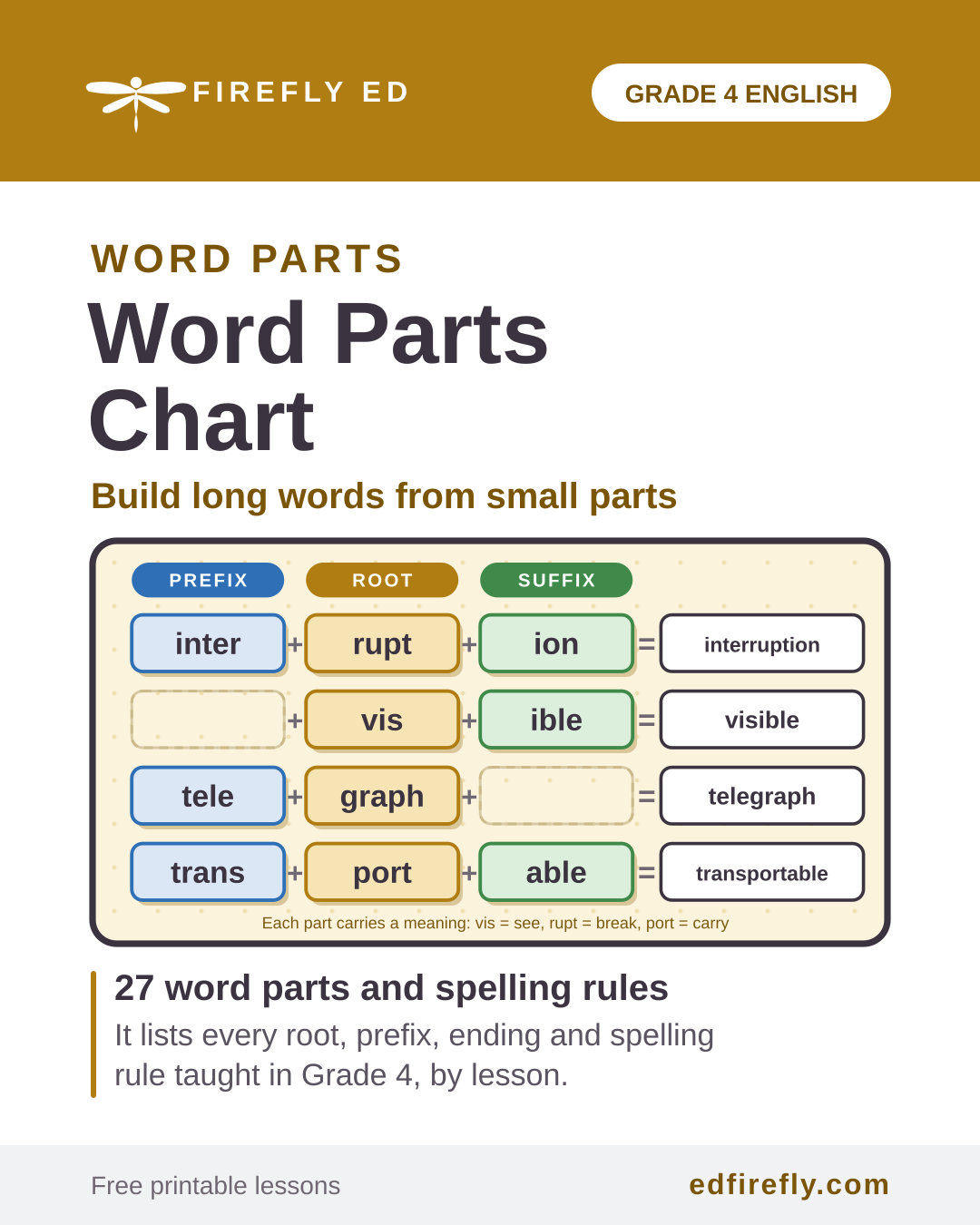


Share your thoughts or ask something..