
Term 3 | Level 3 | Phonics focus: word roots from the sky, the verb endings -ate, -ise and -ify, and prefixes with hyphens
Chapter 7 – Journey Into Space | Chapters – Index
Lessons
This page has the two writing lessons of Chapter 7, Journey Into Space: Lessons 7.3 and 7.4. The chapter page has the chapter overview, the chapter review and the PDF download.
Tap a lesson to open it. Tap the lesson title again, or use the link at the end of the lesson, to close it.
Lesson 7.3: Explain It: How a Rocket Reaches Orbit | Writing | About 20 minutes
Term 3 | Level 3
Goal
“I can explain a process in order, using precise science words and linking words.”
Words to know
explanation, process, thrust, gravity, atmosphere, stage, orbit
Wonder
Think about this question before you start. Say your ideas. You will come back to it at the end of the lesson.
Why can a rocket not just fly straight up to get into space and stay there?
Let’s Learn
An explanation tells how or why something happens. A good explanation of a process:
- starts by saying what will be explained
- tells the steps in order, using linking words such as first, next, then, after, finally
- uses cause and effect words such as because, so that, which means that
- uses precise science words and explains them
- ends with a short summary
How a Rocket Reaches Orbit
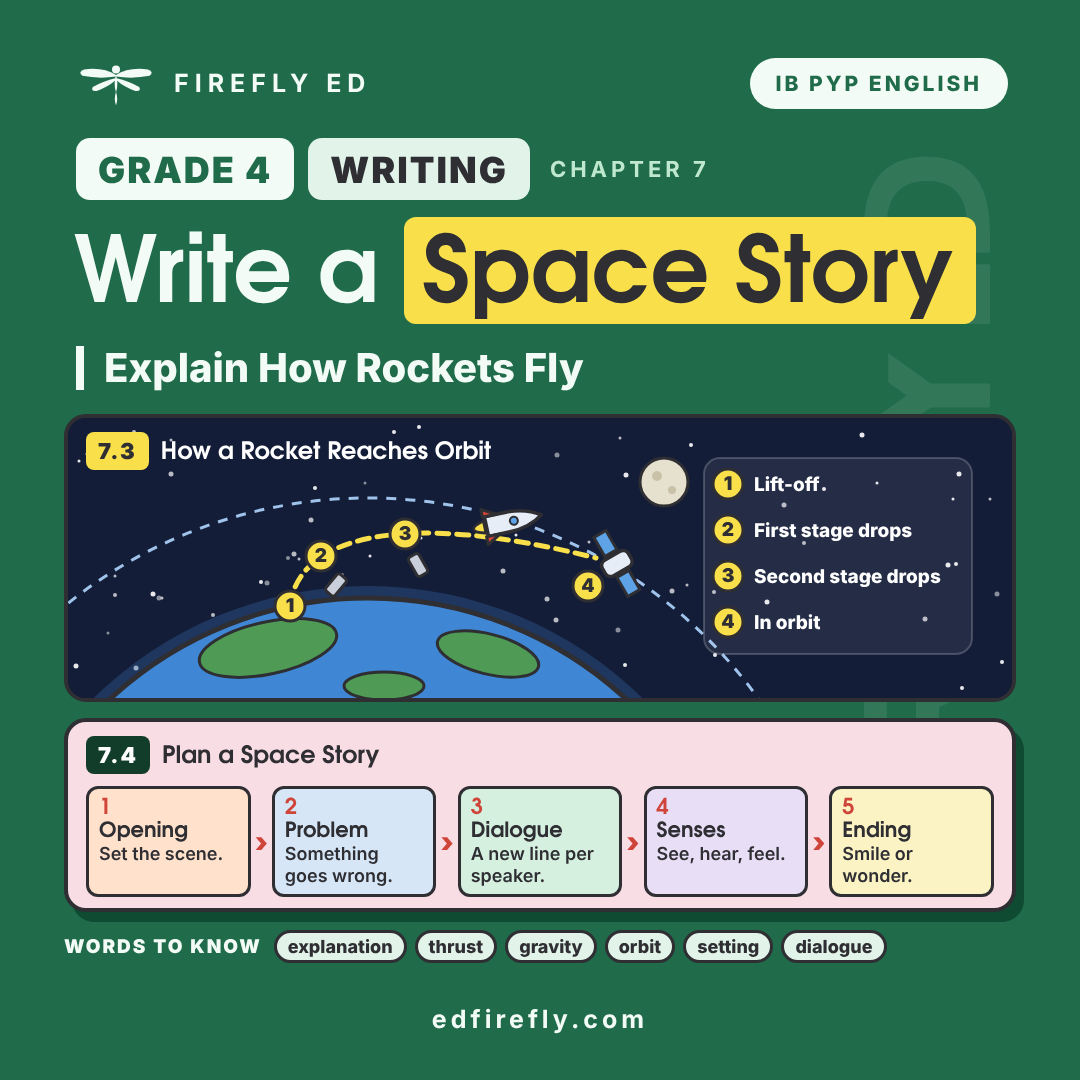
To orbit the Earth, a spacecraft must travel high above the air and move sideways so fast that it keeps falling around the planet instead of back down to it. A rocket does this in several stages.
First, the engines burn fuel and push hot gas down out of the bottom of the rocket. Because the gas pushes down, the rocket is pushed up. This push is called thrust. At lift-off, the thrust must be greater than the rocket’s weight, or it will not leave the ground.
Next, the rocket climbs through the atmosphere, the layer of air around the Earth. It goes straight up at first, to get out of the thick air quickly. Then it slowly tilts over, so that it starts to fly sideways as well as up.
After about two and a half minutes, the first stage has used up its fuel. It drops away and falls back to Earth, which means that the rest of the rocket is lighter and can go faster. Then the second stage fires its engines, and later it drops away too.
Finally, the spacecraft reaches a speed of about 28,000 kilometres per hour. At this speed, it travels around the whole Earth in about 90 minutes. The engines switch off, and the spacecraft is in orbit.
In short, a rocket reaches orbit by pushing hard against gravity, dropping the parts it no longer needs, and going fast enough to fall around the Earth.
See How It’s Done
Now Try It
1. Find two linking words in the model that show order. ______________ ______________
2. Make this more precise: The rocket drops a bit of itself.
__________________________________________________________________
Time To Practise
Name: ______________________
1. Precise words.
Replace each underlined phrase with a science word from the chart.
a) The push from the engines lifts the rocket. ______________
b) The rocket flies through the air around the Earth. ______________
c) The spacecraft goes round and round the planet. ______________
2. Order the steps.
Number the steps from 1 to 5.
____ The first stage drops away. ____ The engines switch off in orbit. ____ The engines create thrust at lift-off.
____ The second stage fires. ____ The rocket tilts over to fly sideways.
3. Cause and effect.
Join each pair with because, so or which means that.
a) The first stage drops away. The rocket is lighter.
__________________________________________________________________
b) The rocket goes straight up at first. It needs to leave the thick air quickly.
__________________________________________________________________
4. Write your explanation.
Explain how a rocket reaches orbit in your own words. Use the diagram to help you. Write an opening sentence, four steps with linking words, and a summary.
__________________________________________________________________
__________________________________________________________________
__________________________________________________________________
__________________________________________________________________
__________________________________________________________________
5. Check it.
Tick each one you used: ☐ an opening sentence ☐ steps in order ☐ three precise science words ☐ a cause and effect word ☐ a summary
Reflect
Think about these questions. Talk about them with someone at home or at school.
1. Go back to the Wonder question: “Why can a rocket not just fly straight up to get into space and stay there?” What do you think now?
2. I was a communicator today when I ______________________________.
A communicator shares ideas clearly by talking, writing or drawing. For example: I was a communicator today when I chose a precise science word instead of a vague one.
Take action: Explain to someone at home how a rocket reaches orbit, using the diagram. Ask them to say the steps back to you.
Next Steps
If this was easy, try: Write a second explanation: how the astronauts get back to Earth from orbit, using the words heat shield and parachute.
If this was hard, go back to: Let’s Learn. Read the model one paragraph at a time and underline one linking word and one science word in each.
Notes for Parents and Teachers
Show notes for parents and teachers
These notes cover this lesson only. How every lesson runs is explained in How to Use This Material.
Let’s Learn
Read Let’s Learn aloud together. Read the model explanation together.
Answer Key
Reveal Answers
Now Try It
1. Any two of: first, next, then, after about two and a half minutes, finally. 2. Sample answer: The first stage drops away when its fuel is used up.
1. Precise words
a) thrust b) the atmosphere c) orbits
2. Order the steps
3 The first stage drops away. 5 The engines switch off in orbit. 1 The engines create thrust at lift-off. 4 The second stage fires. 2 The rocket tilts over.
3. Cause and effect
Sample answers: a) The first stage drops away, which means that the rocket is lighter. b) The rocket goes straight up at first because it needs to leave the thick air quickly.
4. Look for: an opening sentence, the steps in the right order, linking words, at least three precise science words and a summary.
5. Look for: every box ticked.
Reflect
2. Any real moment from the lesson that shows the learner was a communicator. Examples: “I was a communicator today when I chose a precise science word instead of a vague one.” “I was a communicator today when I used linking words to show the order and the cause.”
Lesson 7.4: Write a Story Set on Another Planet | Writing | About 20 minutes
Term 3 | Level 3
Goal
“I can write a story with a strong opening, dialogue, sensory details and a clear ending.”
Words to know
narrative, setting, dialogue, sensory detail, opening, ending
Wonder
Think about this question before you start. Say your ideas. You will come back to it at the end of the lesson.
If you could land on any planet in a story, what would you find there?
Let’s Learn
A good story takes the reader somewhere new. A story set on another planet needs a vivid setting, characters who talk, details that use the senses, and an ending that ties it together.
The Crystal Plain
The rover bumped to a stop at the edge of the plain. Zara pressed her helmet against the window. In front of her, glowing blue-green crystals rose out of the red dust, taller than trees, and a giant ringed planet filled half of the purple sky.
“Commander, are you seeing this?” whispered Kai.
“I’m seeing it,” said Zara. “But I don’t believe it.”
They climbed out. The ground crunched under their boots like frozen snow, and the crystals hummed softly, a sound Zara could feel in her teeth. The air in her helmet smelled of plastic and warm metal. Kai reached out a glove and touched the nearest crystal. It flashed bright white.
All at once, every crystal on the plain flashed back, one after another, in a long wave of light that rolled towards the rock arch on the horizon.
“I think,” said Kai slowly, “it just said hello.”
Zara smiled and switched on her radio. “Mission Control,” she said, “we’re going to need a much bigger notebook.”
See How It’s Done
Now Try It
1. Find a sentence in the model that uses sound. ______________________________
2. Why do you think the writer ends with Mission Control?
__________________________________________________________________
Time To Practise
Name: ______________________
1. Senses.
Write one detail for each sense about your planet.
See: ______________________________ Hear: ______________________________
Feel: ______________________________ Smell: ______________________________
2. Write an opening.
Write two sentences that put the reader straight into your setting.
__________________________________________________________________
__________________________________________________________________
3. Write some dialogue.
Write three lines of dialogue between two explorers. Start a new line for each speaker.
__________________________________________________________________
__________________________________________________________________
__________________________________________________________________
4. Write your story.
Use the plan. Write your story on paper, in four or five paragraphs.
5. Check it.
Tick each one you used: ☐ an opening that sets the scene ☐ a problem or discovery ☐ dialogue in quotation marks ☐ at least three senses ☐ a clear ending
Reflect
Think about these questions. Talk about them with someone at home or at school.
1. Go back to the Wonder question: “If you could land on any planet in a story, what would you find there?” What do you think now?
2. I was a risk-taker today when I ______________________________.
A risk-taker tries something new, even when it feels hard. For example: I was a risk-taker today when I tried a new idea for a setting.
Take action: Read your story aloud to your family. Ask them which detail they could picture most clearly.
Next Steps
If this was easy, try: Rewrite the model story from Kai’s point of view, using I and we.
If this was hard, go back to: Let’s Learn. Read the model and highlight one detail for each sense. Then write one sentence for each part of the plan.
Notes for Parents and Teachers
Show notes for parents and teachers
These notes cover this lesson only. How every lesson runs is explained in How to Use This Material.
Let’s Learn
Read Let’s Learn aloud together. Read the model story together.
Answer Key
Reveal Answers
Now Try It
1. Any one of: the crystals hummed softly; “Commander, are you seeing this?” whispered Kai; the ground crunched under their boots. 2. Sample answer: It ends with a funny line that shows how big the discovery is, and it brings the story back to the mission.
1 to 3. Answers will vary. Look for: details for each sense, an opening set in a place, and dialogue in quotation marks with a new line for each speaker.
4. Look for: a clear opening, a problem or discovery, dialogue, sensory detail and an ending that closes the story.
5. Look for: every box ticked.
Reflect
2. Any real moment from the lesson that shows the learner was a risk-taker. Examples: “I was a risk-taker today when I tried a new idea for a setting.” “I was a risk-taker today when I added a sense I don’t usually use, such as smell.”
For Teachers: IB Details
Show IB and curriculum details
IB theme: How the world works. This theme is about the natural world and its laws, how people and nature affect each other, and how people use science to understand the world.
Central idea: People use science and teamwork to explore space, and what they learn there helps us understand Earth.
| Lesson | Title | Strand | Key concept |
|---|---|---|---|
| 7.3 | Explain It: How a Rocket Reaches Orbit | Writing | Function |
| 7.4 | Write a Story Set on Another Planet | Writing | Connection |
Each lesson also matches the national curriculum for England (Year 4) and the US Common Core (Grade 4). The Grade 4 Curriculum Map lists the full standards for every lesson.
← Back to Chapter 7 – Journey Into Space | Chapters – Index
© 2026 Firefly Ed. All rights reserved. This page may be printed for personal, home and classroom use. It may not be sold, shared online or reproduced for commercial use without written permission. edfirefly.com


Share your thoughts or ask something..