
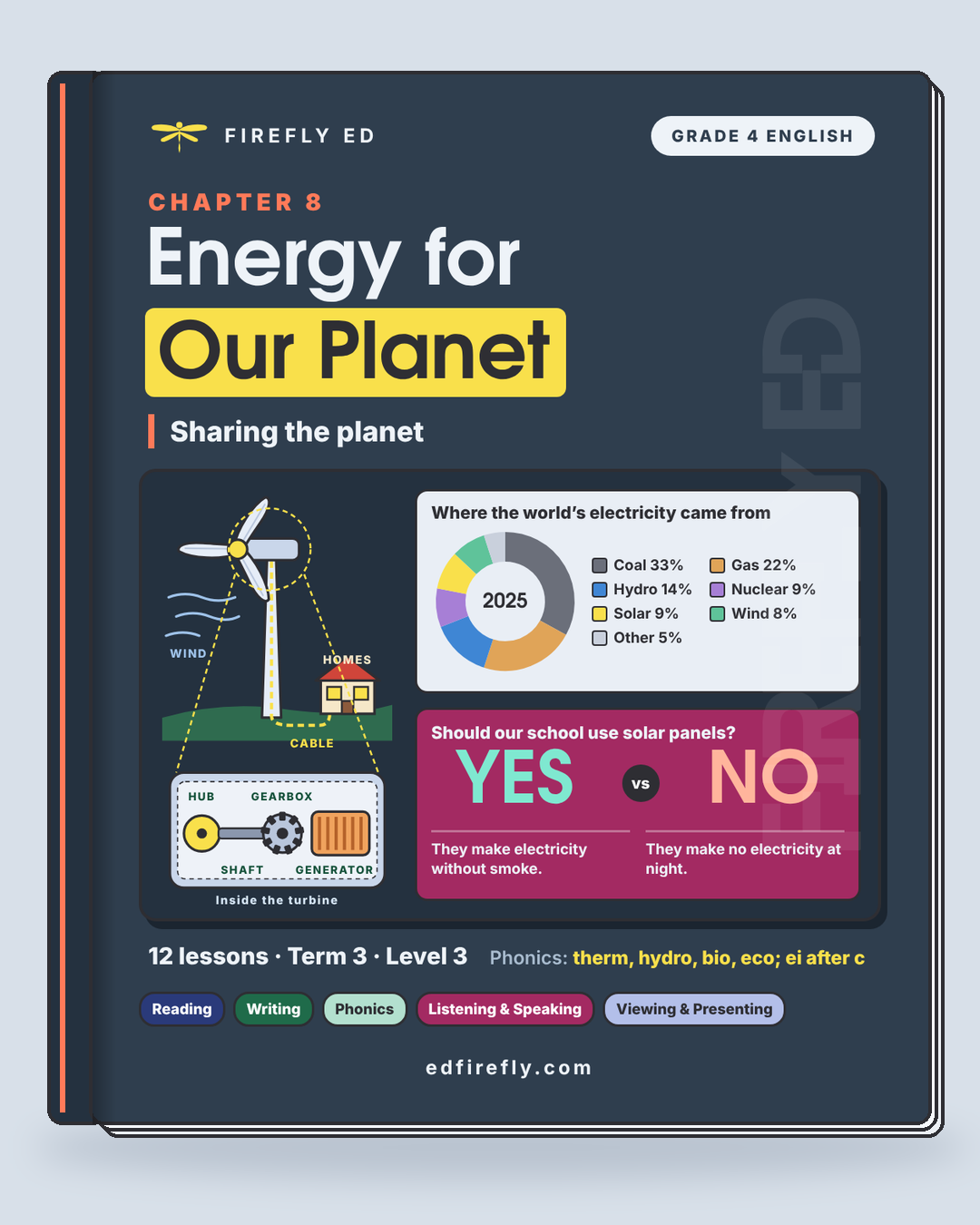
Term 3 | Level 3 | Phonics focus: the roots therm, hydro, bio and eco, and ei after c
What this chapter is about
People get energy from different sources, and the choices we make about energy affect the planet and everyone who shares it.
Theme: Sharing the planet. It covers energy sources, a story about a power cut, persuasive letters, wind turbines, a debate, an energy-saving plan, pie charts and an energy diary.
Before you start
Before Lesson 8.1, walk around your home and count everything that uses electricity. Where does the electricity come from? What would you miss most if it stopped?
Write down your ideas and keep them. You will look at them again at the end of the chapter.
Questions we explore
- Where our energy comes from
- How energy choices affect the planet and other people
- How we can use less energy and use it wisely
How each lesson works
Every lesson starts with a Wonder question to think about. Next, you learn something new, see how it is done, try it, and practise on your own. Each lesson ends with Reflect, where you go back to the Wonder question, think about how you learned, and choose something to do at home.
Lessons
Each strand of this chapter has its own page. Open a page to see its lessons.
Download the full chapter as a PDF (free after you subscribe)
Reading: Compare Energy Sources and The Night of the Power Cut
In Lessons 8.1 and 8.2, you compare how two texts describe energy sources, and work out the theme of a story from how a character changes.
Writing: Write a Persuasive Letter and Explain a Wind Turbine
In Lessons 8.3 and 8.4, you write a persuasive letter with reasons and evidence, and explain step by step how a wind turbine makes electricity.
Listening and Speaking: Debate Solar Panels and Present an Energy-Saving Plan
In Lessons 8.5 and 8.6, you give reasons and evidence in a debate and answer the other side politely, and present an energy-saving plan.
Viewing and Presenting: Read a Pie Chart and Make an Energy Diary Chart
In Lessons 8.7 and 8.8, you read a pie chart and a bar chart about electricity, and keep an energy diary and show it in a bar chart.
Phonics: therm, hydro, bio, eco and ei After c
In Lessons 8.9, 8.10 and 8.11, you use the roots therm, hydro, bio and eco to work out new words, spell ie and ei words, and spell six tricky words.
Chapter review
Lesson 8.12 reviews the whole chapter. An optional Challenge with a story and a grammar task follows it. Tap a lesson to open it. Tap the lesson title again, or use the link at the end of the lesson, to close it.
Lesson 8.12: Chapter 8 Review | All strands | About 20 minutes
Term 3 | Level 3
Goal
“I can show what I have learned about energy texts, stories, letters, explanations, debates, charts and spelling in Chapter 8.”
Words to know
structure, theme, persuasive, explanation, debate, pie chart, root, ei
Wonder
Think about this question before you start. Say your ideas. You will come back to it at the end of the lesson.
What is one energy choice you will make differently after this chapter?
Let’s Learn
This review has six tasks. Here is a reminder of what each one checks.
1. Read each task carefully.
2. Try it on your own first.
3. Check your work with the Answer Key.
4. Mark any task that felt hard. Go back to that lesson and try again.
See How It’s Done
Now Try It
1. What does the root hydro mean? ______________
2. Which chart shows parts of a whole? ______________
Time To Practise
Name: ______________________
1. Reading.
Many towns have a problem: they need more electricity, but they do not want more smoke. One solution is a solar farm. The panels catch sunlight all day, and batteries store some of the power for the evening. Some people worry that the panels take up land that farmers could use. So in some places, sheep now graze between the rows of panels, and the land is used for both.
a) Is this text built as a sequence or as problem and solution? How do you know? ______________________________
b) What worry do some people have? What is the answer to it? ______________________________
2. Writing.
a) Add a linking word: ______________, solar farms make no smoke. ______________, they can share land with sheep.
b) Write one reason, with evidence, to persuade your town to build a solar farm.
__________________________________________________________________
3. Oral.
Debate with an adult for two minutes: Should every new house have solar panels?
An adult listens and ticks each one they hear: ☐ a clear view ☐ reasons with evidence ☐ listened without interrupting ☐ answered the other side politely
4. Visual.
Look at the pie chart in Lesson 8.7. a) What percentage came from hydro? ______ b) Did more electricity come from wind or from gas? ______________
5. Phonics.
a) Write the meaning: therm ______ hydro ______ bio ______ eco ______
b) ie or ei? rec____pt ach____ve c____ling p____ce
6. Spelling.
a) Circle the correct spelling.
concious / conscious thorough / thorogh variety / varity guarantee / garantee
b) Write from dictation.
Listen as an adult reads a sentence aloud. Write it.
__________________________________________________________________
Reflect
Think about these questions. Talk about them with someone at home or at school.
1. Go back to the Wonder question: “What is one energy choice you will make differently after this chapter?” What do you think now?
2. I was reflective today when I ______________________________.
Being reflective means looking back at your work and thinking how to make it better. For example: I was reflective today when I looked back at a task that was hard and tried again.
Take action: Keep your family energy plan going for another week and check how many actions you kept.
Next Steps
If this was easy, try: Write a short report on your family’s energy plan: what you changed, what worked, and what you would try next.
If this was hard, go back to: Let’s Learn. Look at the reminder chart, find the lesson for the task that felt hard, and try that lesson again.
Notes for Parents and Teachers
Show notes for parents and teachers
These notes cover this lesson only. How every lesson runs is explained in How to Use This Material.
Let’s Learn
Read Let’s Learn aloud together. It reminds the learner what Chapter 8 covered. Look back at any lesson if the learner needs to.
See How It’s Done
Ken’s thoughts show one way to check a spelling.
Time To Practise
- Task 3: Tick each one you hear.
- Task 6: Read the sentence from the Answer Key aloud slowly. The learner writes it.
Answer Key
Reveal Answers
Now Try It
1. water 2. a pie chart
1. Reading
a) Problem and solution: it says a problem and one solution. b) That the panels take up land farmers could use. Sheep can graze between the rows, so the land is used for both.
If it was hard, go back to Lessons 8.1 and 8.2.
2. Writing
a) Sample answer: Firstly, In addition b) Sample answer: A solar farm would make clean electricity, because the panels make no smoke while they work.
If it was hard, go back to Lessons 8.3 and 8.4.
3. Oral
Look for: three or more ticks.
If it was hard, go back to Lessons 8.5 and 8.6.
4. Visual
a) 14% b) gas
If it was hard, go back to Lessons 8.7 and 8.8.
5. Phonics
a) heat, water, life, home b) receipt, achieve, ceiling, piece
If it was hard, go back to Lessons 8.9 to 8.11.
6. Spelling
a) conscious, thorough, variety, guarantee b) Dictation sentence: We are conscious of the energy we use, so we made a thorough plan to save it.
If it was hard, go back to Lesson 8.11.
Reflect
2. Any real moment from the lesson that shows the learner was reflective. Examples: “I was reflective today when I looked back at a task that was hard and tried again.” “I was reflective today when I checked my answers and fixed a mistake.”
Challenge: Read-Aloud Story and Grammar | Optional | About 20 minutes
This Challenge is optional. It has a story to listen to and a grammar task.
Part 1: Read-Aloud Story
Listen as an adult reads the story aloud. Then talk about it.
The Solar Oven
“It will never work,” said Leo. “You can’t cook with a cardboard box.”
Mia held up the box. She had lined it with kitchen foil, painted the bottom black, and stretched clear plastic over the top. “It might work,” she said. “The foil reflects the sunlight inside. The black paint soaks up the heat, and the plastic keeps the heat in. Perhaps it could even melt chocolate.”
It was the hottest day of the summer fair. Mia put a biscuit with a square of chocolate on top into the box and placed it in the sunniest spot on the playground. Leo sat beside her, doubtful. “We should check every ten minutes,” Mia said.
After ten minutes, nothing had changed. After twenty, the chocolate looked shiny. After thirty, it had melted into a soft, sticky puddle.
“Let’s eat, Leo!” said Mia, and she handed him the warm biscuit.
Leo took a bite and grinned. “All right,” he said. “It definitely works. Could we build a bigger one?”
Talk about the story
1. What three things did Mia do to make the solar oven?
2. Why did she paint the bottom of the box black?
3. How did Leo feel at the start? How did he feel at the end?
Hint: Look at what he says first and last.
4. Why do you think Mia chose the hottest day of the summer fair?
5. What does Leo’s last question tell you about how his mind has changed?
Part 2: Modal Verbs, Adverbs of Possibility, and Commas That Avoid Confusion (Grammar)
Modal verbs show how likely something is, or whether it is needed: will, would, can, could, may, might, shall, should, must.
Adverbs of possibility do the same job: perhaps, possibly, probably, definitely, certainly, surely.
It might work. (not sure) It will work. (sure) Perhaps it could melt chocolate. (not sure) It definitely works. (sure)
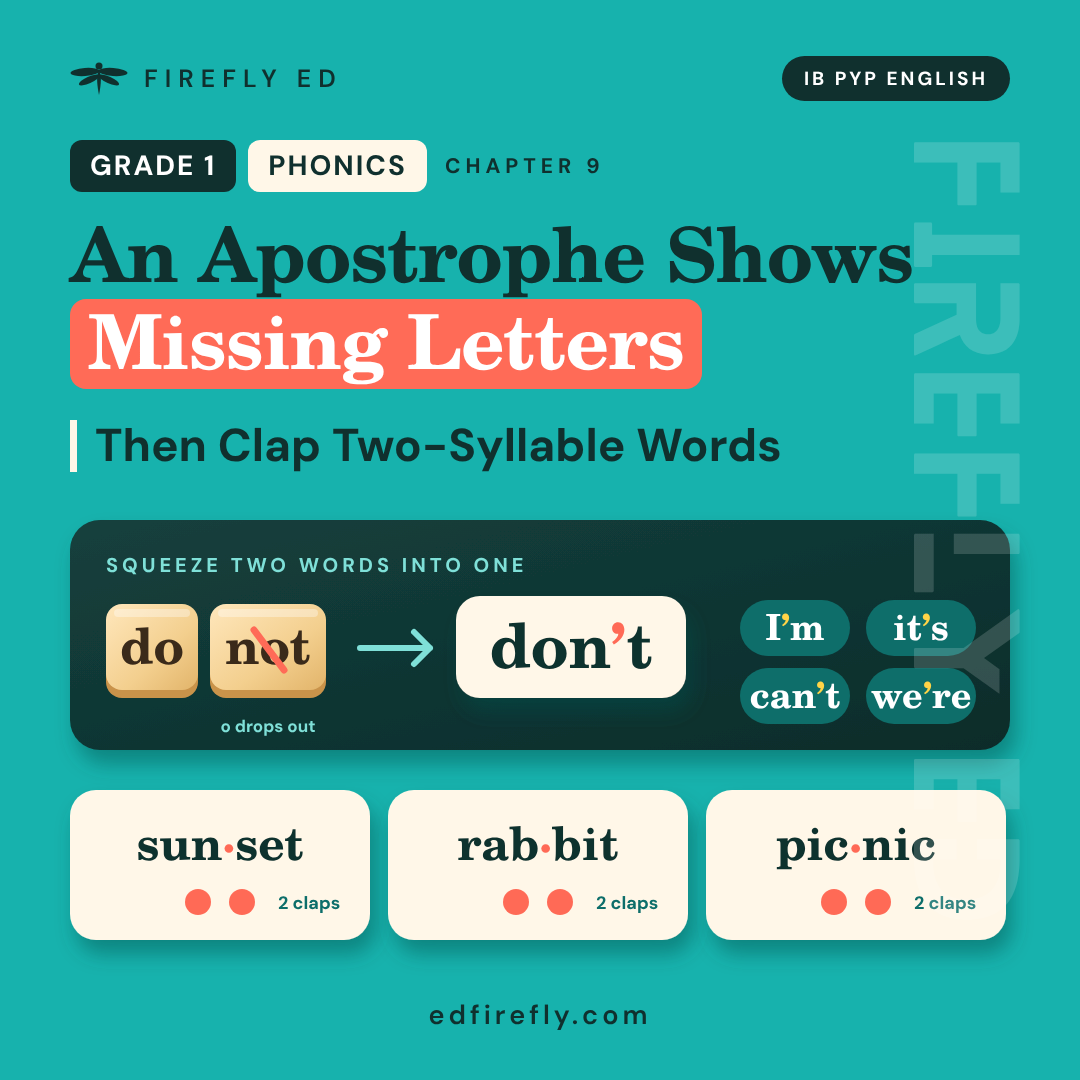
A comma can change the meaning of a sentence. Let’s eat, Leo! means Mia is talking to Leo. Without the comma, Let’s eat Leo! means something very different!
1. Put these in order from least sure to most sure: will, might, should
______________ → ______________ → ______________
2. Complete each sentence with a modal verb or an adverb of possibility.
a) If the sun shines, the chocolate ______________ melt.
b) ______________ we could build an oven from a pizza box.
c) You ______________ always wear a sun hat on a hot day.
3. Add a comma to make each sentence clear.
a) Let’s cook Gran.
b) After eating the dog went to sleep.
c) I like cooking my family and my friends.
______________________________________________
Notes for Parents and Teachers
Show notes for parents and teachers
These notes cover this section only. How every lesson runs is explained in How to Use This Material.
Use the Challenge when the lessons feel easy, or to stretch the learner after Lesson 8.12. The story is for you to read aloud. It uses some harder words on purpose, so talk about them as you read.
Part 1: Read-Aloud Story
Read the story aloud twice. The first time, just enjoy it. The second time, stop at the words in bold and talk about what they mean.
Answer Key
Reveal Answers
Part 1: Talk about the story
1. She lined the box with foil, painted the bottom black, and stretched clear plastic over the top.
2. Black paint soaks up the heat.
3. At the start he was doubtful (“It will never work”). At the end he was impressed and excited (“It definitely works”).
4. The oven needs strong sunlight to get hot.
5. He now believes it works and wants to do more.
Part 2: Grammar
1. might → should → will
2. Sample answers: a) will b) Perhaps c) should
3. a) Let’s cook, Gran. b) After eating, the dog went to sleep. c) I like cooking, my family and my friends. (Each comma stops the sentence meaning something silly.)
Look for: modal verbs and adverbs that match how sure the sentence is, and commas that make the meaning clear.
Try it at home
By the end of this chapter, you could:
- Choose one room and find three ways to use less energy there, such as switching off a light or a charger.
- Look at an electricity bill or meter reading together and talk about what the numbers mean.
- Spend one evening with the lights low or off, and talk about what it was like.
Lesson 8.12 reviews the chapter. Look back at the ideas from “Before you start” and talk about how they have changed.
Notes for Parents and Teachers
Show notes for parents and teachers
The chapter page and the lessons are written for the learner. How every lesson runs is explained once in How to Use This Material. Each lesson also has its own short notes, after Next Steps.
- The lessons are worksheets. The learner opens a lesson and works on paper next to the screen, or on a printout. Printable PDFs are free to download after you subscribe.
- Before you start: help the learner write down their ideas before Lesson 8.1, and keep them. In Lesson 8.12, look at them together and talk about how they have changed.
For Teachers: IB Details
Show IB and curriculum details
IB theme: Sharing the planet. This theme is about the rights and responsibilities we have as we share the planet’s resources with other people and other living things.
Central idea: People get energy from different sources, and the choices we make about energy affect the planet and everyone who shares it.
Key concepts: Causation (why is it like it is?), Responsibility (what is our responsibility?), Perspective (what are the points of view?). Related concepts: energy, resources, choices, sustainability.
Lines of inquiry:
- Where our energy comes from
- How we can use less energy and use it wisely
- How energy choices affect the planet and other people
What each lesson covers
| Lesson | Title | Strand | Key concept |
|---|---|---|---|
| 8.1 | Where Does Our Energy Come From? Comparing Sources | Reading | Causation |
| 8.2 | The Night of the Power Cut: A Story | Reading | Perspective |
| 8.3 | Write a Persuasive Letter: Please Switch It Off | Writing | Responsibility |
| 8.4 | Explain It: How a Wind Turbine Makes Electricity | Writing | Causation |
| 8.5 | Debate: Should Our School Use Solar Panels? | Listening and speaking | Perspective |
| 8.6 | Present an Energy-Saving Plan | Speaking | Responsibility |
| 8.7 | Read a Pie Chart and a Bar Chart: Where Electricity Comes From | Viewing | Causation |
| 8.8 | Keep an Energy Diary and Make a Chart | Presenting | Responsibility |
| 8.9 | Roots: therm and hydro | Reading and spelling | Causation |
| 8.10 | Roots: bio and eco | Reading and spelling | Responsibility |
| 8.11 | ei After c, and Tricky Words | Reading and spelling | Responsibility |
| 8.12 | Chapter 8 Review | All strands | Causation, Responsibility and Perspective |
Each lesson also matches the national curriculum for England (Year 4) and the US Common Core (Grade 4). The Grade 4 Curriculum Map lists the full standards for every lesson.
Chapters – Index | Next: Chapter 9: Protecting Wildlife →
© 2026 Firefly Ed. All rights reserved. This page may be printed for personal, home and classroom use. It may not be sold, shared online or reproduced for commercial use without written permission. edfirefly.com


Share your thoughts or ask something..