
Term 3 | Level 3 | Phonics focus: word roots from the sky, the verb endings -ate, -ise and -ify, and prefixes with hyphens
Chapter 7 – Journey Into Space | Chapters – Index
Lessons
This page has the two listening and speaking lessons of Chapter 7, Journey Into Space: Lessons 7.5 and 7.6. The chapter page has the chapter overview, the chapter review and the PDF download.
Tap a lesson to open it. Tap the lesson title again, or use the link at the end of the lesson, to close it.
Lesson 7.5: Tell a Story Aloud: The Mission Log | Oral | About 20 minutes
Term 3 | Level 3
Goal
“I can tell a story aloud in an organised way, with clear order, details and expression.”
Words to know
log, entry, sequence, expression, pace, audience
Wonder
Think about this question before you start. Say your ideas. You will come back to it at the end of the lesson.
How is telling a story aloud different from writing it down?
Let’s Learn
A log is a record of events, written in the order they happen, often with times. Astronauts and ship captains keep logs. A log makes a good plan for a spoken story, because the times keep the events in order.
Mission Log: Day 3
Log of Commander Leo, on board the spaceship Firefly
07:00 Woke up floating. My sleeping bag is strapped to the wall, so I didn’t drift away in the night. Breakfast was porridge from a pouch. I had to catch a blob of it before it floated into the controls.
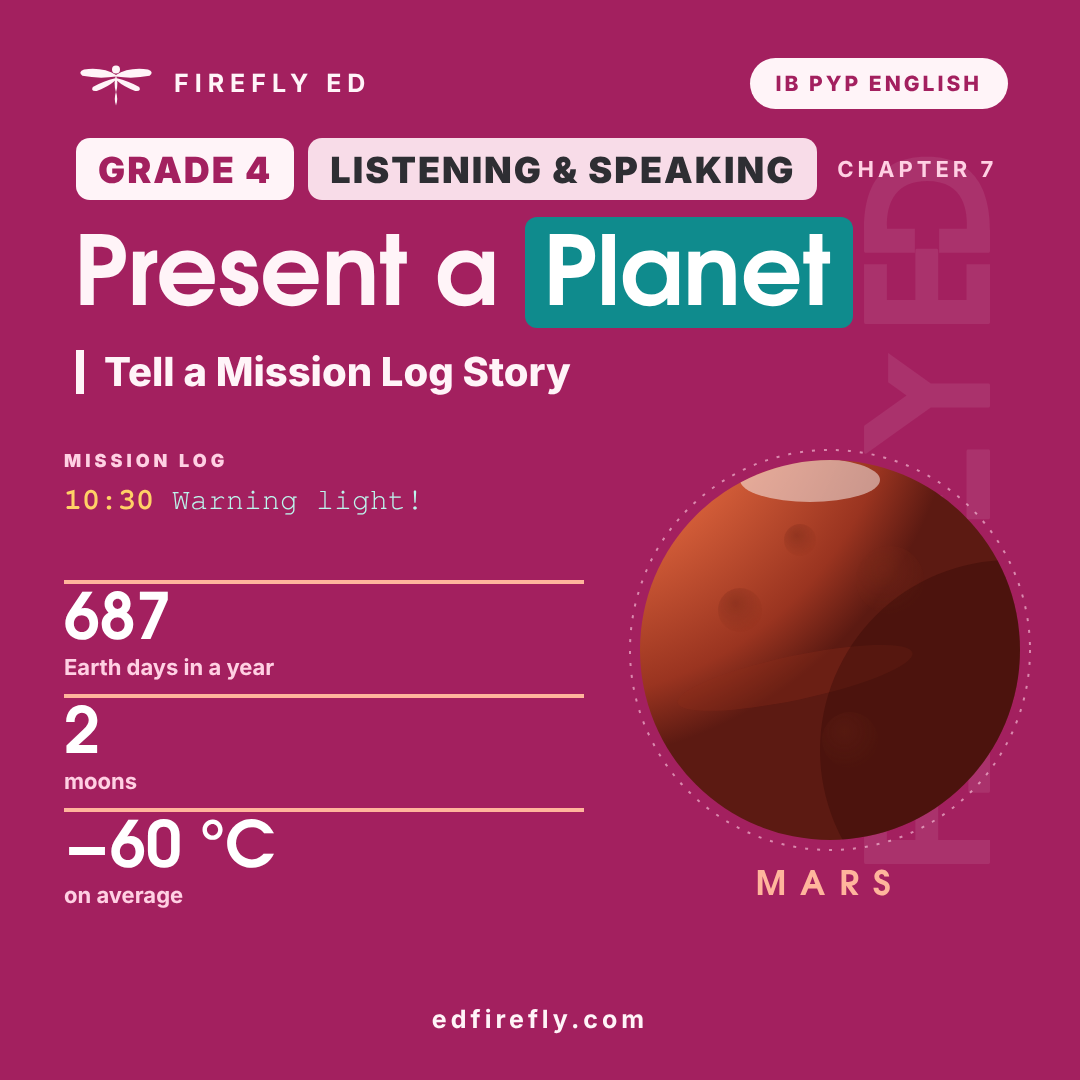
10:30 Warning light! A small rock hit the solar panel. We put on our suits, went outside and fixed it with a spare panel. It took two hours. The Earth looked like a blue marble below us.
15:00 We saw the Moon getting bigger in the window. Tomorrow we land.
21:00 Lights out. I can hear the fans humming. I’m tired, but I’m too excited to sleep.
See How It’s Done
Now Try It
1. Which entry is the most exciting? How should your voice change? ______________________________
2. Find one detail a listener could picture. ______________________________
Time To Practise
Name: ______________________
1. Plan your log.
You are an astronaut. Write four log entries for one day, with a time and one or two sentences each.
______ __________________________________________________________
______ __________________________________________________________
______ __________________________________________________________
______ __________________________________________________________
2. Mark your voice.
Above each entry, write F where you will speak faster, S where you will slow down, and Q where you will go quiet.
3. Tell it.
Tell your mission log to an adult. Use your notes, but look up at the end of each entry.
An adult listens and ticks each one they hear.
☐ events in order ☐ changed pace and volume ☐ a detail I could picture ☐ looked up from the notes
4. Listen and respond.
The adult tells you about one day from their life, in order. Retell it in three sentences, using first, then and finally.
__________________________________________________________________
Reflect
Think about these questions. Talk about them with someone at home or at school.
1. Go back to the Wonder question: “How is telling a story aloud different from writing it down?” What do you think now?
2. I was a communicator today when I ______________________________.
A communicator shares ideas clearly by talking, writing or drawing. For example: I was a communicator today when I changed my voice to suit the event.
Take action: Keep a log of one real day this week, with times. Tell it to your family at dinner.
Next Steps
If this was easy, try: Record your mission log as a voice memo, adding sound effects for the warning light and the fans.
If this was hard, go back to: Let’s Learn. Practise one entry at a time. Read it, close your eyes, then tell it in your own words.
Notes for Parents and Teachers
Show notes for parents and teachers
These notes cover this lesson only. How every lesson runs is explained in How to Use This Material.
Let’s Learn
Read Let’s Learn aloud together. Read the mission log together, using the tips.
Time To Practise
- Task 3: Tick each one you hear.
Answer Key
Reveal Answers
Now Try It
1. 10:30, the warning light. Speak faster and louder, then slow down for the view of the Earth. 2. Any one of: a blob of porridge floating; the Earth like a blue marble; the Moon getting bigger in the window; the fans humming.
1 and 2. Answers will vary. Look for: four entries in time order, each with a clear event, and voice marks that suit the events.
3. Look for: three or more ticks.
4. Look for: three sentences in the right order, using first, then and finally.
Reflect
2. Any real moment from the lesson that shows the learner was a communicator. Examples: “I was a communicator today when I changed my voice to suit the event.” “I was a communicator today when I kept my story in the right order.”
Lesson 7.6: Present a Planet Fact File | Oral | About 20 minutes
Term 3 | Level 3
Goal
“I can present a planet fact file with clear facts, a visual and a strong opening and ending.”
Words to know
fact file, presentation, visual, audience, main idea, source
Wonder
Think about this question before you start. Say your ideas. You will come back to it at the end of the lesson.
What makes a presentation easy to listen to?
Let’s Learn
A fact file gives the most important facts about one topic, grouped under headings. When you present it, you speak to an audience and use a visual, such as a poster or a slide, to help them understand.
A good presentation has:
- an opening that grabs attention: Imagine a volcano two and a half times as tall as Mount Everest.
- the facts in a clear order, pointing to the visual as you go
- a clear voice, a steady pace and eye contact
- an ending that sums up: So Mars is small, cold and red, but it has the biggest volcano we know.
- the source of your facts, such as a space agency website
See How It’s Done
Now Try It
1. Which fact would you choose for your opening? Why? ______________________________
2. Why should you say numbers slowly? ______________________________
Time To Practise
Name: ______________________
1. Choose a planet.
Choose a planet (not Mars). Find six facts from a trusted source, such as a space agency or science museum website.
Planet: ______________ Source: ______________________________
2. Make your fact file.
Size: ______________________________ Day: ______________________________
Year: ______________________________ Moons: ______________________________
Weather: ______________________________ Amazing fact: ______________________________
3. Make your visual.
Draw your planet on a large sheet of paper and add the six headings.
4. Plan your opening and ending.
Opening: __________________________________________________________
Ending: ___________________________________________________________
5. Present it.
Present your fact file to an adult for one to two minutes.
An adult listens and ticks each one they hear or see.
☐ an opening that grabbed attention ☐ pointed to the visual ☐ numbers said slowly and clearly ☐ eye contact ☐ an ending that summed up ☐ named the source
Reflect
Think about these questions. Talk about them with someone at home or at school.
1. Go back to the Wonder question: “What makes a presentation easy to listen to?” What do you think now?
2. I was knowledgeable today when I ______________________________.
Being knowledgeable means knowing things and using what you know. For example: I was knowledgeable today when I checked my facts in a trusted source.
Take action: Look for your planet in the night sky with an app or a sky chart, and show it to your family.
Next Steps
If this was easy, try: Add a short comparison to your presentation: how is your planet different from Earth? Give two differences.
If this was hard, go back to: Let’s Learn. Use the Mars fact file as a model. Practise saying one fact at a time, pointing to the planet.
Notes for Parents and Teachers
Show notes for parents and teachers
These notes cover this lesson only. How every lesson runs is explained in How to Use This Material.
Let’s Learn
Read Let’s Learn aloud together. Look at the model fact file together.
Time To Practise
- Task 5: Tick each one you hear or see.
Answer Key
Reveal Answers
Now Try It
1. Sample answer: The volcano, because it is surprising and makes people want to listen. 2. Listeners cannot read them again, so they need time to take them in.
1 to 4. Answers will vary. Look for: six correct facts from a trusted source, a clear visual, and an opening and ending that suit the audience.
5. Look for: four or more ticks.
Reflect
2. Any real moment from the lesson that shows the learner was knowledgeable. Examples: “I was knowledgeable today when I checked my facts in a trusted source.” “I was knowledgeable today when I explained a fact clearly to my audience.”
For Teachers: IB Details
Show IB and curriculum details
IB theme: How the world works. This theme is about the natural world and its laws, how people and nature affect each other, and how people use science to understand the world.
Central idea: People use science and teamwork to explore space, and what they learn there helps us understand Earth.
| Lesson | Title | Strand | Key concept |
|---|---|---|---|
| 7.5 | Tell a Story Aloud: The Mission Log | Speaking | Connection |
| 7.6 | Present a Planet Fact File | Speaking | Function |
Each lesson also matches the national curriculum for England (Year 4) and the US Common Core (Grade 4). The Grade 4 Curriculum Map lists the full standards for every lesson.
← Back to Chapter 7 – Journey Into Space | Chapters – Index
© 2026 Firefly Ed. All rights reserved. This page may be printed for personal, home and classroom use. It may not be sold, shared online or reproduced for commercial use without written permission. edfirefly.com

Share your thoughts or ask something..