
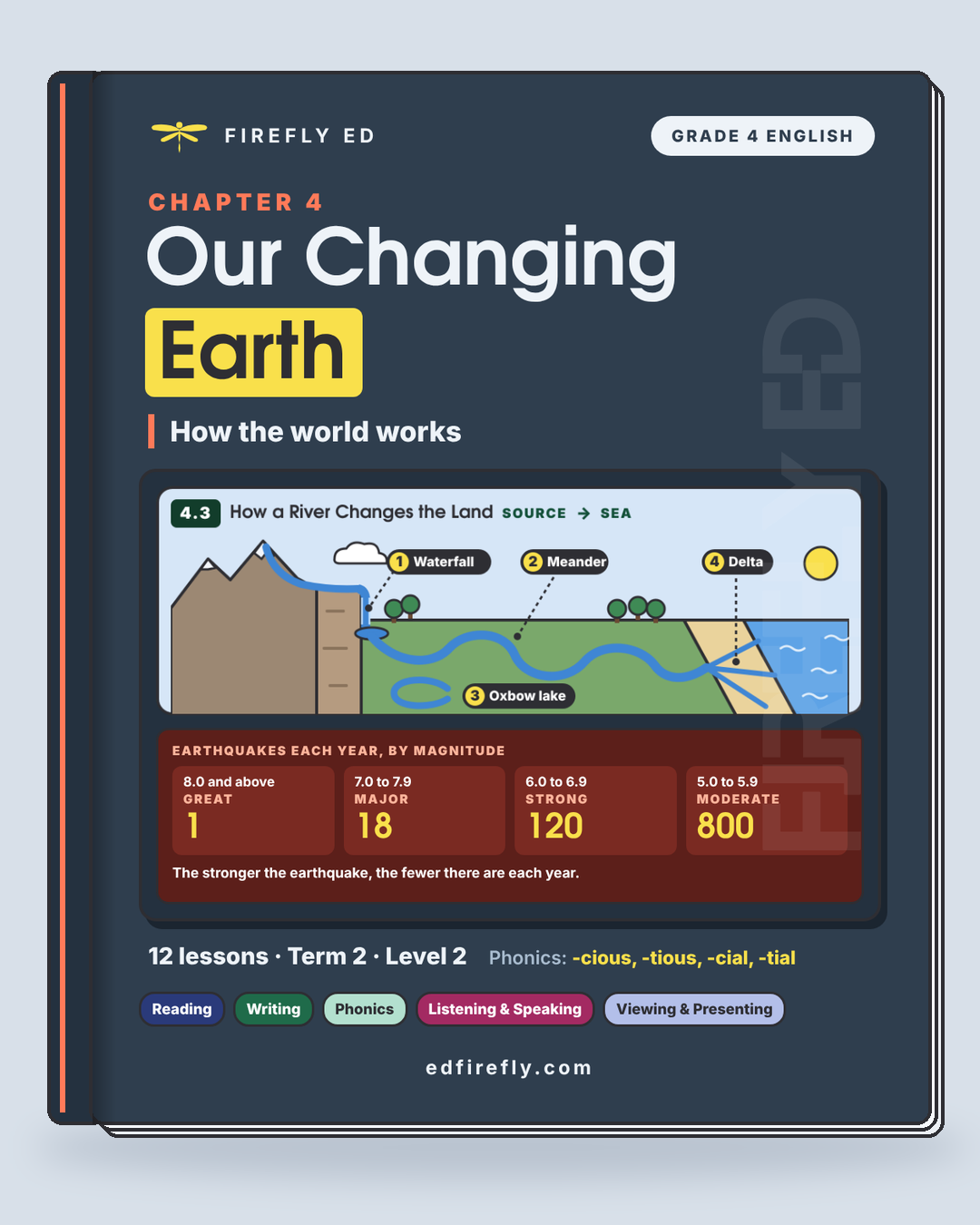
Term 2 | Level 2 | Phonics focus: word endings: -cious, -tious, -cial and -tial
What this chapter is about
Forces inside the Earth and on its surface change the land, and people can prepare for those changes.
Theme: How the world works. It covers volcanoes, earthquakes and rivers, the legends people told to explain them, and how people stay safe when the land changes.
Before you start
Before Lesson 4.1, look at a hill, a river or a beach near your home, or at a photograph of one. Has this place always looked like this? What could change it? What do you already know about volcanoes and earthquakes?
Write down your ideas and keep them. You will look at them again at the end of the chapter.
Questions we explore
- How forces inside the Earth shape the land
- How water and weather change the land over time
- How people prepare for and respond to natural hazards
How each lesson works
Every lesson starts with a Wonder question to think about. Next, you learn something new, see how it is done, try it, and practise on your own. Each lesson ends with Reflect, where you go back to the Wonder question, think about how you learned, and choose something to do at home.
Lessons
Each strand of this chapter has its own page. Open a page to see its lessons.
Download the full chapter as a PDF (free after you subscribe)
Reading: How a Volcano Erupts and Two Volcano Legends
In Lessons 4.1 and 4.2, you explain the causes and effects of a volcanic eruption, and compare two volcano legends from different cultures.
Writing: Explain How a River Changes the Land and Write a Safety Leaflet
In Lessons 4.3 and 4.4, you write an explanation in paragraphs with linking words, and write an earthquake safety leaflet with clear instructions.
Listening and Speaking: Listen for Reasons and Evidence and Present Your Findings
In Lessons 4.5 and 4.6, you name a speaker’s claim, reasons and evidence, and present what they found out with a visual display.
Viewing and Presenting: Read a Volcano Cross-Section and an Earthquake Chart
In Lessons 4.7 and 4.8, you read a cross-section of a volcano with its labels and key, and compare the numbers in an earthquake table and bar chart.
Phonics: -cious, -tious, -cial and -tial
In Lessons 4.9, 4.10 and 4.11, you read and spell words ending in -cious, -tious, -cial and -tial, choose the right ending, and spell six tricky words.
Chapter review
Lesson 4.12 reviews the whole chapter. An optional Challenge with a story and a grammar task follows it. Tap a lesson to open it. Tap the lesson title again, or use the link at the end of the lesson, to close it.
Lesson 4.12: Chapter 4 Review | All strands | About 20 minutes
Term 2 | Level 2
Goal
“I can show what I have learned about causes and effects, legends, explanations, leaflets, diagrams, charts and word endings in Chapter 4.”
Words to know
cause, effect, compare, contrast, linking word, heading, evidence, cross-section, axis, ending
Wonder
Think about this question before you start. Say your ideas. You will come back to it at the end of the lesson.
Which change to the Earth from this chapter do you think is the most powerful? Why?
Let’s Learn
This part reminds you of what you learned in Chapter 4. Look back at any lesson if you need to.
This review has six tasks. Here is a reminder of what each one checks.
1. Read each task carefully.
2. Try it on your own first.
3. Check your work with the Answer Key.
4. Mark any task that felt hard. Go back to that lesson and try again.
See How It’s Done
Now Try It
1. Which ending is correct? spe____ -cial or -tial? ______________
Hint: Is the letter before the ending a vowel or a consonant?
2. Name one feature of a safety leaflet. ______________
Time To Practise
Name: ______________________
1. Reading.
When the ground shakes, rocks can break loose on steep hills. As a result, landslides may block roads. Because of this, people who live in the hills keep extra food and water at home.
a) Write one cause and its effect from the text. Cause: ______________ Effect: ______________
b) Write two signal words from the text. ______________ ______________
c) In Pele’s story and Vulcan’s story, where does the fire live? Write one thing that is the same and one thing that is different.
__________________________________________________________________
2. Writing.
a) Add a linking word: Wind wears away rock. ______________, it shapes the arches in deserts.
b) Rewrite as an instruction for a leaflet: You should stay away from windows.
__________________________________________________________________
3. Oral.
A speaker says: “Every school should practise earthquake drills. My first reason is that practice helps us act quickly. Schools that practise often finish their drills faster.”
a) What is the claim? ______________________ b) What is the evidence? ______________________
4. Visual.
a) What is label 7? ______________ b) What is label 4? ______________
c) In the table in Lesson 4.8, about how many strong earthquakes happen each year? ______________
5. Phonics.
Add the ending: gra____ ______________ nutri____ ______________ offi____ ______________ essen____ ______________
6. Spelling.
a) Circle the correct spelling.
lightning / lightening enviroment / environment imediately / immediately physical / phisical
b) Write from dictation.
Listen as an adult reads a sentence aloud slowly. Write it on the line.
__________________________________________________________________
Reflect
Think about these questions. Talk about them with someone at home or at school.
1. Go back to the Wonder question: “Which change to the Earth from this chapter do you think is the most powerful? Why?” What do you think now?
2. I was reflective today when I ______________________________.
Being reflective means looking back at your work and thinking how to make it better. For example: I was reflective today when I looked back at a task that was hard and tried again.
Take action: Choose one safety tip from this chapter and teach it to someone at home.
Next Steps
If this was easy, try: Write a short explanation of how an earthquake can change the land. Use three linking words and one cause-and-effect signal word.
If this was hard, go back to: Let’s Learn. Look at the reminder chart, find the lesson for the task that felt hard, and try that lesson again.
Notes for Parents and Teachers
Show notes for parents and teachers
These notes cover this lesson only. How every lesson runs is explained in How to Use This Material.
Time To Practise
- Task 6: Read the sentence in the Answer Key slowly. The learner writes it.
Answer Key
Reveal Answers
Now Try It
1. -cial (special): the letter before is e, a vowel. 2. Any one of: a title, headings, imperative verbs, short instructions, pictures.
1. Reading
a) Any one of: the ground shakes, so rocks break loose; landslides happen, so roads are blocked; landslides block roads, so people keep extra food and water. b) Any two of: When, As a result, Because of this. c) Both live inside a mountain. Different: Pele travels from island to island to find a home, while Vulcan stays in one place and works at his forge.
If it was hard, go back to Lessons 4.1 and 4.2.
2. Writing
a) For example (also accept Also, In addition) b) Stay away from windows.
If it was hard, go back to Lessons 4.3 and 4.4.
3. Oral
a) Every school should practise earthquake drills. b) Schools that practise often finish their drills faster.
If it was hard, go back to Lessons 4.5 and 4.6.
4. Visual
a) the magma chamber b) a side vent c) about 120
If it was hard, go back to Lessons 4.7 and 4.8.
5. Phonics
gracious, nutritious, official, essential
If it was hard, go back to Lessons 4.9 to 4.11.
6. Spelling
a) lightning, environment, immediately, physical b) Dictation sentence: The average storm can develop quickly, so leave the beach immediately if you see lightning.
If it was hard, go back to Lesson 4.11.
Reflect
2. Any real moment from the lesson that shows the learner was reflective. Examples: “I was reflective today when I looked back at a task that was hard and tried again.” “I was reflective today when I checked my answers and fixed a mistake.”
Challenge: Read-Aloud Story and Grammar | Optional | About 20 minutes
This Challenge is optional. It has a story to listen to and a grammar task.
Part 1: Read-Aloud Story
Listen as an adult reads the story aloud. Then talk about it.
The Day the Ground Shook
Kofi was reading a book about rivers when his pencil began to roll across the desk. At first, he thought Jo was nudging the table again. Then he noticed that the window blinds were swaying and the lights above them were swinging gently from side to side.
“Drop, cover and hold on!” Ms Tan said calmly. Everyone dived under their desks. Kofi crouched on his hands and knees and held the table leg tightly. His heart was thumping, but he remembered the drill they had practised every term.
The tremor lasted only a few seconds. When the room was still, Ms Tan counted everyone. Then the class walked out in a line and assembled on the field, far from the buildings. A few minutes later, there was a small aftershock, but nobody panicked. They were standing in the open, exactly where they should be.
That evening, Kofi told his family all about it. “Were you scared?” asked Dad. “We was a bit scared,” said his little sister, Esi, who had been in the class next door. Kofi smiled. “We were all a bit scared,” he said, “but we did everything right.”
Talk about the story
1. What were the first three signs that the ground was shaking?
2. Why did Kofi know what to do?
Hint: Look at the end of the second paragraph.
3. What does assembled mean? What clue helps you?
4. Why did nobody panic when the aftershock came?
5. Ms Tan spoke calmly. Why is it important for a teacher to stay calm in an emergency?
Part 2: Progressive Tenses and Standard English Verbs (Grammar)
The progressive form of a verb shows an action that is, was or will be going on for a while. It uses a form of be and a verb ending in -ing.
Past progressive: Kofi was reading a book. The blinds were swaying.
Present progressive: The river is flowing to the sea.
Future progressive: Tomorrow we will be practising the drill.
In Standard English, the verb must agree with the subject. We say I was, you were, he was, we were, they were, and I did, not I done. People sometimes say we was when they chat, but in writing and formal speech we use we were.
1. Underline the progressive verb in each sentence. Write past, present or future.
a) The lights were swinging from side to side. ______________
b) Lava is flowing down the slope. ______________
c) The scientists will be watching the volcano all night. ______________
2. Change each verb to the past progressive.
a) Jo writes a story. Jo ______________ a story.
b) The children play outside. The children ______________ outside.
3. Write the Standard English form.
a) We was a bit scared. ______________________________
b) They done the drill perfectly. ______________________________
c) You was very brave. ______________________________
4. Write a sentence about what you were doing at nine o’clock this morning. Use the past progressive.
______________________________________________
Notes for Parents and Teachers
Show notes for parents and teachers
These notes cover this section only. How every lesson runs is explained in How to Use This Material.
Use the Challenge when the lessons feel easy, or to stretch the learner after Lesson 4.12. The story is for you to read aloud. It uses some harder words on purpose, so talk about them as you read.
Part 1: Read-Aloud Story
Read the story aloud twice. The first time, just enjoy it. The second time, stop at the words in bold and talk about what they mean.
Answer Key
Reveal Answers
Part 1: Talk about the story
1. His pencil rolled across the desk, the window blinds were swaying, and the lights were swinging.
2. The class had practised the drill every term.
3. It means gathered together in one place. The clue is that the class walked out in a line to the field.
4. They were already standing in the open, away from the buildings, where they should be.
5. Sample answer: If the teacher is calm, the children feel safer and can follow the instructions clearly.
Part 2: Grammar
1. a) were swinging, past b) is flowing, present c) will be watching, future
2. a) was writing b) were playing
3. a) We were a bit scared. b) They did the drill perfectly. c) You were very brave.
4. Any correct sentence, for example: At nine o’clock, I was walking to school.
Look for: a form of be (was or were) with a verb ending in -ing, and a verb that agrees with its subject.
Try it at home
By the end of this chapter, you could:
- Find out what kinds of natural hazards can happen where you live, such as floods, storms or earthquakes.
- Make a family safety plan: where to meet, what to pack and who to call.
- Practise Drop, Cover and Hold On together, and check that heavy things in your home cannot fall.
Lesson 4.12 reviews the chapter. Look back at the ideas from “Before you start” and talk about how they have changed.
Notes for Parents and Teachers
Show notes for parents and teachers
The chapter page and the lessons are written for the learner. How every lesson runs is explained once in How to Use This Material. Each lesson also has its own short notes, after Next Steps.
- The lessons are worksheets. The learner opens a lesson and works on paper next to the screen, or on a printout. Printable PDFs are free to download after you subscribe.
- Before you start: help the learner write down their ideas before Lesson 4.1, and keep them. In Lesson 4.12, look at them together and talk about how they have changed.
For Teachers: IB Details
Show IB and curriculum details
IB theme: How the world works. This theme is about the natural world and its laws, how people and nature affect each other, and how people use science to understand the world.
Central idea: Forces inside the Earth and on its surface change the land, and people can prepare for those changes.
Key concepts: Causation (why is it like it is?), Change (how is it changing?), Responsibility (what is our responsibility?). Related concepts: cause and effect, forces, hazards, safety.
Lines of inquiry:
- How forces inside the Earth shape the land
- How water and weather change the land over time
- How people prepare for and respond to natural hazards
What each lesson covers
| Lesson | Title | Strand | Key concept |
|---|---|---|---|
| 4.1 | How a Volcano Erupts: Cause and Effect | Reading | Causation |
| 4.2 | Two Volcano Legends: Pele and Vulcan | Reading | Perspective |
| 4.3 | Explain It: How a River Changes the Land | Writing | Change |
| 4.4 | Write a Safety Leaflet: What to Do in an Earthquake | Writing | Responsibility |
| 4.5 | Listen for Reasons and Evidence | Listening | Responsibility |
| 4.6 | Present Your Findings With a Visual Display | Speaking | Change |
| 4.7 | Read a Cross-Section: Inside a Volcano | Viewing | Form |
| 4.8 | Read a Table and a Chart: Earthquake Facts | Viewing | Causation |
| 4.9 | -cious and -tious: delicious, cautious | Reading and spelling | Form |
| 4.10 | -cial and -tial: special, essential | Reading and spelling | Form |
| 4.11 | Endings Review, and Tricky Words | Reading and spelling | Form |
| 4.12 | Chapter 4 Review | All strands | Causation, Change and Responsibility |
Each lesson also matches the national curriculum for England (Year 4) and the US Common Core (Grade 4). The Grade 4 Curriculum Map lists the full standards for every lesson.
Chapters – Index | Next: Chapter 5: Choosing and Leading →
© 2026 Firefly Ed. All rights reserved. This page may be printed for personal, home and classroom use. It may not be sold, shared online or reproduced for commercial use without written permission. edfirefly.com



Share your thoughts or ask something..