
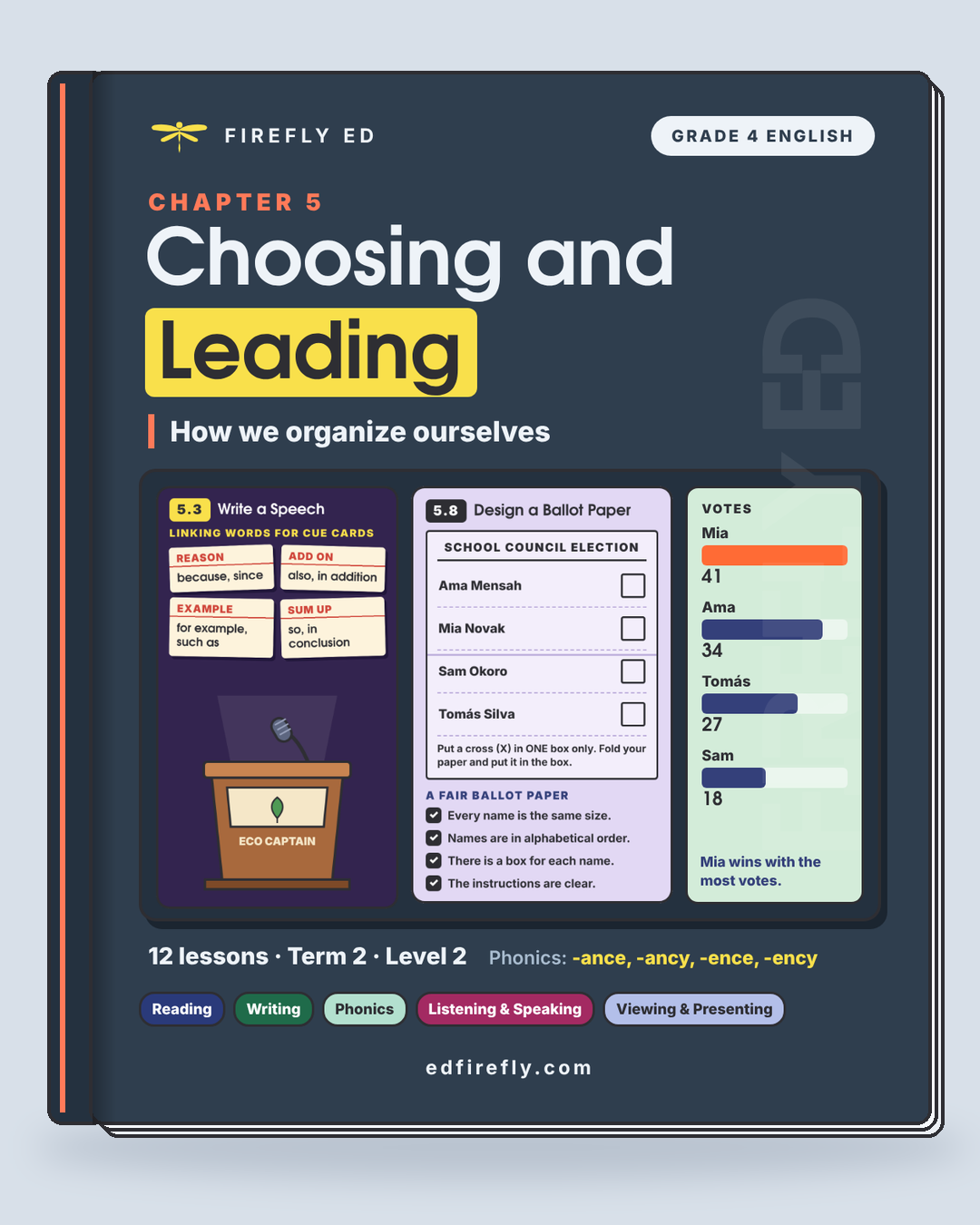
Term 2 | Level 2 | Phonics focus: word endings: -ant, -ance, -ancy, -ent, -ence and -ency
What this chapter is about
Groups make fair decisions in different ways, and leaders have responsibilities to the people they lead.
Theme: How we organize ourselves. It covers class elections, speeches, meetings, agendas and minutes, and what makes a fair decision and a good leader.
Before you start
Before Lesson 5.1, think about a time a group had to make a choice together, such as a game to play or a place to visit. How did you decide? Was it fair? What makes someone a good leader?
Write down your ideas and keep them. You will look at them again at the end of the chapter.
Questions we explore
- How groups make decisions fairly
- What makes a good leader
- How we take part in the decisions that affect us
How each lesson works
Every lesson starts with a Wonder question to think about. Next, you learn something new, see how it is done, try it, and practise on your own. Each lesson ends with Reflect, where you go back to the Wonder question, think about how you learned, and choose something to do at home.
Lessons
Each strand of this chapter has its own page. Open a page to see its lessons.
Download the full chapter as a PDF (free after you subscribe)
Reading: Describe a Character and Find Reasons and Evidence
In Lessons 5.1 and 5.2, you describe a character from what they think, say and do, and explain how an author uses reasons and evidence.
Writing: Write a Persuasive Speech and Meeting Minutes
In Lessons 5.3 and 5.4, you write a persuasive speech with reasons and linking words, and write an agenda and minutes for a class meeting.
Listening and Speaking: Give a Formal Speech and Hold a Class Council Meeting
In Lessons 5.5 and 5.6, you give a speech in formal English, and take a role in a class council meeting with polite phrases to propose, agree and disagree.
Viewing and Presenting: Read a Bar Chart of Votes and Design a Ballot Paper
In Lessons 5.7 and 5.8, you read a bar chart of election results, and design a ballot paper and a campaign poster.
Phonics: -ant, -ance, -ancy, -ent, -ence and -ency
In Lessons 5.9, 5.10 and 5.11, you read and spell words ending in -ant, -ance, -ancy, -ent, -ence and -ency, choose the right ending, and spell six tricky words.
Chapter review
Lesson 5.12 reviews the whole chapter. An optional Challenge with a story and a grammar task follows it. Tap a lesson to open it. Tap the lesson title again, or use the link at the end of the lesson, to close it.
Lesson 5.12: Chapter 5 Review | All strands | About 20 minutes
Term 2 | Level 2
Goal
“I can show what I have learned about characters, reasons and evidence, speeches, meetings, charts, posters and word endings in Chapter 5.”
Words to know
character trait, reason, evidence, agenda, minutes, formal, scale, ballot, ending
Wonder
Think about this question before you start. Say your ideas. You will come back to it at the end of the lesson.
What is one thing you could now do to help your class or family make a fair decision?
Let’s Learn
This part reminds you of what you learned in Chapter 5. Look back at any lesson if you need to.
This review has six tasks. Here is a reminder of what each one checks.
1. Read each task carefully.
2. Try it on your own first.
3. Check your work with the Answer Key.
4. Mark any task that felt hard. Go back to that lesson and try again.
See How It’s Done
Now Try It
1. Is this formal or informal? “Thank you for your kind attention.” ______________
2. a or e? emerg__ncy ______________
Time To Practise
Name: ______________________
1. Reading.
Kai did not want to be chair. But when the meeting got noisy, he stood up and said, “Let’s take turns. Ama first, then Sam.” Everyone went quiet and listened.
a) Write one trait for Kai and one piece of evidence. Trait: ______________ Evidence: ______________________
b) In “Why Do We Vote?”, what evidence does the author give about secret ballots? ______________________
2. Writing.
a) Add a linking word: I would be a good captain. ______________, I always help younger children.
b) Write A for agenda or M for minutes: “Leo will make a sign-up sheet by Wednesday.” ______
3. Oral.
a) Make this formal: Hey guys, wanna hear my idea? ________________________________
b) Write a polite phrase to disagree in a meeting. ________________________________
4. Visual.
Look at the bar chart in Lesson 5.7. a) Who won? ______ b) How many votes did Ama get? ______
c) Give two features of a good campaign poster. ________________________________
5. Phonics.
Write the ending: assist______ (a helper) innoc______ (not guilty) sil______ (no sound) toler______ (noun)
6. Spelling.
a) Circle the correct spelling.
comittee / committee persuade / persuaid goverment / government sugest / suggest
b) Write from dictation.
Listen as an adult reads a sentence aloud slowly. Write it on the line.
__________________________________________________________________
Reflect
Think about these questions. Talk about them with someone at home or at school.
1. Go back to the Wonder question: “What is one thing you could now do to help your class or family make a fair decision?” What do you think now?
2. I was reflective today when I ______________________________.
Being reflective means looking back at your work and thinking how to make it better. For example: I was reflective today when I looked back at a task that was hard and tried again.
Take action: Hold a family vote on something real, using a fair ballot and a bar chart of the results.
Next Steps
If this was easy, try: Write a short speech persuading your family to try something new. Use formal English and three linking words.
If this was hard, go back to: Let’s Learn. Look at the reminder chart, find the lesson for the task that felt hard, and try that lesson again.
Notes for Parents and Teachers
Show notes for parents and teachers
These notes cover this lesson only. How every lesson runs is explained in How to Use This Material.
Time To Practise
- Task 6: Read the sentence in the Answer Key slowly. The learner writes it.
Answer Key
Reveal Answers
Now Try It
1. formal 2. e (emergency), because of the soft g
1. Reading
a) Sample answer: Trait: fair (or calm). Evidence: he stood up and made everyone take turns. b) In 1856, the colony of Victoria, in Australia, became one of the first places to use secret ballot papers.
If it was hard, go back to Lessons 5.1 and 5.2.
2. Writing
a) For instance (also accept For example, In addition) b) M
If it was hard, go back to Lessons 5.3 and 5.4.
3. Oral
a) Good morning, everyone. I would like to share my idea. b) I see it differently, because…
If it was hard, go back to Lessons 5.5 and 5.6.
4. Visual
a) Mia b) 34 c) Any two of: a clear purpose, a big bold title at the top, a few colours that stand out, a picture of the candidate, pictures that match the words.
If it was hard, go back to Lessons 5.7 and 5.8.
5. Phonics
assistant, innocent, silence, tolerance
If it was hard, go back to Lessons 5.9 to 5.11.
6. Spelling
a) committee, persuade, government, suggest b) Dictation sentence: According to the committee, the student council should recommend a quiet reading corner.
If it was hard, go back to Lesson 5.11.
Reflect
2. Any real moment from the lesson that shows the learner was reflective. Examples: “I was reflective today when I looked back at a task that was hard and tried again.” “I was reflective today when I checked my answers and fixed a mistake.”
Challenge: Read-Aloud Story and Grammar | Optional | About 20 minutes
This Challenge is optional. It has a story to listen to and a grammar task.
Part 1: Read-Aloud Story
Listen as an adult reads the story aloud. Then talk about it.
The Ball Problem
Every lunchtime, the small playground was full. The younger children played hopscotch and skipping games, and the older children played football right beside them. One Tuesday, a ball flew across the playground and knocked over a little boy’s drink. He was not hurt, but he was upset.
The next day, the problem was on the class council’s agenda. “I think we should ban balls from the small playground,” said Ama. “Someone might get hurt.”
“But we must have somewhere to play football,” said Sam. “It is the only game some of us really enjoy.” Several children nodded. Priya, the chair, listened to both sides. “Can anyone think of a compromise?” she asked. A compromise, she explained, is an answer where each side gives up a little.
Leo had an idea. “The big field is empty at lunchtime,” he said. “The footballers could use the field, and the small playground could be a ball-free zone.” “That may work,” said Priya, “but the field is muddy in winter.” “Then on wet days, we could take turns,” suggested Ama. “Footballers on Monday, Wednesday and Friday, and quiet games on the other days.”
The council voted, and the idea won. Mia wrote it in the minutes, and Priya took it to the head teacher, who approved it. A week later, the small playground was calm, the field was busy, and nobody’s drink was knocked over again.
Talk about the story
1. What was the problem on the small playground?
2. What are the two sides of the argument? Who speaks for each side?
3. What does compromise mean? What was the compromise in this story?
Hint: Look at what Leo and Ama suggest.
4. What does Priya do that shows she is a fair chair?
5. Do you think the new rule is fair to everyone? Give a reason.
Part 2: Modal Verbs, and Formal and Informal English (Grammar)
Modal verbs go before another verb. They show how likely, how possible or how necessary something is.
Necessary: We must have somewhere to play. A good idea: We should ban balls.
Possible: Someone might get hurt. That may work. We could take turns. Able to: Can anyone think of a compromise? Certain: It will rain tomorrow.
At a meeting, people use formal English: “Can anyone think of a compromise?” With friends, people often use informal English: “Any ideas, guys?”
1. Underline the modal verb in each sentence.
a) Someone might get hurt. b) We must listen to both sides. c) The footballers could use the field.
2. Choose the modal verb that fits best: must, might, should.
a) It ______________ rain later, so bring a coat just in case.
b) You ______________ wear a helmet when you ride a bike. It is the law in many places.
c) I think we ______________ ask the head teacher. It is a good idea.
3. Change how sure each sentence is. Rewrite it with might.
The council will agree. ______________________________________________
4. Formal or informal? Write F or I.
a) “Any ideas, guys?” ____ b) “I would like to propose a compromise.” ____ c) “Nah, that won’t work.” ____
5. Rewrite in formal English for a meeting: “Yeah, let’s do turns, it’s fine.”
______________________________________________
Notes for Parents and Teachers
Show notes for parents and teachers
These notes cover this section only. How every lesson runs is explained in How to Use This Material.
Use the Challenge when the lessons feel easy, or to stretch the learner after Lesson 5.12. The story is for you to read aloud. It uses some harder words on purpose, so talk about them as you read.
Part 1: Read-Aloud Story
Read the story aloud twice. The first time, just enjoy it. The second time, stop at the words in bold and talk about what they mean.
Answer Key
Reveal Answers
Part 1: Talk about the story
1. Older children played football beside younger children, and a ball knocked over a little boy’s drink.
2. One side wants to ban balls from the small playground so nobody gets hurt (Ama). The other side wants somewhere to play football (Sam).
3. An answer where each side gives up a little. The footballers play on the field, the small playground becomes ball-free, and on wet days they take turns.
4. Any one of: she listens to both sides; she asks for a compromise; she points out the problem with the muddy field; she lets the council vote.
5. Answers will vary. Look for: an opinion with a reason.
Part 2: Grammar
1. a) might b) must c) could
2. a) might b) must c) should
3. The council might agree.
4. a) I b) F c) I
5. Sample answer: I agree that we should take turns. I think that is a fair solution.
Look for: modal verbs that match how sure or how necessary something is, and formal words such as I would like to, I agree that, and full sentences.
Try it at home
By the end of this chapter, you could:
- Hold a family meeting with an agenda to plan a meal, a trip or a weekend activity.
- Take turns to be the chair, so that each person leads the meeting once.
- Vote on a family choice using secret ballot papers, and count the votes together.
Lesson 5.12 reviews the chapter. Look back at the ideas from “Before you start” and talk about how they have changed.
Notes for Parents and Teachers
Show notes for parents and teachers
The chapter page and the lessons are written for the learner. How every lesson runs is explained once in How to Use This Material. Each lesson also has its own short notes, after Next Steps.
- The lessons are worksheets. The learner opens a lesson and works on paper next to the screen, or on a printout. Printable PDFs are free to download after you subscribe.
- Before you start: help the learner write down their ideas before Lesson 5.1, and keep them. In Lesson 5.12, look at them together and talk about how they have changed.
For Teachers: IB Details
Show IB and curriculum details
IB theme: How we organize ourselves. This theme is about how people work together in groups, how communities make decisions and share responsibilities, and how organisations are run.
Central idea: Groups make fair decisions in different ways, and leaders have responsibilities to the people they lead.
Key concepts: Function (how does it work?), Responsibility (what is our responsibility?), Perspective (what are the points of view?). Related concepts: fairness, leadership, democracy, cooperation.
Lines of inquiry:
- What makes a good leader
- How groups make decisions fairly
- How we take part in the decisions that affect us
What each lesson covers
| Lesson | Title | Strand | Key concept |
|---|---|---|---|
| 5.1 | Vote for Me! A Story of a Class Election | Reading | Responsibility |
| 5.2 | Why Do We Vote? Reasons and Evidence | Reading | Function |
| 5.3 | Write a Speech: Why You Should Choose Me | Writing | Perspective |
| 5.4 | Write an Agenda and Minutes for a Class Meeting | Writing | Function |
| 5.5 | Give a Speech in Formal English | Speaking | Perspective |
| 5.6 | Hold a Class Council Meeting | Speaking and listening | Responsibility |
| 5.7 | Read a Bar Chart of Votes | Viewing | Function |
| 5.8 | Design a Ballot Paper and a Campaign Poster | Presenting | Function |
| 5.9 | -ant, -ance and -ancy | Reading and spelling | Form |
| 5.10 | -ent, -ence and -ency | Reading and spelling | Form |
| 5.11 | Choosing the Ending, and Tricky Words | Reading and spelling | Form |
| 5.12 | Chapter 5 Review | All strands | Function, Responsibility and Perspective |
Each lesson also matches the national curriculum for England (Year 4) and the US Common Core (Grade 4). The Grade 4 Curriculum Map lists the full standards for every lesson.
Chapters – Index | Next: Chapter 6: News, Adverts and Media →
© 2026 Firefly Ed. All rights reserved. This page may be printed for personal, home and classroom use. It may not be sold, shared online or reproduced for commercial use without written permission. edfirefly.com


Share your thoughts or ask something..