This page has the three phonics lessons of Chapter 4, Our Changing Earth: Lessons 4.9, 4.10 and 4.11. The chapter page has the chapter overview, the chapter review and the PDF download.
Tap a lesson to open it. Tap the lesson title again, or use the link at the end of the lesson, to close it.
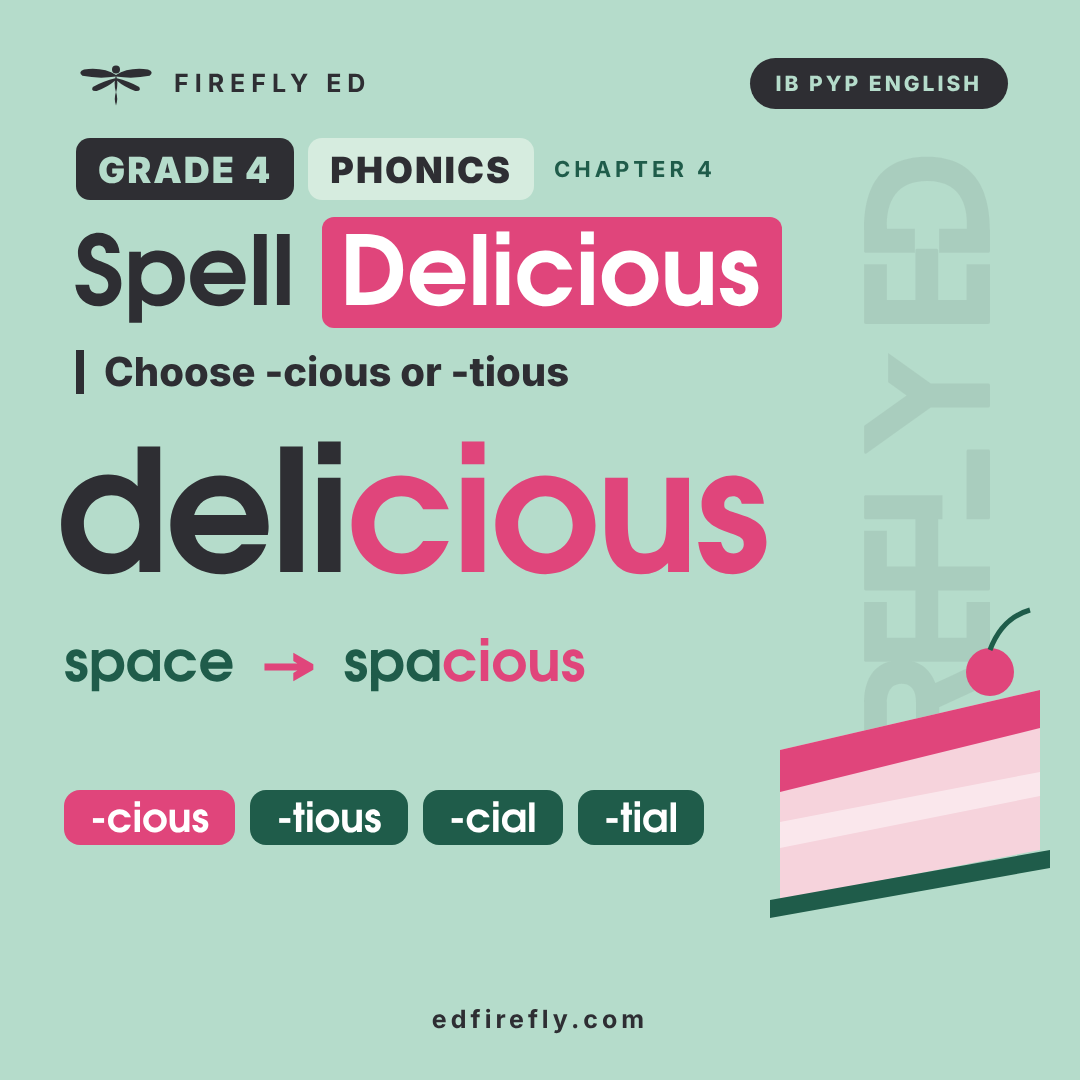
Lesson 4.9: -cious and -tious: delicious, cautious | Phonics | About 20 minutes
Term 2 | Level 2
Goal
“I can read and spell words ending in -cious and -tious, and choose the right ending.”
Words to know
suffix, ending, root word, -cious, -tious, adjective
Wonder
Think about this question before you start. Say your ideas. You will come back to it at the end of the lesson.
The end of delicious and the end of cautious sound the same. Why might they be spelled differently?
Let’s Learn
The endings -cious and -tious both sound like /shus/. They turn words into adjectives (describing words): a delicious meal, a cautious driver.
If the root word ends in -ce, the /sh/ sound is usually spelled with a c. Drop the e, then add -ious:
Watch out:anxious sounds like it should follow the pattern, but it is spelled with an x. Learn it on its own.
See How It’s Done
Now Try It
1. Add -cious or -tious: space → ______________
Hint: Does the root word end in -ce?
2. Which word is spelled correctly? nutricious / nutritious ______________
space ______________ grace ______________ malice ______________ caution ______________
3. Choose the word.
delicious cautious precious spacious nutritious
a) Be ______________ when you walk near the edge of the crater.
b) The new library has a ______________ reading room.
c) Vegetables are ______________ food.
d) The farmer’s mangoes were ______________.
e) Clean water is ______________ after an earthquake.
4. Find the mistake.
Each sentence has one spelling mistake. Write the word correctly.
a) The ambicious climber reached the top. ______________
b) The dog was suspitious of the stranger. ______________
5. Write from dictation.
Listen as an adult reads a sentence aloud slowly. Write it, and then check each -cious or -tious word.
Think about these questions. Talk about them with someone at home or at school.
1. Go back to the Wonder question: “The end of delicious and the end of cautious sound the same. Why might they be spelled differently?” What do you think now?
2. I was reflective today when I ______________________________.
Being reflective means looking back at your work and thinking how to make it better. For example: I was reflective today when I checked the root word before choosing the ending.
Take action: Look at food labels or menus at home. Find any words ending in -cious or -tious, and read them to someone.
Next Steps
If this was easy, try: Write a short description of a market stall using four -cious or -tious words.
If this was hard, go back to: Let’s Learn. Say each word in the picture, clap its syllables and point to its ending.
Notes for Parents and Teachers
Show notes for parents and teachers
These notes cover this lesson only. How every lesson runs is explained in How to Use This Material.
Let’s Learn
Say each word together and clap its syllables.
Time To Practise
Task 5: Read the sentence in the Answer Key slowly. The learner writes it, then checks each -cious or -tious word.
a) cautious b) spacious c) nutritious d) delicious e) precious
4. Find the mistake
a) ambitious b) suspicious
5. Write from dictation
Dictation sentence: The cautious farmers grew delicious fruit in the rich soil near the volcano.
Reflect
2. Any real moment from the lesson that shows the learner was reflective. Examples: “I was reflective today when I checked the root word before choosing the ending.” “I was reflective today when I wrote a word both ways and chose the one that looked right.”
a) Water is ______________ for life.
b) Our class went on a ______________ trip to the volcano museum.
c) The ______________ warning said that people should leave.
d) Last year there was a ______________ eclipse of the sun.
e) Playing team games is a ______________ activity.
Think about these questions. Talk about them with someone at home or at school.
1. Go back to the Wonder question: “Look at special and essential. What letter comes just before the ending in each word?” What do you think now?
2. I was an inquirer today when I ______________________________.
An inquirer asks questions and finds things out. For example: I was an inquirer today when I looked at the letter before the ending to choose -cial or -tial.
Take action: Make a small poster of the -cial and -tial rule with your own examples, and stick it where you do your homework.
Next Steps
If this was easy, try: Find three more -cial or -tial words in a dictionary. Check whether each one follows the rule.
If this was hard, go back to: Let’s Learn. Cover the endings of the words in the picture and say which letter comes just before each ending.
Notes for Parents and Teachers
Show notes for parents and teachers
These notes cover this lesson only. How every lesson runs is explained in How to Use This Material.
Let’s Learn
Say each word together and clap its syllables.
Time To Practise
Task 5: Read the sentence in the Answer Key slowly. The learner writes it, then checks each -cial or -tial word.
a) essential b) special c) official d) partial e) social
3. Rule breakers
initial, financial, commercial
4. Sample answer: A torch is essential, and our special bag is ready by the door.
5. Write from dictation
Dictation sentence: The official leaflet says that water and a torch are essential.
Reflect
2. Any real moment from the lesson that shows the learner was an inquirer. Examples: “I was an inquirer today when I looked at the letter before the ending to choose -cial or -tial.” “I was an inquirer today when I found out why some words break the rule.”
Lesson 4.11: Endings Review, and Tricky Words | Phonics | About 20 minutes
Term 2 | Level 2
Goal
“I can choose between -cious, -tious, -cial and -tial, and spell six tricky words using memory aids.”
Words to know
ending, root word, vowel, consonant, tricky word, memory aid
Wonder
Think about this question before you start. Say your ideas. You will come back to it at the end of the lesson.
Which is harder to spell, delicious or essential? Why?
Let’s Learn
Part 1: The four endings
Ask two questions to choose the ending. /shus/ or /shul/? Then: does the root word end in -ce (for -cious), or is the letter before the ending a vowel or a consonant (for -cial and -tial)?
Part 2: Tricky words
These six words are often spelled wrongly. The tricky letters are in pink. Use the memory aid, then look, say, cover, write and check.
See How It’s Done
Now Try It
1. Which ending? offi____ ______________
Hint: Is the letter before the ending a vowel or a consonant?
2. Which word hides inside environment? ______________
Think about these questions. Talk about them with someone at home or at school.
1. Go back to the Wonder question: “Which is harder to spell, delicious or essential? Why?” What do you think now?
2. I was reflective today when I ______________________________.
Being reflective means looking back at your work and thinking how to make it better. For example: I was reflective today when I looked back at my spelling and fixed the tricky letters.
Take action: Make a set of word cards for the six tricky words. Test a family member, then let them test you.
Next Steps
If this was easy, try: Write a short weather report about a storm, using all six tricky words.
If this was hard, go back to: Part 2 of Let’s Learn. Spell one tricky word at a time, saying the tricky letters aloud.
Notes for Parents and Teachers
Show notes for parents and teachers
These notes cover this lesson only. How every lesson runs is explained in How to Use This Material.
Let’s Learn
Say each word together.
Time To Practise
Task 5: Read the two sentences in the Answer Key slowly. The learner writes them and checks the tricky words.
Answer Key
Reveal Answers
Now Try It
1. -cial (official): the letter before is i, a vowel. 2. iron
a) lightning, environment b) immediately c) physical, develop
4. Sample answer: Lightning can start fires that change the environment.
5. Write from dictation
Dictation sentences: When the lightning flashed, we went inside immediately. A storm can develop very quickly in a hot environment.
Reflect
2. Any real moment from the lesson that shows the learner was reflective. Examples: “I was reflective today when I looked back at my spelling and fixed the tricky letters.” “I was reflective today when I chose a memory aid that works for me.”
IB theme: How the world works. This theme is about the natural world and its laws, how people and nature affect each other, and how people use science to understand the world.
Central idea: Forces inside the Earth and on its surface change the land, and people can prepare for those changes.
Each lesson also matches the national curriculum for England (Year 4) and the US Common Core (Grade 4). The Grade 4 Curriculum Map lists the full standards for every lesson.




Share your thoughts or ask something..