

Term 3 | Level 3 | Phonics focus: contractions, two-syllable words, tricky word review
Lesson 9 – Our Community | Lessons – Index
Lessons
This page has the two listening and speaking lessons in Lesson 9, Our Community: Lessons 9.5 and 9.6. The Lesson 9 page has the Lesson 9 overview, the Lesson 9 review and the PDF download.
Select a lesson to go straight to it. Each lesson ends with a link back to the top of the page.
Lesson 9.5: My Short Talk
Oral | About 20 minutes
Term 3 | Level 3
Goal
“I can plan and give a short talk of four sentences about my town.”
Words to know
talk, opening, closing, speaking tips
Wonder
Think about this question before you start. Say your ideas. You will come back to it at the end of the lesson.
What makes a talk easy to listen to?
Let’s Learn
A talk is when one person speaks to a group, and the others listen. A good short talk is planned before you give it.
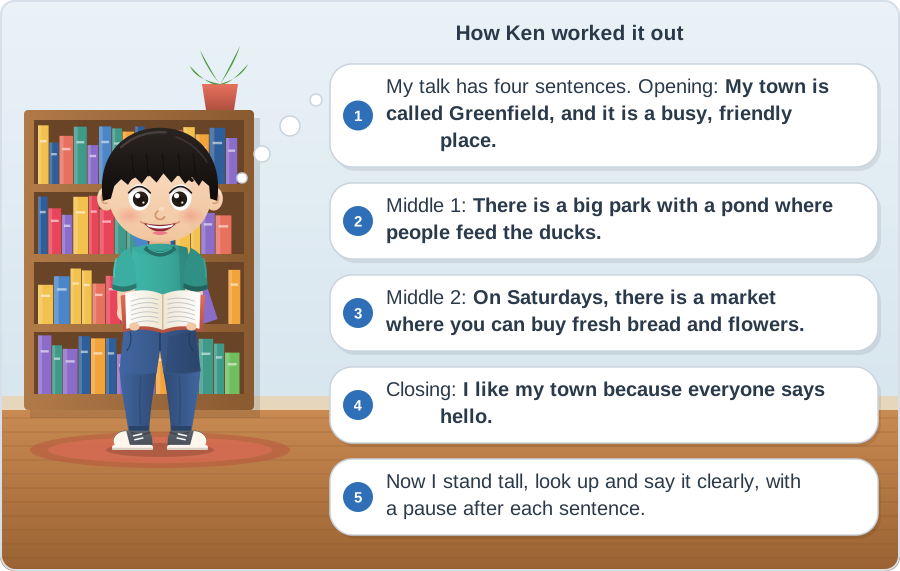
A four-sentence talk has an opening that says what the talk is about, two middle sentences with interesting facts or details, and a closing that sums it up.
When you give your talk, use the four speaking tips. Keep your plan in your hand, but try to look up as much as you can.
See How It’s Done
Now Try It
1. Say an opening sentence about your own town.
Hint: Say the name of your town and one word that describes it.
2. Say one middle sentence with a detail about a place in your town.
Hint: Name a place, then say what people do there.
Time To Practise
Name: ______________________
1. Put the talk in order.
Number the sentences 1 to 4 to make a good talk.
____ There is a library where I borrow books every Friday.
____ So I think Hilltop is a great place to live.
____ My town is called Hilltop, and it is small and quiet.
____ In the summer, the whole town has a picnic in the park.
2. Plan your talk.
Write a few words for each part.
Opening (the name of my town and what it is like): ______________________________________________
Middle 1 (a place and what people do there): ______________________________________________
Middle 2 (another place, event or person): ______________________________________________
Closing (what I think of my town and why): ______________________________________________
3. Give your talk.
Practise your talk twice. Then give it to one or more people at home. After your talk, ask: Do you have a question? Answer their question.
☐ I said four sentences in order.
☐ I stood tall and looked up at my listeners.
☐ I spoke clearly and paused between sentences.
☐ I answered a question from a listener.
What was the question, and what did you answer?
______________________________________________
Reflect
Think about these questions. Talk about them with someone at home or at school.
1. Go back to the Wonder question: “What makes a talk easy to listen to?” What do you think now?
2. I was a communicator today when I ______________________________.
A communicator shares ideas clearly by talking, writing or drawing. For example: I was a communicator today when I gave a short talk about my town.
Take action: Give your short talk about your town to your family at dinner time.
Next Steps
If this was easy, try: Give a longer talk of six sentences about a favourite place in your town. Add a drawing or photo to show.
If this was hard, go back to: Now Try It. Say just an opening and a closing, then add one middle sentence.
Notes for Parents and Teachers
Show notes for parents and teachers
These notes cover this lesson only. How every lesson runs is explained in How to Use This Material.
Let’s Learn
Act out each speaking tip.
See How It’s Done
Say Ken’s talk aloud as if the learner is your audience. Use the speaking tips.
Now Try It
Listen and help the learner build each sentence out loud.
Answer Key
Reveal Answers
Now Try It
1. Sample answer: My town is called Riverside, and it is big and busy.
2. Sample answer: There is a swimming pool where children have lessons on Saturday.
1. Put the talk in order
2 There is a library where I borrow books every Friday.
4 So I think Hilltop is a great place to live.
1 My town is called Hilltop, and it is small and quiet.
3 In the summer, the whole town has a picnic in the park.
Note: the two middle sentences can go in either order. Accept 2 and 3 swapped.
2. Plan your talk
Sample answer: Opening: Riverside, busy. Middle 1: the pool, swimming lessons. Middle 2: the fire station, fire engine visits. Closing: I like it, lots to do.
3. Give your talk
Look for: a talk that follows the plan; four sentences; eye contact for at least part of the talk; a clear, steady voice. It is fine to glance at the plan. Praise the learner for trying, then name one thing to try next time.
Reflect
2. Any real moment from the lesson that shows the learner was a communicator. Examples: “I was a communicator today when I gave a short talk about my town.” “I was a communicator today when I spoke clearly so people could hear me.”
Lesson 9.6: Interview a Helper
Oral | About 20 minutes
Term 3 | Level 3
Goal
“I can ask open questions in an interview, listen carefully and share what I found out.”
Words to know
interview, open question, closed question, notes
Wonder
Think about this question before you start. Say your ideas. You will come back to it at the end of the lesson.
What can we learn by asking good questions?
Let’s Learn
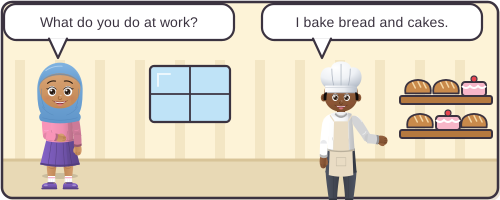
An interview is when we ask someone questions to find out about them. A reporter interviews people to learn facts for a news story.
Good interview questions are open questions. They start with what, where, when, why or how, and they get a long answer. Closed questions only get yes or no: Do you like your job?
A good interviewer listens carefully, looks at the person and asks one more question to find out more. Then they write down the answers so they can share them later.
See How It’s Done
Now Try It
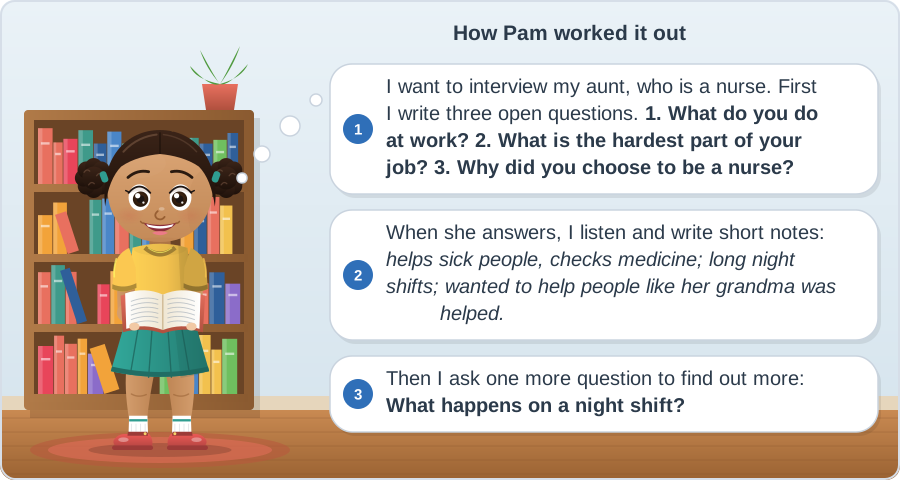
1. Turn this closed question into an open question: “Do you like your job?”
Hint: Start with What or Why.
2. Ask an adult one open question about something they did today. Listen to the answer, then ask one more question to find out more.
Hint: Use a word from the answer in your next question.
Time To Practise
Name: ______________________
1. Open or closed?
Write O for open or C for closed.
a) What do you do at work? ____
b) Do you work on Sundays? ____
c) Is your job hard? ____
d) Why did you choose this job? ____
e) How do you help people? ____
2. Write your questions.
Choose a family member or a helper to interview. Write their name and job. Then write three open questions.
Name and job: ______________________________
1. ______________________________________________?
2. ______________________________________________?
3. ______________________________________________?
3. Do the interview.
Ask your three questions. Write short notes for each answer. Then ask one more question to find out more.
| Question | Notes on the answer |
|---|---|
| 1 | ______________________________________ |
| 2 | ______________________________________ |
| 3 | ______________________________________ |
| Extra | ______________________________________ |
Share it. Tell another person three things you found out. Start with: “I interviewed ______. I found out that…”
☐ I asked open questions. ☐ I listened and wrote notes. ☐ I asked one more question. ☐ I shared what I found out.
Reflect
Think about these questions. Talk about them with someone at home or at school.
1. Go back to the Wonder question: “What can we learn by asking good questions?” What do you think now?
2. I was an inquirer today when I ______________________________.
An inquirer asks questions and finds things out. For example: I was an inquirer today when I asked open questions to find out about a job.
Take action: Interview another person about their job, such as a shopkeeper or a neighbour, with an adult.
Next Steps
If this was easy, try: Interview a second person with a different job. Tell someone how the two jobs are the same and different.
If this was hard, go back to: Now Try It. Practise turning three closed questions into open questions before writing your own.
Notes for Parents and Teachers
Show notes for parents and teachers
These notes cover this lesson only. How every lesson runs is explained in How to Use This Material.
Let’s Learn
Point to the question and the answer in the picture.
See How It’s Done
Pam’s thoughts show how to plan open questions and take short notes in an interview.
Answer Key
Reveal Answers
Now Try It
1. Sample answer: What do you like about your job? or Why do you like your job?
2. Look for: an open question, careful listening and a follow-up that uses the answer.
1. Open or closed?
a) O
b) C
c) C
d) O
e) O
2. Write your questions
Sample answer: Name and job: Grandpa, farmer. 1. What do you grow on your farm? 2. When do you start work in the morning? 3. Why do you like being a farmer?
3. Do the interview
Sample notes: 1. rice and vegetables; 2. at five o’clock, before it is hot; 3. likes being outside; Extra: the rain matters most.
Sample share: I interviewed my grandpa. I found out that he grows rice and vegetables. He starts work at five o’clock. He likes being outside all day.
Look for: three open questions; short notes, not full sentences; a follow-up question; three facts shared in full sentences.
Reflect
2. Any real moment from the lesson that shows the learner was an inquirer. Examples: “I was an inquirer today when I asked open questions to find out about a job.” “I was an inquirer today when I found out how a helper helps people.”
For Teachers: IB Details
Show IB and curriculum details
IB theme: How we organize ourselves. It covers the communities we belong to, the jobs people do, how people work together, and how messages and ideas are shared.
Central idea: People in a community have different roles, and they share ideas and messages to help one another.
| Lesson | Title | Strand | Key concept |
|---|---|---|---|
| 9.5 | My Short Talk | Speaking | Function |
| 9.6 | Interview a Helper | Listening and speaking | Function |
Each lesson also matches the national curriculum for England (Year 1) and the US Common Core (Grade 1). The Grade 1 Curriculum Map lists the full standards for every lesson.
← Back to Lesson 9 – Our Community | Lessons – Index
© 2026 Firefly Ed. All rights reserved. This page may be printed for personal, home and classroom use. It may not be sold, shared online or reproduced for commercial use without written permission. edfirefly.com

Share your thoughts or ask something..