
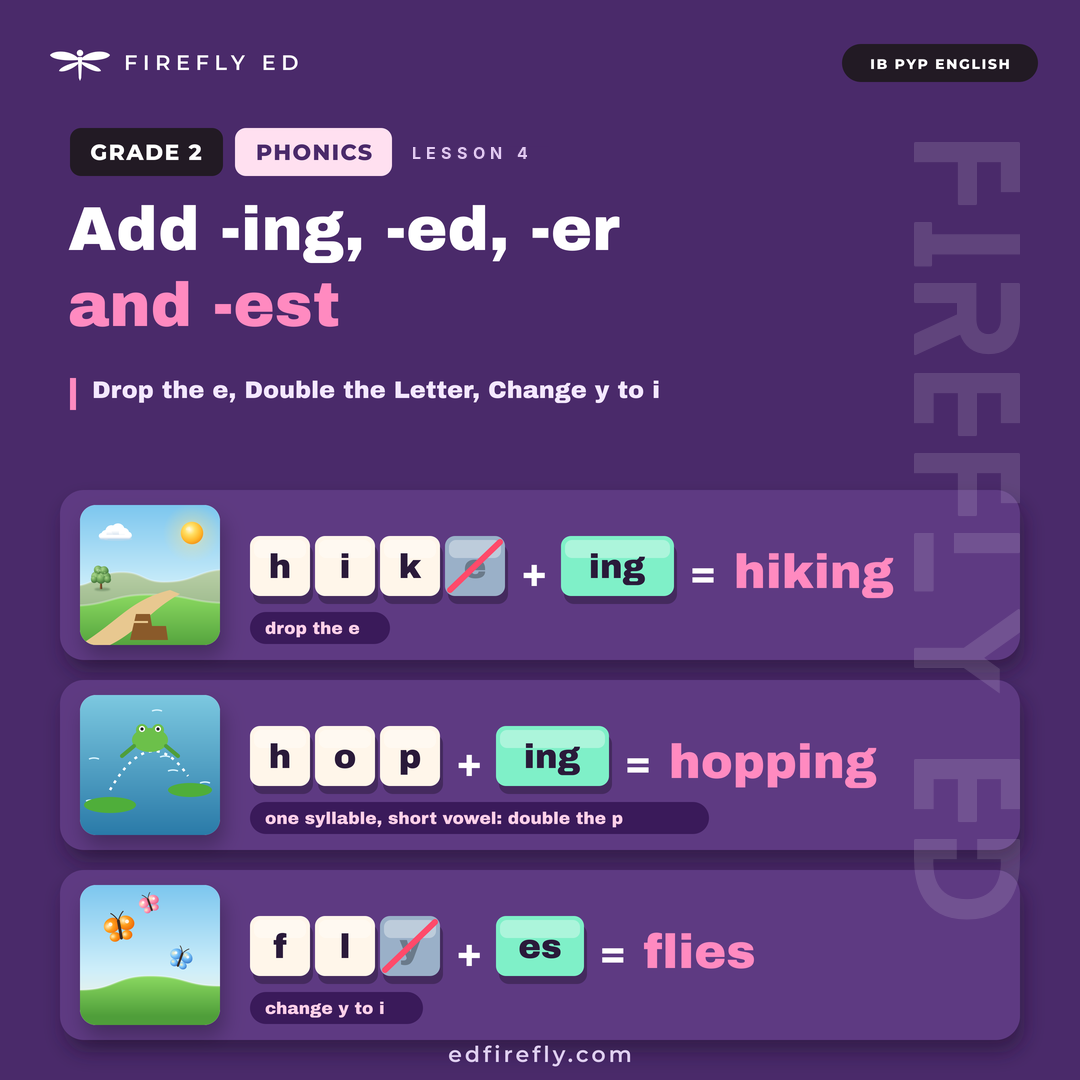
Term 2 | Level 2 | Phonics focus: adding -ing, -ed, -er and -est: drop the e, double the letter, y to i
Lesson 4 – Plants and Growing | Lessons – Index
Lessons
This page has the three phonics lessons of Lesson 4, Plants and Growing: Lessons 4.9, 4.10 and 4.11. The Lesson 4 page has the Lesson 4 overview, the Lesson 4 review and the PDF download.
Select a lesson to go straight to it. Each lesson ends with a link back to the top of the page.
- Lesson 4.9: Adding Endings to Words Ending in e
- Lesson 4.10: Doubling the Last Letter
- Lesson 4.11: y to i, and Tricky Words
Lesson 4.9: Adding Endings to Words Ending in e
Phonics | About 20 minutes
Term 2 | Level 2
Goal
“I can add -ing, -ed, -er, -est and -y to words ending in e by dropping the e, and know when to keep it.”
Words to know
suffix, root word, drop the e, vowel, consonant
Wonder
Think about this question before you start. Say your ideas. You will come back to it at the end of the lesson.
Why does hike lose its e when it becomes hiking?
Let’s Learn
A suffix is a group of letters added to the end of a word. In Grade 1, you added -ing, -ed, -er and -est to words like jump and tall.
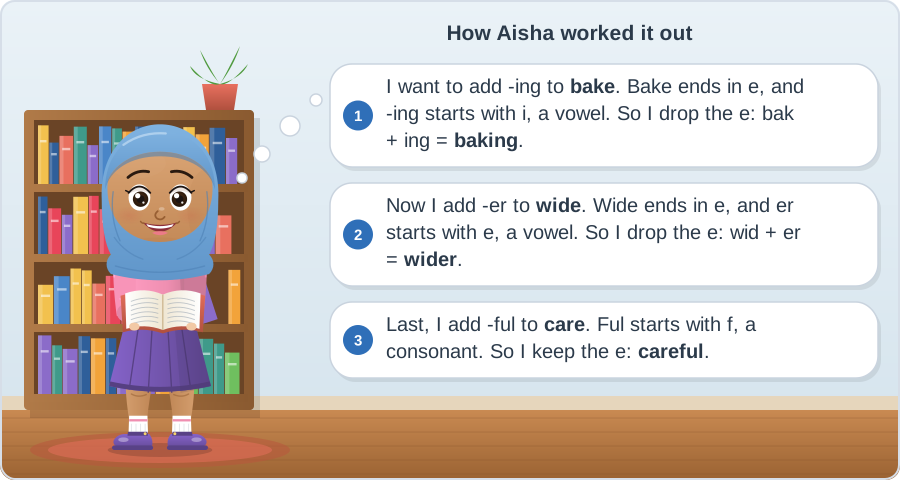
When a word ends in e, and the suffix starts with a vowel, drop the e before you add the suffix.
The suffixes -ing, -ed, -er, -est and -y all start with a vowel (y works like a vowel here), so the e goes.
Watch out: if the suffix starts with a consonant, keep the e: hope + ful = hopeful, late + ly = lately.
See How It’s Done
Now Try It
1. Add -ing to ride. Do you keep the e or drop it?
Hint: Does -ing start with a vowel?
2. Sam wrote larger for large + er, and safely for safe + ly. Are both right? Why?
Hint: Look at the first letter of each suffix.
Time To Practise
Name: ______________________
1. Add the suffixes.
| Word | + ing | + ed |
|---|---|---|
| dance | ______________ | ______________ |
| skate | ______________ | ______________ |
| chase | ______________ | ______________ |
| hope | ______________ | ______________ |
| Word | + er | + est |
|---|---|---|
| late | ______________ | ______________ |
| wise | ______________ | ______________ |
| brave | ______________ | ______________ |
2. Keep the e or drop it?
Hint: Look at the first letter of the suffix: vowel or consonant?
a) hope + ful = ______________ b) stone + y = ______________ c) close + ly = ______________
d) make + er = ______________ e) use + ful = ______________ f) bone + y = ______________
3. Fix the plant diary.
Leo wrote about his seeds. He made five spelling mistakes with suffixes. Write the five words correctly.
On Monday I was writeing in my diary. My bean had made the bigest leaf yet! I placeed the pot nearer the window. The sun was shineing, and the leaves looked shiney and green.
1. ______________ 2. ______________ 3. ______________ 4. ______________ 5. ______________
Hint: One mistake is a doubling word, which you will learn about in Lesson 4.10.
4. Listen and write the sentence.
__________________________________________________________________
Reflect
Think about these questions. Talk about them with someone at home or at school.
1. Go back to the Wonder question: “Why does hike lose its e when it becomes hiking?” What do you think now?
2. I was a thinker today when I ______________________________.
A thinker thinks carefully to work things out. For example: I was a thinker today when I worked out when to drop the e and when to keep it.
Take action: Find five words with -ing or -ed in a book. Write the root word for each one. Did the root word end in e?
Next Steps
If this was easy, try: Make a list of ten words ending in e. Add a suffix to each, and sort them into keep the e and drop the e.
If this was hard, go back to: Let’s Learn. Practise with -ing only first: hike, ride, bake, smile. Cross out the e each time before adding -ing.
Notes for Parents and Teachers
Show notes for parents and teachers
These notes cover this lesson only. How every lesson runs is explained in How to Use This Material.
Let’s Learn
Point to the crossed-out e in each word sum.
See How It’s Done
Write each word sum on paper and cross out the e as you go through Aisha’s thoughts.
Time To Practise
- Task 4: Read the sentence from the Answer Key aloud twice.
Answer Key
Reveal Answers
Now Try It
1. riding. Drop the e, because -ing starts with a vowel.
2. Yes, both are right. Er starts with a vowel, so the e of large is dropped and er is added: larger. Ly starts with a consonant, so the e of safe stays: safely.
1. Add the suffixes
dancing, danced; skating, skated; chasing, chased; hoping, hoped
later, latest; wiser, wisest; braver, bravest
2. Keep or drop
a) hopeful (keep)
b) stony (drop)
c) closely (keep)
d) maker (drop)
e) useful (keep)
f) bony (drop)
3. Fix the diary
writeing: writing
bigest: biggest
placeed: placed
shineing: shining
shiney: shiny
Look for: “nearer” and “looked” are already correct.
4. Dictation
We were hiking and the sun was shining, so we smiled.
Look for: the e dropped in hiking, shining and smiled.
Reflect
2. Any real moment from the lesson that shows the learner was a thinker. Examples: “I was a thinker today when I worked out when to drop the e and when to keep it.” “I was a thinker today when I found the five mistakes in Leo’s plant diary.”
Lesson 4.10: Doubling the Last Letter
Phonics | About 20 minutes
Term 2 | Level 2
Goal
“I can double the last letter of a short word before -ing, -ed, -er, -est or -y when it has one short vowel and one final consonant.”
Words to know
suffix, double, short vowel, consonant, root word
Wonder
Think about this question before you start. Say your ideas. You will come back to it at the end of the lesson.
Why does hop become hopping, but hope becomes hoping?
Let’s Learn
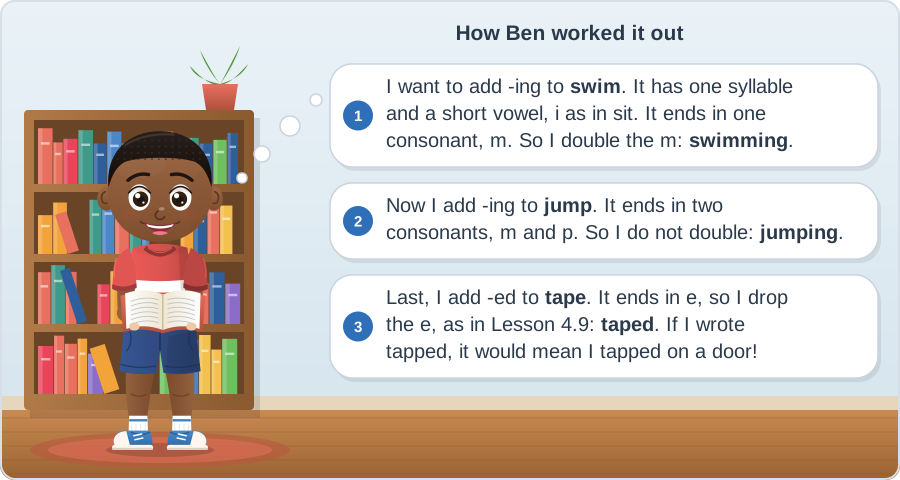
Some short words double their last letter before a suffix that starts with a vowel (-ing, -ed, -er, -est, -y).
Double the last letter when the word has:
- one syllable,
- one short vowel,
- and ends in one consonant.
Do not double when:
- the word ends in two consonants: jump → jumping, help → helped
- the vowel sound is long, spelt with two letters: rain → raining, cool → cooler
- the word ends in x: mix → mixing, box → boxer
The double letter keeps the vowel short. Compare hoping (from hope) and hopping (from hop).
See How It’s Done
Now Try It
1. Add -ing to sit and to sing. Which one doubles? Why?
Hint: How many consonants are at the end of each word?
2. Add -er to fat and to fast.
Hint: Check the three rules for each word.
Time To Practise
Name: ______________________
1. Double or not? Add -ing.
| Word | + ing | Doubled? (yes or no) |
|---|---|---|
| run | ______________ | ______ |
| clap | ______________ | ______ |
| help | ______________ | ______ |
| wait | ______________ | ______ |
| fix | ______________ | ______ |
| dig | ______________ | ______ |
2. Add the suffix.
a) sad + est = ______________ b) drop + ed = ______________ c) fun + y = ______________
d) hot + er = ______________ e) plant + ed = ______________ f) green + er = ______________
3. Which word is it?
Circle the right word. Think about the root word.
a) The rabbit was (hoping / hopping) across the garden.
b) I am (hoping / hopping) my seeds will grow.
c) Mia (taped / tapped) her drawing to the wall.
d) Leo (taped / tapped) on the window to say hello.
4. Listen and write the sentence.
__________________________________________________________________
Reflect
Think about these questions. Talk about them with someone at home or at school.
1. Go back to the Wonder question: “Why does hop become hopping, but hope becomes hoping?” What do you think now?
2. I was a thinker today when I ______________________________.
A thinker thinks carefully to work things out. For example: I was a thinker today when I checked the three rules before doubling the last letter.
Take action: Play a doubling game with someone at home: one person says a short word, the other spells it with -ing.
Next Steps
If this was easy, try: Write five pairs like hoping and hopping, or taping and tapping. Use each word in a sentence.
If this was hard, go back to: Let’s Learn. Practise with -ing on four words that double: hop, run, sit, dig. Then try two that do not: jump, rain.
Notes for Parents and Teachers
Show notes for parents and teachers
These notes cover this lesson only. How every lesson runs is explained in How to Use This Material.
Let’s Learn
Check the three rules with your fingers: one syllable, short vowel, one consonant.
See How It’s Done
Write each word and its new form on paper as you go through Ben’s thoughts.
Time To Practise
- Task 4: Read the sentence from the Answer Key aloud twice.
Answer Key
Reveal Answers
Now Try It
1. sitting doubles, because sit ends in one consonant after a short vowel. singing does not, because sing ends in two consonants, n and g.
2. fatter, faster
1. Double or not
running, yes
clapping, yes
helping, no (two consonants)
waiting, no (long vowel ai)
fixing, no (x is never doubled)
digging, yes
2. Add the suffix
a) saddest
b) dropped
c) funny
d) hotter
e) planted
f) greener
3. Which word
a) hopping
b) hoping
c) taped
d) tapped
Look for: the learner names the root word each time: hop or hope, tap or tape.
4. Dictation
The runner was hopping and skipping in the sunny garden.
Look for: the double letters in runner, hopping, skipping and sunny.
Reflect
2. Any real moment from the lesson that shows the learner was a thinker. Examples: “I was a thinker today when I checked the three rules before doubling the last letter.” “I was a thinker today when I chose hopping or hoping by thinking about the root word.”
Lesson 4.11: y to i, and Tricky Words
Phonics | About 20 minutes
Term 2 | Level 2
Goal
“I can change y to i before -es, -ed, -er and -est, keep the y before -ing or after a vowel, and spell six tricky words.”
Words to know
suffix, y to i, consonant, vowel, tricky word
Wonder
Think about this question before you start. Say your ideas. You will come back to it at the end of the lesson.
Why does cry become cries, but play becomes plays?
Let’s Learn
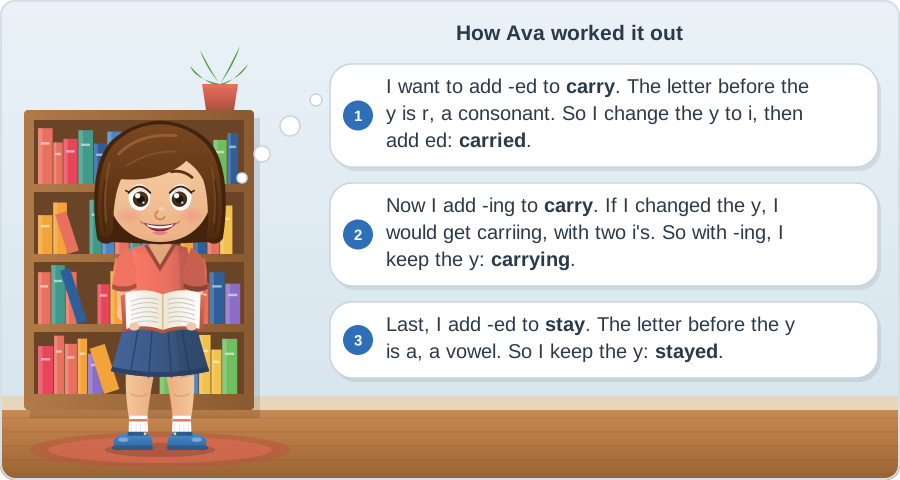
When a word ends in a consonant + y, change the y to i before you add -es, -ed, -er or -est.
- Keep the y before -ing, or the word would have two i’s: cry → crying, copy → copying.
- Keep the y when there is a vowel before it: play → plays, played; key → keys; enjoy → enjoyed.
Tricky words. Learn these by heart: great, break, steak, pretty, beautiful, after. In great, break and steak, the ea says ai. In pretty, the e says i. Beautiful has eau, which says “yoo”.
See How It’s Done
Now Try It
1. Add -es to fly. Do you change the y?
Hint: Is the letter before the y a vowel or a consonant?
2. Add -ing to fly. Do you change the y this time? Why?
Hint: What would happen if you did?
Time To Practise
Name: ______________________
1. Add the suffixes.
| Word | + es | + ed | + ing |
|---|---|---|---|
| try | ______________ | ______________ | ______________ |
| hurry | ______________ | ______________ | ______________ |
| reply | ______________ | ______________ | ______________ |
| Word | + er | + est |
|---|---|---|
| funny | ______________ | ______________ |
| tiny | ______________ | ______________ |
| early | ______________ | ______________ |
2. Change the y or keep it?
Hint: Check the letter before the y, and check the suffix.
a) pony + es = ______________ b) play + ed = ______________ c) dry + ing = ______________
d) berry + es = ______________ e) monkey + s = ______________ f) lucky + est = ______________
3. Tricky words.
Look at each word. Say it. Cover it. Write it. Check it.
| Word | Write it | Word | Write it |
|---|---|---|---|
| great | ______________ | pretty | ______________ |
| break | ______________ | beautiful | ______________ |
| steak | ______________ | after | ______________ |
Fill each gap with a tricky word.
a) Be careful not to ______________ the flower’s stem.
b) The garden looked ______________ when all the roses opened.
c) We water the plants ______________ school.
d) Mia’s sunflower grew to a ______________ height.
4. Listen and write the sentence.
__________________________________________________________________
Reflect
Think about these questions. Talk about them with someone at home or at school.
1. Go back to the Wonder question: “Why does cry become cries, but play becomes plays?” What do you think now?
2. I was knowledgeable today when I ______________________________.
Being knowledgeable means knowing things and using what you know. For example: I was knowledgeable today when I knew to keep the y in crying so there are not two i’s.
Take action: Look at food labels and books for plurals ending in -ies, such as berries or cherries. What was the root word?
Next Steps
If this was easy, try: Write a short plant story with five words that change y to i and two that keep the y. Underline them.
If this was hard, go back to: Let’s Learn. Work on -es only first: cry, fly, try, dry. Then try -ing with the same words.
Notes for Parents and Teachers
Show notes for parents and teachers
These notes cover this lesson only. How every lesson runs is explained in How to Use This Material.
Let’s Learn
Point to the y that changes in each word sum.
See How It’s Done
Write carried, carrying and stayed on paper as you go through Ava’s thoughts.
Time To Practise
- Task 4: Read the sentence from the Answer Key aloud twice.
Answer Key
Reveal Answers
Now Try It
1. Yes: flies. The letter before the y is l, a consonant.
2. No: flying. If you changed the y, the word would have two i’s next to each other.
1. Add the suffixes
try: tries, tried, trying
hurry: hurries, hurried, hurrying
reply: replies, replied, replying
funny: funnier, funniest
tiny: tinier, tiniest
early: earlier, earliest
2. Change or keep
a) ponies (change)
b) played (keep, vowel before y)
c) drying (keep, -ing)
d) berries (change)
e) monkeys (keep, vowel before y)
f) luckiest (change)
3. Tricky words
a) break
b) beautiful (accept pretty or great)
c) after
d) great
Look for: accept any tricky word that makes sense and is spelt correctly.
4. Dictation
After the rain, the pretty flowers looked happier and the berries were bigger.
Look for: y to i in happier and berries, the double g in bigger, and the tricky words after and pretty.
Reflect
2. Any real moment from the lesson that shows the learner was knowledgeable. Examples: “I was knowledgeable today when I knew to keep the y in crying so there are not two i’s.” “I was knowledgeable today when I spelt beautiful and pretty from memory.”
For Teachers: IB Details
Show IB and curriculum details
IB theme: How the world works. This theme is about the natural world and its laws: how living things grow and change, and how people find out about the world around them.
Central idea: Plants are living things that need the right conditions to grow, change and make new plants.
| Lesson | Title | Strand | Key concept |
|---|---|---|---|
| 4.9 | Adding Endings to Words Ending in e | Reading and spelling | Change |
| 4.10 | Doubling the Last Letter | Reading and spelling | Change |
| 4.11 | y to i, and Tricky Words | Reading and spelling | Change |
Each lesson also matches the national curriculum for England (Year 2) and the US Common Core (Grade 2). The Grade 2 Curriculum Map lists the full standards for every lesson.
← Back to Lesson 4 – Plants and Growing | Lessons – Index
© 2026 Firefly Ed. All rights reserved. This page may be printed for personal, home and classroom use. It may not be sold, shared online or reproduced for commercial use without written permission. edfirefly.com


Share your thoughts or ask something..