
Term 2 | Level 2 | Phonics focus: adding -ing, -ed, -er and -est: drop the e, double the letter, y to i
Lesson 4 – Plants and Growing | Lessons – Index
Lessons
This page has the two writing lessons of Lesson 4, Plants and Growing: Lessons 4.3 and 4.4. The Lesson 4 page has the Lesson 4 overview, the Lesson 4 review and the PDF download.
Select a lesson to go straight to it. Each lesson ends with a link back to the top of the page.
Lesson 4.3: Write a Plant Fact File
Writing | About 20 minutes
Term 2 | Level 2
Goal
“I can sort facts under headings, leave out opinions, turn notes into sentences and write my own plant fact file.”
Words to know
fact file, heading, fact, opinion, notes, caption
Wonder
Think about this question before you start. Say your ideas. You will come back to it at the end of the lesson.
How do writers organise facts so readers can find them quickly?
Let’s Learn
A fact file is a short information page about one topic. The facts are grouped under headings, so the reader can find them quickly.
Fact file: The Sunflower
| What it looks like | Sunflowers have a tall green stem, big rough leaves and a large yellow flower with a brown middle. |
| Where it grows | Sunflowers first grew wild in North America. Now people grow them all over the world. |
| What it needs | Sunflowers need lots of sun, water and space to grow. |
| Amazing fact | Some sunflowers grow taller than 3 metres. That is nearly twice as tall as a grown-up! |
A fact file uses:
- facts, not opinions. A fact can be checked: Sunflowers need sun. An opinion is what someone thinks: Sunflowers are the prettiest flowers.
- full sentences in the present tense: sunflowers grow, need and have.
- a picture with a caption.
See How It’s Done
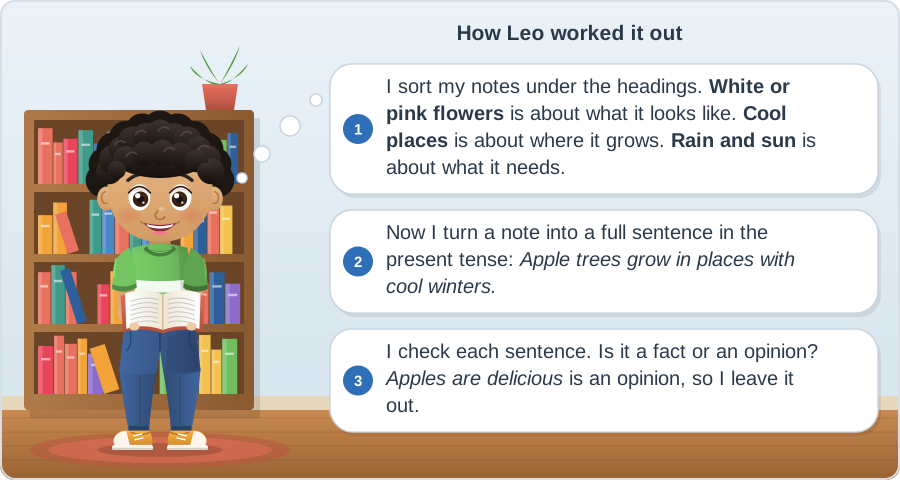
Notes for a fact file on the apple tree: grows in cool places, white or pink flowers in spring, needs rain and sun, apples in autumn.
Now Try It
1. Fact or opinion? a) Roses have thorns on their stems. b) Roses smell the nicest of all flowers.
Hint: Could you check it? Or is it what someone thinks?
2. Turn this note into a full sentence: oak trees, acorns, autumn.
Hint: Use the present tense: Oak trees…
Time To Practise
Name: ______________________
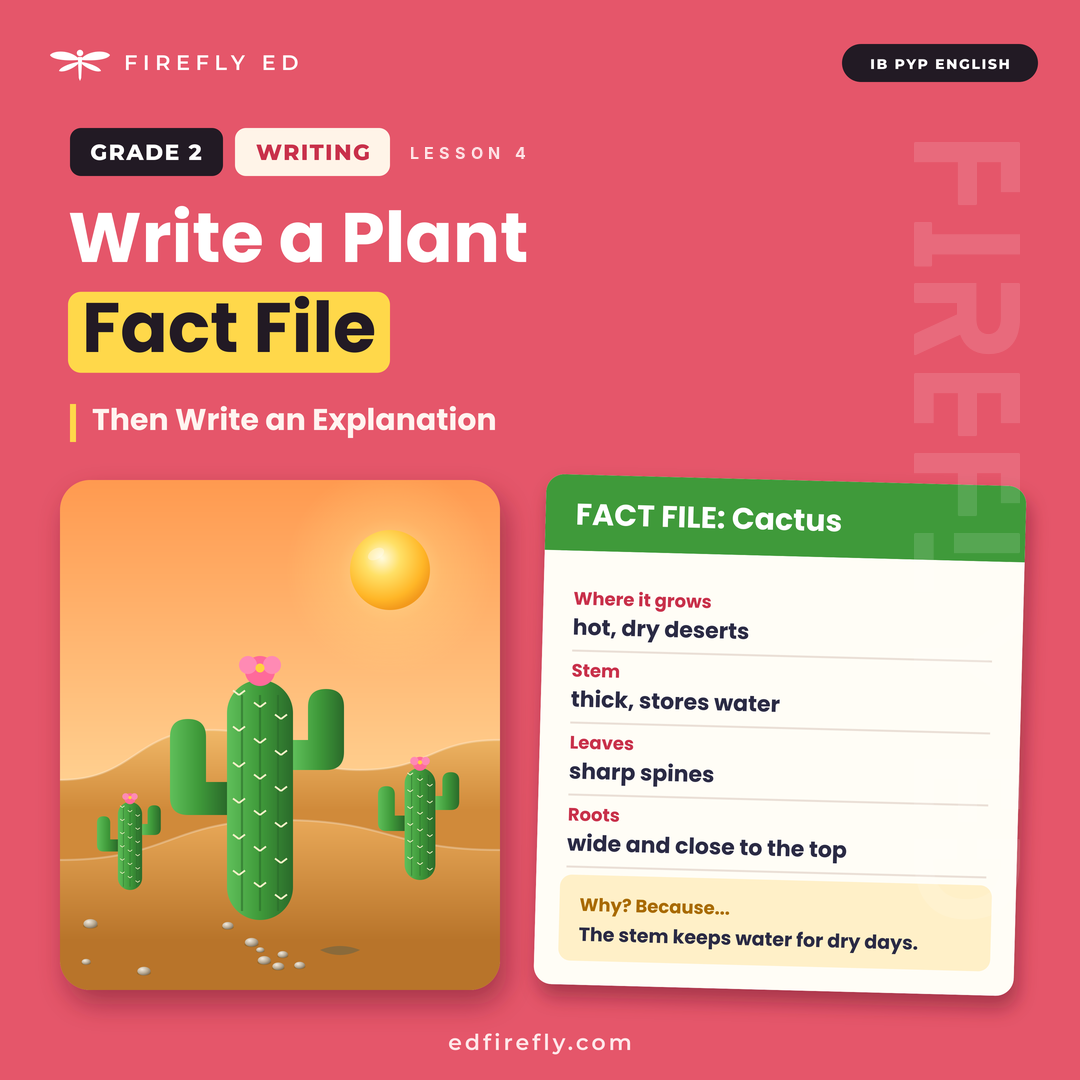
1. Sort the facts about the cactus.
Write the letter of each fact under the right heading. One sentence is an opinion. Write it in the last row.
a) Cacti grow in hot, dry deserts. b) A cactus stores water inside its thick stem. c) Cacti are the best plants to have at home. d) Most cacti have sharp spines instead of leaves. e) Cacti need lots of sun and only a little water. f) Some cacti live for more than 100 years.
| Heading | Letters |
|---|---|
| What it looks like | __________ |
| Where it grows | __________ |
| What it needs | __________ |
| Amazing fact | __________ |
| Opinion (leave it out) | __________ |
2. Turn the notes into sentences.
a) bamboo, grows very fast → ______________________________________________
b) water lily, floats on ponds → ______________________________________________
c) tomato plant, needs sun, warm → ______________________________________________
3. Make your own fact file.
Choose a plant. Find facts with an adult in a book or on a website for children. Write at least one full sentence under each heading. Draw a picture and write a caption.
Fact file: ______________________________
What it looks like: __________________________________________________
Where it grows: __________________________________________________
What it needs: __________________________________________________
Amazing fact: __________________________________________________
Hint: Check every sentence. Is it a fact or an opinion?
Caption: ______________________________________________
Check your work. Tick each one you did.
☐ a title ☐ a sentence under each heading ☐ facts only, no opinions ☐ present tense ☐ a picture with a caption
Reflect
Think about these questions. Talk about them with someone at home or at school.
1. Go back to the Wonder question: “How do writers organise facts so readers can find them quickly?” What do you think now?
2. I was an inquirer today when I ______________________________.
An inquirer asks questions and finds things out. For example: I was an inquirer today when I found facts about my plant in a book with an adult.
Take action: Put your fact file on the wall or the fridge. Ask someone at home to find one fact using only the headings.
Next Steps
If this was easy, try: Make a two-page fact file comparing two plants, such as a cactus and a water lily. Use the same headings for both.
If this was hard, go back to: Task 1. Read each fact aloud with an adult. Say which heading it belongs to before you write the letter.
Notes for Parents and Teachers
Show notes for parents and teachers
These notes cover this lesson only. How every lesson runs is explained in How to Use This Material.
Let’s Learn
Read the sunflower fact file together and point to each heading.
See How It’s Done
Write the four headings on paper and sort the notes under them as you go through Leo’s thoughts.
Time To Practise
- Task 3: Check the learner’s work together, and tick each one you see.
Answer Key
Reveal Answers
Now Try It
1. a) fact b) opinion
2. Sample answer: Oak trees grow acorns in autumn.
1. Sort the facts
What it looks like: d
Where it grows: a
What it needs: e (accept b)
Amazing fact: f (accept b)
Opinion: c
Look for: b can go under “What it needs” or “Amazing fact” if the learner explains why.
2. Notes to sentences
Sample answers:
a) Bamboo grows very fast.
b) Water lilies float on ponds.
c) Tomato plants need sun and warm weather.
3. Fact file
Answers will vary. Look for: four or more ticks, and facts that the learner can show came from a book or website.
Reflect
2. Any real moment from the lesson that shows the learner was an inquirer. Examples: “I was an inquirer today when I found facts about my plant in a book with an adult.” “I was an inquirer today when I sorted the cactus facts under the right headings.”
Lesson 4.4: Explain Why: What Plants Need
Writing | About 20 minutes
Term 2 | Level 2
Goal
“I can write an explanation using because, so and if … then, and use evidence from an experiment.”
Words to know
explanation, cause, effect, because, so, if … then
Wonder
Think about this question before you start. Say your ideas. You will come back to it at the end of the lesson.
What would happen to a plant with no light or no water?
Let’s Learn
An explanation tells the reader how or why something happens.
- It starts with a title, often a question: Why Do Plants Need Light?
- An opening sentence says what will be explained.
- The middle explains each step or reason. It uses cause and effect words.
- A closing sentence sums up.
| Word | What it shows | Example |
|---|---|---|
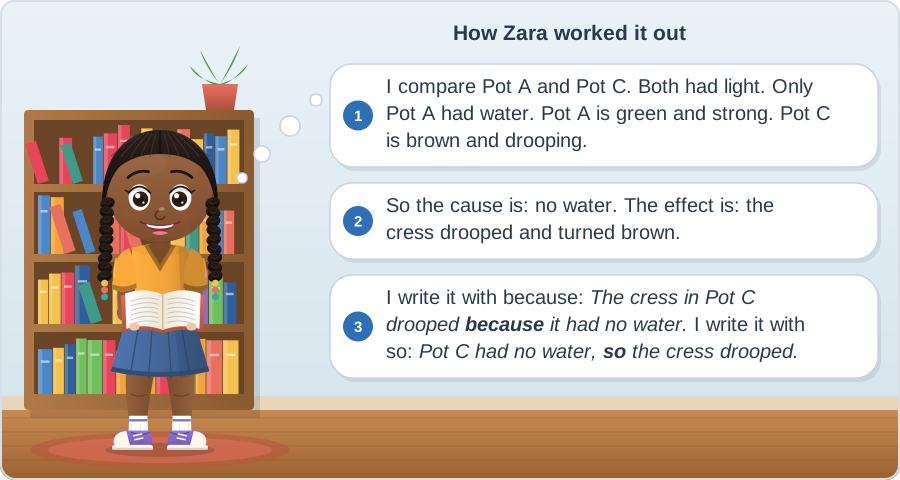
| because | the reason (the cause) | The cress turned brown because it had no water. |
| so | what happened next (the effect) | The cress had no water, so it turned brown. |
| if … then | what will happen | If a plant has no light, then its leaves turn yellow. |
See How It’s Done
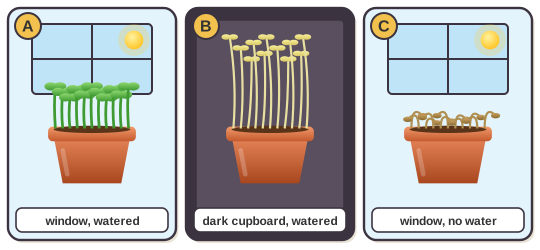
Ava and Sam grew cress in three pots for one week. Each pot had something different.
Now Try It
Use the picture of the three pots in See How It’s Done.
1. Which two pots had water? Which one of those had no light?
Hint: Read the label under each pot.
2. Finish the sentence: “The cress in Pot B is pale yellow because…”
Hint: What was missing in the cupboard?
Time To Practise
Name: ______________________
1. Look at the experiment again.
a) Which pot grew the healthiest cress? Pot ______
b) The cress in Pot B grew tall, thin and pale. Why do you think it did that?
Hint: Plants try to grow towards something they need.
__________________________________________________________________
c) What two things do plants need, according to this experiment?
______________________ and ______________________
2. Join the cause and the effect.
Use because or so. Write the full sentence.
a) The soil was dry. The seeds did not grow. (so)
__________________________________________________________________
b) The plant leaned towards the window. It needed light. (because)
__________________________________________________________________
c) Bees carried the pollen. New seeds could grow. (so)
__________________________________________________________________
3. Write an explanation.
Title: Why Do Plants Need Light and Water?
Write an opening sentence, three sentences that explain, and a closing sentence. Use because, so, and if … then. Use the experiment as your evidence.
__________________________________________________________________
__________________________________________________________________
__________________________________________________________________
__________________________________________________________________
__________________________________________________________________
Check your work. Tick each one you did.
☐ an opening sentence ☐ because ☐ so ☐ if … then ☐ evidence from the experiment ☐ a closing sentence
Reflect
Think about these questions. Talk about them with someone at home or at school.
1. Go back to the Wonder question: “What would happen to a plant with no light or no water?” What do you think now?
2. I was a thinker today when I ______________________________.
A thinker thinks carefully to work things out. For example: I was a thinker today when I used the cress experiment as evidence in my explanation.
Take action: Try the cress experiment yourself with three pots. After one week, compare your results with Ava and Sam’s.
Next Steps
If this was easy, try: Plan a new experiment: what would happen to cress grown in a cold fridge? Predict the result and explain why using if … then.
If this was hard, go back to: Task 2. Say each joined sentence aloud with an adult before you write it. Then write two sentences only for Task 3.
Notes for Parents and Teachers
Show notes for parents and teachers
These notes cover this lesson only. How every lesson runs is explained in How to Use This Material.
Let’s Learn
Say each example sentence together.
See How It’s Done
Look at the three pots together before Zara’s thoughts.
Time To Practise
- Task 3: Check the learner’s work together, and tick each one you see.
Answer Key
Reveal Answers
Now Try It
1. Pots A and B had water. Pot B had no light.
2. …because it was in a dark cupboard with no light.
1. The experiment
a) A
b) Sample answer: It was trying to reach light. In the dark, plants grow tall and thin to find light.
c) light and water
Look for: in b), the learner links the shape of the cress to looking for light.
2. Cause and effect
a) The soil was dry, so the seeds did not grow.
b) The plant leaned towards the window because it needed light.
c) Bees carried the pollen, so new seeds could grow.
3. Explanation
Sample answer: Plants need light and water to grow well. Leaves use light to make food, so a plant with no light turns pale and weak. Water travels up from the roots, and if a plant has no water, then it droops. In our experiment, the cress in the dark cupboard turned yellow because it had no light. That is why the healthiest cress was on the window and was watered.
Look for: five or more ticks.
Reflect
2. Any real moment from the lesson that shows the learner was a thinker. Examples: “I was a thinker today when I used the cress experiment as evidence in my explanation.” “I was a thinker today when I worked out why the cress in the cupboard grew tall and pale.”
For Teachers: IB Details
Show IB and curriculum details
IB theme: How the world works. This theme is about the natural world and its laws: how living things grow and change, and how people find out about the world around them.
Central idea: Plants are living things that need the right conditions to grow, change and make new plants.
| Lesson | Title | Strand | Key concept |
|---|---|---|---|
| 4.3 | Write a Plant Fact File | Writing | Function |
| 4.4 | Explain Why: What Plants Need | Writing | Causation |
Each lesson also matches the national curriculum for England (Year 2) and the US Common Core (Grade 2). The Grade 2 Curriculum Map lists the full standards for every lesson.
← Back to Lesson 4 – Plants and Growing | Lessons – Index
© 2026 Firefly Ed. All rights reserved. This page may be printed for personal, home and classroom use. It may not be sold, shared online or reproduced for commercial use without written permission. edfirefly.com


Share your thoughts or ask something..