
Term 2 | Level 2 | Phonics focus: adding -ing, -ed, -er and -est: drop the e, double the letter, y to i
Lesson 4 – Plants and Growing | Lessons – Index
Lessons
This page has the two reading lessons of Lesson 4, Plants and Growing: Lessons 4.1 and 4.2. The Lesson 4 page has the Lesson 4 overview, the Lesson 4 review and the PDF download.
Select a lesson to go straight to it. Each lesson ends with a link back to the top of the page.
Lesson 4.1: From Seed to Plant: Headings and a Glossary
Reading | About 20 minutes
Term 2 | Level 2
Goal
“I can use headings, bold words and a glossary to find facts in an information text, and put two facts together to answer a why question.”
Words to know
information text, heading, bold word, glossary, germination, seedling
Wonder
Think about this question before you start. Say your ideas. You will come back to it at the end of the lesson.
What happens inside a seed before we can see anything grow?
Let’s Learn
An information text gives facts about a topic. It has features that help you find facts quickly, without reading every word.
| Feature | How it helps |
|---|---|
| title | tells you the topic of the whole text |
| headings | tell you what each part is about, so you can go straight to the part you need |
| bold words | show important topic words. They are often explained in the glossary. |
| glossary | a list of topic words and their meanings, usually at the end, in alphabetical order |
| pictures and captions | show what the words describe |
To find a fact: read the question, choose the heading that matches it, then read only that part carefully.
See How It’s Done
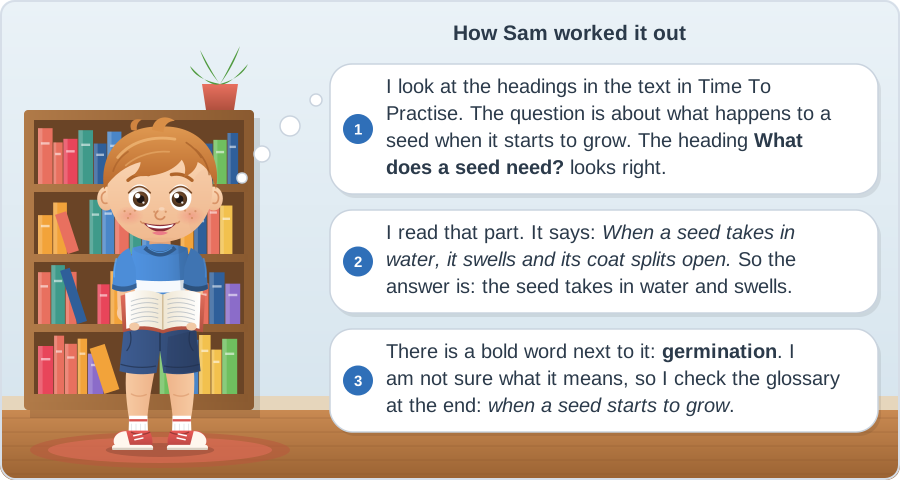
Question: What makes the seed coat split open?
Now Try It
Use the text in Time To Practise.
1. Which heading would you read to find out about pollen?
Hint: Look for the heading about the part of the plant that bees visit.
2. Use the glossary. What is a seedling?
Hint: The glossary is the table at the end of the text.
Time To Practise
Name: ______________________
1. Read the information text.
From Seed to Plant
What is a seed?
A seed is a tiny package. Inside it, there is a baby plant called an embryo and a store of food. A hard coat on the outside keeps the seed safe until it is ready to grow. Seeds come in many sizes. An avocado seed is as big as an egg, but a mustard seed is smaller than a grain of rice.
What does a seed need?
To start growing, a seed needs water, air and warmth. It does not need light yet, because it is under the soil. When a seed takes in water, it swells and its coat splits open. This is called germination.
Roots and shoots
First, a root grows down into the soil. The root holds the plant in place and takes in water. Next, a shoot grows up towards the light. When the shoot pushes through the soil, its first leaves open. Now the young plant is called a seedling.
Leaves and flowers
A seedling needs light to keep growing. Its green leaves use sunlight, air and water to make food for the plant. As the plant grows taller, it makes flowers. Bees and other insects visit the flowers and carry pollen from one flower to another.
New seeds
When the pollen has done its job, the petals fall off and new seeds grow in their place. Some seeds drop to the ground. Others are carried away by the wind, by water or by animals. If a seed lands in a good place, the whole life cycle starts again.
| Glossary | |
|---|---|
| embryo | the tiny baby plant inside a seed |
| germination | when a seed starts to grow |
| pollen | a yellow powder that flowers need to make seeds |
| seedling | a young plant with its first leaves |
2. Use the features.
a) Which heading tells you what grows first, the root or the shoot? ______________________________
b) How many headings are there? ______
c) Use the glossary. What is an embryo? ______________________________
3. Find the facts.
a) What three things does a seed need to start growing?
______________ ______________ ______________
b) Write two jobs that a root does.
__________________________________________________________________
c) Name three ways that seeds can be carried away.
__________________________________________________________________
4. Think about it.
a) Why does a seed not need light when it first starts to grow?
__________________________________________________________________
b) What might happen to plants if there were no bees? Use facts from the text to explain.
Hint: Read the parts about flowers and new seeds again.
__________________________________________________________________
__________________________________________________________________
Reflect
Think about these questions. Talk about them with someone at home or at school.
1. Go back to the Wonder question: “What happens inside a seed before we can see anything grow?” What do you think now?
2. I was an inquirer today when I ______________________________.
An inquirer asks questions and finds things out. For example: I was an inquirer today when I used the headings to find out what a seed needs.
Take action: Plant a bean in a clear jar with a damp paper towel. Watch for the root and the shoot. Which comes first?
Next Steps
If this was easy, try: Find a non-fiction book about plants. Use its contents, headings and glossary to find three new facts.
If this was hard, go back to: Let’s Learn. Read the text one heading at a time with an adult. After each part, say one fact you learned.
Notes for Parents and Teachers
Show notes for parents and teachers
These notes cover this lesson only. How every lesson runs is explained in How to Use This Material.
Let’s Learn
Find a non-fiction book at home and look for its headings and glossary together.
See How It’s Done
Point to the heading, the sentence and the glossary as you go through Sam’s thoughts.
Answer Key
Reveal Answers
Now Try It
1. Leaves and flowers
2. A young plant with its first leaves.
2. Use the features
a) Roots and shoots
b) 5
c) The tiny baby plant inside a seed.
3. Find the facts
a) water, air and warmth
b) It holds the plant in place. It takes in water.
c) By the wind, by water and by animals.
4. Think about it
a) It is under the soil, where there is no light. It uses its own store of food until its leaves can reach the light.
b) Sample answer: Fewer flowers would get pollen, so fewer new seeds would grow. Then there would be fewer new plants.
Look for: in 4a, accept “because it is under the soil”. In 4b, the learner links bees to pollen and pollen to new seeds. This answer is not written in the text, so it needs two facts put together.
Reflect
2. Any real moment from the lesson that shows the learner was an inquirer. Examples: “I was an inquirer today when I used the headings to find out what a seed needs.” “I was an inquirer today when I looked up germination in the glossary when I did not know it.”
Lesson 4.2: Mia’s Sunflower Diary
Reading | About 20 minutes
Term 2 | Level 2
Goal
“I can read a diary over time, compare how something changed from one entry to the next, and explain why with clues from the text.”
Words to know
diary, entry, date, first person, compare, change
Wonder
Think about this question before you start. Say your ideas. You will come back to it at the end of the lesson.
How can a diary show us how something changes over time?
Let’s Learn
A diary is a record of what happens over time. A growing diary shows how something changes from one entry to the next.
- Each entry starts with a date, so the reader knows when it was written.
- Diaries are written in the first person, using I, my and we.
- Most of a diary is in the past tense, because it tells what has already happened.
- Diary writers often say how they feel.
To compare entries, look at the same thing in each one, such as the height of a plant, and ask: What changed? Why did it change?
See How It’s Done
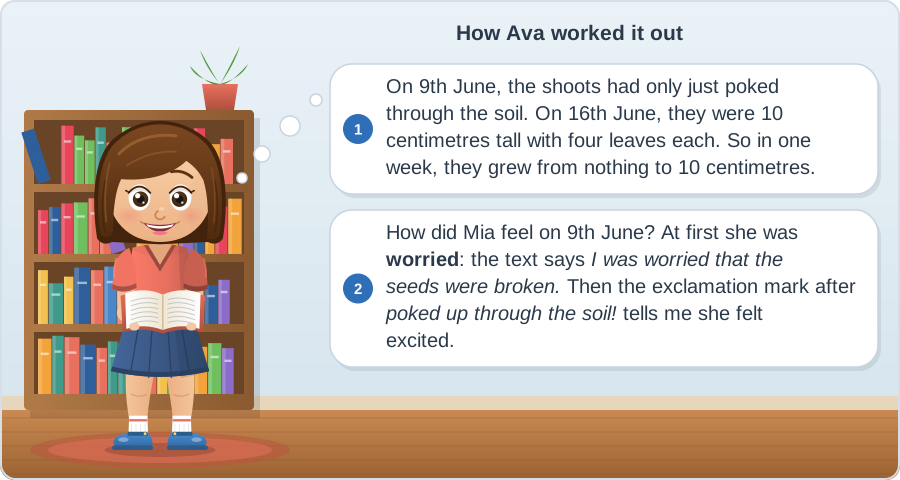
Read the entries for 9th June and 16th June in Time To Practise.
Now Try It
Use the diary in Time To Practise.
1. How many seeds did Mia plant, and how many came up?
Hint: Read the first two entries.
2. Find a sentence that shows the diary is written in the first person.
Hint: Look for I, my or we.
Time To Practise
Name: ______________________
1. Read the diary.
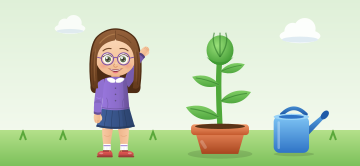
Mia’s Sunflower Diary
Monday 2nd June
Today Gran and I planted three sunflower seeds in a big pot. We pushed each seed into the soil, about as deep as my finger. Then we put the pot by the back door, where it gets lots of sun, and I watered the soil. Gran says sunflowers love warm, sunny weather. I can’t wait to see them grow!
Monday 9th June
Nothing happened for six whole days. I was worried that the seeds were broken. Then, this morning, two green shoots poked up through the soil! The third seed never came up. Gran says that not every seed grows, and that is normal.
Monday 16th June
My two seedlings are 10 centimetres tall now. Each one has four leaves. Gran told me to pull out the smaller one, so the bigger one has more space and water. I felt a bit sad, but I did it.
Monday 23rd June
Disaster! We went to my cousin’s house for the weekend. It was very hot, and nobody was at home to water my sunflower. When we came back, its leaves were floppy and the top was bent over. I gave it two full cans of water. By bedtime, it was standing up straight again. Phew!
Monday 30th June
My sunflower is 1 metre tall now. That is taller than my little brother! A big green bud has appeared at the top. Gran says it will open into a yellow flower soon. I check it every morning before school.
2. Find the answers.
a) Where did Mia and Gran put the pot? Why there? ______________________________
b) How tall was the sunflower on 30th June? ______________
c) On which date did Mia pull out a seedling? ______________
3. Compare the entries.
| Date | What the sunflower looked like |
|---|---|
| 9th June | ______________________________ |
| 16th June | ______________________________ |
| 23rd June (when Mia came home) | ______________________________ |
| 30th June | ______________________________ |
4. Think about it.
a) Why were the leaves floppy on 23rd June? Use two clues from the entry.
__________________________________________________________________
b) Why did Gran tell Mia to pull out the smaller seedling?
__________________________________________________________________
c) Mia felt “a bit sad” on 16th June. Why do you think she felt that way?
__________________________________________________________________
d) What do you think Mia will write in her next entry? Write one sentence, starting with a date.
__________________________________________________________________
Reflect
Think about these questions. Talk about them with someone at home or at school.
1. Go back to the Wonder question: “How can a diary show us how something changes over time?” What do you think now?
2. I was a thinker today when I ______________________________.
A thinker thinks carefully to work things out. For example: I was a thinker today when I worked out why the sunflower’s leaves were floppy.
Take action: Keep a growing diary for your own seed. Write the date, the height and how you feel, once a week.
Next Steps
If this was easy, try: Write two more diary entries for Mia: one when the flower opens, and one when the seeds are ready.
If this was hard, go back to: Task 3. Read one entry at a time with an adult. After each one, draw a quick sketch of the sunflower before you write.
Notes for Parents and Teachers
Show notes for parents and teachers
These notes cover this lesson only. How every lesson runs is explained in How to Use This Material.
Let’s Learn
If you have kept a diary or a calendar, look at it together.
See How It’s Done
Read the entries for 9th June and 16th June aloud before Ava’s thoughts.
Answer Key
Reveal Answers
Now Try It
1. She planted three seeds. Two came up.
2. Any sentence with I, my or we, for example: Today Gran and I planted three sunflower seeds in a big pot.
2. Find the answers
a) By the back door, because it gets lots of sun.
b) 1 metre
c) 16th June
3. Compare the entries
9th June: two green shoots had just come up.
16th June: 10 centimetres tall, with four leaves each.
23rd June: floppy leaves and the top bent over.
30th June: 1 metre tall, with a big green bud at the top.
4. Think about it
a) It had no water. Clues: it was very hot, and nobody was at home to water it.
b) So the bigger one would have more space and water to grow.
c) Sample answer: She had looked after both seedlings and did not want to throw one away.
d) Sample answer: Monday 7th July: My sunflower has opened into a big yellow flower!
Look for: in 4a, two clues, not just one. In 4d, a date, the first person and a prediction that fits the bud on 30th June.
Reflect
2. Any real moment from the lesson that shows the learner was a thinker. Examples: “I was a thinker today when I worked out why the sunflower’s leaves were floppy.” “I was a thinker today when I compared how the sunflower changed from week to week.”
For Teachers: IB Details
Show IB and curriculum details
IB theme: How the world works. This theme is about the natural world and its laws: how living things grow and change, and how people find out about the world around them.
Central idea: Plants are living things that need the right conditions to grow, change and make new plants.
| Lesson | Title | Strand | Key concept |
|---|---|---|---|
| 4.1 | From Seed to Plant: Headings and a Glossary | Reading | Change |
| 4.2 | Mia’s Sunflower Diary | Reading | Change |
Each lesson also matches the national curriculum for England (Year 2) and the US Common Core (Grade 2). The Grade 2 Curriculum Map lists the full standards for every lesson.
← Back to Lesson 4 – Plants and Growing | Lessons – Index
© 2026 Firefly Ed. All rights reserved. This page may be printed for personal, home and classroom use. It may not be sold, shared online or reproduced for commercial use without written permission. edfirefly.com


Share your thoughts or ask something..