
Term 1 | Level 1 | Phonics focus: -dge and -ge, soft c and g, silent letters kn, gn, wr
Lesson 2 – Rules, Routines and Jobs | Lessons – Index
Lessons
This page has the two reading lessons of Lesson 2, Rules, Routines and Jobs: Lessons 2.1 and 2.2. The Lesson 2 page has the Lesson 2 overview, the Lesson 2 review and the PDF download.
Select a lesson to go straight to it. Each lesson ends with a link back to the top of the page.
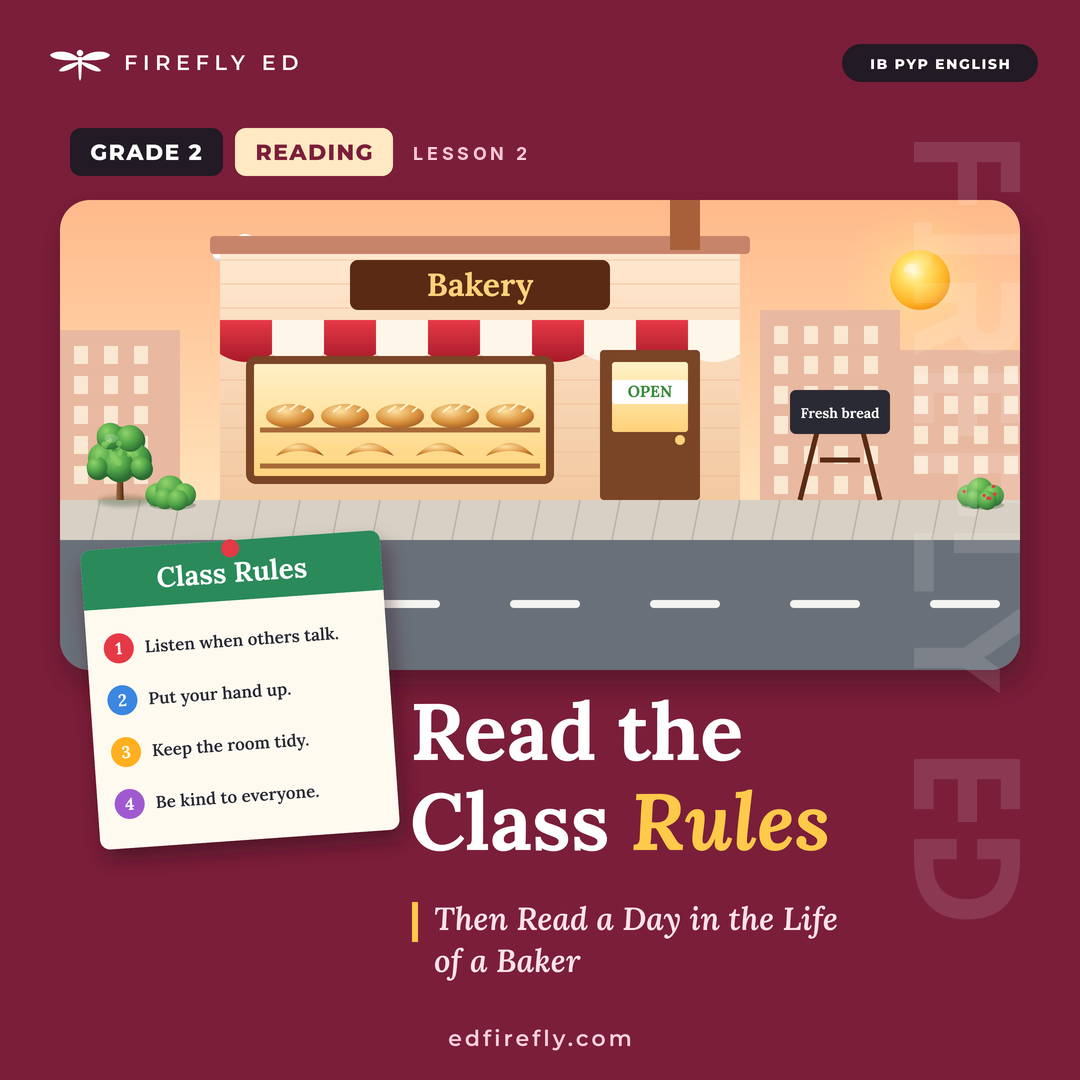
Lesson 2.1: Read the Class Rules
Reading | About 20 minutes
Term 1 | Level 1
Goal
“I can read a set of rules, find information, match each rule to its reason and work out a reason that is not given.”
Words to know
rule, reason, bossy verb, because, so that, heading
Wonder
Think about this question before you start. Say your ideas. You will come back to it at the end of the lesson.
Why do groups of people make rules?
Let’s Learn
A rule tells people what to do, or what not to do. Groups make rules to keep people safe, to be fair and to help everyone get along.
Many rules start with a bossy verb, such as Listen, Walk or Put.
A good rule has a reason. The reason tells you why the rule matters. Reasons often start with because or so that.
Some signs and lists give the reasons. When they do not, you can work out the reason by thinking about what could go wrong without the rule.
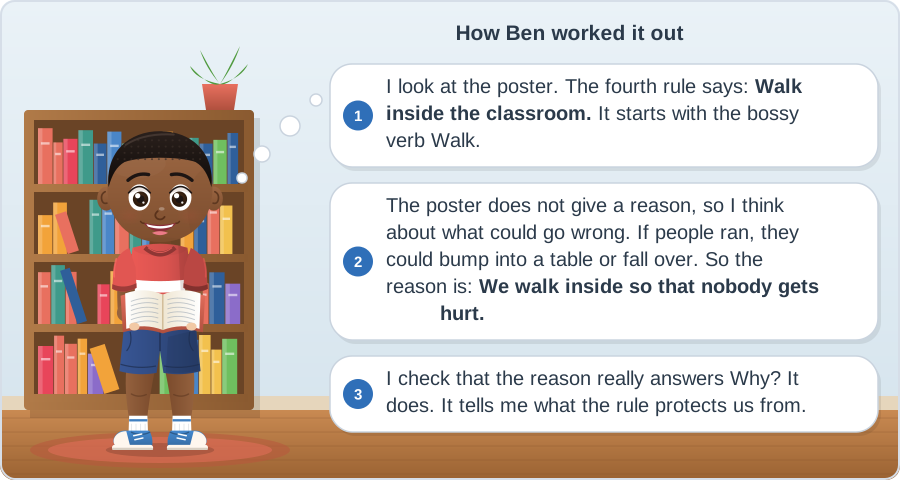
See How It’s Done
Now Try It
Use the rules poster in Let’s Learn.
1. Which rule helps everyone hear the person who is talking? Give a reason for it.
Hint: Look for the ear.
2. “No shouting!” tells you what not to do. Say it as a rule that tells you what to do.
Hint: Start with a bossy verb, such as Speak or Use.
Time To Practise
Name: ______________________
Read the rules on your own. Ask an adult if you get stuck.
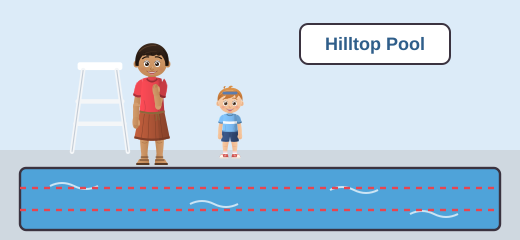
Rules at Hilltop Pool
Welcome to Hilltop Pool. These rules keep everyone safe and happy.
Before you swim
Have a shower before you get in the pool. This keeps the water clean. Children under eight must come with an adult.
In the pool
Walk, do not run. The floor around the pool is wet and slippery, so you could fall and hurt yourself. Only jump in at the deep end. Never push anyone into the water.
Listen to the lifeguard
The lifeguards sit in tall chairs so that they can see the whole pool. If a lifeguard blows a whistle, stop and look up. Do what they say straight away.
After your swim
Put your float back in the box. Take all your things home with you. Lost property is kept at the front desk for one week.
1. Find the answers in the text.
a) What must you do before you get in the pool? ______________________________
b) Who must come to the pool with an adult? ______________________________
c) How long is lost property kept at the front desk? ______________________________
2. Match each rule to its reason. Write the letter.
1. Walk, do not run. ____
2. Have a shower before you swim. ____
3. The lifeguards sit in tall chairs. ____
a) so that they can see the whole pool
b) because the floor is wet and slippery
c) because the pool closes at six o’clock
d) because it keeps the water clean
Hint: One reason is not in the text.
3. Work out the reason.
The rules say: “Only jump in at the deep end.” The text does not say why. Why do you think this rule matters? Write two sentences.
__________________________________________________________________
__________________________________________________________________
4. Write two rules for your home.
Start each rule with a bossy verb. Give a reason with because or so that.
1. __________________________________________________________________
2. __________________________________________________________________
Reflect
Think about these questions. Talk about them with someone at home or at school.
1. Go back to the Wonder question: “Why do groups of people make rules?” What do you think now?
2. I was a thinker today when I ______________________________.
A thinker thinks carefully to work things out. For example: I was a thinker today when I read the pool rules and found the reason for each one.
Take action: Look for a set of rules outside your home, such as at a park, a library or a pool. Read them with an adult and talk about the reason for each one.
Next Steps
If this was easy, try: Choose a place, such as a library or a playground. Write five rules for it, each with a reason.
If this was hard, go back to: See How It’s Done. Read one rule at a time. Ask: What could go wrong if nobody followed this rule? Say the answer before writing anything.
Notes for Parents and Teachers
Show notes for parents and teachers
These notes cover this lesson only. How every lesson runs is explained in How to Use This Material.
Let’s Learn
If you have rules at home or at school, talk about one of them.
See How It’s Done
Point to the rule on the poster as you go through Ben’s thoughts.
Answer Key
Reveal Answers
Now Try It
1. Listen when others speak. Sample reason: so that everyone can hear and nobody feels ignored.
2. Sample answers: Speak in a quiet voice. Use an indoor voice.
1. Find the answers
a) Have a shower.
b) Children under eight.
c) One week.
2. Match
1. b
2. d
3. a
Look for: the learner does not use c). Ask: Does the text say anything about six o’clock?
3. Work out the reason
Sample answer: The water at the shallow end is not deep. If you jump in there, you could hit the bottom and hurt yourself.
Look for: a reason about safety that the learner worked out, written in two sentences.
4. Rules for home
Sample answers: Put your shoes on the rack so that nobody trips over them. Wash your hands before you eat because it stops germs spreading.
Look for: each rule starts with a bossy verb and has a reason that fits.
Reflect
2. Any real moment from the lesson that shows the learner was a thinker. Examples: “I was a thinker today when I read the pool rules and found the reason for each one.” “I was a thinker today when I worked out a reason for a rule that the text did not give.”
Lesson 2.2: A Day in the Life of a Baker
Reading | About 20 minutes
Term 1 | Level 1
Goal
“I can read a recount of a working day, find times, put events in order and explain why with a clue from the text.”
Words to know
recount, time, o’clock, half past, order, clue
Wonder
Think about this question before you start. Say your ideas. You will come back to it at the end of the lesson.
How do people organise their time at work?
Let’s Learn
This recount tells us about one day in someone’s job. It is written in the order things happen.
Times help us follow the order: four o’clock, half past seven, twelve o’clock. Other time words help too, such as first, then, soon and in the afternoon.
“Four o’clock in the morning” is very early, before the sun comes up. “Eight o’clock in the evening” is at night.
Some answers are written in the text. For others, you need to use clues and what you already know.
See How It’s Done
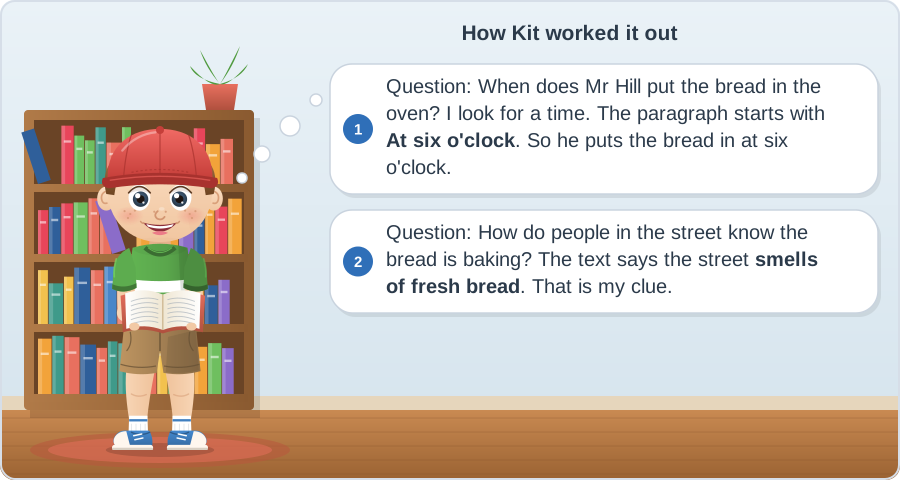
Read this part of the text first. Then read how Kit finds the answers.
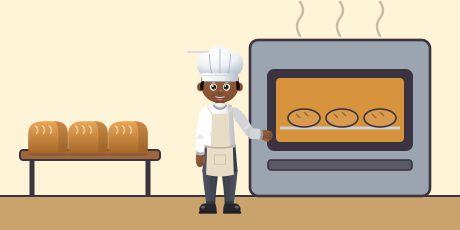
Part of the text: At six o’clock, he shapes the dough into loaves and rolls. He puts them into the big hot oven. Soon the whole street smells of fresh bread.
Now Try It
Use the text in Time To Practise.
1. Where does Mr Hill work? Find the name of the street.
Hint: Look in the first paragraph.
2. What is Mr Hill’s busiest time? Why do you think it is so busy then?
Hint: Who buys bread on their way somewhere?
Time To Practise
Name: ______________________
Read the recount on your own. Ask an adult if you get stuck.
A Day in the Life of a Baker
Mr Hill is a baker. He works at Hill’s Bakery on Station Road. His day starts when most people are fast asleep.
At four o’clock in the morning, Mr Hill’s alarm rings. He drinks a cup of tea and walks to the bakery in the dark. First, he mixes flour, water, salt and yeast to make dough. Then he leaves the dough to rise for an hour.
At six o’clock, he shapes the dough into loaves and rolls. He puts them into the big hot oven. Soon the whole street smells of fresh bread.
At half past seven, the shop opens. People buy bread on their way to work and school. Mr Hill’s busiest time is between eight and nine o’clock.
At twelve o’clock, he has lunch and a short rest. In the afternoon, he cleans the ovens and orders more flour for the next day.
At three o’clock, Mr Hill walks home. He goes to bed at eight o’clock in the evening, because his alarm will ring again very early.
1. Write the time for each part of Mr Hill’s day.
| What happens | Time |
|---|---|
| The shop opens. | ______________________ |
| Mr Hill’s alarm rings. | ______________________ |
| Mr Hill walks home. | ______________________ |
| Mr Hill has lunch. | ______________________ |
| Mr Hill goes to bed. | ______________________ |
2. Number the jobs 1 to 5 in the order Mr Hill does them.
____ He cleans the ovens.
____ He mixes flour, water, salt and yeast.
____ He puts the loaves into the oven.
____ He leaves the dough to rise.
____ He shapes the dough into loaves and rolls.
3. Answer with a clue from the text.
a) Why does Mr Hill go to bed at eight o’clock in the evening?
__________________________________________________________________
b) Why do you think a baker has to start work so early? Write two sentences.
__________________________________________________________________
__________________________________________________________________
4. Compare your day with Mr Hill’s day.
Write three sentences about how your day is different from Mr Hill’s day. Use times in your sentences.
__________________________________________________________________
__________________________________________________________________
__________________________________________________________________
Reflect
Think about these questions. Talk about them with someone at home or at school.
1. Go back to the Wonder question: “How do people organise their time at work?” What do you think now?
2. I was an inquirer today when I ______________________________.
An inquirer asks questions and finds things out. For example: I was an inquirer today when I found the times in Mr Hill’s day and put his jobs in order.
Take action: Ask an adult at home about one day at their work. Write down three times and what happens at each one.
Next Steps
If this was easy, try: Write a recount called A Day in the Life of ______ about someone you know. Use five times.
If this was hard, go back to: Let’s Learn. Practise reading the four clocks. Then read only the paragraphs that start with a time, and find what happens at each one.
Notes for Parents and Teachers
Show notes for parents and teachers
These notes cover this lesson only. How every lesson runs is explained in How to Use This Material.
Let’s Learn
Point to each clock as you say the time.
Answer Key
Reveal Answers
Now Try It
1. At Hill’s Bakery on Station Road.
2. Between eight and nine o’clock. Sample reason: People buy bread on their way to work and school at that time.
1. Times
The shop opens: half past seven
Mr Hill’s alarm rings: four o’clock in the morning
Mr Hill walks home: three o’clock
Mr Hill has lunch: twelve o’clock
Mr Hill goes to bed: eight o’clock in the evening
Look for: times written as words or as 7:30 and 4:00. Both are fine.
2. Order
5 He cleans the ovens.
1 He mixes flour, water, salt and yeast.
4 He puts the loaves into the oven.
2 He leaves the dough to rise.
3 He shapes the dough into loaves and rolls.
3. Clues
a) Because his alarm will ring again very early, at four o’clock in the morning.
b) Sample answer: Bread takes a long time to make. The bread must be ready before people go to work and school.
Look for: in b), a reason the learner worked out, linked to the text.
4. Compare
Sample answer: Mr Hill gets up at four o’clock, but I get up at seven o’clock. He walks home at three o’clock, and I come home from school at half past three. He goes to bed at eight o’clock, but I go to bed at half past seven.
Look for: three sentences, each with a time and a clear difference.
Reflect
2. Any real moment from the lesson that shows the learner was an inquirer. Examples: “I was an inquirer today when I found the times in Mr Hill’s day and put his jobs in order.” “I was an inquirer today when I used a clue from the text to explain why he starts work so early.”
For Teachers: IB Details
Show IB and curriculum details
IB theme: How we organize ourselves. This theme is about the systems people make and how they work: how people live and work together, share jobs and make decisions.
Central idea: Rules, routines and jobs help people live, learn and work well together.
| Lesson | Title | Strand | Key concept |
|---|---|---|---|
| 2.1 | Read the Class Rules | Reading | Function |
| 2.2 | A Day in the Life of a Baker | Reading | Function |
Each lesson also matches the national curriculum for England (Year 2) and the US Common Core (Grade 2). The Grade 2 Curriculum Map lists the full standards for every lesson.
← Back to Lesson 2 – Rules, Routines and Jobs | Lessons – Index
© 2026 Firefly Ed. All rights reserved. This page may be printed for personal, home and classroom use. It may not be sold, shared online or reproduced for commercial use without written permission. edfirefly.com


Share your thoughts or ask something..