
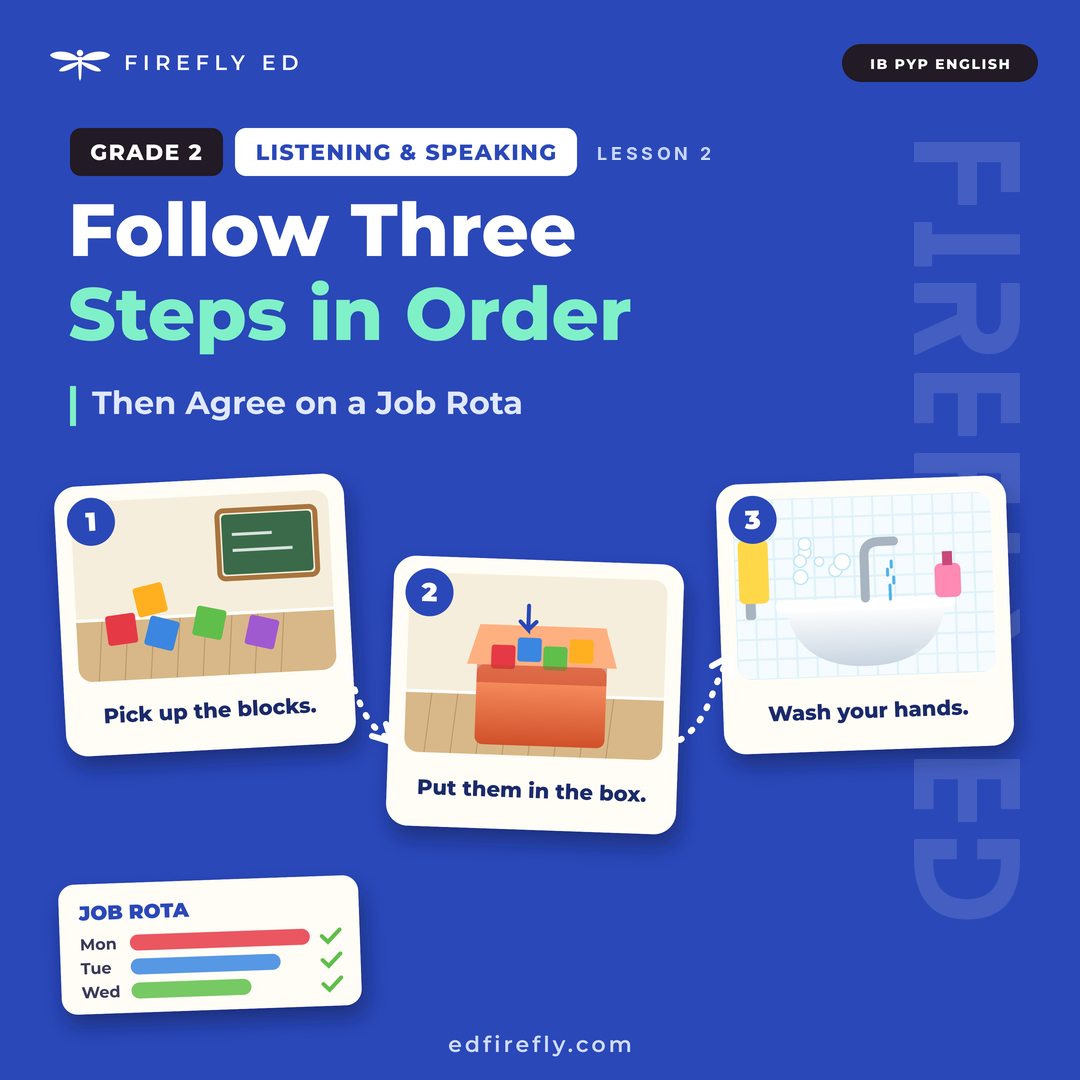
Term 1 | Level 1 | Phonics focus: -dge and -ge, soft c and g, silent letters kn, gn, wr
Lesson 2 – Rules, Routines and Jobs | Lessons – Index
Lessons
This page has the two listening and speaking lessons of Lesson 2, Rules, Routines and Jobs: Lessons 2.5 and 2.6. The Lesson 2 page has the Lesson 2 overview, the Lesson 2 review and the PDF download.
Select a lesson to go straight to it. Each lesson ends with a link back to the top of the page.
Lesson 2.5: Three-Step Instructions
Oral | About 20 minutes
Term 1 | Level 1
Goal
“I can follow spoken instructions with three steps, including before, after and if, and give clear three-step instructions to someone else.”
Words to know
instruction, step, order word, before, after, if
Wonder
Think about this question before you start. Say your ideas. You will come back to it at the end of the lesson.
What makes an instruction easy to follow?
Let’s Learn
An instruction tells you what to do. Some instructions have three steps, or more.
To follow spoken instructions well:
- Listen to the whole instruction before you start.
- Count the steps on your fingers as you listen.
- Listen for order words: first, then, after that, finally. Before and after can change the order.
- Listen for if. “Colour it red if it is round” means you only do it when the thing is round.
- If you are not sure, ask the speaker to say it again.
When you give instructions, speak slowly, use order words and check the listener understood. You can ask them to say the steps back to you.
See How It’s Done

Now Try It
Listen as an adult says each instruction once. Then act it out.
1. “After you touch your nose, wave with your left hand. Then sit down.”
Hint: What do you do first? Listen for “after”.
2. “If it is morning, say good morning. If it is afternoon, say good afternoon. Then shake my hand.”
Hint: Only one of the first two parts is true right now.
Time To Practise
Name: ______________________
1. Listen and follow the instructions on the picture.
You need coloured pencils. Listen as an adult reads each set of instructions once. Follow them on the picture.
2. Which instruction is clearer? Tick one in each pair.
a) ☐ “Do the thing with the book.” ☐ “Put the red book on the top shelf.”
b) ☐ “First wash the cup, then dry it, and finally put it in the cupboard.” ☐ “Cup, wash, cupboard, dry.”
c) ☐ “Feed the cat.” ☐ “Put one scoop of food in the cat’s bowl, then fill her water dish.”
3. Give three-step instructions.
Plan three steps for a small job at home, such as laying the table or watering a plant. Use order words. Use if in one step.
First, ______________________________________________
Then, ______________________________________________
Finally, ______________________________________________
Now say your instructions to an adult. Ask them to say the steps back to you, then do the job.
Tick each one you did.
☐ I gave three clear steps. ☐ I used order words. ☐ I gave one step with if. ☐ I spoke slowly and clearly. ☐ I checked that the listener understood.
Reflect
Think about these questions. Talk about them with someone at home or at school.
1. Go back to the Wonder question: “What makes an instruction easy to follow?” What do you think now?
2. I was a communicator today when I ______________________________.
A communicator shares ideas clearly by talking, writing or drawing. For example: I was a communicator today when I followed an instruction with before in the right order.
Take action: Help at home by doing a three-step job when someone asks. Say the steps back to them first, so they know you listened.
Next Steps
If this was easy, try: Give a partner four-step instructions with before, after and if, without showing what you mean. Can they do it first time?
If this was hard, go back to: Now Try It. Start with two steps and no before or after. Count the steps on your fingers. Then add a third step.
Notes for Parents and Teachers
Show notes for parents and teachers
These notes cover this lesson only. How every lesson runs is explained in How to Use This Material.
Let’s Learn
Show how to count steps on your fingers.
See How It’s Done
Say each instruction in Sam’s thoughts aloud, and act it out with the learner.
Now Try It
Say each instruction once, and then let the learner act it out.
Time To Practise
- Task 1: You need coloured pencils. Read each set of instructions once only, at a normal speed. Wait until the learner has finished before you read the next set.
Set A: “Draw a ring round the apple. Then colour the box on the top shelf red. After that, draw a line under the cup.”
Set B: “Before you do anything else, put a cross on the teddy. Colour the ball blue, but only if it is on the bottom shelf. Finally, draw a star next to the book.”
Set C: “If there are two cups, colour both of them green. If there is only one cup, colour it yellow. Then draw a smiley face on the box on the middle shelf.” - Task 3: Listen to the instructions, and tick the checklist together.
Answer Key
Reveal Answers
Now Try It
1. Touch your nose, wave with your left hand, then sit down.
2. Say good morning or good afternoon, whichever is true now. Then shake hands.
1. Listen and follow
Set A: a ring round the apple; the box on the top shelf coloured red; a line under the cup.
Set B: a cross on the teddy (done first); the ball coloured blue, because it is on the bottom shelf; a star next to the book.
Set C: the cup coloured yellow, because there is only one cup; a smiley face on the box on the middle shelf.
Look for: the box on the middle shelf is not coloured red in Set A, because only the top box was named. In Set C, a learner who colours the cup green has missed the word “if”. Read the set again and talk about it.
2. Clearer instructions
a) “Put the red book on the top shelf.”
b) “First wash the cup, then dry it, and finally put it in the cupboard.”
c) “Put one scoop of food in the cat’s bowl, then fill her water dish.”
Look for: the learner says why: the clearer instruction says exactly what to do and in what order.
3. Give instructions
Sample answer: First, put a plate in front of each chair. Then, put a fork on the left of each plate. Finally, if it is dark, switch on the light.
Look for: four or more ticks. The listener can do the job without asking questions.
Reflect
2. Any real moment from the lesson that shows the learner was a communicator. Examples: “I was a communicator today when I followed an instruction with before in the right order.” “I was a communicator today when I said my steps slowly and checked that my listener understood.”
Lesson 2.6: Let’s Agree: A Family Job Rota
Oral | About 20 minutes
Term 1 | Level 1
Goal
“I can take part in a discussion: take turns, agree and disagree politely, build on other people’s ideas and reach a fair decision.”
Words to know
discussion, take turns, agree, disagree politely, build on, fair
Wonder
Think about this question before you start. Say your ideas. You will come back to it at the end of the lesson.
How can a group make a decision that is fair to everyone?
Let’s Learn
In a discussion, a group talks about something together to share ideas and make a decision.
Good discussions have rules:
- One person speaks at a time.
- Listen to the speaker and look at them.
- Wait for a gap, or put your hand up, before you speak.
- Be polite, even when you do not agree.
These talk phrases help:
| Job | Talk phrase |
|---|---|
| agree | I agree with … because … |
| disagree politely | I see what you mean, but … |
| build on an idea | Adding to what … said, … |
| ask a question | What do you mean by …? |
| suggest | Could we …? What if we …? |
A fair decision is one where everyone has had a say, and the jobs are shared out sensibly.
See How It’s Done
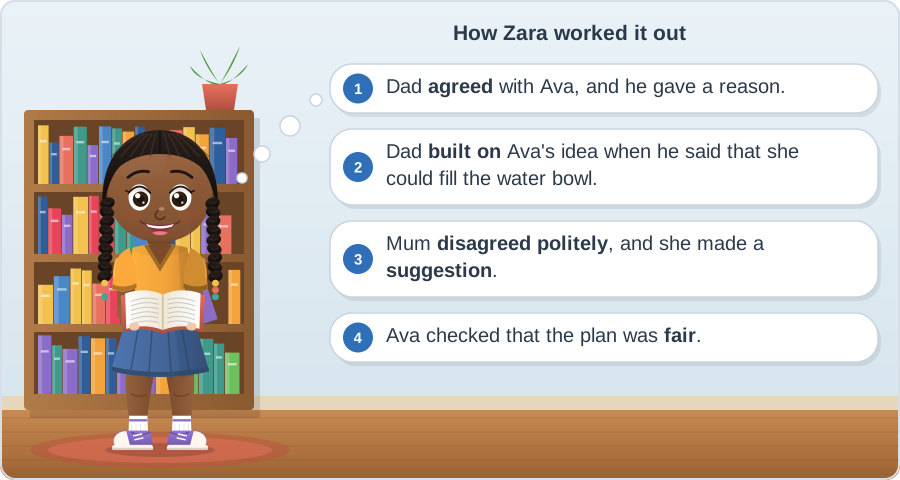
Read the discussion with an adult. Take different parts. Then read what Zara noticed.

Ava’s family is choosing jobs for the week.
Mum: “We need someone to feed the cat every day.”
Ava: “I could feed the cat! I always get up early.”
Dad: “I agree with Ava, because she is up first. Adding to that, Ava could also fill the cat’s water bowl.”
Mum: “I see what you mean, but Ava already waters the plants. What if we take turns with the water bowl?”
Ava: “That sounds fair. Could we write it on the rota?”
Now Try It
1. Someone says: “You should do all the washing up!” You do not agree. Say a polite way to disagree.
Hint: Start with “I see what you mean, but…”
2. Someone says: “We should tidy our room on Saturdays.” Build on the idea.
Hint: Start with “Adding to that…” and add one more idea.
Time To Practise
Name: ______________________
1. Read the discussion. Answer the questions.
Leo’s class is deciding who looks after the class plant.
1. Mia: “I think we should take turns, one person each week.”
2. Leo: “I agree with Mia, because then everyone gets a go.”
3. Sam: “That is a silly idea. I want to do it every week.”
4. Ava: “Adding to what Leo said, we could make a chart with our names on it.”
5. Mia: “What do you mean by a chart?”
6. Ava: “A list with one name for each week, so we know whose turn it is.”
a) Who built on someone else’s idea? Write the line number. Line ______
b) Who asked a question to understand better? ______________
c) Which line was not polite? Line ______ Write it again so it is polite.
__________________________________________________________________
2. Match the talk phrase to its job. Write the letter.
1. “What if we each choose one job?” ____
2. “I agree with you because it is fair.” ____
3. “I see what you mean, but I am busy on Mondays.” ____
4. “What do you mean by tidy?” ____
a) agree b) disagree politely c) ask a question d) suggest
3. Hold a family meeting. Make a job rota.
Sit together with at least two other people at home. Lead the meeting. Agree three jobs and who will do each one.
| Job | Who | When |
|---|---|---|
| ______________________ | ______________ | ______________ |
| ______________________ | ______________ | ______________ |
| ______________________ | ______________ | ______________ |
Write two sentences about how your family agreed.
__________________________________________________________________
__________________________________________________________________
Tick each one you did.
☐ I waited for my turn to speak. ☐ I agreed with a reason. ☐ I disagreed politely. ☐ I built on someone’s idea. ☐ I asked a question. ☐ I checked that the plan was fair.
Reflect
Think about these questions. Talk about them with someone at home or at school.
1. Go back to the Wonder question: “How can a group make a decision that is fair to everyone?” What do you think now?
2. I was principled today when I ______________________________.
Being principled means being fair and honest and doing the right thing. For example: I was principled today when I disagreed politely and gave my reason.
Take action: Put your family job rota on the wall. After one week, hold another short meeting: Is the rota still fair? What would you change?
Next Steps
If this was easy, try: Lead a discussion with friends about a game to play at break time. Use at least four different talk phrases.
If this was hard, go back to: See How It’s Done. Read the discussion together, one line each. Then practise only two phrases: I agree with … because, and I see what you mean, but.
Notes for Parents and Teachers
Show notes for parents and teachers
These notes cover this lesson only. How every lesson runs is explained in How to Use This Material.
Let’s Learn
Practise each talk phrase with the learner.
See How It’s Done
Read the discussion aloud together, and take different parts.
Time To Practise
- Task 3: Sit together with at least two other people. Let the learner lead the meeting. Agree three jobs and who will do each one.
- Task 3: Listen to the meeting, and tick the checklist together.
Answer Key
Reveal Answers
Now Try It
1. Sample answer: I see what you mean, but I did it yesterday. Could we take turns?
2. Sample answer: Adding to that, we could put on music to make it more fun.
1. Read the discussion
a) Line 4 (Ava)
b) Mia
c) Line 3. Sample answer: “I see what you mean, but I would really like to do it. Could I have the first week?”
Look for: in c), the new line keeps Sam’s wish but says it politely.
2. Match
1. d
2. a
3. b
4. c
3. Family meeting
Sample rota: Feed the cat, Ava, every morning. Water the plants, Dad, Saturday. Lay the table, Mum, every evening.
Sample sentences: We each said which job we liked best. When two of us wanted the same job, we agreed to take turns.
Look for: four or more ticks. The learner gave everyone a chance to speak.
Reflect
2. Any real moment from the lesson that shows the learner was principled. Examples: “I was principled today when I disagreed politely and gave my reason.” “I was principled today when I made sure everyone had a fair job on our family rota.”
For Teachers: IB Details
Show IB and curriculum details
IB theme: How we organize ourselves. This theme is about the systems people make and how they work: how people live and work together, share jobs and make decisions.
Central idea: Rules, routines and jobs help people live, learn and work well together.
| Lesson | Title | Strand | Key concept |
|---|---|---|---|
| 2.5 | Three-Step Instructions | Listening and speaking | Responsibility |
| 2.6 | Let’s Agree: A Family Job Rota | Listening and speaking | Responsibility |
Each lesson also matches the national curriculum for England (Year 2) and the US Common Core (Grade 2). The Grade 2 Curriculum Map lists the full standards for every lesson.
← Back to Lesson 2 – Rules, Routines and Jobs | Lessons – Index
© 2026 Firefly Ed. All rights reserved. This page may be printed for personal, home and classroom use. It may not be sold, shared online or reproduced for commercial use without written permission. edfirefly.com


Share your thoughts or ask something..