
Term 1 | Level 1 | Phonics focus: -dge and -ge, soft c and g, silent letters kn, gn, wr
Lesson 2 – Rules, Routines and Jobs | Lessons – Index
Lessons
This page has the two writing lessons of Lesson 2, Rules, Routines and Jobs: Lessons 2.3 and 2.4. The Lesson 2 page has the Lesson 2 overview, the Lesson 2 review and the PDF download.
Select a lesson to go straight to it. Each lesson ends with a link back to the top of the page.
Lesson 2.3: How to Brush Your Teeth
Writing | About 20 minutes
Term 1 | Level 1
Goal
“I can write clear instructions with a title, a list of what you need, numbered steps with bossy verbs, detail words and a tip.”
Words to know
instructions, title, you need, numbered steps, bossy verb, detail word, tip
Wonder
Think about this question before you start. Say your ideas. You will come back to it at the end of the lesson.
Why do we need clear instructions to do a job well?
Let’s Learn
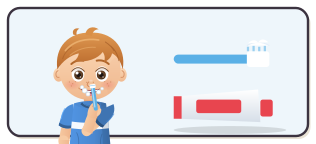
Instructions tell someone how to do something, step by step. Good instructions have:
- a title that says what you will do, such as “How to Brush Your Teeth”;
- a list of what you need;
- numbered steps in the right order;
- a bossy verb at the start of each step, such as Put, Brush or Rinse;
- detail words that tell how or how long, such as gently, carefully or for two minutes;
- sometimes a tip at the end.
Each step is a command, so it ends with a full stop.
See How It’s Done
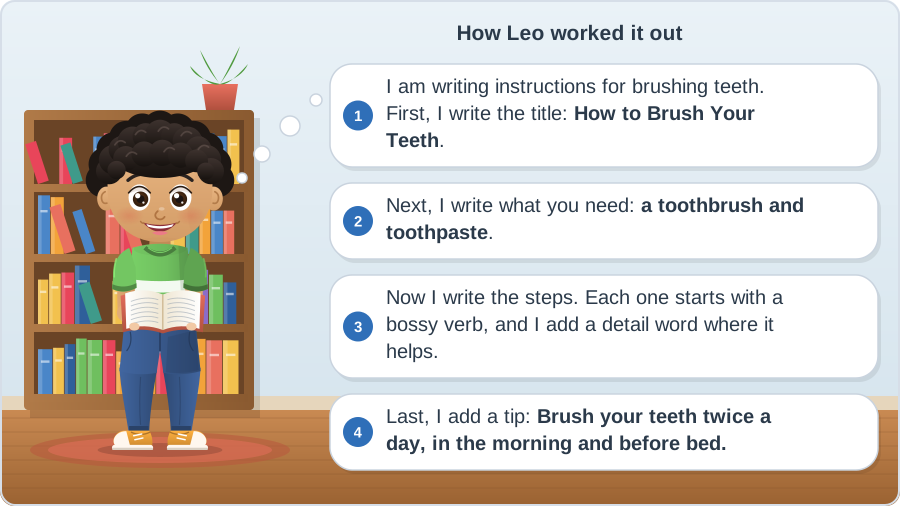
Here are the steps Leo wrote.
1. Squeeze a small blob of toothpaste onto your toothbrush.
2. Brush the front of your teeth gently, in small circles.
3. Brush the backs and the tops of your teeth.
4. Keep brushing for two minutes.
5. Spit the toothpaste into the sink.
Now Try It
1. This step is missing its bossy verb: “____ your toothbrush under the tap.” Which verb fits?
Hint: What do you do to clean the brush?
2. Add a detail word to make this step clearer: “Brush your teeth.”
Hint: How should you brush? For how long?
Time To Practise
Name: ______________________
1. Find the parts of the instructions.
Read these instructions. Then answer the questions.
How to Make a Jam Sandwich
You need: two slices of bread, butter, jam, a knife and a plate.
1. Put the two slices of bread on the plate.
2. Spread butter thinly on one side of each slice.
3. Spread jam on one slice.
4. Press the other slice on top, butter side down.
5. Cut the sandwich in half carefully.
Tip: Ask an adult to help you with the knife.
a) Write the five bossy verbs. ______________________________________________
b) Write two detail words that tell how. ______________ ______________
c) Why is the tip important? ______________________________________________
2. Fix the instructions.
These steps for packing a school bag are mixed up, and two steps have no bossy verb. Write them in order. Start each step with a bossy verb.
Your water bottle in the side pocket. Zip the bag shut. Check your timetable for today. Your reading book and pencil case inside.
1. __________________________________________________________________
2. __________________________________________________________________
3. __________________________________________________________________
4. __________________________________________________________________
3. Write instructions: How to Wash Your Hands.
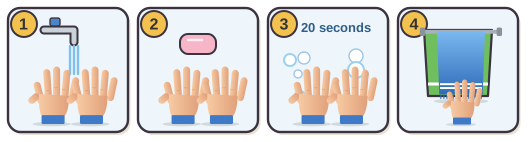
Use the pictures to help you. Write a title, a list of what you need, four or five numbered steps and a tip. Use a detail word in at least two steps.
Word bank: wet | rub | rinse | dry | soap | towel | carefully | well | for 20 seconds
Title: ______________________________________________
You need: ______________________________________________
1. __________________________________________________________________
2. __________________________________________________________________
3. __________________________________________________________________
4. __________________________________________________________________
5. __________________________________________________________________
Tip: ______________________________________________
☐ I wrote a title. ☐ I listed what you need. ☐ Each step starts with a bossy verb. ☐ I used two detail words. ☐ I added a tip.
Reflect
Think about these questions. Talk about them with someone at home or at school.
1. Go back to the Wonder question: “Why do we need clear instructions to do a job well?” What do you think now?
2. I was a communicator today when I ______________________________.
A communicator shares ideas clearly by talking, writing or drawing. For example: I was a communicator today when I wrote my steps with bossy verbs and numbers so they were easy to follow.
Take action: Write instructions for a job you do at home, such as feeding a pet or setting the table. Give them to someone and see if they can follow them.
Next Steps
If this was easy, try: Write instructions for a game you know. Ask someone to follow them without asking any questions. Did your instructions work?
If this was hard, go back to: See How It’s Done. Say the steps for brushing your teeth out loud while you do them. Then write only the bossy verb for each step before writing full sentences.
Notes for Parents and Teachers
Show notes for parents and teachers
These notes cover this lesson only. How every lesson runs is explained in How to Use This Material.
Let’s Learn
If you can, get a toothbrush and toothpaste and act out each step.
See How It’s Done
Write the instructions on paper as you go through Leo’s thoughts, so that the learner sees the layout.
Answer Key
Reveal Answers
Now Try It
1. Rinse (or Wash)
2. Sample answers: Brush your teeth gently. Brush your teeth for two minutes.
1. Parts of the instructions
a) Put, Spread, Spread, Press, Cut
b) thinly, carefully (also accept “butter side down” as a detail)
c) Sample answer: Knives can be sharp, so an adult should help to keep you safe.
2. Fix the instructions
1. Check your timetable for today.
2. Put your reading book and pencil case inside.
3. Put your water bottle in the side pocket.
4. Zip the bag shut.
Look for: a bossy verb added to the two steps, such as Put or Pack. Steps 2 and 3 can swap. Checking the timetable comes first and zipping the bag comes last.
3. How to Wash Your Hands
Sample answer:
How to Wash Your Hands
You need: water, soap and a towel.
1. Wet your hands under the tap.
2. Put some soap on your hands.
3. Rub your hands together well for 20 seconds.
4. Rinse the soap off carefully.
5. Dry your hands on a clean towel.
Tip: Wash your hands before you eat and after you use the toilet.
Look for: all five boxes ticked. Steps follow the order of the pictures.
Reflect
2. Any real moment from the lesson that shows the learner was a communicator. Examples: “I was a communicator today when I wrote my steps with bossy verbs and numbers so they were easy to follow.” “I was a communicator today when I checked my instructions by asking someone to follow them.”
Lesson 2.4: Write a Job Profile
Writing | About 20 minutes
Term 1 | Level 1
Goal
“I can write an information text about a job, with a title, an opening sentence, facts, a reason with because and a closing sentence.”
Words to know
job profile, information text, opening sentence, fact, because, closing sentence
Wonder
Think about this question before you start. Say your ideas. You will come back to it at the end of the lesson.
How can we tell other people about a job, using only facts?
Let’s Learn
A job profile is a short information text about a job. It gives the reader facts, not a story.
| Part | What it does | Example |
|---|---|---|
| title | names the job | The Lifeguard |
| opening sentence | says what the job is | A lifeguard keeps swimmers safe. |
| facts | what they do, where they work, what they use | Lifeguards sit in tall chairs. |
| reason | explains a fact with because | They sit up high because they need to see the whole pool. |
| closing sentence | says why the job matters | Without lifeguards, pools would not be safe. |
Information texts use the present tense: a lifeguard sits, watches and helps. Each fact should be about the job. Leave out facts that do not belong, such as the lifeguard’s favourite food.
See How It’s Done
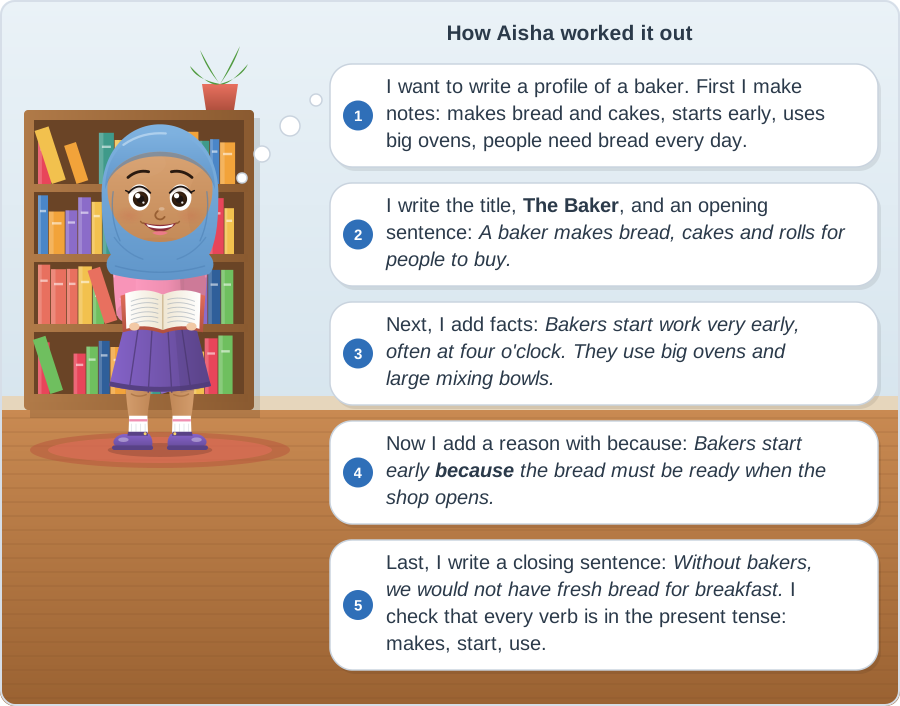
Now Try It
1. Which is the best opening sentence for a profile of a nurse?
a) I went to the doctor’s last week. b) A nurse looks after people who are ill or hurt. c) Nurses are nice.
Hint: The opening sentence says what the job is.
2. Finish this reason: “Nurses wash their hands many times a day because…”
Hint: Think about germs.
Time To Practise
Name: ______________________
1. Sort the facts about a vet.
Write each fact under the right heading. One fact does not belong. Cross it out.
a) Vets work in animal hospitals. b) Vets use a stethoscope to listen to an animal’s heart. c) Vets give animals medicine. d) My vet has a red car. e) Some vets visit farms to look after cows. f) Vets use scales to weigh pets.
| What vets do | Where vets work | What vets use |
|---|---|---|
| __________ | __________ | __________ |
| __________ | __________ |
The fact that does not belong is ______, because ______________________________________
2. Add a reason with because.
a) Firefighters wear thick coats because ______________________________________
b) Bus drivers check the tyres every morning because ______________________________________
c) Teachers plan their lessons because ______________________________________
3. Write a job profile.
Choose a job done by someone you know, such as a family member or a neighbour. Ask them three questions first: What do you do? Where do you work? What do you use?
Title: ______________________________________________
Opening sentence: __________________________________________________
__________________________________________________________________
__________________________________________________________________
__________________________________________________________________
Closing sentence: __________________________________________________
Check your work. Tick each one you did.
☐ I wrote a title. ☐ I wrote an opening sentence that says what the job is. ☐ I gave three facts about the job. ☐ I gave a reason with because. ☐ I used present tense verbs. ☐ I wrote a closing sentence.
Reflect
Think about these questions. Talk about them with someone at home or at school.
1. Go back to the Wonder question: “How can we tell other people about a job, using only facts?” What do you think now?
2. I was knowledgeable today when I ______________________________.
Being knowledgeable means knowing things and using what you know. For example: I was knowledgeable today when I asked my uncle three questions so my facts about his job were right.
Take action: Give your job profile to the person you wrote about. Ask them to check your facts and say thank you for their work.
Next Steps
If this was easy, try: Write a second job profile and add a heading for each group of facts, as in a real information book.
If this was hard, go back to: Task 1. Sort the facts together first. Then write only the opening sentence, two facts and the closing sentence.
Notes for Parents and Teachers
Show notes for parents and teachers
These notes cover this lesson only. How every lesson runs is explained in How to Use This Material.
Let’s Learn
Point to each part in the example column.
See How It’s Done
Write the baker profile on paper, one part at a time, as you go through Aisha’s thoughts.
Time To Practise
- Task 3: Read the profile, and tick the checklist together.
Answer Key
Reveal Answers
Now Try It
1. b) A nurse looks after people who are ill or hurt.
2. Sample answer: …because germs can make patients more ill.
1. Sort the facts
What vets do: c
Where vets work: a, e
What vets use: b, f
Does not belong: d, because it is about one vet’s car, not about the job.
Look for: accept e under “What vets do” if the learner explains it.
2. Reasons
Sample answers:
a) …because the coats keep them safe from the heat of a fire.
b) …because a flat tyre could cause an accident.
c) …because they need to know what the class will learn.
3. Job profile
Sample answer: The Postal Worker. A postal worker delivers letters and parcels to homes. Postal workers often start work at six o’clock. They carry a big red bag and use a handheld scanner. They scan every parcel because people need to know where it is. Without postal workers, we would not get our birthday cards.
Look for: five or more ticks.
Reflect
2. Any real moment from the lesson that shows the learner was knowledgeable. Examples: “I was knowledgeable today when I asked my uncle three questions so my facts about his job were right.” “I was knowledgeable today when I found the fact about the vet that did not belong.”
For Teachers: IB Details
Show IB and curriculum details
IB theme: How we organize ourselves. This theme is about the systems people make and how they work: how people live and work together, share jobs and make decisions.
Central idea: Rules, routines and jobs help people live, learn and work well together.
| Lesson | Title | Strand | Key concept |
|---|---|---|---|
| 2.3 | How to Brush Your Teeth | Writing | Function |
| 2.4 | Write a Job Profile | Writing | Function |
Each lesson also matches the national curriculum for England (Year 2) and the US Common Core (Grade 2). The Grade 2 Curriculum Map lists the full standards for every lesson.
← Back to Lesson 2 – Rules, Routines and Jobs | Lessons – Index
© 2026 Firefly Ed. All rights reserved. This page may be printed for personal, home and classroom use. It may not be sold, shared online or reproduced for commercial use without written permission. edfirefly.com


Share your thoughts or ask something..