
Term 2 | Level 2 | Phonics focus: word endings: -able, -ably, -ible and -ibly, and adding suffixes to words ending in -fer
Chapter 6 – News, Adverts and Media | Chapters – Index
Lessons
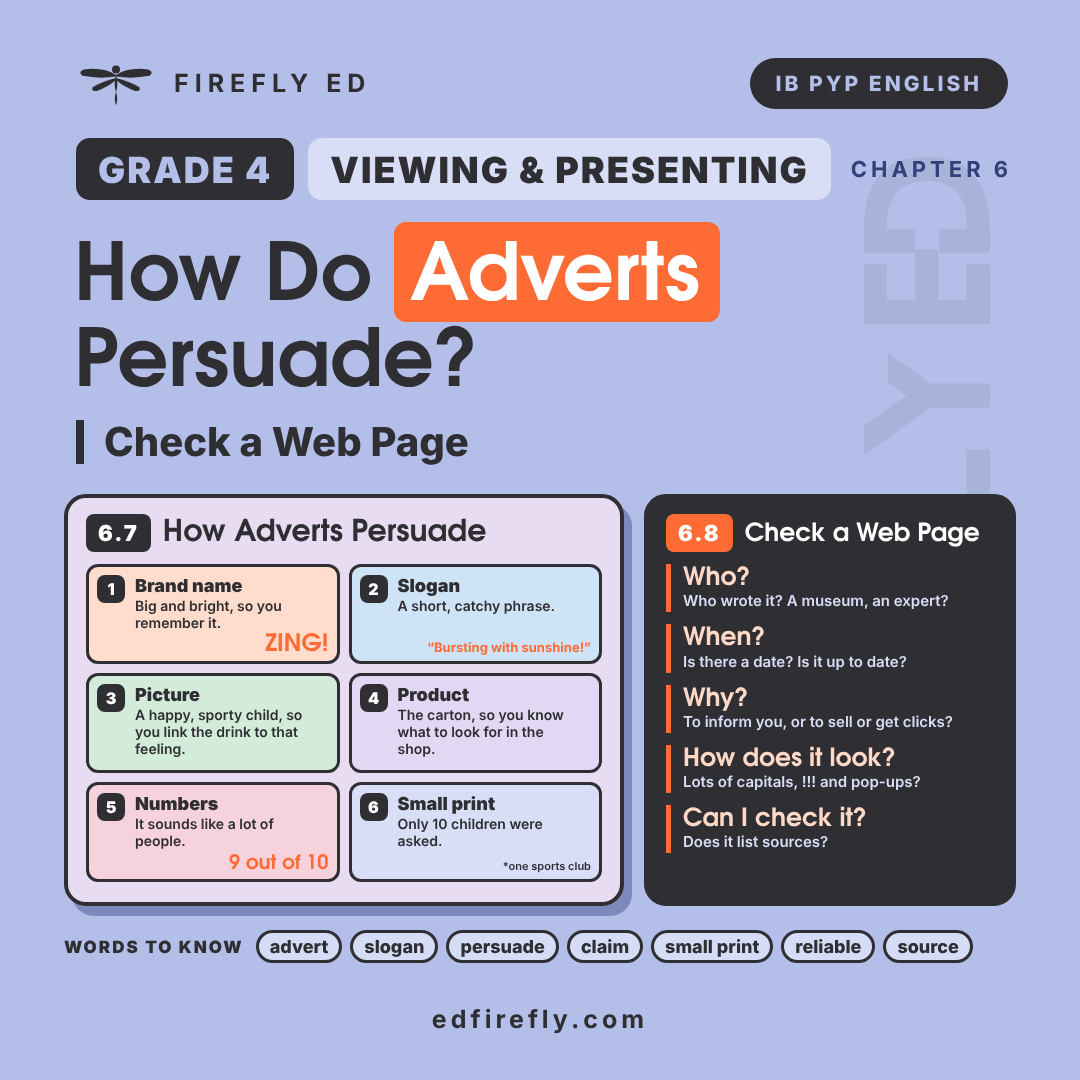
This page has the two viewing and presenting lessons of Chapter 6, News, Adverts and Media: Lessons 6.7 and 6.8. The chapter page has the chapter overview, the chapter review and the PDF download.
Tap a lesson to open it. Tap the lesson title again, or use the link at the end of the lesson, to close it.
Lesson 6.7: How Adverts Persuade: Pictures, Colour and Words | Visual | About 20 minutes
Term 2 | Level 2
Goal
“I can explain how the pictures, colours and words in an advert are chosen to persuade, and spot claims that need checking.”
Words to know
advert, brand, slogan, persuade, claim, small print, target audience
Wonder
Think about this question before you start. Say your ideas. You will come back to it at the end of the lesson.
Have you ever wanted something just because you saw an advert for it? What made you want it?
Let’s Learn
An advert is made to persuade you to buy something or do something. Every part of it is chosen on purpose: the colours, the pictures, the words and even the size of the letters. The people the advert is aimed at are its target audience.
Zing! is an invented drink, made up for this lesson.
See How It’s Done
Now Try It
1. What is the slogan? ______________________________
2. Why is the small print so small, do you think?
__________________________________________________________________
Time To Practise
Name: ______________________
1. Name the trick.
Match each part of the advert to its trick: slogan, brand name, picture, small print, numbers.
a) ZING! ______________ b) Bursting with sunshine! ______________ c) 9 out of 10 kids love it! ______________
d) A cheering boy ______________ e) We asked 10 children at one sports club. ______________
2. Colours.
Why do you think the advert uses yellow and orange? What would change if it were grey and brown?
__________________________________________________________________
3. Check the claim.
Is “9 out of 10 kids love it” good evidence? Explain, using the small print.
__________________________________________________________________
4. What is missing?
Write one thing the advert does not tell you that you might want to know before buying it.
__________________________________________________________________
5. Find a real advert.
With an adult, look at an advert in a magazine, on a poster or on a bus. Write down its slogan, the colours, the picture and who you think the target audience is.
Slogan: ________________ Colours: ________________ Picture: ________________ Audience: ________________
Reflect
Think about these questions. Talk about them with someone at home or at school.
1. Go back to the Wonder question: “Have you ever wanted something just because you saw an advert for it? What made you want it?” What do you think now?
2. I was a thinker today when I ______________________________.
A thinker thinks carefully to work things out. For example: I was a thinker today when I read the small print before believing the claim.
Take action: Next time you see an advert with a big claim, ask: Who says so? How many people were asked?
Next Steps
If this was easy, try: Design your own advert for a healthy snack. Use a slogan, colours and a picture, and make sure every claim is true.
If this was hard, go back to: Let’s Learn. Point to each numbered label on the advert and read what it does in the table.
Notes for Parents and Teachers
Show notes for parents and teachers
These notes cover this lesson only. How every lesson runs is explained in How to Use This Material.
Let’s Learn
Look at the advert together, one label at a time.
Answer Key
Reveal Answers
Now Try It
1. Bursting with sunshine! 2. Sample answer: So readers notice the big claim and do not notice that only 10 children were asked.
1. Name the trick
a) brand name b) slogan c) numbers d) picture e) small print
2. Colours
Sample answer: Yellow and orange look like sunshine and oranges, and they feel cheerful and fresh. Grey and brown would make the drink seem dull.
3. Check the claim
Sample answer: No. Only 10 children were asked, all from one sports club, so we cannot say that most children love it.
4. Any one of: how much sugar it has; how much it costs; what is in it; whether it is good for you.
5. Answers will vary.
Reflect
2. Any real moment from the lesson that shows the learner was a thinker. Examples: “I was a thinker today when I read the small print before believing the claim.” “I was a thinker today when I explained how colours were chosen to persuade.”
Lesson 6.8: Is This Page Reliable? Check an Online Source | Visual | About 20 minutes
Term 2 | Level 2
Goal
“I can use five questions to decide whether a web page is reliable, and check a fact in a second source.”
Words to know
reliable, source, author, website, pop-up, check, trusted
Wonder
Think about this question before you start. Say your ideas. You will come back to it at the end of the lesson.
Anyone can put a page on the internet. How do you know which pages to trust?
Let’s Learn
A reliable source is one you can trust to be accurate. Some web pages are written by experts and checked carefully. Others are made to sell things, to get clicks, or by people who have not checked their facts.
Five questions to ask about a web page:
1. Who? Who wrote it? Is it a museum, a university, a government, a well-known news service or an expert?
2. When? Is there a date? Is it up to date?
3. Why? Is it trying to inform you, or to sell you something or get you to click?
4. How does it look? Are there lots of capital letters, exclamation marks and pop-ups?
5. Can I check it? Does it list sources? Do other reliable pages say the same thing?
Both pages below are invented for this lesson.
See How It’s Done
Now Try It
1. Which page shows who wrote it? ______________
2. Name two warning signs on Page B.
__________________________________________________________________
Time To Practise
Name: ______________________
1. Score the pages.
| Question | Page A | Page B |
|---|---|---|
| Who wrote it? | ||
| Is there a date? | ||
| Why was it made? | ||
| How does it look? | ||
| Can I check it? |
2. Trust it or check it?
Write T if you would trust it or C if you would check it first.
a) A page from a national museum, written by a scientist, with a date. ____
b) A page with no author that says “This one food cures everything!” ____
c) A video that says “Doctors don’t want you to know this!” ____
3. Pop-ups.
What should you do if a pop-up says you have won a prize?
__________________________________________________________________
4. Check a fact.
With an adult, choose one animal fact you have read. Find it on two reliable websites. Do they agree?
Fact: ________________________________ Site 1: ______________ Site 2: ______________ Agree? ____
5. Advice.
Write one piece of advice for a younger child about using the internet to find facts.
__________________________________________________________________
Reflect
Think about these questions. Talk about them with someone at home or at school.
1. Go back to the Wonder question: “Anyone can put a page on the internet. How do you know which pages to trust?” What do you think now?
2. I was principled today when I ______________________________.
Being principled means being fair and honest and doing the right thing. For example: I was principled today when I checked a fact before sharing it.
Take action: Make a bookmark with the five questions on it, and keep it beside the computer or tablet at home.
Next Steps
If this was easy, try: Find a reliable website about an animal and write down why you trust it, using all five questions.
If this was hard, go back to: Let’s Learn. Ask the five questions about Page A first, then about Page B.
Notes for Parents and Teachers
Show notes for parents and teachers
These notes cover this lesson only. How every lesson runs is explained in How to Use This Material.
Let’s Learn
Look at the two web pages together.
Answer Key
Reveal Answers
Now Try It
1. Page A 2. Any two of: no author; no date; a title in capitals with exclamation marks; “Scientists HATE this one secret”; a pop-up offering a prize; a claim that is not true; no sources.
1. Score the pages
Page A: a museum and a marine biologist; yes, updated 2 March 2026; to inform; clear and calm; yes, it lists sources. Page B: no author; no date; to get clicks; shouting title and a pop-up; no sources.
2. Trust it or check it?
a) T b) C c) C
3. Do not click it. Close it or ask an adult.
4 and 5. Answers will vary. Sample advice: Ask who made the page, and check the fact on a second trusted website.
Reflect
2. Any real moment from the lesson that shows the learner was principled. Examples: “I was principled today when I checked a fact before sharing it.” “I was principled today when I did not click a pop-up and asked an adult.”
For Teachers: IB Details
Show IB and curriculum details
IB theme: How we express ourselves. This theme is about the ways we discover and express ideas, feelings and beliefs, and how we reflect on and enjoy what others create.
Central idea: People use words, pictures and sound to inform, persuade and entertain, and we can learn to judge what we read and see.
| Lesson | Title | Strand | Key concept |
|---|---|---|---|
| 6.7 | How Adverts Persuade: Pictures, Colour and Words | Viewing | Perspective |
| 6.8 | Is This Page Reliable? Check an Online Source | Viewing | Responsibility |
Each lesson also matches the national curriculum for England (Year 4) and the US Common Core (Grade 4). The Grade 4 Curriculum Map lists the full standards for every lesson.
← Back to Chapter 6 – News, Adverts and Media | Chapters – Index
© 2026 Firefly Ed. All rights reserved. This page may be printed for personal, home and classroom use. It may not be sold, shared online or reproduced for commercial use without written permission. edfirefly.com

Share your thoughts or ask something..