
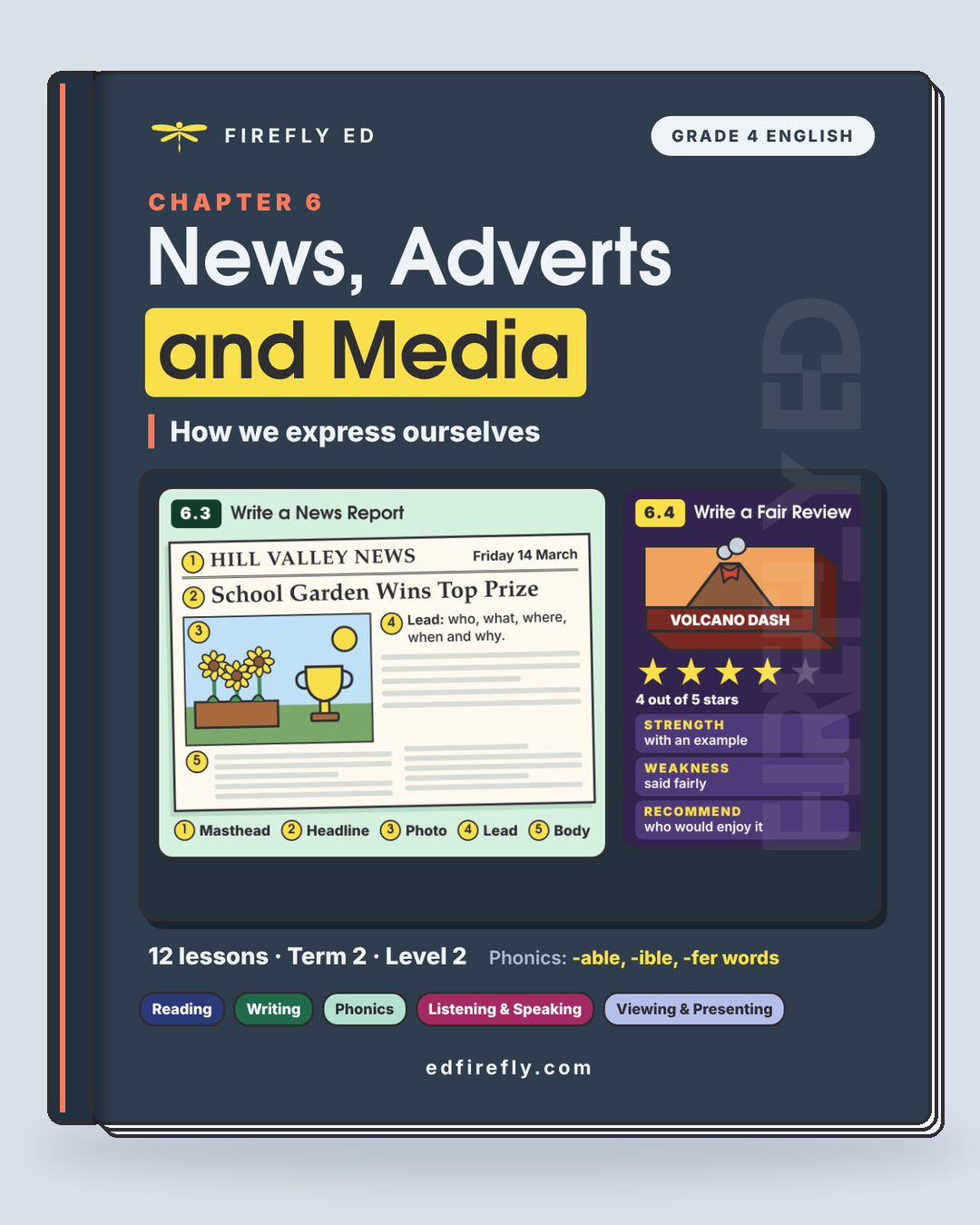
Term 2 | Level 2 | Phonics focus: word endings: -able, -ably, -ible and -ibly, and adding suffixes to words ending in -fer
What this chapter is about
People use words, pictures and sound to inform, persuade and entertain, and we can learn to judge what we read and see.
Theme: How we express ourselves. It covers news reports, features, reviews, interviews, radio bulletins, adverts and how to check whether a web page can be trusted.
Before you start
Before Lesson 6.1, look at a newspaper, a news website or an advert with an adult. What is it trying to do? Does it tell you something, sell you something or entertain you? How can you tell?
Write down your ideas and keep them. You will look at them again at the end of the chapter.
Questions we explore
- How news, adverts and stories have different purposes
- How words, pictures and sound are chosen to persuade us
- How we can check whether information is fair and reliable
How each lesson works
Every lesson starts with a Wonder question to think about. Next, you learn something new, see how it is done, try it, and practise on your own. Each lesson ends with Reflect, where you go back to the Wonder question, think about how you learned, and choose something to do at home.
Lessons
Each strand of this chapter has its own page. Open a page to see its lessons.
Download the full chapter as a PDF (free after you subscribe)
Reading: Fact or Opinion in a News Report and a Feature Article
In Lessons 6.1 and 6.2, you tell facts from opinions in a news report, and compare how a news report and a feature article are organised.
Writing: Write a News Report and a Fair Review
In Lessons 6.3 and 6.4, you write a news report with a headline, a lead and quotations, and write a fair review of a game or a film.
Listening and Speaking: Interview for a News Story and Record a Radio Bulletin
In Lessons 6.5 and 6.6, you plan and ask interview questions, paraphrase the answers, and record a short radio news bulletin.
Viewing and Presenting: How Adverts Persuade and Check an Online Source
In Lessons 6.7 and 6.8, you explain how pictures, colour and words in an advert persuade, and use five questions to check whether a web page is reliable.
Phonics: -able, -ably, -ible, -ibly and -fer Words
In Lessons 6.9, 6.10 and 6.11, you add -able, -ably, -ible and -ibly to words, add suffixes to -fer words, and spell six tricky words.
Chapter review
Lesson 6.12 reviews the whole chapter. An optional Challenge with a story and a grammar task follows it. Tap a lesson to open it. Tap the lesson title again, or use the link at the end of the lesson, to close it.
Lesson 6.12: Chapter 6 Review | All strands | About 20 minutes
Term 2 | Level 2
Goal
“I can show what I have learned about news, reviews, interviews, adverts, reliable websites and word endings in Chapter 6.”
Words to know
fact, opinion, headline, lead, quotation, review, interview, advert, reliable, suffix
Wonder
Think about this question before you start. Say your ideas. You will come back to it at the end of the lesson.
What is one question you will now ask yourself before you believe something you read or see?
Let’s Learn
This part reminds you of what you learned in Chapter 6. Look back at any lesson if you need to.
This review has six tasks. Here is a reminder of what each one checks.
1. Read each task carefully.
2. Try it on your own first.
3. Check your work with the Answer Key.
4. Mark any task that felt hard. Go back to that lesson and try again.
See How It’s Done
Now Try It
1. Fact or opinion? The bulletin lasted two minutes. ______________
2. -able or -ible? vis____ ______________
Time To Practise
Name: ______________________
1. Reading.
Over 200 people watched the school play on Friday night. “It was the best show we have ever done,” said the head teacher. Tickets were sold at the door, and the money will buy new costumes.
a) Write one fact and one opinion. Fact: ______________ Opinion: ______________
b) How does a feature article usually begin, compared with a news report? ______________________________
2. Writing.
a) Write a headline for the text in task 1. ______________________________
b) Punctuate the quotation: The costumes will be ready in May said Mrs Rao
__________________________________________________________________
3. Oral.
a) Make this an open question: Did you like the play? ______________________________
b) Why does the most important story go first in a bulletin? ______________________________
4. Visual.
a) Name two tricks adverts use to persuade. ______________ ______________
b) Name two signs that a web page might not be reliable. ______________ ______________
5. Phonics.
Add the suffix: comfort + able ______________ terrible + ly ______________ notice + able ______________ refer + ing ______________ refer + ence ______________
6. Spelling.
a) Circle the correct spelling.
frequently / frequentley interupt / interrupt explanation / explaination catagory / category
b) Write from dictation.
Listen as an adult reads a sentence aloud slowly. Write it on the line.
__________________________________________________________________
Reflect
Think about these questions. Talk about them with someone at home or at school.
1. Go back to the Wonder question: “What is one question you will now ask yourself before you believe something you read or see?” What do you think now?
2. I was reflective today when I ______________________________.
Being reflective means looking back at your work and thinking how to make it better. For example: I was reflective today when I looked back at a task that was hard and tried again.
Take action: Teach your family the five questions for checking a web page, and use them together this week.
Next Steps
If this was easy, try: Write a short, fair review of a news website or children’s magazine, using the five questions as your reasons.
If this was hard, go back to: Let’s Learn. Look at the reminder chart, find the lesson for the task that felt hard, and try that lesson again.
Notes for Parents and Teachers
Show notes for parents and teachers
These notes cover this lesson only. How every lesson runs is explained in How to Use This Material.
Time To Practise
- Task 6: Read the sentence in the Answer Key slowly. The learner writes it.
Answer Key
Reveal Answers
Now Try It
1. fact 2. -ible (visible): vis is not a whole word.
1. Reading
a) Fact: any one of: over 200 people watched; it was on Friday night; tickets were sold at the door; the money will buy costumes. Opinion: “It was the best show we have ever done.” b) A feature often begins with a scene or a description; a news report begins with the main facts.
If it was hard, go back to Lessons 6.1 and 6.2.
2. Writing
a) Sample answer: School Play Raises Money for Costumes b) “The costumes will be ready in May,” said Mrs Rao.
If it was hard, go back to Lessons 6.3 and 6.4.
3. Oral
a) Sample answer: What did you enjoy most about the play? b) Because it matters most to listeners, and some people only hear the start.
If it was hard, go back to Lessons 6.5 and 6.6.
4. Visual
a) Any two of: bright colours, a slogan, a happy picture, big numbers, a famous or sporty person, small print. b) Any two of: no author, no date, shouting capital letters, pop-ups, prizes, no sources, claims that seem too amazing.
If it was hard, go back to Lessons 6.7 and 6.8.
5. Phonics
comfortable, terribly, noticeable, referring, reference
If it was hard, go back to Lessons 6.9 to 6.11.
6. Spelling
a) frequently, interrupt, explanation, category b) Dictation sentence: The reporter frequently had to communicate a clear explanation without letting anyone interrupt.
If it was hard, go back to Lesson 6.11.
Reflect
2. Any real moment from the lesson that shows the learner was reflective. Examples: “I was reflective today when I looked back at a task that was hard and tried again.” “I was reflective today when I checked my answers and fixed a mistake.”
Challenge: Read-Aloud Story and Grammar | Optional | About 20 minutes
This Challenge is optional. It has a story to listen to and a grammar task.
Part 1: Read-Aloud Story
Listen as an adult reads the story aloud. Then talk about it.
The Front Page
It was Thursday afternoon, and the Class 4 newspaper had to be printed by Friday morning. The deadline was only hours away.
“We still need a front-page story,” said Ama, the editor. She looked at the empty space on the big sheet of paper. “Something that everyone will want to read.”
“What about the river clean-up?” suggested Tomás. “I have three photographs, and I interviewed Mr Novak.” He read from his notebook: “I think the water looks cleaner than it has in years.”
“That’s a good quote,” said Ama, “but we need to check the facts first.” Mia found the council’s official figures online and compared them with Tomás’s notes. One number was wrong: he had written 30 kilograms instead of 300. “Good thing we checked,” said Tomás, his face turning red. “That would have been very embarrassing.”
They worked until the bell rang. Leo wrote the headline, Mia added the photographs, and Ama read every word twice. On Friday morning, the printer hummed, and warm copies of the Class 4 Chronicle piled up on the table. By lunchtime, there were none left.
Talk about the story
1. What is a deadline? What was the class’s deadline?
2. Why did Ama want to check the facts before printing?
3. What mistake did Mia find? How did Tomás feel about it?
Hint: Look at how his face changed.
4. What job did each child do on Friday morning?
5. “By lunchtime, there were none left.” What does this tell you about the newspaper?
Part 2: Words That Are Often Confused, and Punctuating Speech (Grammar)
Some words sound the same or almost the same, but are spelled differently and mean different things.
there (a place) their (belongs to them) they’re (they are)
your (belongs to you) you’re (you are)
to (towards) too (also, or more than enough) two (2)
accept (to take or agree to) except (not including)
Punctuating speech and quotations: put the spoken words inside quotation marks. The comma, full stop, question mark or exclamation mark goes inside the closing mark. Start a new paragraph when a new person speaks.
“We still need a front-page story,” said Ama. Tomás asked, “What about the river clean-up?”
1. Choose the correct word.
a) The children put (there / their / they’re) photographs on the table.
b) “(Your / You’re) the editor,” said Leo.
c) The newspaper had (to / too / two) pages, and it was (to / too / two) late to add a third.
d) Everyone (accepted / excepted) the plan (accept / except) Tomás, who wanted more photos.
2. Add the missing punctuation.
a) Good thing we checked said Tomás
b) Mia asked Where are the official figures
c) Ama said We print tomorrow
3. Write a sentence that uses there, their and they’re.
______________________________________________
Notes for Parents and Teachers
Show notes for parents and teachers
These notes cover this section only. How every lesson runs is explained in How to Use This Material.
Use the Challenge when the lessons feel easy, or to stretch the learner after Lesson 6.12. The story is for you to read aloud. It uses some harder words on purpose, so talk about them as you read.
Part 1: Read-Aloud Story
Read the story aloud twice. The first time, just enjoy it. The second time, stop at the words in bold and talk about what they mean.
Answer Key
Reveal Answers
Part 1: Talk about the story
1. The time by which something must be finished. The newspaper had to be printed by Friday morning.
2. So that the newspaper did not print anything wrong.
3. Tomás had written 30 kilograms instead of 300. He was embarrassed; his face turned red.
4. Leo wrote the headline, Mia added the photographs, and Ama read every word twice.
5. It was popular; everyone wanted a copy.
Part 2: Grammar
1. a) their b) You’re c) two, too d) accepted, except
2. a) “Good thing we checked,” said Tomás. b) Mia asked, “Where are the official figures?” c) Ama said, “We print tomorrow.” (or tomorrow!)
3. Sample answer: They’re putting their copies over there.
Look for: the correct word in each sentence, and punctuation inside the closing quotation marks.
Try it at home
By the end of this chapter, you could:
- Watch or listen to a short news report together and talk about the facts and any opinions you notice.
- Look at an advert and spot the tricks it uses: colours, pictures, slogans and promises.
- Agree on three questions your family will ask before trusting something online.
Lesson 6.12 reviews the chapter. Look back at the ideas from “Before you start” and talk about how they have changed.
Notes for Parents and Teachers
Show notes for parents and teachers
The chapter page and the lessons are written for the learner. How every lesson runs is explained once in How to Use This Material. Each lesson also has its own short notes, after Next Steps.
- The lessons are worksheets. The learner opens a lesson and works on paper next to the screen, or on a printout. Printable PDFs are free to download after you subscribe.
- Before you start: help the learner write down their ideas before Lesson 6.1, and keep them. In Lesson 6.12, look at them together and talk about how they have changed.
For Teachers: IB Details
Show IB and curriculum details
IB theme: How we express ourselves. This theme is about the ways we discover and express ideas, feelings and beliefs, and how we reflect on and enjoy what others create.
Central idea: People use words, pictures and sound to inform, persuade and entertain, and we can learn to judge what we read and see.
Key concepts: Form (what is it like?), Perspective (what are the points of view?), Responsibility (what is our responsibility?). Related concepts: media, persuasion, fairness, reliability.
Lines of inquiry:
- How news, adverts and stories have different purposes
- How words, pictures and sound are chosen to persuade us
- How we can check whether information is fair and reliable
What each lesson covers
| Lesson | Title | Strand | Key concept |
|---|---|---|---|
| 6.1 | Fact or Opinion? Reading a News Report | Reading | Perspective |
| 6.2 | Behind the Headline: A News Report and a Feature Article | Reading | Form |
| 6.3 | Write a News Report: Headline, Lead and Quotations | Writing | Form |
| 6.4 | Write a Fair Review: A Game or a Film | Writing | Perspective |
| 6.5 | Interview for a News Story | Listening and speaking | Perspective |
| 6.6 | Record a Radio News Bulletin | Speaking | Form |
| 6.7 | How Adverts Persuade: Pictures, Colour and Words | Viewing | Perspective |
| 6.8 | Is This Page Reliable? Check an Online Source | Viewing | Responsibility |
| 6.9 | -able and -ably | Reading and spelling | Form |
| 6.10 | -ible and -ibly | Reading and spelling | Form |
| 6.11 | Suffixes on -fer Words, and Tricky Words | Reading and spelling | Form |
| 6.12 | Chapter 6 Review | All strands | Form, Perspective and Responsibility |
Each lesson also matches the national curriculum for England (Year 4) and the US Common Core (Grade 4). The Grade 4 Curriculum Map lists the full standards for every lesson.
Chapters – Index | Next: Term 2 Review →
© 2026 Firefly Ed. All rights reserved. This page may be printed for personal, home and classroom use. It may not be sold, shared online or reproduced for commercial use without written permission. edfirefly.com


Share your thoughts or ask something..