
Term 2 | Level 2 | Phonics focus: word endings: -able, -ably, -ible and -ibly, and adding suffixes to words ending in -fer
Chapter 6 – News, Adverts and Media | Chapters – Index
Lessons
This page has the two listening and speaking lessons of Chapter 6, News, Adverts and Media: Lessons 6.5 and 6.6. The chapter page has the chapter overview, the chapter review and the PDF download.
Tap a lesson to open it. Tap the lesson title again, or use the link at the end of the lesson, to close it.
Lesson 6.5: Interview for a News Story | Oral | About 20 minutes
Term 2 | Level 2
Goal
“I can plan and ask open and follow-up questions in an interview, and paraphrase the answers accurately.”
Words to know
interview, interviewer, open question, closed question, follow-up, paraphrase
Wonder
Think about this question before you start. Say your ideas. You will come back to it at the end of the lesson.
What question would you most like to ask a firefighter? Why?
Let’s Learn
Read the interview with an adult. Take one part each.
Reporters interview people to find facts and quotations for their stories. Good interviewers plan their questions, listen carefully, and ask follow-up questions to find out more.
Part of Ava’s interview
AVA: Thank you for talking to us. How long have you been a firefighter?
FIREFIGHTER JONES: Twelve years.
AVA: What do you check first when you arrive at a fire?
FIREFIGHTER JONES: First, we check that everyone is out of the building. People always come first. Then we look at where the fire is and which way the wind is blowing.
AVA: Why does the wind matter?
FIREFIGHTER JONES: Because wind can push the fire towards other houses, so we decide where to stand and where to spray the water.
AVA: What is one thing every family can do to stay safe?
FIREFIGHTER JONES: Check your smoke alarm once a month. Press the button, and if it beeps, it works.
Paraphrasing means saying what someone told you in your own words, without changing the meaning. Reporters paraphrase most answers and quote only the most interesting words.
See How It’s Done
Now Try It
1. Is this open or closed? Is the fire engine heavy? ______________ Make it open: ______________________________
2. Paraphrase the firefighter’s tip about smoke alarms.
__________________________________________________________________
Time To Practise
Name: ______________________
1. Open or closed?
Write O for open or C for closed.
a) Do you wear a helmet? ____ b) How do you train for your job? ____ c) What is the hardest part of your day? ____ d) Is your job fun? ____
2. Write follow-up questions.
a) Answer: “I train three mornings a week.” Follow-up: ________________________________
b) Answer: “My favourite part is working with animals.” Follow-up: ________________________________
3. Plan an interview.
Choose someone to interview: a family member, a neighbour, a shopkeeper or a teacher. Write five questions. Make at least three of them open.
1. ________________________________________________________________
2. ________________________________________________________________
3. ________________________________________________________________
4. ________________________________________________________________
5. ________________________________________________________________
4. Hold the interview.
Ask your questions and at least one follow-up. Take short notes, using key words.
An adult watches and ticks each one they see or hear:
☐ polite greeting and thanks ☐ open questions ☐ a follow-up question ☐ listened without interrupting ☐ took notes
5. Paraphrase.
Write two sentences that paraphrase what you found out, and one exact quotation.
__________________________________________________________________
__________________________________________________________________
Reflect
Think about these questions. Talk about them with someone at home or at school.
1. Go back to the Wonder question: “What question would you most like to ask a firefighter? Why?” What do you think now?
2. I was an inquirer today when I ______________________________.
An inquirer asks questions and finds things out. For example: I was an inquirer today when I asked a follow-up question to find out more.
Take action: Interview an older relative about how life was different when they were your age, and share what you learned.
Next Steps
If this was easy, try: Write a short news story using your interview notes, with one paraphrase and one quotation.
If this was hard, go back to: Let’s Learn. Read the three kinds of questions aloud and make up one more of each.
Notes for Parents and Teachers
Show notes for parents and teachers
These notes cover this lesson only. How every lesson runs is explained in How to Use This Material.
Let’s Learn
Read the interview together, taking the two parts.
Time To Practise
- Task 4: Tick each one you see or hear during the interview.
Answer Key
Reveal Answers
Now Try It
1. Closed. Sample open question: What is it like to drive the fire engine? 2. Sample answer: Every family should test its smoke alarm once a month by pressing the button to check that it beeps.
1. Open or closed?
a) C b) O c) O d) C
2. Write follow-up questions
Sample answers: a) What do you do in a training session? b) Which animal has been the most interesting to work with?
3 to 5. Answers will vary. Look for: at least three open questions, one follow-up, notes in key words, and a paraphrase that keeps the meaning.
Reflect
2. Any real moment from the lesson that shows the learner was an inquirer. Examples: “I was an inquirer today when I asked a follow-up question to find out more.” “I was an inquirer today when I listened carefully to the answers.”
Lesson 6.6: Record a Radio News Bulletin | Oral | About 20 minutes
Term 2 | Level 2
Goal
“I can plan, rehearse and record a short news bulletin, speaking clearly and at a steady pace.”
Words to know
bulletin, presenter, running order, script, rehearse, record, pace
Wonder
Think about this question before you start. Say your ideas. You will come back to it at the end of the lesson.
Radio has no pictures. How can a news reader help listeners picture the story?
Let’s Learn
Read the bulletin with an adult. Take one part each.
A news bulletin is a short programme that tells listeners the main news. On the radio, listeners cannot see anything, so the presenters must speak clearly, at a steady pace, and use precise words.
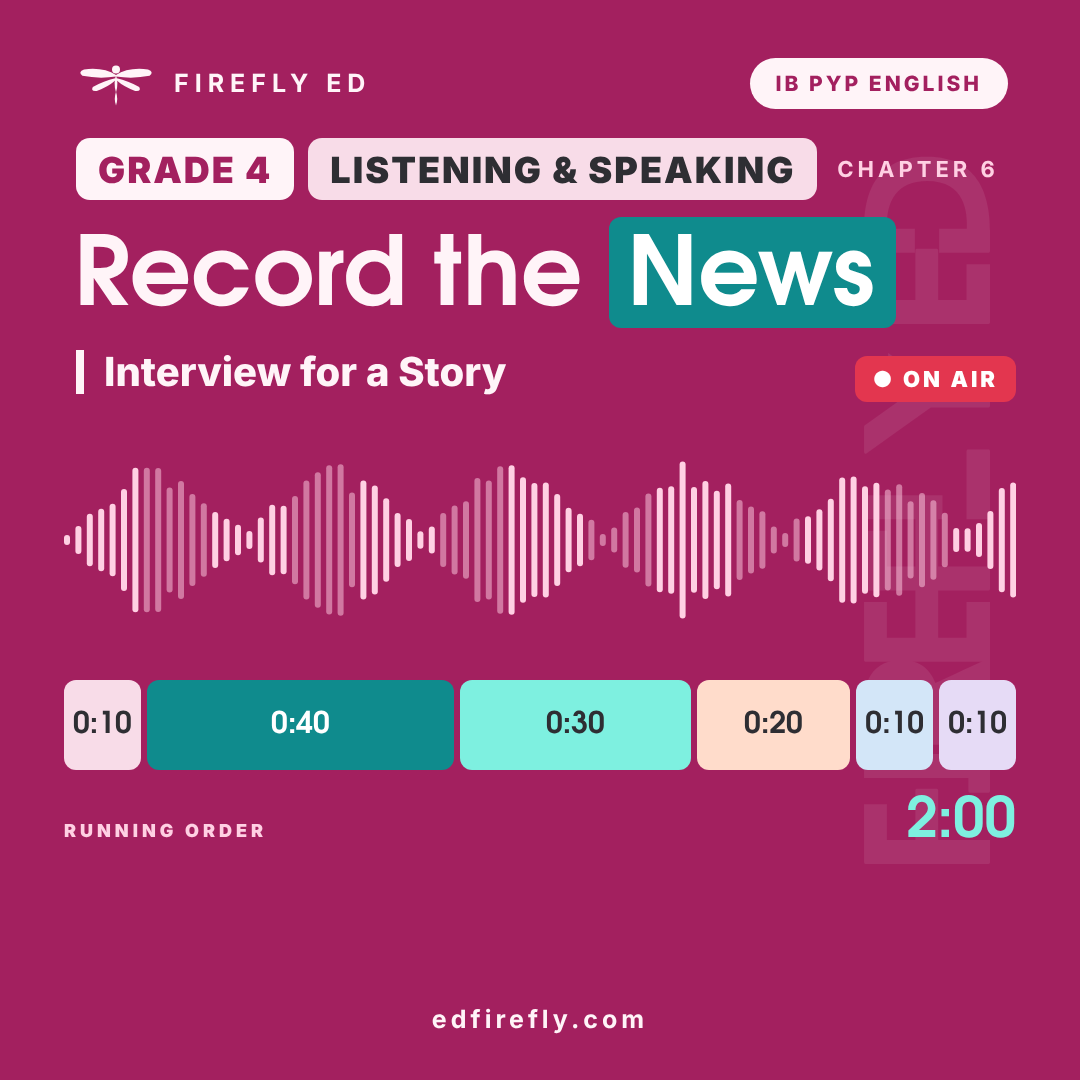
Presenters follow a running order: a list of the stories in order, with a time for each. The most important story goes first.
Class 4 Radio: Friday Bulletin
MIA: Good morning. It is nine o’clock, and this is the Class 4 news, with me, Mia…
LEO: …and me, Leo.
MIA: Our top story. More than 80 volunteers cleaned up the Hill River last Saturday and collected 300 kilograms of rubbish in just four hours. The clean-up was organised by pupils at Riverside School. The next one is planned for June.
LEO: At Coral Bay, 92 baby sea turtles have reached the ocean safely, after volunteers guarded their nest for two months. Visitors are asked to switch off bright lights near the beach at night.
MIA: And Riverside School’s vegetable garden has won first prize at the Hill Valley Garden Show.
LEO: Now the weather. Today will be sunny, with a light wind.
MIA: That’s all from Class 4 Radio. Thank you for listening. Goodbye!
See How It’s Done
Now Try It
1. Which story is the top story? Why do you think it goes first?
__________________________________________________________________
2. How long is the whole bulletin? Add up the times. ______________
Time To Practise
Name: ______________________
1. Plan your running order.
Choose three news stories from your home, school or town.
| # | Part | Story | Time |
|---|---|---|---|
| 1 | Opening | ||
| 2 | Top story | ||
| 3 | Second story | ||
| 4 | Short item | ||
| 5 | Weather | ||
| 6 | Closing |
2. Write your script.
Write the words for your top story. Use the 5 Ws. Mark pauses with / and underline words to stress.
__________________________________________________________________
__________________________________________________________________
__________________________________________________________________
3. Rehearse.
Read your bulletin aloud twice with a stopwatch. Is it about two minutes? ______
4. Record.
Record your bulletin with a phone or tablet, with an adult’s help. Play it back.
Listen to your recording with an adult. The adult ticks each one they hear:
☐ clear opening and closing ☐ most important story first ☐ clear words ☐ steady pace ☐ pauses and stress
5. Improve.
After listening to your recording, write one thing to improve next time.
__________________________________________________________________
Reflect
Think about these questions. Talk about them with someone at home or at school.
1. Go back to the Wonder question: “Radio has no pictures. How can a news reader help listeners picture the story?” What do you think now?
2. I was a risk-taker today when I ______________________________.
A risk-taker tries something new, even when it feels hard. For example: I was a risk-taker today when I recorded my voice even though it felt strange.
Take action: Share your recording with a relative who lives far away, as a “news from home” message.
Next Steps
If this was easy, try: Add a short interview clip from Lesson 6.5 to your bulletin.
If this was hard, go back to: Let’s Learn. Read the model bulletin aloud with an adult, then read only the top story on your own.
Notes for Parents and Teachers
Show notes for parents and teachers
These notes cover this lesson only. How every lesson runs is explained in How to Use This Material.
Let’s Learn
Read the bulletin together, taking the two parts.
Time To Practise
- Task 4: Listen to the recording together, and tick each one you hear.
Answer Key
Reveal Answers
Now Try It
1. The river clean-up. Sample reason: it affected the most people in the area, so it is the most important news for local listeners. 2. 2 minutes (10 + 40 + 30 + 20 + 10 + 10 = 120 seconds)
1 to 5. Answers will vary. Look for: a running order with the most important story first, a script that answers the 5 Ws, marked pauses and stress, a bulletin of about two minutes, and at least four ticks.
Reflect
2. Any real moment from the lesson that shows the learner was a risk-taker. Examples: “I was a risk-taker today when I recorded my voice even though it felt strange.” “I was a risk-taker today when I tried again to make my recording better.”
For Teachers: IB Details
Show IB and curriculum details
IB theme: How we express ourselves. This theme is about the ways we discover and express ideas, feelings and beliefs, and how we reflect on and enjoy what others create.
Central idea: People use words, pictures and sound to inform, persuade and entertain, and we can learn to judge what we read and see.
| Lesson | Title | Strand | Key concept |
|---|---|---|---|
| 6.5 | Interview for a News Story | Listening and speaking | Perspective |
| 6.6 | Record a Radio News Bulletin | Speaking | Form |
Each lesson also matches the national curriculum for England (Year 4) and the US Common Core (Grade 4). The Grade 4 Curriculum Map lists the full standards for every lesson.
← Back to Chapter 6 – News, Adverts and Media | Chapters – Index
© 2026 Firefly Ed. All rights reserved. This page may be printed for personal, home and classroom use. It may not be sold, shared online or reproduced for commercial use without written permission. edfirefly.com


Share your thoughts or ask something..