
Term 2 | Level 2 | Phonics focus: word endings: -ant, -ance, -ancy, -ent, -ence and -ency
Chapter 5 – Choosing and Leading | Chapters – Index
Lessons
This page has the two listening and speaking lessons of Chapter 5, Choosing and Leading: Lessons 5.5 and 5.6. The chapter page has the chapter overview, the chapter review and the PDF download.
Tap a lesson to open it. Tap the lesson title again, or use the link at the end of the lesson, to close it.
Lesson 5.5: Give a Speech in Formal English | Oral | About 20 minutes
Term 2 | Level 2
Goal
“I can give a speech in formal English, speaking clearly and choosing words that suit my audience.”
Words to know
formal, informal, audience, contraction, slang, pace, volume
Wonder
Think about this question before you start. Say your ideas. You will come back to it at the end of the lesson.
Do you speak in the same way to your best friend and to the head teacher? Why or why not?
Let’s Learn
We change the way we speak to suit our audience and the situation.
Informal English is relaxed. We use it with friends and family. It can include slang (gonna, loads), short forms and chatty greetings.
Formal English is careful and polite. We use it in speeches, assemblies, interviews and letters. It uses full sentences, polite greetings and precise words.
Tips for giving a formal speech: stand up straight; look at the audience; speak loudly enough for the back row to hear; speak at a steady pace; pause after each important point; end with a thank you.
See How It’s Done
Now Try It
1. Make this formal: Thanks a lot, guys!
__________________________________________________________________
2. Name one place where you would use formal English.
______________________________
Time To Practise
Name: ______________________
1. Formal or informal?
Write F for formal or I for informal.
a) Good afternoon, ladies and gentlemen. ____ b) Yeah, it was awesome. ____ c) Thank you for your kind attention. ____ d) See ya later! ____
2. Make it formal.
a) I wanna be your rep. ______________________________________________
b) Loads of kids think the bins are gross. ______________________________
c) Vote for me, OK? ______________________________________________
3. Get ready.
Use the speech you wrote in Lesson 5.3. Read it and circle any informal words. Change them to formal words.
4. Practise.
Practise your speech three times. The first time, read it. The second time, look up after each sentence. The third time, use only key words on a card.
5. Give your speech.
Give your speech to your family or class.
An adult listens and ticks each one they see or hear:
☐ a formal greeting ☐ no slang ☐ loud enough to hear ☐ steady pace ☐ eye contact ☐ a thank you at the end
Reflect
Think about these questions. Talk about them with someone at home or at school.
1. Go back to the Wonder question: “Do you speak in the same way to your best friend and to the head teacher? Why or why not?” What do you think now?
2. I was a communicator today when I ______________________________.
A communicator shares ideas clearly by talking, writing or drawing. For example: I was a communicator today when I changed informal words to formal words for my speech.
Take action: Listen to an announcement or a speech on the radio or at an assembly. Notice the formal words the speaker uses.
Next Steps
If this was easy, try: Record your speech, play it back, and choose one thing to make even clearer.
If this was hard, go back to: Let’s Learn. Read each row of the table aloud: first the informal way, then the formal way.
Notes for Parents and Teachers
Show notes for parents and teachers
These notes cover this lesson only. How every lesson runs is explained in How to Use This Material.
Let’s Learn
Look at the two pictures together.
Time To Practise
- Task 5: Tick each one you see or hear while the learner gives the speech.
Answer Key
Reveal Answers
Now Try It
1. Thank you very much, everyone. 2. Any one of: a speech, an assembly, an interview, a letter, talking to a visitor.
1. Formal or informal?
a) F b) I c) F d) I
2. Make it formal
a) I would like to be your class representative. b) Many children think the bins are unpleasant. c) Please vote for me. Thank you.
3 to 5. Answers will vary. Look for: informal words replaced, three practices, and at least four ticks in task 5.
Reflect
2. Any real moment from the lesson that shows the learner was a communicator. Examples: “I was a communicator today when I changed informal words to formal words for my speech.” “I was a communicator today when I looked at my audience and spoke at a steady pace.”
Lesson 5.6: Hold a Class Council Meeting | Oral | About 20 minutes
Term 2 | Level 2
Goal
“I can take a role in a meeting, follow the agreed rules, and use polite phrases to propose, agree and disagree.”
Words to know
council, chair, secretary, timekeeper, propose, second, in favour
Wonder
Think about this question before you start. Say your ideas. You will come back to it at the end of the lesson.
What could go wrong at a meeting with no rules? How do rules help?
Let’s Learn
Read the script with an adult. Take different parts.
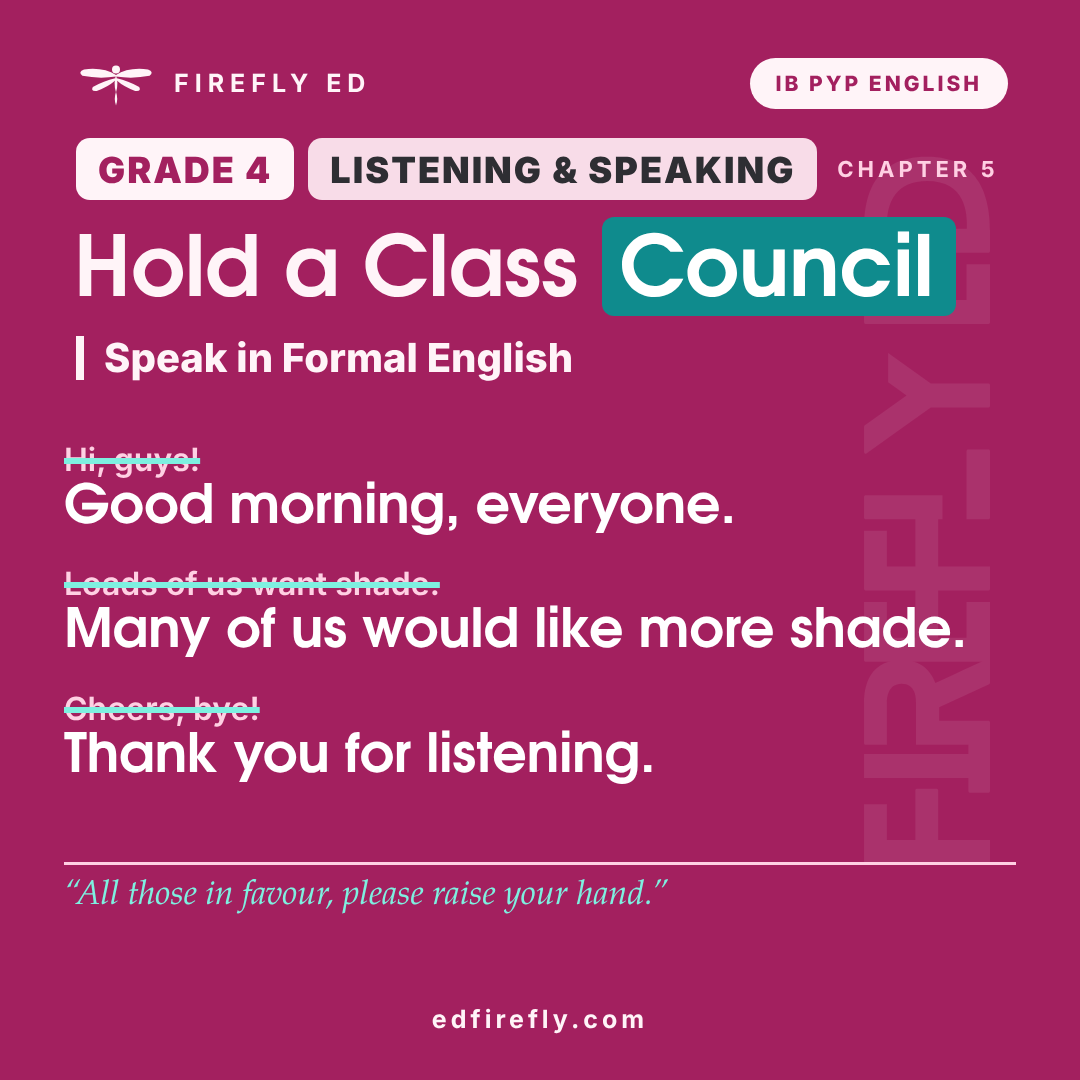
A council is a group that meets to make decisions for others. In a good meeting, each person has a role, and everyone follows the rules: one person speaks at a time, the chair decides who speaks next, and everyone keeps to the agenda.
Part of a Class 4 Council meeting
PRIYA (chair): Item 4 is the talent show. Leo, would you like to start?
LEO: Yes. I propose that we hold the talent show in the hall on the last Friday of each month.
AMA: I second that.
TOMÁS: I see it differently, because the hall is used for sports on Fridays. Could we use the library instead?
LEO (timekeeper): We have two minutes left for this item.
PRIYA: Thank you. Let’s vote. All those in favour of the library, please raise your hand… That’s four. All those in favour of the hall… That’s two. The talent show will be in the library.
MIA (secretary): I have written that down. Leo will ask the librarian by Wednesday.
See How It’s Done
Now Try It
1. In the script, which phrase does Tomás use to disagree politely?
__________________________________________________________________
2. Why does the timekeeper speak during item 4?
__________________________________________________________________
Time To Practise
Name: ______________________
1. Match the role.
Write the role: chair, secretary, timekeeper or member.
a) “We have one minute left.” ______________ b) “Let’s move to item 5.” ______________
c) “I propose a new bench by the gate.” ______________ d) “Leo will ask by Wednesday.” ______________
2. Choose the phrase.
Write a polite phrase for each situation.
a) You agree with an idea. ______________________________________________
b) You disagree with an idea. ____________________________________________
c) You want the group to vote. __________________________________________
3. Agree the rules.
Write three rules for your meeting.
1. ________________________________________________________________
2. ________________________________________________________________
3. ________________________________________________________________
4. Hold the meeting.
Use the agenda you wrote in Lesson 5.4. Give each person a role, and hold the meeting for about ten minutes.
An adult watches the meeting and ticks each one they see or hear:
☐ did the job of a role ☐ waited for a turn ☐ used a phrase to propose or agree ☐ disagreed politely ☐ took part in a vote
5. Reflect.
What went well in your meeting? What would you change next time?
__________________________________________________________________
Reflect
Think about these questions. Talk about them with someone at home or at school.
1. Go back to the Wonder question: “What could go wrong at a meeting with no rules? How do rules help?” What do you think now?
2. I was open-minded today when I ______________________________.
Being open-minded means listening to other ideas and other ways of doing things. For example: I was open-minded today when I listened to an idea that was different from mine.
Take action: Suggest that your class or family holds a short meeting each week, with a different chair each time.
Next Steps
If this was easy, try: Be the chair for a meeting with four or more people, and keep every item to time.
If this was hard, go back to: Let’s Learn. Read the script aloud with an adult, taking turns to be the chair.
Notes for Parents and Teachers
Show notes for parents and teachers
These notes cover this lesson only. How every lesson runs is explained in How to Use This Material.
Let’s Learn
Read the script together, taking different parts.
Time To Practise
- Task 4: Tick each one you see or hear during the meeting.
Answer Key
Reveal Answers
Now Try It
1. “I see it differently, because…” 2. To tell the group how much time is left, so the meeting keeps to the agenda.
1. Match the role
a) timekeeper b) chair c) member d) secretary
2. Choose the phrase
Sample answers: a) I second that. / I agree, because… b) I see it differently, because… c) All those in favour, please raise your hand.
3 to 5. Answers will vary. Look for: fair rules, roles carried out, polite phrases, and a vote.
Reflect
2. Any real moment from the lesson that shows the learner was open-minded. Examples: “I was open-minded today when I listened to an idea that was different from mine.” “I was open-minded today when I disagreed politely and gave a reason.”
For Teachers: IB Details
Show IB and curriculum details
IB theme: How we organize ourselves. This theme is about how people work together in groups, how communities make decisions and share responsibilities, and how organisations are run.
Central idea: Groups make fair decisions in different ways, and leaders have responsibilities to the people they lead.
| Lesson | Title | Strand | Key concept |
|---|---|---|---|
| 5.5 | Give a Speech in Formal English | Speaking | Perspective |
| 5.6 | Hold a Class Council Meeting | Speaking and listening | Responsibility |
Each lesson also matches the national curriculum for England (Year 4) and the US Common Core (Grade 4). The Grade 4 Curriculum Map lists the full standards for every lesson.
← Back to Chapter 5 – Choosing and Leading | Chapters – Index
© 2026 Firefly Ed. All rights reserved. This page may be printed for personal, home and classroom use. It may not be sold, shared online or reproduced for commercial use without written permission. edfirefly.com



Share your thoughts or ask something..