
Term 3 | Level 3 | Phonics focus: contractions, apostrophes for owning, and -tion words
Lesson 7 – Day, Night and the Sky | Lessons – Index
Lessons
This page has the two viewing and presenting lessons of Lesson 7, Day, Night and the Sky: Lessons 7.7 and 7.8. The Lesson 7 page has the Lesson 7 overview, the Lesson 7 review and the PDF download.
Select a lesson to go straight to it. Each lesson ends with a link back to the top of the page.
Lesson 7.7: Read a Moon Chart
Visual | About 20 minutes
Term 3 | Level 3
Goal
“I can read a Moon chart set out like a calendar, find dates and patterns, and use the pattern to work out what I cannot see.”
Words to know
Moon, phase, full Moon, new Moon, waxing, waning
Wonder
Think about this question before you start. Say your ideas. You will come back to it at the end of the lesson.
Why does the Moon look different on different nights?
Let’s Learn
The Moon does not make its own light. The Sun shines on it, and the Moon reflects the light, like a mirror. As the Moon travels around the Earth, we see different amounts of its lit side. So the Moon seems to change shape. These shapes are called the phases of the Moon.
- When the lit part gets bigger each night, the Moon is waxing (growing).
- When the lit part gets smaller each night, the Moon is waning (shrinking).
- The whole pattern, from new Moon to new Moon, takes about four weeks. Then it starts again.
A chart set out like a calendar shows one row for each week and one column for each day. Read the title and the key first.
See How It’s Done
Now Try It
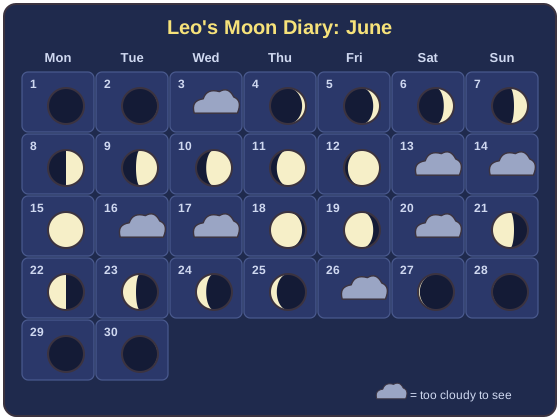
Use Leo’s Moon diary in See How It’s Done.
1. What shape was the Moon on the 11th?
Hint: Find the box with the number 11. Is it more or less than half lit?
2. How many nights in the first week was it too cloudy to see the Moon?
Hint: Look along the first row for clouds.
Time To Practise
Name: ______________________
1. Read the chart.
Use Leo’s Moon diary in See How It’s Done.
a) On which date was the Moon full? ______ What day of the week was it? ______________
b) On which two dates was there a half Moon? ______ and ______
c) How many nights in June were too cloudy to see the Moon? ______
d) How many days after the new Moon on the 1st was the full Moon? ______ days
e) Look at the 18th to the 25th. Is the Moon waxing or waning? ______________
2. Find the pattern.
a) Look at the Mondays: the 1st, 8th, 15th, 22nd and 29th. What do you notice?
__________________________________________________________________
b) When the Moon is waxing, which side is lit? When it is waning, which side is lit?
__________________________________________________________________
3. Use the pattern to work it out.
a) The 14th was cloudy. What do you think the Moon looked like that night? Explain why.
Hint: Look at the nights just before and just after.
__________________________________________________________________
b) Leo wants to see the next full Moon after June. About how many weeks after the 15th of June should he look? ______ weeks
c) Why is a chart a good way to show this information, instead of a long list of sentences?
__________________________________________________________________
4. Keep your own Moon diary.
For the next two weeks, look for the Moon each evening with an adult. Draw its shape in a calendar like Leo’s. If you cannot see it, draw a cloud. Sometimes the Moon is easier to see in the early morning, or even in the daytime sky.
Reflect
Think about these questions. Talk about them with someone at home or at school.
1. Go back to the Wonder question: “Why does the Moon look different on different nights?” What do you think now?
2. I was a thinker today when I ______________________________.
A thinker thinks carefully to work things out. For example: I was a thinker today when I used the pattern to work out the Moon on a cloudy night.
Take action: Check tonight’s Moon. Is it waxing or waning? Tell someone at home how you worked it out.
Next Steps
If this was easy, try: Find the dates of the next full Moon and new Moon where you live, with an adult, using a calendar or a website for children.
If this was hard, go back to: Task 1. Do a) and c) first with an adult, pointing to each box. Then try b).
Notes for Parents and Teachers
Show notes for parents and teachers
These notes cover this lesson only. How every lesson runs is explained in How to Use This Material.
Let’s Learn
Shine a torch on a ball in a dark room and walk around it to see the lit part change shape.
See How It’s Done
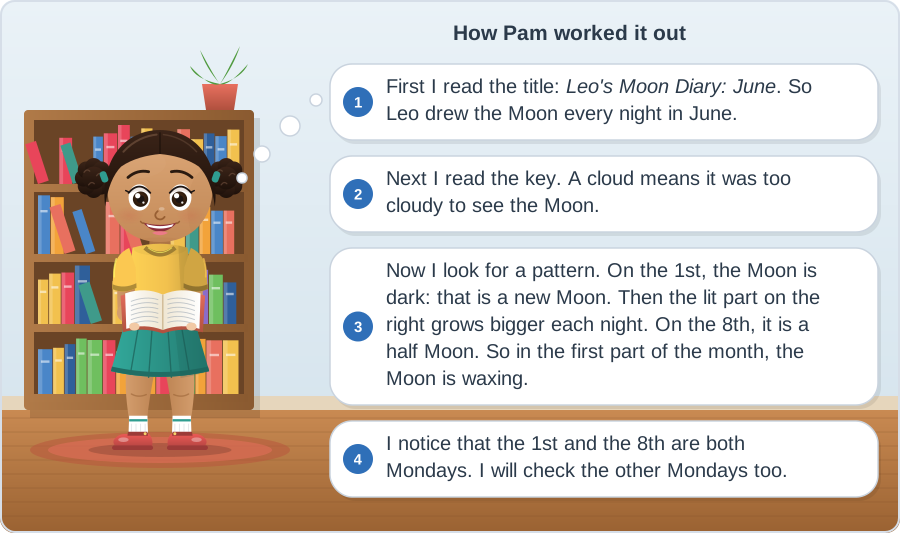
Point to each date as you talk about it.
Answer Key
Reveal Answers
Now Try It
1. More than half lit, on the right side. It was nearly full.
2. One night (the 3rd).
1. Read the chart
a) The 15th. Monday.
b) The 8th and the 22nd.
c) Seven (the 3rd, 13th, 14th, 16th, 17th, 20th and 26th).
d) 14 days
e) Waning
2. Pattern
a) Each Monday the Moon is at an important phase: new Moon on the 1st, half Moon on the 8th, full Moon on the 15th, half Moon on the 22nd and new Moon again on the 29th. The changes happen about once a week.
b) Waxing: the right side is lit. Waning: the left side is lit.
3. Work it out
a) Sample answer: Almost full, lit on the right side, because the 12th was nearly full and the 15th was full, so the 14th was in between.
b) About four weeks.
c) Sample answer: You can see the whole month at once and spot the pattern quickly.
Look for: in 3a, the learner uses the pattern from the nights around it, not a guess. Leo’s diary shows the pattern as seen from countries in the north of the world, such as the UK. In countries in the south, such as Australia, the lit side is the other way round.
4. Moon diary
Look for: a drawing for each night, with clouds where the Moon could not be seen.
Reflect
2. Any real moment from the lesson that shows the learner was a thinker. Examples: “I was a thinker today when I used the pattern to work out the Moon on a cloudy night.” “I was a thinker today when I spotted that the big changes happened on Mondays.”
Lesson 7.8: Star Patterns: Invent a Constellation
Visual | About 20 minutes
Term 3 | Level 3
Goal
“I can join stars to find a shape, explain that people see different pictures in the same stars, and design my own constellation with a key and a story.”
Words to know
constellation, star, symbol, key, shape, story
Wonder
Think about this question before you start. Say your ideas. You will come back to it at the end of the lesson.
What pictures could you find in the stars?
Let’s Learn
For thousands of years, people have looked at the stars and imagined lines joining them into pictures. A group of stars that makes a picture is called a constellation. Today, astronomers divide the whole sky into 88 constellations.
Different people have seen different pictures in the same stars. One famous group of seven stars is called the Plough in the UK and the Big Dipper in the USA. In India, the same seven stars are called the Saptarishi, the Seven Sages. In China, they are called the Northern Dipper. They are part of a bigger constellation called the Great Bear.
A star picture uses symbols: a star shape for each star, and straight lines to join them. Stars are not really joined. The lines are only there to help us see the shape.
Many constellations have a story that explains their name, such as a hunter, an animal or a hero.
See How It’s Done
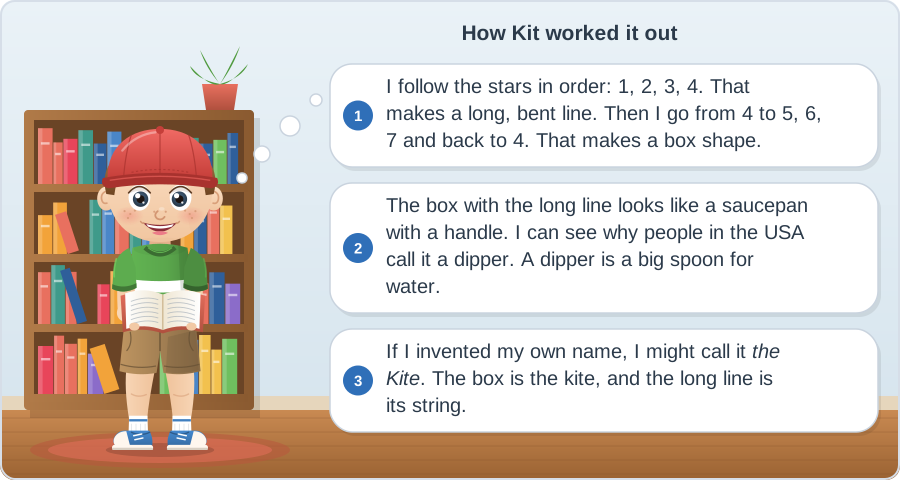
Look at the joined stars in Let’s Learn.
Now Try It
1. In the Plough, which stars make the handle?
Hint: Follow the long line from star 1.
2. Why do you think people in different countries gave the same stars different names?
Hint: What objects did they see in their everyday life?
Time To Practise
Name: ______________________
1. Join the stars.
Copy the five stars onto paper, or print this lesson. Join them in order with a ruler, from 1 to 5.
a) What letter of the alphabet does the shape look like? ______
b) Turn your paper upside down. What letter does it look like now? ______
Hint: People in the north of the world can see this constellation. It is called Cassiopeia, after a queen in an old Greek story.
2. What can you see?
These eight stars have no numbers. Join them in any way you like to make a picture. You do not have to use every star.
My picture is a ______________________________ .
3. Invent a constellation.
Draw 5 to 9 stars in the night sky box. Join them to make a picture of something important to you, such as an animal, a toy or a person.
Name of my constellation: ______________________________
Key: ★ = a bright star ___ = an imaginary line
Hint: Use only straight lines, like real star maps.
4. Write its story.
Write three or four sentences that explain how your constellation got into the sky.
Hint: Start with Long ago …
__________________________________________________________________
__________________________________________________________________
__________________________________________________________________
Check your work. Tick each one you did.
☐ 5 to 9 stars ☐ straight joining lines ☐ a clear picture ☐ a name ☐ a key ☐ a story that explains the name
Show your constellation to someone at home without telling them the name. Can they guess what it is?
Reflect
Think about these questions. Talk about them with someone at home or at school.
1. Go back to the Wonder question: “What pictures could you find in the stars?” What do you think now?
2. I was open-minded today when I ______________________________.
Being open-minded means listening to other ideas and other ways of doing things. For example: I was open-minded today when I learned that people in different places see different pictures in the same stars.
Take action: On a clear night, go outside with an adult and look for the Plough or another star pattern. Use a star map app or a book to help.
Next Steps
If this was easy, try: Find out about one real constellation, such as Orion, and the story behind its name. Draw it and retell the story.
If this was hard, go back to: Task 3. Use five stars only. Make a simple shape first, such as a house or a kite, then give it a name.
Notes for Parents and Teachers
Show notes for parents and teachers
These notes cover this lesson only. How every lesson runs is explained in How to Use This Material.
Let’s Learn
Trace the lines of the Plough with your finger together.
See How It’s Done
As you go through Kit’s thoughts, follow the stars in order with your finger.
Time To Practise
- Task 4: Check the learner’s work together, and tick each one you see.
Answer Key
Reveal Answers
Now Try It
1. Stars 1, 2, 3 and 4.
2. Sample answer: They named the stars after things they knew. Farmers in the UK used ploughs, so they saw a plough.
1. Join the stars
a) W
b) M
2. Mystery stars
Any picture is fine, for example a fish, a boat, a cat or a crown.
Look for: the learner can show which stars make which part of the picture.
3 and 4. Constellation and story
Sample answer: The Running Dog. Long ago, a little dog chased a shooting star across the hills. It ran so fast that it ran right up into the sky. Now it is made of stars, and it is still chasing the shooting star every night.
Look for: five or more ticks.
Reflect
2. Any real moment from the lesson that shows the learner was open-minded. Examples: “I was open-minded today when I learned that people in different places see different pictures in the same stars.” “I was open-minded today when I listened to someone else’s idea for the mystery stars.”
For Teachers: IB Details
Show IB and curriculum details
IB theme: How the world works. This theme is about the natural world and its laws: how the Earth, the Sun and the Moon move, and how people find out about the world around them.
Central idea: The movement of the Earth and the Moon causes patterns that we can see in the sky.
| Lesson | Title | Strand | Key concept |
|---|---|---|---|
| 7.7 | Read a Moon Chart | Viewing | Change |
| 7.8 | Star Patterns: Invent a Constellation | Viewing and presenting | Form |
Each lesson also matches the national curriculum for England (Year 2) and the US Common Core (Grade 2). The Grade 2 Curriculum Map lists the full standards for every lesson.
← Back to Lesson 7 – Day, Night and the Sky | Lessons – Index
© 2026 Firefly Ed. All rights reserved. This page may be printed for personal, home and classroom use. It may not be sold, shared online or reproduced for commercial use without written permission. edfirefly.com

Share your thoughts or ask something..