
Term 3 | Level 3 | Phonics focus: contractions, apostrophes for owning, and -tion words
Lesson 7 – Day, Night and the Sky | Lessons – Index
Lessons
This page has the two writing lessons of Lesson 7, Day, Night and the Sky: Lessons 7.3 and 7.4. The Lesson 7 page has the Lesson 7 overview, the Lesson 7 review and the PDF download.
Select a lesson to go straight to it. Each lesson ends with a link back to the top of the page.
Lesson 7.3: Write an Explanation: How Shadows Change
Writing | About 20 minutes
Term 3 | Level 3
Goal
“I can plan and write an explanation in time order, using time words and cause words to explain how shadows change during the day.”
Words to know
explanation, time order, time words, cause, shadow, pattern
Wonder
Think about this question before you start. Say your ideas. You will come back to it at the end of the lesson.
Why is your shadow sometimes long and sometimes short?
Let’s Learn
An explanation tells the reader how or why something happens. When the explanation is about something that changes over time, write the steps in time order.
| Part | What to write |
|---|---|
| title | a how or why question: How Do Shadows Change During the Day? |
| opening | say what a shadow is, or what you will explain |
| steps | one step for each part of the day, in order |
| closing | sum up the pattern |
Time words show the order: first, in the morning, then, by midday, later, in the evening, finally.
Cause words show why: because, so, this means that.
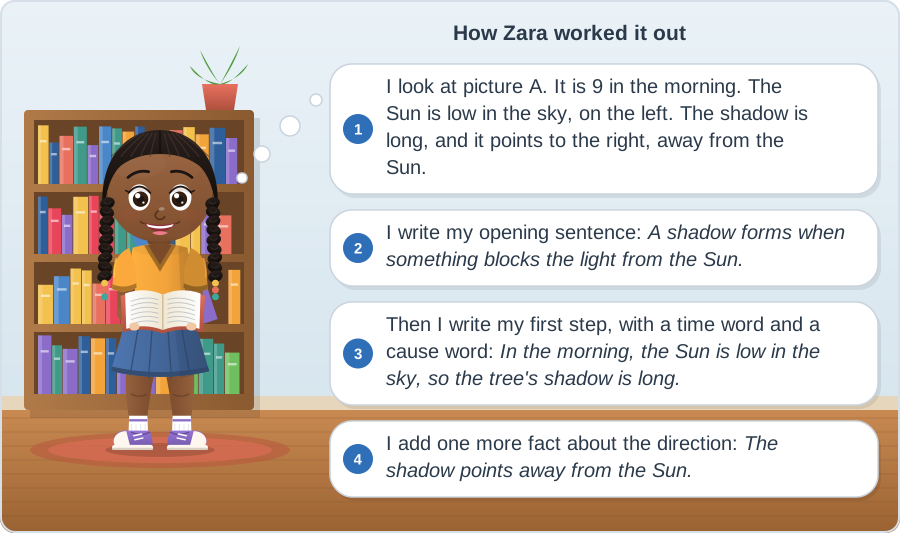
Science fact: a shadow forms when something blocks the light. A shadow always points away from the Sun. When the Sun is low in the sky, shadows are long. When the Sun is high, shadows are short.
See How It’s Done
Now Try It
Use the three pictures in See How It’s Done.
1. In which picture is the shadow shortest? Where is the Sun in that picture?
Hint: Look at the size of the dark patch under the tree.
2. Finish the sentence: “At 5 in the evening, the shadow is long because …”
Hint: Is the Sun high or low?
Time To Practise
Name: ______________________
1. Look closely at the pictures.
Use the three pictures in See How It’s Done to complete the table.
| Time | Where is the Sun? (high or low) | How long is the shadow? (long or short) |
|---|---|---|
| 9 in the morning | ______________ | ______________ |
| 12 noon | ______________ | ______________ |
| 5 in the evening | ______________ | ______________ |
2. Join the cause and the effect.
Use because or so. Write the full sentence.
a) The Sun is high in the sky. The shadow is short. (so)
__________________________________________________________________
b) The tree blocks the sunlight. A shadow forms behind it. (so)
__________________________________________________________________
c) In the evening the shadow points the other way. The Sun seems to have moved across the sky. (because)
__________________________________________________________________
3. Plan your explanation.
| Part | My notes |
|---|---|
| Opening: what is a shadow? | ______________________________ |
| Morning | ______________________________ |
| Midday | ______________________________ |
| Evening | ______________________________ |
| Closing: the pattern | ______________________________ |
4. Write your explanation.
Title: How Do Shadows Change During the Day?
Write at least six sentences. Use your plan.
__________________________________________________________________
__________________________________________________________________
__________________________________________________________________
__________________________________________________________________
__________________________________________________________________
__________________________________________________________________
Check your work. Tick each one you did.
☐ an opening that says what a shadow is ☐ steps in time order ☐ three or more time words ☐ because or so ☐ the direction of the shadow ☐ a closing sentence ☐ present tense throughout
5. Test it outside.
On a sunny day, stand in the same spot at three different times. Ask someone to draw around your shadow with chalk and write the time next to it. Does your explanation match what you see?
Reflect
Think about these questions. Talk about them with someone at home or at school.
1. Go back to the Wonder question: “Why is your shadow sometimes long and sometimes short?” What do you think now?
2. I was a thinker today when I ______________________________.
A thinker thinks carefully to work things out. For example: I was a thinker today when I planned my explanation before I wrote it.
Take action: Use a torch and a toy to show someone at home how a shadow changes. Explain it using your writing.
Next Steps
If this was easy, try: Find out what a sundial is. Make a simple one with a stick and stones, and mark the shadow every hour on a sunny day.
If this was hard, go back to: Task 4. Write three sentences only: one for the morning, one for midday and one for the evening. Start each with a time word.
Notes for Parents and Teachers
Show notes for parents and teachers
These notes cover this lesson only. How every lesson runs is explained in How to Use This Material.
Let’s Learn
Shine a torch on a toy from low down, then from high up, and watch its shadow change.
See How It’s Done
Look at the three pictures together. Then go through Zara’s thoughts.
Time To Practise
- Task 4: Check the learner’s work together, and tick each one you see.
Answer Key
Reveal Answers
Now Try It
1. Picture B, at 12 noon. The Sun is high in the sky.
2. …because the Sun is low in the sky.
1. Table
9 in the morning: low, long
12 noon: high, short
5 in the evening: low, long
2. Cause and effect
a) The Sun is high in the sky, so the shadow is short.
b) The tree blocks the sunlight, so a shadow forms behind it.
c) In the evening the shadow points the other way because the Sun seems to have moved across the sky.
Look for: accept “the Sun seems to move” in c). This links to Lesson 7.1: really, the Earth is turning.
4. Explanation
Sample answer: A shadow forms when something blocks the light from the Sun. Shadows change during the day because the Sun seems to move across the sky. In the morning, the Sun is low, so shadows are long. They point away from the Sun. By midday, the Sun is high in the sky, so shadows are short. Later, in the evening, the Sun is low again on the other side of the sky. This means that shadows are long again, but now they point the other way. Shadows are longest in the morning and evening, and shortest at midday.
Look for: five or more ticks.
5. Outside test
Look for: the learner compares the chalk outlines with the explanation and says whether they match.
Reflect
2. Any real moment from the lesson that shows the learner was a thinker. Examples: “I was a thinker today when I planned my explanation before I wrote it.” “I was a thinker today when I tested my explanation by drawing around my shadow.”
Lesson 7.4: Write a Night Sky Poem
Writing | About 20 minutes
Term 3 | Level 3
Goal
“I can write a night sky poem with a repeated line and at least three similes using like and as … as, then improve one word.”
Words to know
poem, simile, like, as … as, repeated line, senses
Wonder
Think about this question before you start. Say your ideas. You will come back to it at the end of the lesson.
What does the night sky remind you of?
Let’s Learn
A simile compares two things using like or as … as. A good simile helps your reader picture something in a new way.
| Pattern | Examples |
|---|---|
| as (describing word) as … | The Moon is as bright as a torch. The sky is as dark as a cave. |
| like … | The stars sparkle like glitter on black paper. |
Try to be fresh. “As bright as the Sun” is used a lot. “As bright as a lighthouse” is more surprising, and still makes sense.
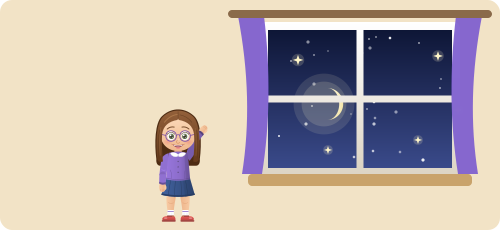
Many poems use a repeated line to hold them together. You can start several lines the same way: At night I see … At night I hear …
A poem does not have to rhyme. Choose the best words first.
See How It’s Done
Now Try It
1. Finish the simile: The night sky is as dark as …
Hint: Think of something you know that is very dark.
2. Which simile is more interesting? a) The Moon is like a ball. b) The Moon is like a white plate floating in ink.
Hint: Which one helps you picture it more clearly?
Time To Practise
Name: ______________________
1. Finish the similes.
a) The stars twinkle like ______________________________
b) The full Moon is as round as ______________________________
c) The night is as quiet as ______________________________
d) The clouds drift across the Moon like ______________________________
2. Collect your words.
Think about the night sky. Write words for each sense.
| I see | I hear | I feel |
|---|---|---|
| ______________ | ______________ | ______________ |
| ______________ | ______________ | ______________ |
| ______________ | ______________ | ______________ |
3. Write your poem.
Write at least eight lines. Use the repeated starts At night I see, At night I hear and At night I feel, or make up your own. Use at least three similes. Give your poem a title.
Title: ______________________________
__________________________________________________________________
__________________________________________________________________
__________________________________________________________________
__________________________________________________________________
__________________________________________________________________
__________________________________________________________________
__________________________________________________________________
__________________________________________________________________
Hint: End with a line that feels finished, such as going to sleep, or the Sun coming back.
4. Check and improve.
Read your poem aloud. Find one word you could change for a better one. Cross it out and write the new word above it.
Check your work. Tick each one you did.
☐ a title ☐ eight or more lines ☐ three or more similes ☐ a repeated line or pattern ☐ more than one sense ☐ one word improved ☐ a line that ends the poem well
Copy your poem neatly onto paper and decorate it with stars and a Moon.
Reflect
Think about these questions. Talk about them with someone at home or at school.
1. Go back to the Wonder question: “What does the night sky remind you of?” What do you think now?
2. I was a communicator today when I ______________________________.
A communicator shares ideas clearly by talking, writing or drawing. For example: I was a communicator today when I chose a fresh simile instead of the first one I thought of.
Take action: Read your poem aloud by a window at night, with the lights off if it is safe. Does it match what you see?
Next Steps
If this was easy, try: Write a second poem about the daytime sky, using the same pattern. Compare the mood of your two poems.
If this was hard, go back to: Task 3. Write four lines only, using At night I see each time. Add one simile from Task 1.
Notes for Parents and Teachers
Show notes for parents and teachers
These notes cover this lesson only. How every lesson runs is explained in How to Use This Material.
Let’s Learn
Make up a fresh simile together for something in the room.
See How It’s Done
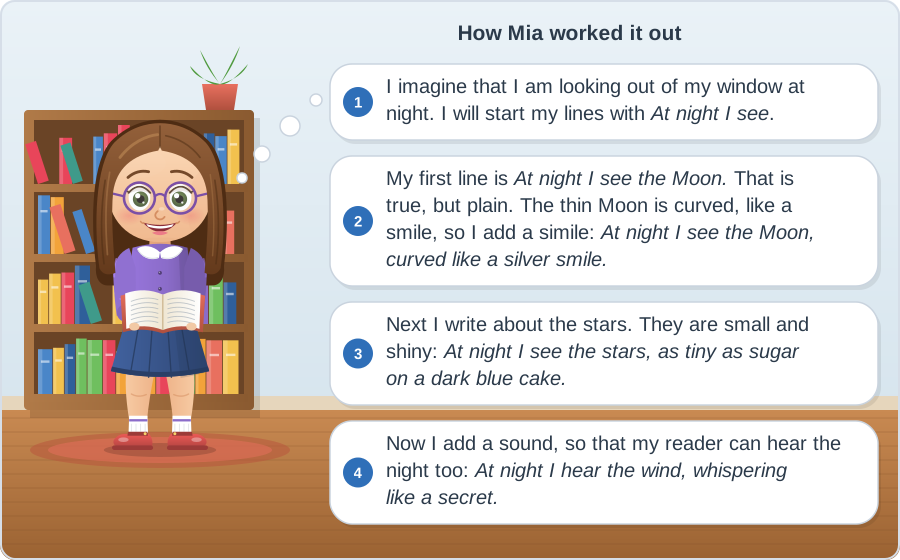
Write each line on paper as you build it.
Time To Practise
- Task 4: Check the learner’s work together, and tick each one you see.
Answer Key
Reveal Answers
Now Try It
1. Sample answers: …a cave, …a cupboard with the door shut, …the bottom of the sea.
2. b), because it gives the colour and a picture of the Moon in a dark sky.
1. Similes
Sample answers:
a) …tiny diamonds on a black cloth.
b) …a dinner plate.
c) …a sleeping mouse.
d) …grey sheep walking slowly over a hill.
Look for: the two things in each simile really are alike in some way.
3. Poem
Sample answer:
Night Sky
At night I see the Moon, curved like a silver smile.
At night I see the stars, as tiny as sugar on a dark blue cake.
At night I see an aeroplane, blinking like a firefly.
At night I hear the wind, whispering like a secret.
At night I hear an owl, calling to its friends.
At night I feel the cool air, as soft as a feather on my face.
At night I feel sleepy, as heavy as a bag of sand.
I close the curtains and say goodnight to the sky.
Look for: five or more ticks.
Reflect
2. Any real moment from the lesson that shows the learner was a communicator. Examples: “I was a communicator today when I chose a fresh simile instead of the first one I thought of.” “I was a communicator today when I changed one word to make my poem better.”
For Teachers: IB Details
Show IB and curriculum details
IB theme: How the world works. This theme is about the natural world and its laws: how the Earth, the Sun and the Moon move, and how people find out about the world around them.
Central idea: The movement of the Earth and the Moon causes patterns that we can see in the sky.
| Lesson | Title | Strand | Key concept |
|---|---|---|---|
| 7.3 | Write an Explanation: How Shadows Change | Writing | Change |
| 7.4 | Write a Night Sky Poem | Writing | Form |
Each lesson also matches the national curriculum for England (Year 2) and the US Common Core (Grade 2). The Grade 2 Curriculum Map lists the full standards for every lesson.
← Back to Lesson 7 – Day, Night and the Sky | Lessons – Index
© 2026 Firefly Ed. All rights reserved. This page may be printed for personal, home and classroom use. It may not be sold, shared online or reproduced for commercial use without written permission. edfirefly.com


Share your thoughts or ask something..