

Term 1 | Level 1 | Phonics focus: long and short vowels, vowel teams review
Lesson 1 – Growing and Changing | Lessons – Index
Lessons
This page has the two viewing and presenting lessons of Lesson 1, Growing and Changing: Lessons 1.7 and 1.8. The Lesson 1 page has the Lesson 1 overview, the Lesson 1 review and the PDF download.
Select a lesson to go straight to it. Each lesson ends with a link back to the top of the page.
Lesson 1.7: Baby to Grandparent: Life in Pictures
Visual | About 20 minutes
Term 1 | Level 1
Goal
“I can put pictures of a person in order from youngest to oldest, explain the clues I used, and make a timeline of my life.”
Words to know
toddler, teenager, adult, older adult, clue, timeline
Wonder
Think about this question before you start. Say your ideas. You will come back to it at the end of the lesson.
How can a picture show that time has passed?
Let’s Learn
Pictures can show how a person changes as time goes by.
People grow from a baby to a toddler, then a child, a teenager, an adult and an older adult.
To put pictures in order, look for clues:
- How big is the person, and how do they stand or move?
- What colour is their hair?
- What are they holding or using?
- Where might they be going?
We put the youngest first and the oldest last. A timeline shows events in order, with the earliest on the left.
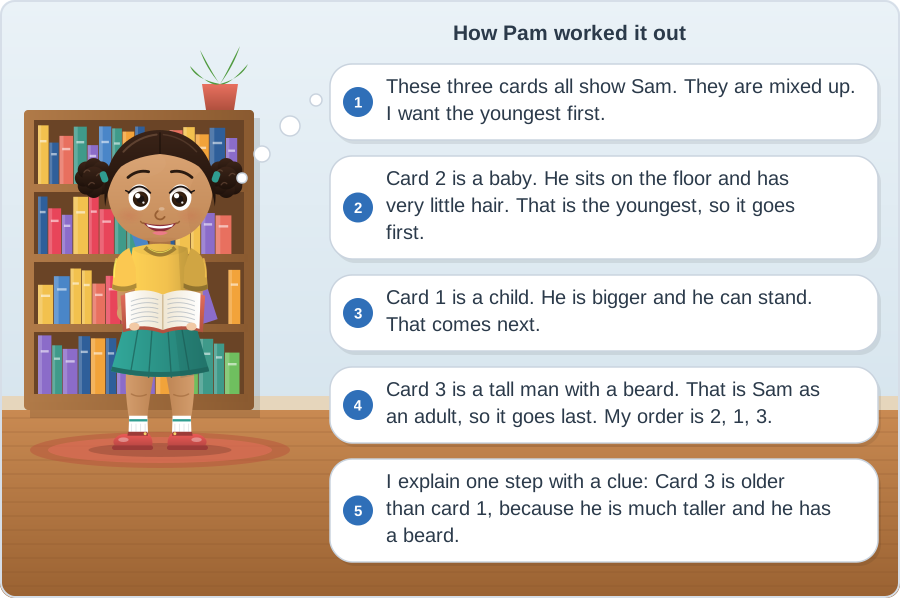
When you explain an order, say the clue: “Card D is younger than card F, because she is smaller.”
See How It’s Done

Now Try It
Use the six cards in Time To Practise for these questions.
1. Look at card C. Which clues show that this person is old? Say two.
Hint: Look at her hair, her face and what she holds.
2. Card D and card F both go to school. Which one is older? Say a clue.
Hint: Compare their size and what they carry.
Time To Practise
Name: ______________________
1. Put the cards in order, from youngest to oldest. Write the letters.
Hint: Look at size, hair and what each person holds.

youngest ______ ______ ______ ______ ______ ______ oldest
2. Which card matches each caption? Write the letter.
a) “I am about 14. I go to a big school and I have my own phone.” ______
b) “I am about 2. I can walk, but I still wobble.” ______
c) “I am about 75. I take my stick when I walk to the shops.” ______
d) “I am about 35. I go to work every day.” ______
3. Explain your order.
How can you tell that card A is younger than card C? Write two sentences. Give a clue in each sentence.
__________________________________________________________________
__________________________________________________________________
4. Make a timeline of your life.
Write a caption for each age. Start each caption with a time phrase, such as “When I was a baby” or “Now”.
| When | My caption |
|---|---|
| When I was a baby | ______________________________________ |
| When I was a toddler | ______________________________________ |
| Now | ______________________________________ |
| When I am a grown-up | ______________________________________ |
Draw yourself now and as a grown-up.
Reflect
Think about these questions. Talk about them with someone at home or at school.
1. Go back to the Wonder question: “How can a picture show that time has passed?” What do you think now?
2. I was a thinker today when I ______________________________.
A thinker thinks carefully to work things out. For example: I was a thinker today when I used clues to put six pictures in order.
Take action: Ask people at home for photos of themselves at different ages. Put them on a timeline and tell the family which clues you used.
Next Steps
If this was easy, try: Make a timeline for someone in your family, with six ages from baby to now. Ask them to check your captions.
If this was hard, go back to: See How It’s Done. Use only two cards at a time: Which one is younger? Say one clue. Then add a third card.
Notes for Parents and Teachers
Show notes for parents and teachers
These notes cover this lesson only. How every lesson runs is explained in How to Use This Material.
Let’s Learn
If you can, show photos of people in your family at different ages.
See How It’s Done
Point to each clue on the cards as you go through Pam’s thoughts.
Answer Key
Reveal Answers
Now Try It
1. Any two of: she has grey hair, she wears glasses, she uses a walking stick.
2. Card F is older. She is taller than D, and she has a phone and a bigger bag.
1. Order from youngest to oldest
B, E, D, F, A, C
Look for: the learner can give a clue for each step, such as “E can walk but B cannot” or “F is taller than D”.
2. Which card?
a) F
b) E
c) C
d) A
3. Explain your order
Sample answer: Card C has grey hair, but card A has dark hair. Card C needs a walking stick, but card A walks to work on her own.
Look for: two clues from the pictures, each in a full sentence.
4. Timeline
Sample captions: When I was a baby, I slept in a cot. When I was a toddler, I liked to splash in puddles. Now I am seven and I can swim. When I am a grown-up, I want to be a vet.
Look for: each caption starts with the time phrase and ends with a full stop. The two drawings show a clear change, such as height or hair.
Reflect
2. Any real moment from the lesson that shows the learner was a thinker. Examples: “I was a thinker today when I used clues to put six pictures in order.” “I was a thinker today when I explained why card A is younger than card C.”
Lesson 1.8: Read a Height Chart
Visual | About 20 minutes
Term 1 | Level 1
Goal
“I can read heights from a chart, put people in order, and work out how much someone has grown.”
Words to know
height chart, centimetres (cm), mark, taller, shorter, grew
Wonder
Think about this question before you start. Say your ideas. You will come back to it at the end of the lesson.
How can we find out how much we have grown?
Let’s Learn
A height chart shows how tall people are.
The numbers go up the side. They are in centimetres. We write centimetres as cm.
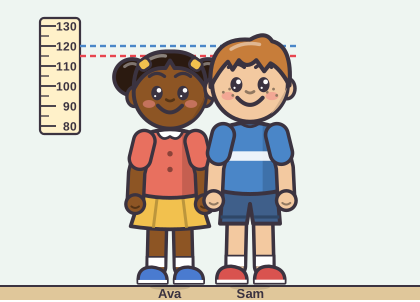
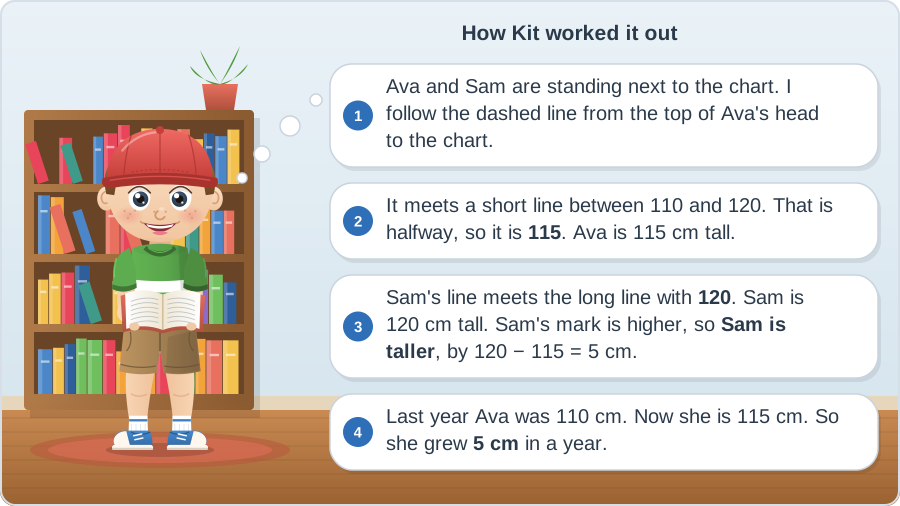
A mark is a line level with the top of someone’s head. Read across from the mark to the number.
A higher mark means a taller person. The long lines have numbers. A short line in between is halfway: 115 is halfway between 110 and 120.
To find out how much someone has grown, take their old height away from their new height. If Ava was 110 cm last year and is 115 cm now, she grew 115 − 110 = 5 cm.
See How It’s Done
Now Try It
Use the chart with four children in Time To Practise.
1. Follow Leo’s line to the chart. How tall is Leo?
Hint: Is the line on a long line with a number, or a short line halfway?
2. Is Mia taller or shorter than Ava? By how many centimetres?
Hint: Find both heights first. Then take the smaller one away from the bigger one.
Time To Practise
Name: ______________________
1. Read the height chart. Write the answers.
Hint: Follow each dashed line from the top of a head to the numbers.
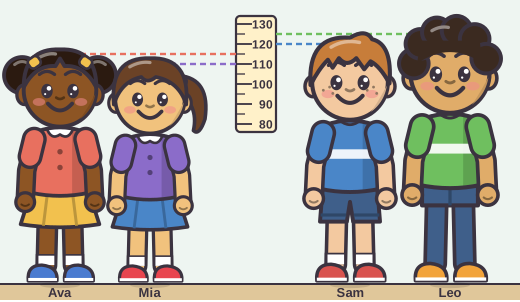
a) Who is the tallest? ______________
b) Who is the shortest? ______________
c) How tall is Sam? __________ cm
d) Write the four names in order, from shortest to tallest.
______________ ______________ ______________ ______________
2. How much did they grow?
The table shows how tall each child was last year. Write how tall each child is now, from the chart. Then work out how much each child grew.
| Name | Last year | Now | Grew |
|---|---|---|---|
| Ava | 110 cm | ______ cm | ______ cm |
| Leo | 119 cm | ______ cm | ______ cm |
| Mia | 106 cm | ______ cm | ______ cm |
| Sam | 113 cm | ______ cm | ______ cm |
a) Who grew the most this year? ______________
b) Is the tallest child also the one who grew the most? Explain in two sentences.
__________________________________________________________________
__________________________________________________________________
3. Your own mark
Ask an adult to measure you, and one other person at home, against a wall. Draw your mark on the chart and write your name next to it.
Ask an adult to help you measure your height with a tape measure. Draw your mark at the right height.
I am __________ cm tall. ______________ is __________ cm tall.
Who is taller, and by how many centimetres? Write a sentence.
__________________________________________________________________
Reflect
Think about these questions. Talk about them with someone at home or at school.
1. Go back to the Wonder question: “How can we find out how much we have grown?” What do you think now?
2. I was knowledgeable today when I ______________________________.
Being knowledgeable means knowing things and using what you know. For example: I was knowledgeable today when I read heights in centimetres from the chart.
Take action: Start a height chart at home on a door frame or a strip of paper. Add a new mark on your next birthday and work out how much you grew.
Next Steps
If this was easy, try: Measure four people at home. Make a table with their names and heights, then write three sentences comparing them.
If this was hard, go back to: See How It’s Done. Use only the long lines with numbers first. Ask: Is Sam’s mark on 120? Then look at the short lines between the numbers. Do the take-away sums with counters or on a number line.
Notes for Parents and Teachers
Show notes for parents and teachers
These notes cover this lesson only. How every lesson runs is explained in How to Use This Material.
Let’s Learn
If you have a tape measure or a ruler, show the learner where the numbers start.
See How It’s Done
Trace each dashed line with your finger, from the head to the chart, as you go through Kit’s thoughts.
Time To Practise
- Task 3: Use a tape measure. Help the learner draw the mark at the right height.
Answer Key
Reveal Answers
Now Try It
1. Leo is 125 cm tall.
2. Mia is shorter than Ava, by 5 cm (115 − 110 = 5).
Look for: the learner follows the line with a finger and checks whether it lands on a long line or a short line.
1. Read the height chart
a) Leo
b) Mia
c) 120 cm
d) Mia, Ava, Sam, Leo
Look for: the learner follows each line to the chart and reads the number, instead of guessing from the size of the heads. Leo’s curly hair sits above his mark, so the learner must use the line.
2. How much did they grow?
Ava: now 115 cm, grew 5 cm
Leo: now 125 cm, grew 6 cm
Mia: now 110 cm, grew 4 cm
Sam: now 120 cm, grew 7 cm
a) Sam
b) Sample answer: No, it is not. Leo is the tallest, but Sam grew the most this year.
Look for: correct take-away sums. The learner may count on from last year’s height to this year’s height.
3. Your own mark
Answers will vary. Sample answer: Dad is 178 cm tall, so he is 58 cm taller than me.
Look for: the mark drawn at the right height, and a sentence that names who is taller and the difference in cm. If the other person is taller than 130 cm, their mark will be above the chart. That is fine.
Reflect
2. Any real moment from the lesson that shows the learner was knowledgeable. Examples: “I was knowledgeable today when I read heights in centimetres from the chart.” “I was knowledgeable today when I worked out how much Sam grew in a year.”
For Teachers: IB Details
Show IB and curriculum details
IB theme: Who we are. It covers our bodies and feelings, our families and friends, where we belong, and how we learn and grow.
Central idea: People grow and change over time, and we can share the story of how we have changed.
| Lesson | Title | Strand | Key concept |
|---|---|---|---|
| 1.7 | Baby to Grandparent: Life in Pictures | Viewing | Change |
| 1.8 | Read a Height Chart | Viewing | Form |
Each lesson also matches the national curriculum for England (Year 2) and the US Common Core (Grade 2). The Grade 2 Curriculum Map lists the full standards for every lesson.
← Back to Lesson 1 – Growing and Changing | Lessons – Index
© 2026 Firefly Ed. All rights reserved. This page may be printed for personal, home and classroom use. It may not be sold, shared online or reproduced for commercial use without written permission. edfirefly.com


Share your thoughts or ask something..