
Term 1 | Level 1 | Phonics focus: long and short vowels, vowel teams review
Lesson 1 – Growing and Changing | Lessons – Index
Lessons
This page has the three phonics lessons of Lesson 1, Growing and Changing: Lessons 1.9, 1.10 and 1.11. The Lesson 1 page has the Lesson 1 overview, the Lesson 1 review and the PDF download.
Select a lesson to go straight to it. Each lesson ends with a link back to the top of the page.
- Lesson 1.9: Long or Short? Vowel Sounds
- Lesson 1.10: Vowel Teams Review: ai, ay, ee, ea, oa, ow, igh
- Lesson 1.11: Tricky Words: door, floor, poor, find, kind, behind
Lesson 1.9: Long or Short? Vowel Sounds
Phonics | About 20 minutes
Term 1 | Level 1
Goal
“I can hear short and long vowel sounds, read two-syllable words with a split digraph, and choose the right spelling for a long vowel sound.”
Words to know
vowel, short sound, long sound, split digraph, syllable
Wonder
Think about this question before you start. Say your ideas. You will come back to it at the end of the lesson.
How can we tell whether a vowel is long or short, and how do we choose the right spelling?
Let’s Learn
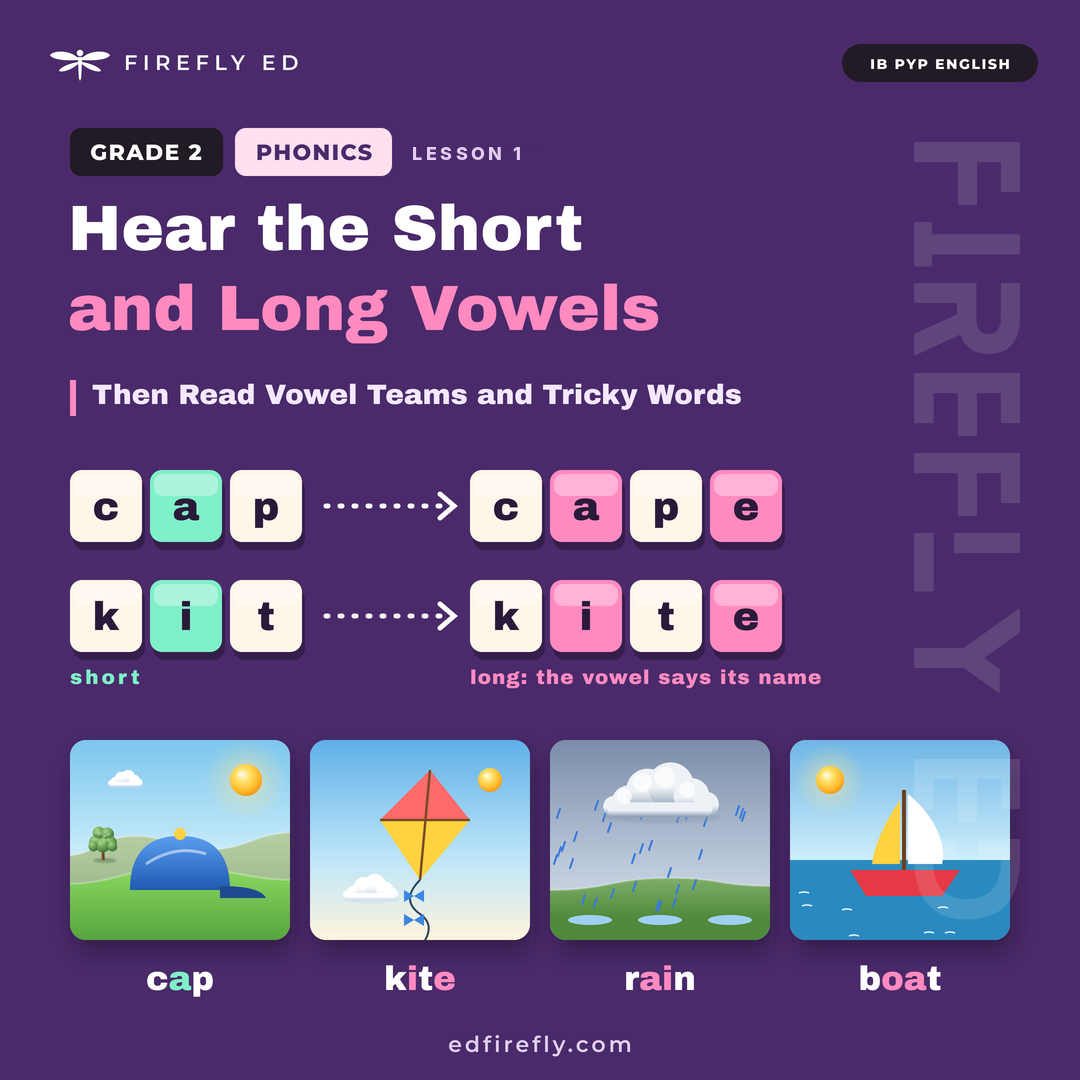
The letters a, e, i, o and u are vowels. Each vowel can make a short sound and a long sound. A long vowel sound says the letter’s name.
| Vowel | Short sound | Long sound with a split digraph | Other ways to spell the long sound |
|---|---|---|---|
| a | cap | cape | rain, day |
| e | them | these | tree, sea |
| i | kit | kite | night |
| o | hop | hope | boat, snow |
| u | cub | cube | new |
In a split digraph, the silent e jumps back over one letter and makes the vowel say its name: hop, hope.
Long words are made of syllables, or beats. A long word can have a short vowel in one syllable and a long vowel in another: cup | cake.
When you spell a long vowel sound, think about which spelling looks right. The split digraph is often used when the sound is followed by one consonant at the end: cake, bike, bone.
See How It’s Done

Now Try It
1. Which picture has the long u sound? Say its number. Then say which letters make the long sound.
Hint: Which word says the letter name “you”?
Listen as an adult names each picture.
2. Read these two words: them these. Which one has a long e? How do you know?
Hint: Look for a silent e at the end.
Time To Practise
Name: ______________________
1. Long or short? Tick the vowel sound you hear. For each long sound, write the letters that make it.
Listen as an adult names each picture.
a) ☐ short ☐ long ______ b) ☐ short ☐ long ______ c) ☐ short ☐ long ______
d) ☐ short ☐ long ______ e) ☐ short ☐ long ______ f) ☐ short ☐ long ______
2. Split each word into two syllables. Circle the syllable with a long vowel sound.
Hint: Clap the word first. Look for a split digraph in one syllable.
| Word | Syllable 1 | Syllable 2 |
|---|---|---|
| inside | __________ | __________ |
| cupcake | __________ | __________ |
| explode | __________ | __________ |
| invite | __________ | __________ |
| reptile | __________ | __________ |
3. Circle the word that is spelt correctly.
a) The snake / snaik hid under a rock.
b) We waited for the trane / train at the station.
c) Dad sailed a little bote / boat on the lake.
d) My kite / kight flew over the trees.
e) We walked home / hoam after school.
4. Listen and write the sentence.
Listen as an adult says a sentence twice. Write it.
__________________________________________________________________
Reflect
Think about these questions. Talk about them with someone at home or at school.
1. Go back to the Wonder question: “How can we tell whether a vowel is long or short, and how do we choose the right spelling?” What do you think now?
2. I was a thinker today when I ______________________________.
A thinker thinks carefully to work things out. For example: I was a thinker today when I split cupcake into two syllables and found the long vowel.
Take action: Go on a word hunt in a book or on food packets. Find three two-syllable words with a split digraph, such as inside or sunshine.
Next Steps
If this was easy, try: Make your own two-syllable words by joining a short syllable and a split digraph syllable, such as pan + cake, sun + rise and bed + time. Write a sentence with each one.
If this was hard, go back to: Let’s Learn. Read only the short and long words in the table, one row at a time. Then try one-syllable words like cap and cape before the two-syllable words.
Notes for Parents and Teachers
Show notes for parents and teachers
These notes cover this lesson only. How every lesson runs is explained in How to Use This Material.
Let’s Learn
Say each vowel sound clearly. For long sounds, say the letter name.
See How It’s Done
Clap the syllables of sunshine with the learner as you go through Aisha’s thoughts.
Now Try It
Point to each picture and name it first. The full words are in the Answer Key.
Time To Practise
- Task 1: Point to each picture and name it first. The full words are in the Answer Key.
- Task 4: Read the sentence from the Answer Key aloud twice. Do not stretch the sounds.
Answer Key
Reveal Answers
Now Try It
1. Picture 2 (tube). Picture 1 is a tub, with a short u. The letters u and e make the long sound (u_e).
2. these. It has a silent e at the end that makes the e say its name.
1. Long or short?
a) short (sock)
b) long (kite): i_e
c) short (jug)
d) long (tree): ee
e) long (boat): oa
f) short (hat)
Look for: the learner hears the long sound in tree and boat even though there is no split digraph. Long sounds can be spelt in different ways.
2. Syllables
in | side (side is long)
cup | cake (cake is long)
ex | plode (plode is long)
in | vite (vite is long)
rep | tile (tile is long)
Look for: accept small differences in where the word is split, as long as each part has a vowel. The circled syllable is always the one with the split digraph.
3. Spelt correctly
a) snake
b) train
c) boat
d) kite
e) home
4. Dictation
We hope the snake will hide inside its home.
Look for: the split digraph in hope, snake, hide, inside and home. A capital letter at the start and a full stop at the end.
Reflect
2. Any real moment from the lesson that shows the learner was a thinker. Examples: “I was a thinker today when I split cupcake into two syllables and found the long vowel.” “I was a thinker today when I chose the right spelling for snake.”
Lesson 1.10: Vowel Teams Review: ai, ay, ee, ea, oa, ow, igh
Phonics | About 20 minutes
Term 1 | Level 1
Goal
“I can sort words by their long vowel sound, choose the right vowel team for a word, and find long vowel words in a text.”
Words to know
vowel team, long sound, spelling, middle, end
Wonder
Think about this question before you start. Say your ideas. You will come back to it at the end of the lesson.
Why can the same sound be spelt in different ways?
Let’s Learn

A vowel team is two or three letters that work together to make one sound.
Many long vowel sounds can be spelt in more than one way. When you read, look for the team and say one sound. When you spell, choose the spelling that looks right.
| Long sound | Spellings | Where they often go |
|---|---|---|
| long a | ai, ay, a_e | ai in the middle (rain), ay at the end (play) |
| long e | ee, ea | both in the middle or at the end (tree, sea, beach) |
| long i | igh, ie, i_e | igh in the middle or end (night, high), ie at the end of short words (pie, tie) |
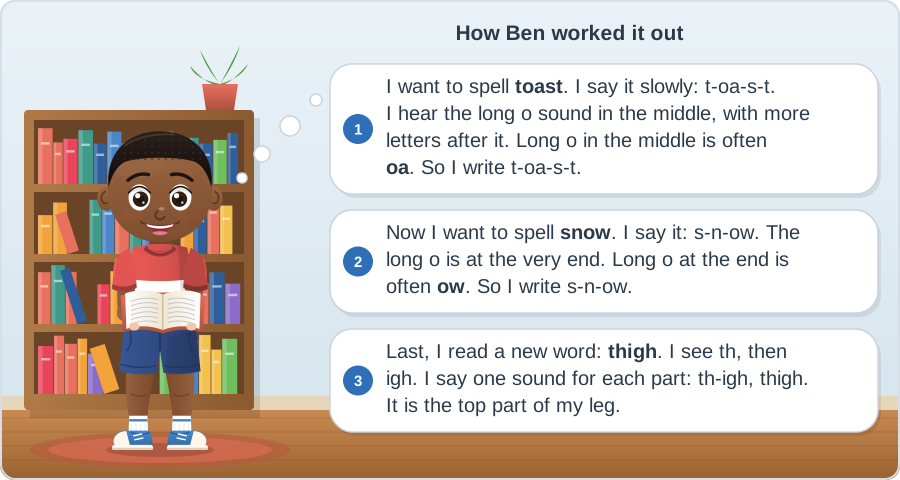
| long o | oa, ow, o_e | oa in the middle (boat), ow often at the end (snow) |
The table gives patterns, not rules that always work. If a word looks wrong, try another spelling and check in a dictionary or a word list.
See How It’s Done
Now Try It
1. Snail (picture 1) and hay (picture 2) have the same long sound. Which letters spell the sound in each word? Why are they different?
Hint: Where does the long a sound come in each word?
2. Which word does not have a long o sound: boat, snow, sock, home?
Hint: Say each word slowly and listen to the middle.
Listen as an adult names each picture.
Time To Practise
Name: ______________________
1. Sort the words by their long vowel sound.
Hint: Sort by the sound you hear, not by the letters you see.
Words: rain | tree | night | boat | play | beach | pie | snow | cake | green | bike | home
| long a | long e | long i | long o |
|---|---|---|---|
| __________ | __________ | __________ | __________ |
| __________ | __________ | __________ | __________ |
| __________ | __________ | __________ | __________ |
2. Write the missing vowel team.
Listen as an adult reads each word. Then write the missing vowel team.
a) sn ____ ____ b) t ____ ____ st c) t ____ ____
d) br ____ ____ ____ t e) pl ____ ____ f) w ____ ____ t
3. Read the recount. Find eight words with a long vowel sound.
Hint: Look for vowel teams and split digraphs. Write each word in the right box.
A Day at the Sea
One morning, Ava and Gran went to the beach by train. The sky was cloudy, but the rain stayed away. They sat on a green seat and had toast with cheese. Ava found a white shell and a long piece of seaweed. Gran told her about a boat trip she took when she was a girl. As the sun went down, the light turned gold. “What a lovely day,” said Ava on the way home.
| long a | long e | long i | long o |
|---|---|---|---|
| __________ | __________ | __________ | __________ |
| __________ | __________ | __________ | __________ |
4. Listen and write the sentence.
Listen as an adult says a sentence twice. Write it.
__________________________________________________________________
Reflect
Think about these questions. Talk about them with someone at home or at school.
1. Go back to the Wonder question: “Why can the same sound be spelt in different ways?” What do you think now?
2. I was a thinker today when I ______________________________.
A thinker thinks carefully to work things out. For example: I was a thinker today when I sorted words by the sound I heard, not the letters I saw.
Take action: Make a long vowel poster with four boxes: long a, long e, long i and long o. Add words you find in books this week.
Next Steps
If this was easy, try: Write a short recount of a day out with eight long vowel words. Underline them and ask someone at home to sort them by sound.
If this was hard, go back to: Let’s Learn. Work on one long sound at a time. Start with long a: say rain, play and cake, and point to the letters that make the sound in each word.
Notes for Parents and Teachers
Show notes for parents and teachers
These notes cover this lesson only. How every lesson runs is explained in How to Use This Material.
Let’s Learn
Point to each team and say its sound, not the letter names.
See How It’s Done
Write toast and snow on paper, one sound at a time, as you go through Ben’s thoughts.
Now Try It
Point to each picture and name it first. The full words are in the Answer Key.
Time To Practise
- Task 2: Read each word aloud first. The words are in the Answer Key.
- Task 4: Read the sentence from the Answer Key aloud twice.
Answer Key
Reveal Answers
Now Try It
1. Snail uses ai. Hay uses ay. In snail, the sound is in the middle. In hay, it is at the end.
2. sock
1. Sort by sound
long a: rain, play, cake
long e: tree, beach, green
long i: night, pie, bike
long o: boat, snow, home
Look for: cake, bike and home sorted by sound, even though they have a split digraph instead of a vowel team.
2. Missing vowel team
a) ow (snow)
b) oa (toast)
c) ie (tie)
d) igh (bright)
e) ay (play)
f) ai (wait)
3. Find eight words
Any eight of these, in the right box:
long a: train, rain, stayed, away, day, way
long e: beach, green, seat, cheese, piece, seaweed
long i: white, light
long o: toast, boat, home
Look for: “piece” has the long e sound spelt ie. Accept it as a good find. Also accept by, sky, she, they, told and gold, which have a long vowel sound spelt another way. “took” and “down” do not have these long vowel sounds.
4. Dictation
We waited on the beach until the rain stopped.
Look for: ai in waited and rain, ea in beach. A capital letter at the start and a full stop at the end.
Reflect
2. Any real moment from the lesson that shows the learner was a thinker. Examples: “I was a thinker today when I sorted words by the sound I heard, not the letters I saw.” “I was a thinker today when I found long vowel words in the beach recount.”
Lesson 1.11: Tricky Words: door, floor, poor, find, kind, behind
Phonics | About 20 minutes
Term 1 | Level 1
Goal
“I can read and spell the tricky words door, floor, poor, find, kind and behind, and use the -ind word family.”
Words to know
tricky word, tricky part, word family, look, say, cover, write, check
Wonder
Think about this question before you start. Say your ideas. You will come back to it at the end of the lesson.
Why are some words harder to spell than others?
Let’s Learn
Some words have a tricky part. The letters do not make the sound we expect.
- In door, floor and poor, the letters oo say /or/, not the oo in moon.
- In find, kind and behind, the i says its name, even with no e at the end.
Words that share a tricky part make a word family. If you can spell kind, you can also spell find, mind and behind.
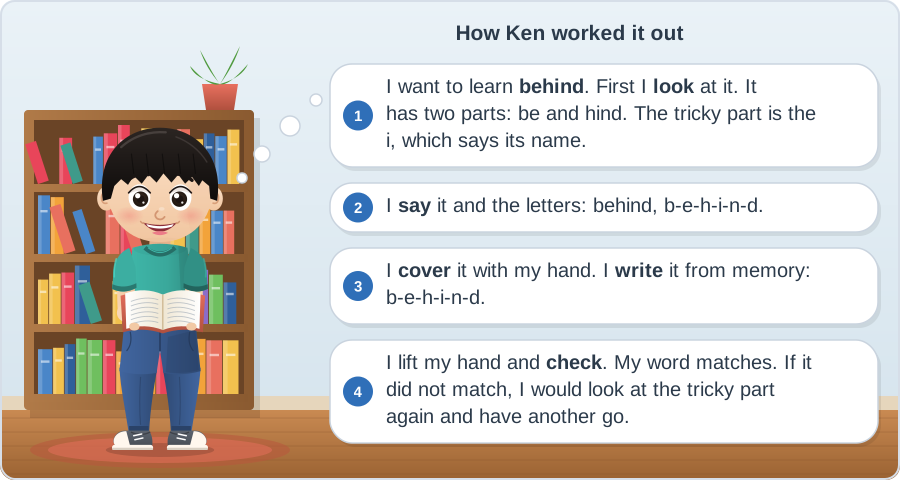
We learn tricky words by looking closely at the tricky part and practising them often.
See How It’s Done
Now Try It
1. Read the sentence. Which two words are tricky words from our list? The kind girl held the door for me.
Hint: Look at the six word cards in Let’s Learn.
2. Kind, find and behind are in the same word family. Can you think of another word in this family?
Hint: Change the first letter of kind.
Time To Practise
Name: ______________________
1. Read the story. Circle every tricky word from the list.
Tricky words: door | floor | poor | find | kind | behind
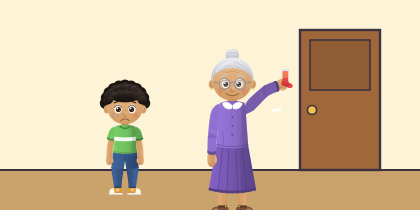
Leo could not find his lucky sock. He looked behind the door and under the bed. He looked on the floor of the kitchen. “Poor Leo,” said Gran. Gran was kind, and she did not mind helping. At last, she found the sock behind the sofa. It was in the dog’s basket!
How many tricky words did you circle? ______
2. Look, say, cover, write, check.
| Word | Write it | Check ✓ or ✗ | Write it again |
|---|---|---|---|
| door | ____________ | ____ | ____________ |
| floor | ____________ | ____ | ____________ |
| poor | ____________ | ____ | ____________ |
| find | ____________ | ____ | ____________ |
| kind | ____________ | ____ | ____________ |
| behind | ____________ | ____ | ____________ |
3. Write the -ind word that matches each clue.
Word bank: mind | behind | kind | find
a) the opposite of “in front of” ______________
b) to look for something and get it ______________
c) nice and helpful to other people ______________
d) “Never ______________,” said Mum. “We can try again.”
4. Be a spelling checker.
Each sentence has two tricky words spelt wrongly. Write the sentence again correctly.
a) I left my bag behined the dor.
__________________________________________________________________
b) The por cat sat on the flor.
__________________________________________________________________
c) It was kined of you to fined my hat.
__________________________________________________________________
5. Listen and write the sentence.
Listen as an adult says a sentence twice. Write it.
__________________________________________________________________
Reflect
Think about these questions. Talk about them with someone at home or at school.
1. Go back to the Wonder question: “Why are some words harder to spell than others?” What do you think now?
2. I was knowledgeable today when I ______________________________.
Being knowledgeable means knowing things and using what you know. For example: I was knowledgeable today when I spelt behind from memory.
Take action: Write the six tricky words on sticky notes. Put door on a door and floor near the floor. Read them each time you pass.
Next Steps
If this was easy, try: Write a short story of four sentences that uses all six tricky words and one more -ind word. Underline each one.
If this was hard, go back to: See How It’s Done. Learn two words a day, starting with door and floor because they share the same tricky part. Use look, say, cover, write, check three times each.
Notes for Parents and Teachers
Show notes for parents and teachers
These notes cover this lesson only. How every lesson runs is explained in How to Use This Material.
Let’s Learn
Point to the red tricky part of each word card as you say the word.
See How It’s Done
Act out each step as you go through Ken’s thoughts. Cover the word with your hand, then write it on paper.
Time To Practise
- Task 5: Read the sentence from the Answer Key aloud twice.
Answer Key
Reveal Answers
Now Try It
1. kind, door
2. Sample answers: mind, wind (as in “wind up a toy”), blind
1. Circle the tricky words
Leo could not find his lucky sock. He looked behind the door and under the bed. He looked on the floor of the kitchen. “Poor Leo,” said Gran. Gran was kind, and she did not mind helping. At last, she found the sock behind the sofa. It was in the dog’s basket!
7 tricky words (behind appears twice).
Look for: the learner checks each word against the list. “Mind” is in the same word family but is not on the list, so it does not count. Accept 8 if the learner explains that they counted mind as a family word.
2. Look, say, cover, write, check
Look for: the learner covers the word before writing. Common mistakes are “dor”, “flor”, “pore”, “fined” and “behined”.
3. -ind words
a) behind
b) find
c) kind
d) mind
4. Spelling checker
a) I left my bag behind the door.
b) The poor cat sat on the floor.
c) It was kind of you to find my hat.
5. Dictation
The kind man looked behind the door.
Look for: kind, behind and door spelt correctly, a capital letter at the start and a full stop at the end.
Reflect
2. Any real moment from the lesson that shows the learner was knowledgeable. Examples: “I was knowledgeable today when I spelt behind from memory.” “I was knowledgeable today when I found the spelling mistakes and fixed them.”
For Teachers: IB Details
Show IB and curriculum details
IB theme: Who we are. It covers our bodies and feelings, our families and friends, where we belong, and how we learn and grow.
Central idea: People grow and change over time, and we can share the story of how we have changed.
| Lesson | Title | Strand | Key concept |
|---|---|---|---|
| 1.9 | Long or Short? Vowel Sounds | Reading and spelling | Form |
| 1.10 | Vowel Teams Review: ai, ay, ee, ea, oa, ow, igh | Reading and spelling | Form |
| 1.11 | Tricky Words: door, floor, poor, find, kind, behind | Reading and spelling | Form |
Each lesson also matches the national curriculum for England (Year 2) and the US Common Core (Grade 2). The Grade 2 Curriculum Map lists the full standards for every lesson.
← Back to Lesson 1 – Growing and Changing | Lessons – Index
© 2026 Firefly Ed. All rights reserved. This page may be printed for personal, home and classroom use. It may not be sold, shared online or reproduced for commercial use without written permission. edfirefly.com


Share your thoughts or ask something..