

Term 1 | Level 1 | Phonics focus: long and short vowels, vowel teams review
Lesson 1 – Growing and Changing | Lessons – Index
Lessons
This page has the two listening and speaking lessons of Lesson 1, Growing and Changing: Lessons 1.5 and 1.6. The Lesson 1 page has the Lesson 1 overview, the Lesson 1 review and the PDF download.
Select a lesson to go straight to it. Each lesson ends with a link back to the top of the page.
Lesson 1.5: Introduce a Friend
Oral | About 20 minutes
Term 1 | Level 1
Goal
“I can ask open and follow-up questions, listen for details, and introduce two people to each other in full sentences.”
Words to know
introduce, open question, follow-up question, in common, full sentence
Wonder
Think about this question before you start. Say your ideas. You will come back to it at the end of the lesson.
What do people need to know when they meet someone new?
Let’s Learn
When you introduce someone, you tell other people who they are.
First, find out about the person. Ask open questions that start with What, Where, How or Why. They get longer answers than yes or no.
Then ask a follow-up question. A follow-up question uses the answer you just heard to find out more.
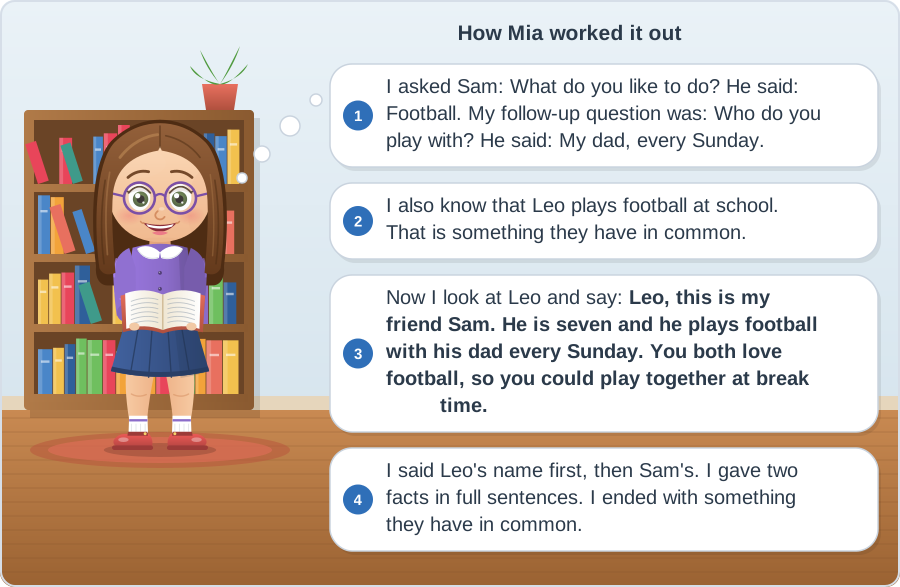
“What do you like to do?” “I like football.” Follow-up: “Which team do you play for?”
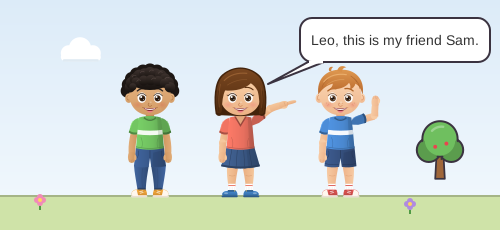
When you introduce two people, say each person’s name and one or two facts. Then say something they have in common, so they have something to talk about.
Speak in full sentences. Look at the people you are talking to, and speak clearly.
See How It’s Done
Now Try It
1. Someone asks Sam: What do you like to eat? Sam says: Pasta. Now say it as a full sentence about Sam.
Hint: Start with “Sam likes…”
2. Mia says: I have a new puppy. Ask Mia a follow-up question.
Hint: Use what Mia just said. Ask about the puppy.
Time To Practise
Name: ______________________
1. Listen to an introduction. Answer the questions.
Listen as an adult reads an introduction aloud once. Do not look at it. Then answer the questions.
a) How old is Mia’s brother? ______________
b) What is Mia learning to do at swimming club? ______________________
c) Why does Mia want to be a vet? ______________________________________
d) Write a follow-up question you could ask Mia.
__________________________________________________________________?
2. Choose and write follow-up questions.
a) Sam says: I have a new puppy. Circle the best follow-up question.
What is your favourite colour?
What is your puppy’s name?
Do you like school?
b) Leo says: I went to the beach in the holidays. Write a follow-up question.
__________________________________________________________________?
c) Ava says: I am learning to play the drums. Write a follow-up question.
__________________________________________________________________?
3. Interview a partner, then introduce them.
Interview a friend or a family member. Write one or two words for each answer. Then introduce them to another person.
| Question | Notes |
|---|---|
| What is your name, and how old are you? | ______________________ |
| What do you like to do? | ______________________ |
| What could you not do when you were little? | ______________________ |
| My follow-up question: ______________________? | ______________________ |
Now introduce your partner. Use these sentence starters if you need them.
______________, this is ______________. He / She / They ______________________________. When ______________ was little, ______________________________. You both ______________________________.
Tick each one you did.
☐ I asked a follow-up question. ☐ I said the person’s name first. ☐ I gave two or more facts. ☐ I said something they have in common. ☐ I spoke in full sentences. ☐ I looked at the listener.
Reflect
Think about these questions. Talk about them with someone at home or at school.
1. Go back to the Wonder question: “What do people need to know when they meet someone new?” What do you think now?
2. I was a communicator today when I ______________________________.
A communicator shares ideas clearly by talking, writing or drawing. For example: I was a communicator today when I introduced my partner and said what we have in common.
Take action: Next time someone new visits your home or class, introduce them to one other person. Say one thing they have in common.
Next Steps
If this was easy, try: Interview an older family member about when they were seven. Ask two follow-up questions. Then introduce them to someone as they were at seven.
If this was hard, go back to: Now Try It. Practise follow-up questions only. An adult says one sentence about themselves, and you ask one question about it. Do this five times before the interview.
Notes for Parents and Teachers
Show notes for parents and teachers
These notes cover this lesson only. How every lesson runs is explained in How to Use This Material.
Let’s Learn
Act out the football example with the learner, so they hear a follow-up question.
See How It’s Done
After Mia’s thoughts, act out the introduction with the learner, using real names.
Time To Practise
- Task 1: Read this introduction aloud once. The learner listens without looking, then answers. Read: “This is my friend Mia. She is seven and she lives next to the park. Mia has a little brother called Tom, who is three. On Saturdays, Mia goes to swimming club. She is learning to dive, but she is a bit scared of the high board. Her favourite food is spicy noodles. When she grows up, she wants to be a vet because she loves animals.”
- Task 3: The learner interviews a friend or a family member, then introduces them to a third person. Help the learner write one or two words for each answer.
- Task 3: Listen to the introduction, and tick the checklist together.
Answer Key
Reveal Answers
Now Try It
1. Sam likes to eat pasta.
2. Sample answers: What is her name? How old is she? What does she look like?
Look for: in 2, the question is about the puppy, not a new topic.
1. Listen to an introduction
a) Three
b) To dive
c) Because she loves animals.
d) Sample answers: Why are you scared of the high board? Where do you eat spicy noodles? What animals do you like best?
Look for: the learner answers without seeing the words. If they miss two or more, read the introduction again and ask them to listen for numbers and the word “because”.
2. Follow-up questions
a) What is your puppy’s name?
b) Sample answers: Which beach did you go to? What did you do at the beach?
c) Sample answers: Who is teaching you? What song can you play?
Look for: each question uses what the speaker said and ends with a question mark.
3. Interview and introduce
Sample answer: Grandpa, this is my cousin Rosa. She is nine and she likes to paint. When Rosa was little, she was scared of dogs. Now she walks her neighbour’s dog every day. You both like painting, so you could paint together.
Look for: four or more ticks. The follow-up question should come from an answer the partner gave.
Reflect
2. Any real moment from the lesson that shows the learner was a communicator. Examples: “I was a communicator today when I introduced my partner and said what we have in common.” “I was a communicator today when I asked a follow-up question to find out more.”
Lesson 1.6: Tell Me About This Photo
Oral | About 20 minutes
Term 1 | Level 1
Goal
“I can give a talk about a photo of when I was little, with an opening, describing words, something I worked out and a closing.”
Words to know
opening, middle, closing, describing word, work out, listener
Wonder
Think about this question before you start. Say your ideas. You will come back to it at the end of the lesson.
What can an old photo tell us about how we have changed?
Let’s Learn
A photo shows one moment from the past. When you talk about a photo, you help other people see what you see.
A good talk has three parts:
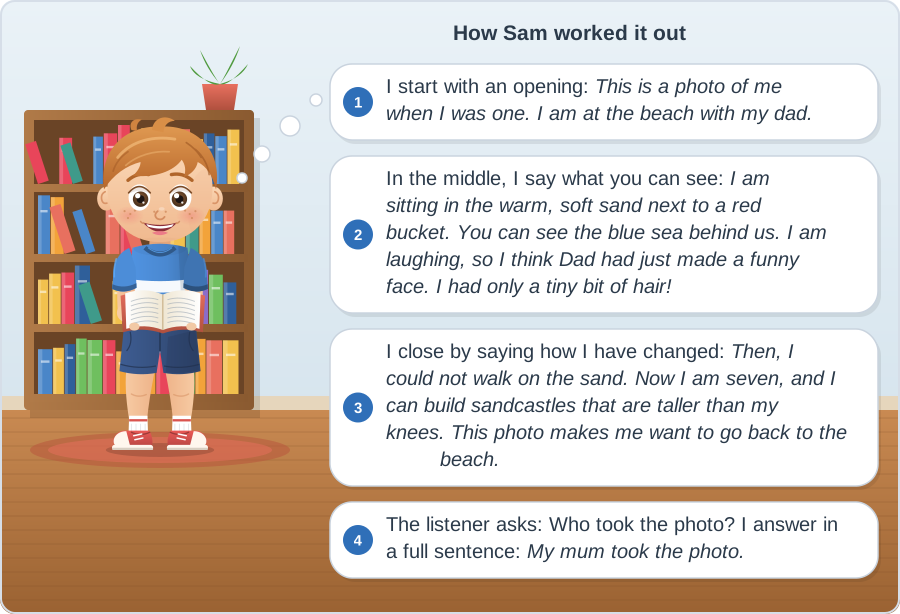
- an opening that says what the photo is: “This is a photo of me when I was one.”
- a middle that answers Who? Where? and What is happening? Use describing words for what you can see, hear or feel, such as tiny, warm, sandy or noisy.
- a closing that says how you have changed since then, or why the photo matters to you.
A photo does not show everything. You can also say what you work out from the clues, such as how someone was feeling.
After your talk, listeners may ask questions. Listen to each question, then answer it in a full sentence.
See How It’s Done

Now Try It
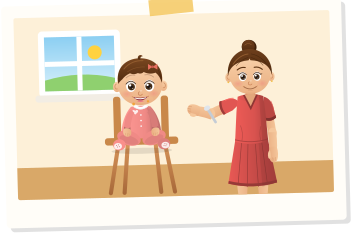
1. This is Ava’s baby photo. Say an opening sentence for a talk about it.
Hint: Start with “This is a photo of…”
2. Say two middle sentences. Use a describing word in each one. Then say one thing you can work out from the clues.
Hint: Look at the food on Ava’s face and her smile. What do they tell you?
Time To Practise
Name: ______________________
1. Look at Leo’s baby photo. Describe it.
Hint: Look closely at the bath, the bubbles, the duck and Gran’s face.
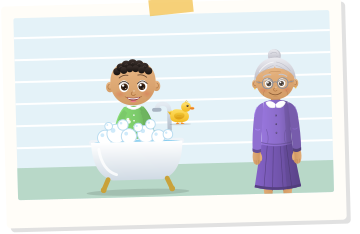
a) Write two sentences about what you can see. Use a describing word in each sentence.
__________________________________________________________________
__________________________________________________________________
b) What can you work out from the photo that it does not say? Write one sentence and give the clue.
__________________________________________________________________
2. Put Ava’s talk in order.
Number the sentences 1 to 5. Then write O next to the opening and C next to the closing.
____ ____ Mum is feeding me with a little spoon.
____ ____ Now I can cook pasta with Dad, so I am not messy any more!
____ ____ This is a photo of me in my high chair when I was one.
____ ____ I have orange food all over my face, so I think I liked it.
____ ____ We are in the kitchen, next to the big window.
3. Plan a talk about a photo of you.
Find a photo of you as a baby or a toddler. If you do not have one, draw one in the box.
| Part | My notes |
|---|---|
| Opening: what is the photo? | ______________________ |
| Middle: who and where? | ______________________ |
| Middle: what is happening? (with describing words) | ______________________ |
| Middle: something I can work out | ______________________ |
| Closing: how I have changed | ______________________ |
4. Give your talk.
Hold up the photo. Say six sentences or more. Then ask your listener for two questions, and answer each one in a full sentence.
Tick each one you did.
☐ I gave an opening. ☐ I said who, where and what. ☐ I used two or more describing words. ☐ I worked something out from a clue. ☐ I gave a closing about how I have changed. ☐ I answered two questions in full sentences.
Reflect
Think about these questions. Talk about them with someone at home or at school.
1. Go back to the Wonder question: “What can an old photo tell us about how we have changed?” What do you think now?
2. I was a risk-taker today when I ______________________________.
A risk-taker tries something new, even when it feels hard. For example: I was a risk-taker today when I gave a talk about my baby photo even though I felt shy.
Take action: Make a small photo wall at home with one baby photo and one photo from today. Give your talk to a visitor.
Next Steps
If this was easy, try: Choose a photo of an adult at home when they were a child. Give a talk about them, then ask them if your clues and guesses were right.
If this was hard, go back to: Now Try It. Say only the opening and one middle sentence about Ava’s photo. Then add a closing sentence before trying your own photo.
Notes for Parents and Teachers
Show notes for parents and teachers
These notes cover this lesson only. How every lesson runs is explained in How to Use This Material.
Let’s Learn
If you have a family photo nearby, point to it as you read each part.
See How It’s Done
Point to each part of the photo as you go through Sam’s thoughts.
Time To Practise
- Task 3: Find a photo of the learner as a baby or a toddler. If there is no photo, the learner can draw one in the box.
- Task 4: Listen to the talk, and tick the checklist together.
Answer Key
Reveal Answers
Now Try It
1. Sample answer: This is a photo of Ava in her high chair when she was a baby.
2. Sample answer: Ava has orange food all over her face. Her mum is holding a little spoon. I think Ava liked the food, because she is smiling.
1. Describe Leo’s photo
a) Sample answer: Baby Leo is sitting in a white bath with lots of bubbles. There is a yellow toy duck next to him.
b) Sample answer: I think Leo was having fun, because he is smiling and playing with the bubbles. Or: I think Gran was giving Leo his bath, because she is standing next to it.
Look for: a describing word in each sentence in a), and a clue from the photo in b).
2. Put Ava’s talk in order
3 Mum is feeding me with a little spoon.
5 C Now I can cook pasta with Dad, so I am not messy any more!
1 O This is a photo of me in my high chair when I was one.
4 I have orange food all over my face, so I think I liked it.
2 We are in the kitchen, next to the big window.
Look for: accept 2, 3 and 4 in any order, because all three are middle sentences. The opening must be first and the closing last.
3 and 4. Plan and give a talk
Sample answer: This is a photo of me when I was two. I am with my grandpa at the park. I am on a little red swing and I am wearing a big woolly hat. My cheeks are pink, so I think it was a cold day. Then, I needed Grandpa to push me. Now I can swing high on my own.
Look for: five or more ticks. Praise any describing word the learner uses.
Reflect
2. Any real moment from the lesson that shows the learner was a risk-taker. Examples: “I was a risk-taker today when I gave a talk about my baby photo even though I felt shy.” “I was a risk-taker today when I answered a question from my listener in a full sentence.”
For Teachers: IB Details
Show IB and curriculum details
IB theme: Who we are. It covers our bodies and feelings, our families and friends, where we belong, and how we learn and grow.
Central idea: People grow and change over time, and we can share the story of how we have changed.
| Lesson | Title | Strand | Key concept |
|---|---|---|---|
| 1.5 | Introduce a Friend | Listening and speaking | Connection |
| 1.6 | Tell Me About This Photo | Speaking | Change |
Each lesson also matches the national curriculum for England (Year 2) and the US Common Core (Grade 2). The Grade 2 Curriculum Map lists the full standards for every lesson.
← Back to Lesson 1 – Growing and Changing | Lessons – Index
© 2026 Firefly Ed. All rights reserved. This page may be printed for personal, home and classroom use. It may not be sold, shared online or reproduced for commercial use without written permission. edfirefly.com


Share your thoughts or ask something..