
Term 2 | Level 2 | Phonics focus: word endings: -ant, -ance, -ancy, -ent, -ence and -ency
Chapter 5 – Choosing and Leading | Chapters – Index
Lessons
This page has the two writing lessons of Chapter 5, Choosing and Leading: Lessons 5.3 and 5.4. The chapter page has the chapter overview, the chapter review and the PDF download.
Tap a lesson to open it. Tap the lesson title again, or use the link at the end of the lesson, to close it.
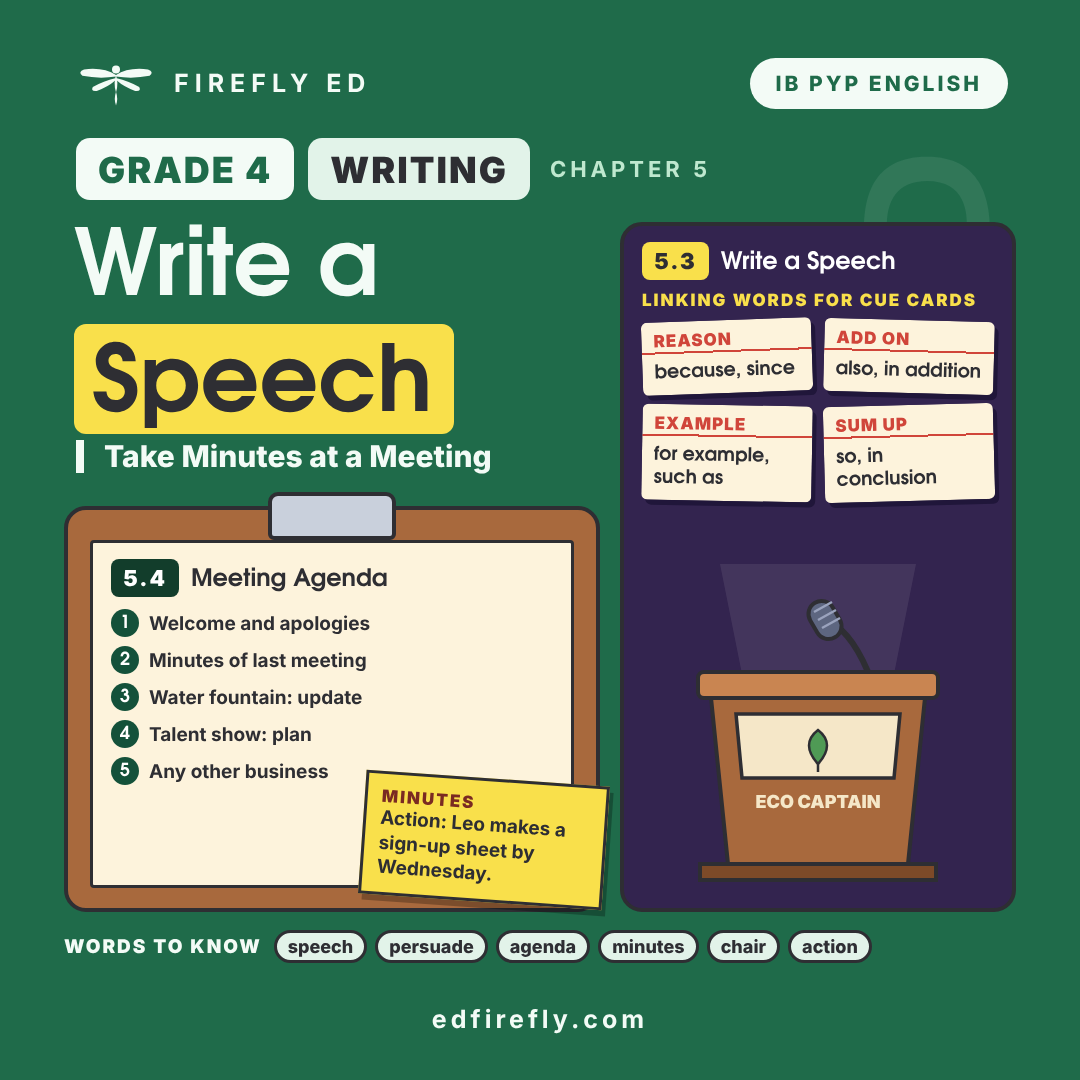
Lesson 5.3: Write a Speech: Why You Should Choose Me | Writing | About 20 minutes
Term 2 | Level 2
Goal
“I can write a persuasive speech that gives my opinion and links it to reasons with linking words.”
Words to know
speech, opinion, reason, persuade, linking word, conclusion
Wonder
Think about this question before you start. Say your ideas. You will come back to it at the end of the lesson.
What would make you vote for someone you did not know well?
Let’s Learn
A persuasive speech tries to make the audience agree with you. It has:
1. An opening that says who you are and what you want (your opinion).
2. Two or three reasons, each with an example.
3. Linking words that join your opinion and reasons.
4. A conclusion that tells the audience what to do.
Why You Should Choose Me as Eco Captain by Tomás
Good morning, everyone. My name is Tomás, and I would like to be our school’s Eco Captain, because I care about our planet and about our school.
My first reason is that I already take action. For instance, every Friday I help Mrs Shah empty the paper recycling bins, and last term I started a seed-planting corner in our classroom.
In addition, I have a clear plan. I want to put a recycling bin in every classroom, start a “switch it off” reminder for lights, and ask the council for a small vegetable garden.
Finally, I am a good listener. I will ask every class for their ideas, so the Eco Team will work for everyone, not just for me.
Therefore, if you want a greener school, please vote for me, Tomás, for Eco Captain. Thank you.
See How It’s Done
Now Try It
1. Underline the linking word in this sentence: I will listen to every class, so the Eco Team will work for everyone.
2. What does Tomás want the audience to do at the end?
__________________________________________________________________
Time To Practise
Name: ______________________
1. Find the parts.
In Tomás’s speech, find:
a) his opinion: ________________________________________________________
b) one reason with an example: ____________________________________________
c) the conclusion: ______________________________________________________
2. Choose the linking word.
Use: because for instance in addition therefore
a) I would be a good captain ______________ I am fair to everyone.
b) I am helpful. ______________, I help the younger children at lunchtime.
c) ______________, I have lots of ideas for clubs.
d) ______________, please choose me.
3. Plan your speech.
Choose a role: class representative, Eco Captain, Library Monitor, Sports Leader or a role of your own.
| Part | My notes |
|---|---|
| Opening and opinion | |
| Reason 1 and example | |
| Reason 2 and example | |
| Reason 3 | |
| Conclusion | |
4. Write your speech.
Write your speech in paragraphs. Use at least four linking words, and underline them.
__________________________________________________________________
__________________________________________________________________
__________________________________________________________________
__________________________________________________________________
__________________________________________________________________
5. Check your work.
☐ a clear opinion ☐ at least two reasons with examples ☐ four linking words ☐ a conclusion that asks for the vote ☐ promises I can keep
Reflect
Think about these questions. Talk about them with someone at home or at school.
1. Go back to the Wonder question: “What would make you vote for someone you did not know well?” What do you think now?
2. I was a communicator today when I ______________________________.
A communicator shares ideas clearly by talking, writing or drawing. For example: I was a communicator today when I linked my reasons with words like for instance and in addition.
Take action: Read your speech to someone at home. Ask them which reason persuaded them most.
Next Steps
If this was easy, try: Write a second, shorter speech for a friend who wants a different role. Use different linking words.
If this was hard, go back to: Let’s Learn. Read Tomás’s speech aloud and point to each linking word before you plan.
Notes for Parents and Teachers
Show notes for parents and teachers
These notes cover this lesson only. How every lesson runs is explained in How to Use This Material.
Let’s Learn
Then read the model speech aloud, as if you were giving it.
Answer Key
Reveal Answers
Now Try It
1. so 2. Vote for him, Tomás, for Eco Captain.
1. Find the parts
a) I would like to be our school’s Eco Captain, because I care about our planet and about our school. b) Any one of: he already takes action, for instance he helps empty the recycling bins; he has a clear plan, such as a recycling bin in every classroom. c) Therefore, if you want a greener school, please vote for me, Tomás, for Eco Captain.
2. Choose the linking word
a) because b) For instance c) In addition d) Therefore
3 to 5. Answers will vary. Look for: an opening with an opinion, at least two reasons with examples, four linking words used correctly, and a conclusion that asks for the vote.
Reflect
2. Any real moment from the lesson that shows the learner was a communicator. Examples: “I was a communicator today when I linked my reasons with words like for instance and in addition.” “I was a communicator today when I wrote a conclusion that told my audience what to do.”
Lesson 5.4: Write an Agenda and Minutes for a Class Meeting | Writing | About 20 minutes
Term 2 | Level 2
Goal
“I can write an agenda before a meeting and minutes after it, using headings to organise the information.”
Words to know
agenda, minutes, chair, secretary, apologies, action, item
Wonder
Think about this question before you start. Say your ideas. You will come back to it at the end of the lesson.
How does a group remember what it decided at a meeting?
Let’s Learn
A group meeting needs two pieces of writing:
An agenda is written before the meeting. It lists the items (topics) the group will talk about, in order. It gives the date, time and place.
Minutes are written during or after the meeting by the secretary. They record who came, who sent apologies (could not come), what was decided for each item, and any actions: who will do what, and by when.
Notice that the minutes use the same item numbers as the agenda, so readers can match them up. Minutes are short. They record decisions, not every word that was said.
See How It’s Done
Now Try It
1. Who sent apologies for the meeting? ______________
2. What is the action for item 4, and who will do it?
__________________________________________________________________
Time To Practise
Name: ______________________
1. Agenda or minutes?
Write A for agenda or M for minutes.
a) Written before the meeting. ____ b) Records what was decided. ____ c) Lists the items to talk about. ____ d) Says who will do each action. ____
2. Read the minutes.
a) Who was the chair? ______________ b) When is the next meeting? ______________
c) What did the council agree to do about the water fountain? ______________________________
3. Write an agenda.
Plan a family or class meeting about something real, such as a trip, a party or a new rule. Write the agenda.
Group: ______________ Date: ______________ Time: ______________ Place: ______________
1. Welcome and apologies
2. ______________________________________________________________
3. ______________________________________________________________
4. Any other business
5. Date of next meeting
4. Hold the meeting and write minutes.
Hold your meeting. Take notes, then write the minutes, using the same numbers as your agenda.
| Heading | Minutes |
|---|---|
| Present | |
| Apologies | |
| Item 2: decision and action | |
| Item 3: decision and action | |
| Next meeting |
Reflect
Think about these questions. Talk about them with someone at home or at school.
1. Go back to the Wonder question: “How does a group remember what it decided at a meeting?” What do you think now?
2. I was balanced today when I ______________________________.
Being balanced means taking care of your body and mind, with time to work, play and rest. For example: I was balanced today when I kept our meeting short, so we still had time to play.
Take action: Hold a short family meeting with an agenda. Keep the minutes, and check at the next meeting that the actions were done.
Next Steps
If this was easy, try: Write the agenda for the next Class 4 Council meeting, based on the minutes.
If this was hard, go back to: Let’s Learn. Put your finger on each agenda item, then find the same number in the minutes.
Notes for Parents and Teachers
Show notes for parents and teachers
These notes cover this lesson only. How every lesson runs is explained in How to Use This Material.
Let’s Learn
Look at the agenda and the minutes together.
Answer Key
Reveal Answers
Now Try It
1. Jo 2. Leo will make a sign-up sheet by Wednesday.
1. Agenda or minutes?
a) A b) M c) A d) M
2. Read the minutes
a) Priya b) Tuesday 18 March, 12:30, Room 4 c) To thank the caretaker.
3 and 4. Answers will vary. Look for: a date, time and place; numbered items; minutes that use the same numbers, record decisions rather than every word, and name who will do each action and by when.
Reflect
2. Any real moment from the lesson that shows the learner was balanced. Examples: “I was balanced today when I kept our meeting short, so we still had time to play.” “I was balanced today when I planned the meeting for a time that left room for work and rest.”
For Teachers: IB Details
Show IB and curriculum details
IB theme: How we organize ourselves. This theme is about how people work together in groups, how communities make decisions and share responsibilities, and how organisations are run.
Central idea: Groups make fair decisions in different ways, and leaders have responsibilities to the people they lead.
| Lesson | Title | Strand | Key concept |
|---|---|---|---|
| 5.3 | Write a Speech: Why You Should Choose Me | Writing | Perspective |
| 5.4 | Write an Agenda and Minutes for a Class Meeting | Writing | Function |
Each lesson also matches the national curriculum for England (Year 4) and the US Common Core (Grade 4). The Grade 4 Curriculum Map lists the full standards for every lesson.
← Back to Chapter 5 – Choosing and Leading | Chapters – Index
© 2026 Firefly Ed. All rights reserved. This page may be printed for personal, home and classroom use. It may not be sold, shared online or reproduced for commercial use without written permission. edfirefly.com



Share your thoughts or ask something..