
Term 2 | Level 2 | Phonics focus: word endings: -ant, -ance, -ancy, -ent, -ence and -ency
Chapter 5 – Choosing and Leading | Chapters – Index
Lessons
This page has the two viewing and presenting lessons of Chapter 5, Choosing and Leading: Lessons 5.7 and 5.8. The chapter page has the chapter overview, the chapter review and the PDF download.
Tap a lesson to open it. Tap the lesson title again, or use the link at the end of the lesson, to close it.
Lesson 5.7: Read a Bar Chart of Votes | Visual | About 20 minutes
Term 2 | Level 2
Goal
“I can read a bar chart of election results, use the scale to find each number, and explain what the results show.”
Words to know
bar chart, scale, axis, tally, total, majority, result
Wonder
Think about this question before you start. Say your ideas. You will come back to it at the end of the lesson.
How can you tell who won an election just by looking at a chart?
Let’s Learn
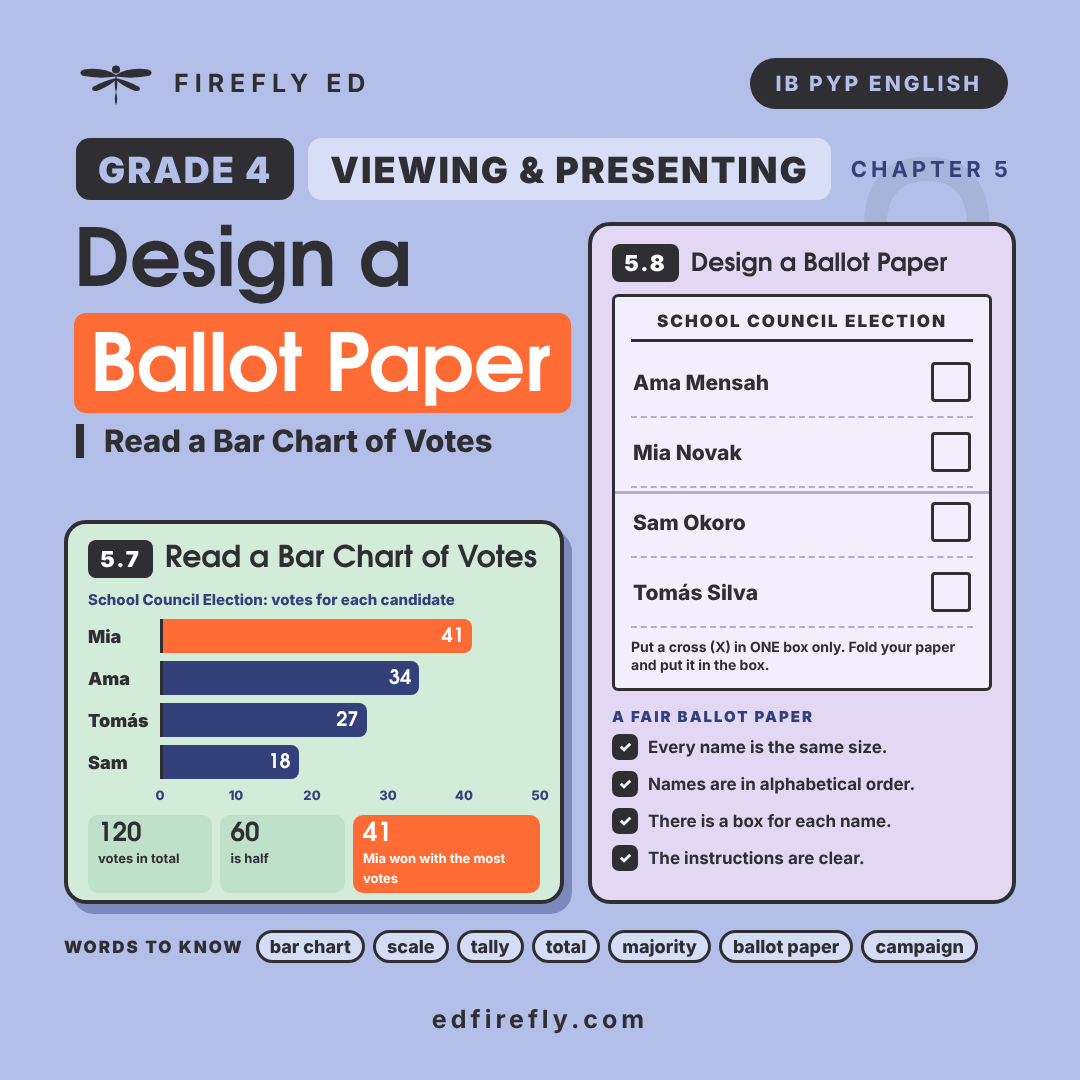
After an election, the votes are counted. A tally uses marks in groups of five to count quickly. Then the results can be shown on a bar chart, so everyone can see them at a glance.
To read the bar chart: 1. Read the title. 2. Find a bar and read its label. 3. Look across from the top of the bar to the scale on the side. 4. If the top is between two lines, work out the number in between.
See How It’s Done
Now Try It
1. Who came second? ______________
2. About how many votes did Tomás get? ______________
Hint: His bar ends between 20 and 30.
Time To Practise
Name: ______________________
1. Read the chart.
| Candidate | Votes | Position (1st to 4th) |
|---|---|---|
| Ama | ||
| Tomás | ||
| Mia | ||
| Sam |
2. Work it out.
a) How many votes were cast altogether? ______________
b) How many more votes did Mia get than Ama? ______________
c) Did Mia get more than half of all the votes? Explain. ______________________________
3. True or false?
a) Sam got about half as many votes as Ama. ______
b) Tomás and Sam together got more votes than Mia. ______
c) The scale goes up in fives. ______
4. What does it show?
Write two sentences that describe the results of the election.
__________________________________________________________________
__________________________________________________________________
5. Make a tally.
Ask ten people at home or school which of two things they prefer, such as cats or dogs. Make a tally, then draw a bar chart with a title, labels and a scale.
Reflect
Think about these questions. Talk about them with someone at home or at school.
1. Go back to the Wonder question: “How can you tell who won an election just by looking at a chart?” What do you think now?
2. I was a thinker today when I ______________________________.
A thinker thinks carefully to work things out. For example: I was a thinker today when I used the scale to work out numbers between the lines.
Take action: Next time your family makes a choice, count the votes with a tally and show the result as a bar chart.
Next Steps
If this was easy, try: Redraw the chart with a scale that goes up in fives. Which chart is easier to read? Why?
If this was hard, go back to: Let’s Learn. Put a ruler across from the top of each bar to the scale before you write the number.
Notes for Parents and Teachers
Show notes for parents and teachers
These notes cover this lesson only. How every lesson runs is explained in How to Use This Material.
Let’s Learn
Look at the picture and the chart together.
Answer Key
Reveal Answers
Now Try It
1. Ama 2. about 27
1. Read the chart
Ama 34, 2nd; Tomás 27, 3rd; Mia 41, 1st; Sam 18, 4th (accept answers within one or two votes)
2. Work it out
a) 120 (34 + 27 + 41 + 18) b) 7 c) No. Half of 120 is 60, and Mia got 41. She won because she got the most votes, but not more than half.
3. True or false?
a) true (18 is about half of 34) b) true (27 + 18 = 45, which is more than 41) c) false (it goes up in tens)
4. What does it show?
Sample answer: Mia won the election with 41 votes. Ama came second with 34 votes, and Sam got the fewest votes.
5. Answers will vary. Look for: a correct tally, a title, labelled bars and a scale that starts at zero.
Reflect
2. Any real moment from the lesson that shows the learner was a thinker. Examples: “I was a thinker today when I used the scale to work out numbers between the lines.” “I was a thinker today when I checked the chart against the tally.”
Lesson 5.8: Design a Ballot Paper and a Campaign Poster | Visual | About 20 minutes
Term 2 | Level 2
Goal
“I can design a clear ballot paper and a campaign poster, choosing layout, colour, fonts and pictures for a purpose.”
Words to know
design, layout, font, symbol, ballot paper, campaign, purpose
Wonder
Think about this question before you start. Say your ideas. You will come back to it at the end of the lesson.
What makes you stop and read a poster?
Let’s Learn
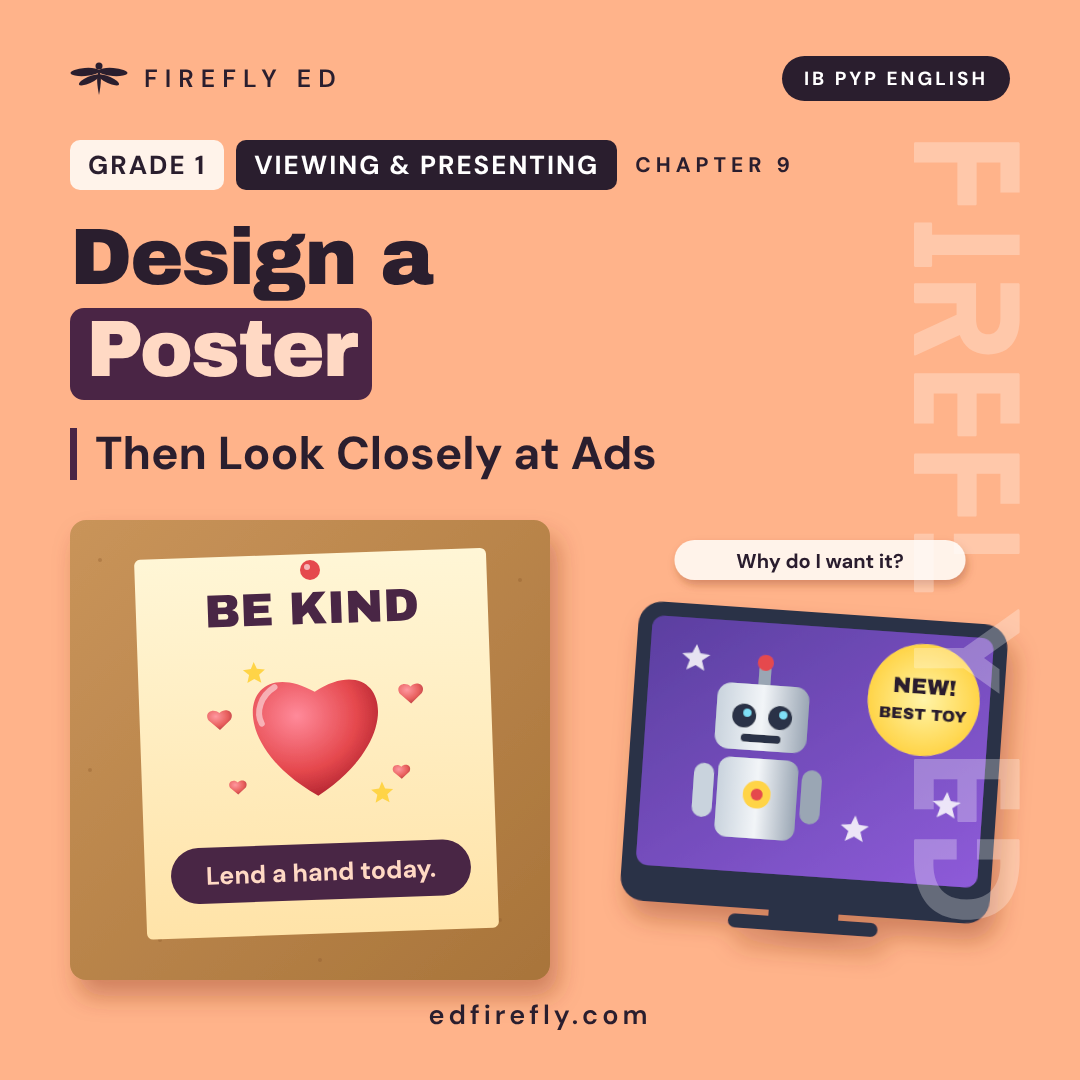
A campaign poster persuades people to vote for a candidate. Its purpose must be clear in a few seconds. A good poster uses:
Layout: the most important words are biggest and at the top. Fonts: bold, clear letters that are easy to read from far away. Colour: a few colours that stand out from each other. Pictures and symbols: a portrait of the candidate and small pictures that match the words.
A ballot paper must be fair and clear. Every candidate’s name is the same size, in an order that does not favour anyone (such as alphabetical order), with a box for each, and clear instructions.
See How It’s Done
Now Try It
1. Give two reasons why Poster A is easier to read than Poster B.
__________________________________________________________________
2. Why are the names on the ballot paper in alphabetical order?
__________________________________________________________________
Time To Practise
Name: ______________________
1. Poster checklist.
Tick the features of Poster A.
☐ clear purpose ☐ biggest words at the top ☐ bold, readable font ☐ colours that stand out ☐ pictures that match the words
2. Improve Poster B.
Write three changes that would make Poster B better.
1. ________________________________________________________________
2. ________________________________________________________________
3. ________________________________________________________________
3. Fair or unfair?
Write F for fair or U for unfair.
a) One name is in bigger letters than the others. ____ b) The names are in alphabetical order. ____ c) The paper has clear instructions. ____
4. Design.
Design a ballot paper for an election of your own, and a poster for one candidate (it could be you).
5. Test it.
Hold your poster up across the room. Ask someone: “What is this poster for?” Could they tell in five seconds? ______
Reflect
Think about these questions. Talk about them with someone at home or at school.
1. Go back to the Wonder question: “What makes you stop and read a poster?” What do you think now?
2. I was principled today when I ______________________________.
Being principled means being fair and honest and doing the right thing. For example: I was principled today when I made a ballot paper that was fair to every candidate.
Take action: Use your ballot papers to hold a real vote at home or in class, and display your poster.
Next Steps
If this was easy, try: Make a second poster for a different candidate in a completely different colour scheme and style.
If this was hard, go back to: Let’s Learn. Use the checklist in task 1 to look at Poster A one feature at a time.
Notes for Parents and Teachers
Show notes for parents and teachers
These notes cover this lesson only. How every lesson runs is explained in How to Use This Material.
Let’s Learn
Compare the two posters together.
Answer Key
Reveal Answers
Now Try It
1. Any two of: the title is big, bold and at the top; there are only a few colours; the picture shows the candidate; the small pictures match the promises; the text is easy to read. 2. So that no candidate gets an unfair advantage from being first.
1. Poster checklist
All five should be ticked.
2. Improve Poster B
Sample answers: Make the title big and bold at the top. Use fewer pictures that match the words. Use dark text on a light background so it is easy to read. Say clearly who to vote for and why.
3. Fair or unfair?
a) U b) F c) F
4 and 5. Answers will vary. Look for: a fair ballot paper with equal names, boxes and instructions; a poster with a clear purpose, a bold title, a few colours and pictures that match the words.
Reflect
2. Any real moment from the lesson that shows the learner was principled. Examples: “I was principled today when I made a ballot paper that was fair to every candidate.” “I was principled today when I made promises on my poster that I could keep.”
For Teachers: IB Details
Show IB and curriculum details
IB theme: How we organize ourselves. This theme is about how people work together in groups, how communities make decisions and share responsibilities, and how organisations are run.
Central idea: Groups make fair decisions in different ways, and leaders have responsibilities to the people they lead.
| Lesson | Title | Strand | Key concept |
|---|---|---|---|
| 5.7 | Read a Bar Chart of Votes | Viewing | Function |
| 5.8 | Design a Ballot Paper and a Campaign Poster | Presenting | Function |
Each lesson also matches the national curriculum for England (Year 4) and the US Common Core (Grade 4). The Grade 4 Curriculum Map lists the full standards for every lesson.
← Back to Chapter 5 – Choosing and Leading | Chapters – Index
© 2026 Firefly Ed. All rights reserved. This page may be printed for personal, home and classroom use. It may not be sold, shared online or reproduced for commercial use without written permission. edfirefly.com


Share your thoughts or ask something..