
Term 3 | Level 3 | Phonics focus: word roots from the sky, the verb endings -ate, -ise and -ify, and prefixes with hyphens
Chapter 7 – Journey Into Space | Chapters – Index
Lessons
This page has the two viewing and presenting lessons of Chapter 7, Journey Into Space: Lessons 7.7 and 7.8. The chapter page has the chapter overview, the chapter review and the PDF download.
Tap a lesson to open it. Tap the lesson title again, or use the link at the end of the lesson, to close it.
Lesson 7.7: Read a Diagram: Stages of a Rocket | Visual | About 20 minutes
Term 3 | Level 3
Goal
“I can read a labelled diagram and explain how it helps me understand a text.”
Words to know
diagram, label, stage, module, sequence, caption
Wonder
Think about this question before you start. Say your ideas. You will come back to it at the end of the lesson.
Why might a diagram explain a rocket better than words alone?
Let’s Learn
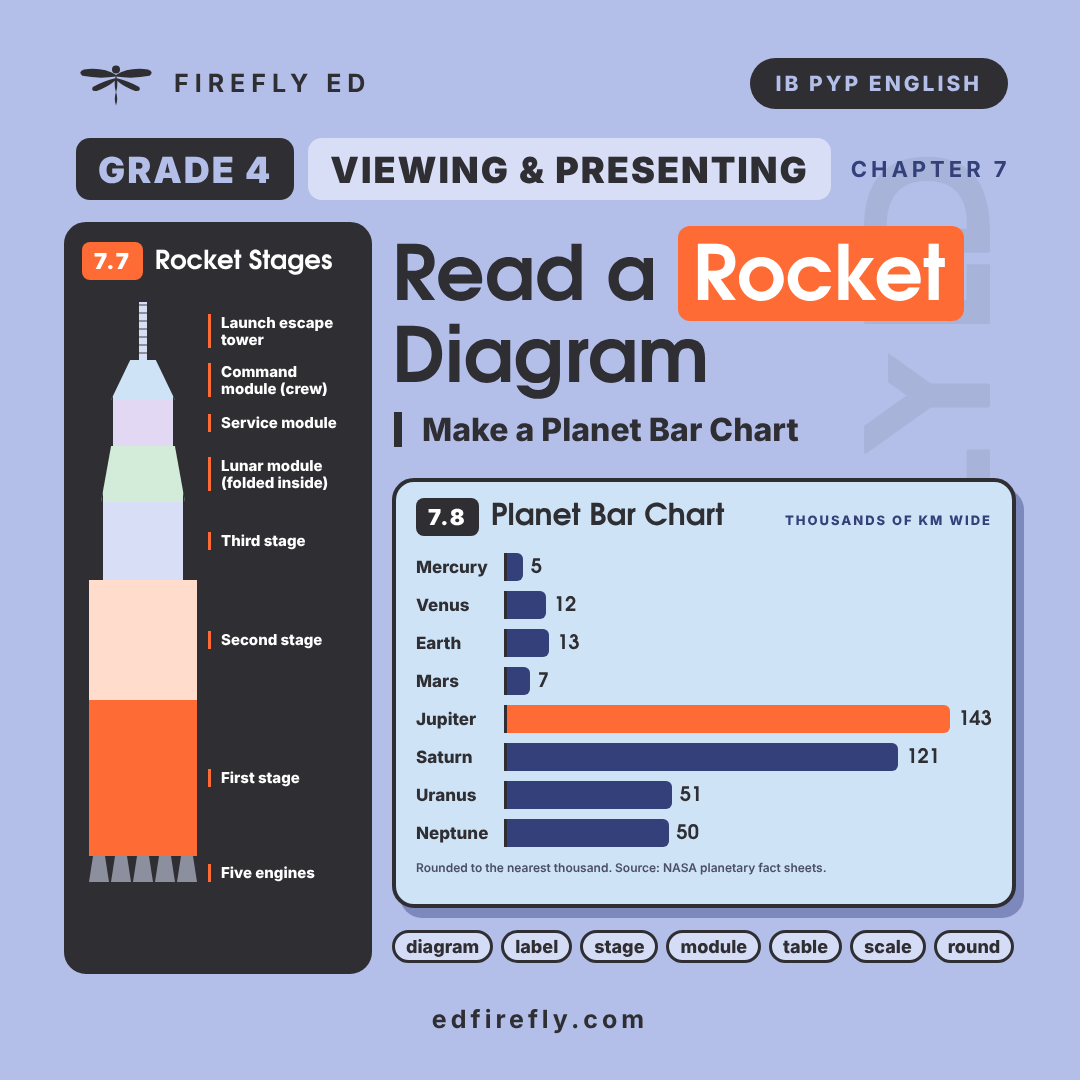
A labelled diagram shows the parts of something. Each label has a line that points to one part. A sequence diagram shows what happens in order, often in numbered pictures with captions.
The rocket that took astronauts to the Moon was built in parts, called stages, stacked on top of each other. Each stage had its own fuel and engines. When a stage used up its fuel, it dropped away, so the rest of the rocket became lighter.
See How It’s Done
Now Try It
1. Which stage is the biggest? ______________
2. What is folded inside, above the third stage? ______________
Time To Practise
Name: ______________________
1. Read the labels.
a) Where were the engines? ______________ b) What was at the very top? ______________
c) Which part did the crew sit in? ______________ d) How many engines did the first stage have? ______________
2. Read the sequence.
a) What happens in picture 2? ______________________________
b) What does the third stage do? ______________________________
3. True or false?
Write T or F.
a) The first stage is at the top. ____ b) The lunar module is folded inside the rocket. ____ c) Each stage has its own engines. ____
4. Why a diagram?
Write two ways the diagrams help you understand the text.
__________________________________________________________________
__________________________________________________________________
5. Draw and label.
Draw a simple rocket with three stages on paper. Add five labels with lines, and a caption under it.
Reflect
Think about these questions. Talk about them with someone at home or at school.
1. Go back to the Wonder question: “Why might a diagram explain a rocket better than words alone?” What do you think now?
2. I was a thinker today when I ______________________________.
A thinker thinks carefully to work things out. For example: I was a thinker today when I followed a label line to the right part.
Take action: Find a labelled diagram at home, such as on a toy box or in a manual, and explain it to someone.
Next Steps
If this was easy, try: Draw a labelled diagram of a space suit, with at least six labels.
If this was hard, go back to: Let’s Learn. Cover the labels with your hand. Point to a part and say its name, then check.
Notes for Parents and Teachers
Show notes for parents and teachers
These notes cover this lesson only. How every lesson runs is explained in How to Use This Material.
Let’s Learn
Read Let’s Learn aloud together. Look at the diagrams together.
Answer Key
Reveal Answers
Now Try It
1. the first stage 2. the lunar module
1. Read the labels
a) at the bottom b) the launch escape tower c) the command module d) five
2. Read the sequence
a) The second stage falls away. b) It sends the spacecraft to the Moon.
3. True or false?
a) F b) T c) T
4. Sample answers: The labels show where each part is, which is hard to describe in words. The numbered pictures show the order the stages drop away.
5. Look for: three stages, five labels with lines that point to the right parts, and a caption.
Reflect
2. Any real moment from the lesson that shows the learner was a thinker. Examples: “I was a thinker today when I followed a label line to the right part.” “I was a thinker today when I used a diagram to understand a text.”
Lesson 7.8: Make a Table and a Bar Chart: Planet Facts | Visual | About 20 minutes
Term 3 | Level 3
Goal
“I can organise facts in a table and show them in a bar chart, with a title, labels and a scale.”
Words to know
table, column, row, bar chart, scale, axis, round
Wonder
Think about this question before you start. Say your ideas. You will come back to it at the end of the lesson.
How could you show quickly which planet is the biggest?
Let’s Learn
A table puts facts in rows and columns, so they are easy to find. A bar chart shows the same facts as bars, so they are easy to compare. Big numbers can be rounded to make a chart simpler.
To make a bar chart: give it a title; label each bar; choose a scale for the side axis that fits the biggest number, going up in equal steps; then draw each bar to the right height.
Source: planet widths from NASA’s planetary fact sheets.
See How It’s Done
Now Try It
1. Round Saturn’s width to the nearest thousand. ______________
2. Which planet is the smallest? ______________
Time To Practise
Name: ______________________
1. Read the table.
a) How wide is Earth? ______________ b) Which planet is about twice as wide as Mars? ______________
c) Which two planets are almost the same width? ______________ and ______________
2. Read the chart.
a) Which planet has the tallest bar? ______________ b) About how many Earths would fit across Jupiter? ______________
3. Make your own table.
Ask five people their favourite planet. Record the results in a table.
| Planet | Tally | Total |
|---|---|---|
4. Make your own bar chart.
On paper, draw a bar chart of your results. Add a title, a label under each bar, and a scale up the side.
5. Explain it.
Write one sentence that tells what your chart shows.
__________________________________________________________________
Reflect
Think about these questions. Talk about them with someone at home or at school.
1. Go back to the Wonder question: “How could you show quickly which planet is the biggest?” What do you think now?
2. I was a thinker today when I ______________________________.
A thinker thinks carefully to work things out. For example: I was a thinker today when I chose a scale that fitted my biggest number.
Take action: Make a bar chart at home of something you count, such as the birds you see from a window in ten minutes.
Next Steps
If this was easy, try: Add a second table and chart: the number of hours in a day on each planet, using a trusted source.
If this was hard, go back to: Let’s Learn. Read the table one row at a time. Then find that planet’s bar on the chart.
Notes for Parents and Teachers
Show notes for parents and teachers
These notes cover this lesson only. How every lesson runs is explained in How to Use This Material.
Let’s Learn
Read Let’s Learn aloud together. Look at the picture, the table and the chart together.
Answer Key
Reveal Answers
Now Try It
1. 121,000 km 2. Mercury
1. Read the table
a) 12,756 km b) Earth or Venus (each is almost twice the width of Mars) c) Venus and Earth (or Uranus and Neptune)
2. Read the chart
a) Jupiter b) about 11 (143 ÷ 13)
3 to 5. Answers will vary. Look for: a tally and total for each planet, a chart with a title, labels and an even scale, and a sentence that names the most popular planet.
Reflect
2. Any real moment from the lesson that shows the learner was a thinker. Examples: “I was a thinker today when I chose a scale that fitted my biggest number.” “I was a thinker today when I rounded large numbers to compare them.”
For Teachers: IB Details
Show IB and curriculum details
IB theme: How the world works. This theme is about the natural world and its laws, how people and nature affect each other, and how people use science to understand the world.
Central idea: People use science and teamwork to explore space, and what they learn there helps us understand Earth.
| Lesson | Title | Strand | Key concept |
|---|---|---|---|
| 7.7 | Read a Diagram: Stages of a Rocket | Viewing | Function |
| 7.8 | Make a Table and a Bar Chart: Planet Facts | Presenting | Function |
Each lesson also matches the national curriculum for England (Year 4) and the US Common Core (Grade 4). The Grade 4 Curriculum Map lists the full standards for every lesson.
← Back to Chapter 7 – Journey Into Space | Chapters – Index
© 2026 Firefly Ed. All rights reserved. This page may be printed for personal, home and classroom use. It may not be sold, shared online or reproduced for commercial use without written permission. edfirefly.com


Share your thoughts or ask something..