
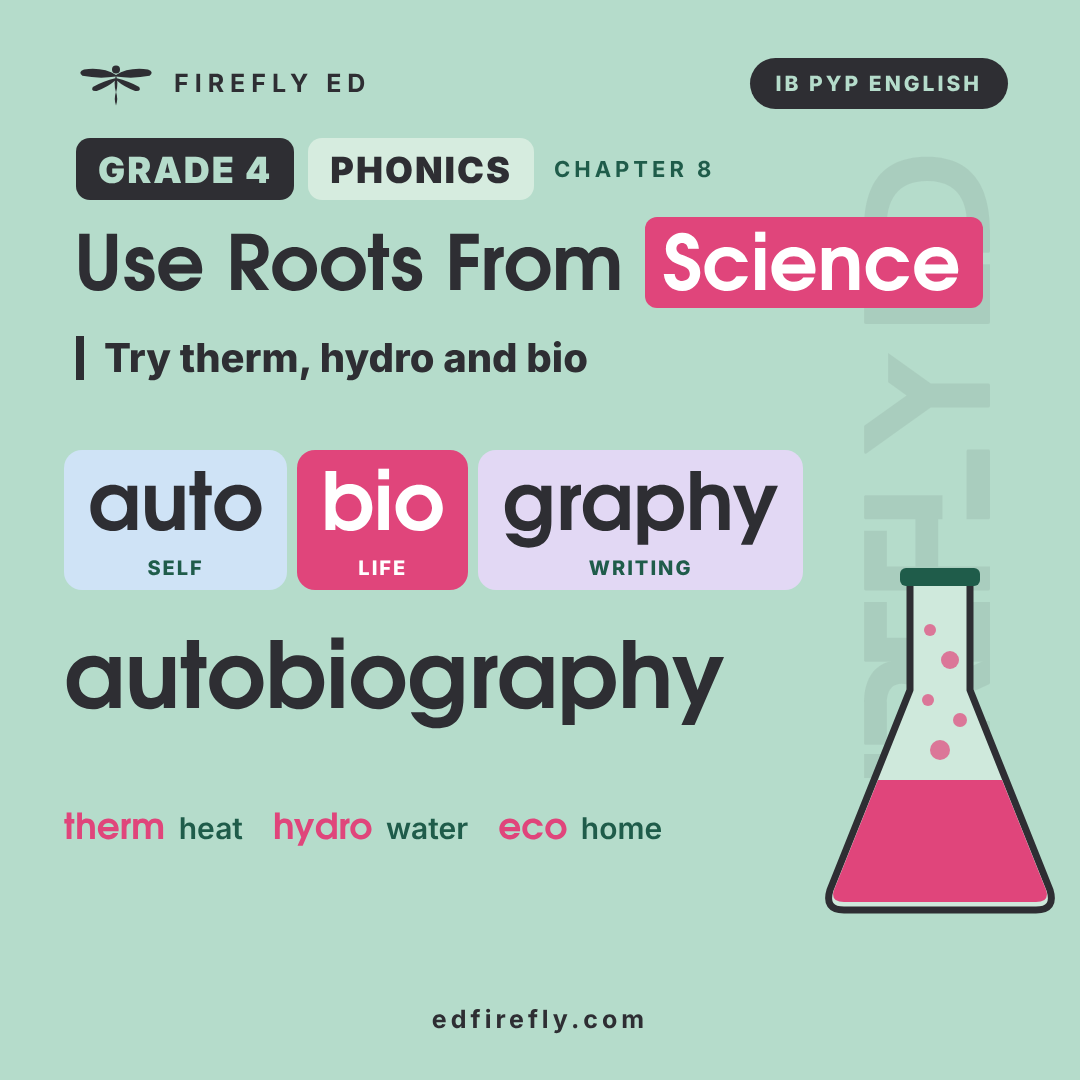
Term 3 | Level 3 | Phonics focus: the roots therm, hydro, bio and eco, and ei after c
Chapter 8 – Energy for Our Planet | Chapters – Index
Lessons
This page has the three phonics lessons of Chapter 8, Energy for Our Planet: Lessons 8.9, 8.10 and 8.11. The chapter page has the chapter overview, the chapter review and the PDF download.
Tap a lesson to open it. Tap the lesson title again, or use the link at the end of the lesson, to close it.
Lesson 8.9: Roots: therm and hydro | Phonics | About 20 minutes
Term 3 | Level 3
Goal
“I can use the roots therm and hydro to read, spell and work out the meaning of words.”
Words to know
root, Greek, therm, hydro, word sum, meaning
Wonder
Think about this question before you start. Say your ideas. You will come back to it at the end of the lesson.
What do a thermometer and a thermos have in common?
Let’s Learn
Many energy and science words come from Greek roots. Therm means heat, and hydro (sometimes hydr) means water. Knowing these roots helps you understand words such as thermal and hydroelectric, which are used to describe ways of making energy.
Spelling tip: hydro starts with h-y, and the y says /ie/, as in my.
See How It’s Done
Now Try It
1. Underline the root: thermal hydrant hydroelectric
2. What do you think dehydrated means? ______________________________
Time To Practise
Name: ______________________
1. Find the root.
Write the root and its meaning.
thermostat ______ ______ hydrate ______ ______ thermal ______ ______ hydroplane ______ ______
2. Choose the word.
thermometer thermos hydroelectric hydrant dehydrated
a) The firefighters joined their hose to the ______________.
b) Drink water on hot days, or you may become ______________.
c) A ______________ dam uses falling water to make electricity.
d) The nurse used a ______________ to check my temperature.
e) Grandad keeps his tea hot in a ______________.
3. Word sums.
therm + al = ______________ de + hydrate = ______________ hydro + electric = ______________
4. Work it out.
A thermostat is used in many homes. Using the root, what do you think it controls?
__________________________________________________________________
5. Write from dictation.
Listen as an adult reads a sentence aloud. Write it.
__________________________________________________________________
Reflect
Think about these questions. Talk about them with someone at home or at school.
1. Go back to the Wonder question: “What do a thermometer and a thermos have in common?” What do you think now?
2. I was an inquirer today when I ______________________________.
An inquirer asks questions and finds things out. For example: I was an inquirer today when I used a root to work out a new word.
Take action: Find a thermometer or thermostat at home. Read it with an adult and say what the root tells you.
Next Steps
If this was easy, try: Use therm and hydro to explain two different ways of making electricity, in two sentences each.
If this was hard, go back to: Let’s Learn. Say each root and its meaning, then find it in each word card.
Notes for Parents and Teachers
Show notes for parents and teachers
These notes cover this lesson only. How every lesson runs is explained in How to Use This Material.
Let’s Learn
Read Let’s Learn aloud together. Say each word together and point to the root.
Time To Practise
- Task 5: Read the sentence from the Answer Key aloud slowly. The learner writes it.
Answer Key
Reveal Answers
Now Try It
1. thermal, hydrant, hydroelectric 2. Having lost too much water from the body.
1. Find the root
thermostat: therm, heat; hydrate: hydr, water; thermal: therm, heat; hydroplane: hydro, water
2. Choose the word
a) hydrant b) dehydrated c) hydroelectric d) thermometer e) thermos
3. Word sums
thermal, dehydrate, hydroelectric
4. The heat in a room or a house: it switches the heating on and off.
5. Write from dictation
Dictation sentence: The hydroelectric dam is near the thermal springs.
Reflect
2. Any real moment from the lesson that shows the learner was an inquirer. Examples: “I was an inquirer today when I used a root to work out a new word.” “I was an inquirer today when I linked two roots I already knew.”
Lesson 8.10: Roots: bio and eco | Phonics | About 20 minutes
Term 3 | Level 3
Goal
“I can use the roots bio and eco to read, spell and work out the meaning of words.”
Words to know
root, bio, eco, ecosystem, biodegradable, word sum
Wonder
Think about this question before you start. Say your ideas. You will come back to it at the end of the lesson.
What do you think the eco in eco-friendly means?
Let’s Learn
Two Greek roots are used in many words about the planet. Bio means life, and eco comes from a Greek word for home. An ecosystem is a home that many living things share, such as a pond or a forest.
See How It’s Done
Now Try It
1. Underline the root: biofuel ecology biography
2. What is a biography? ______________________________
Time To Practise
Name: ______________________
1. Find the root.
Write the root and its meaning.
ecology ______ ______ biofuel ______ ______ biography ______ ______ eco-friendly ______ ______
2. Choose the word.
biology biodegradable ecosystem eco-friendly autobiography
a) A coral reef is an ______________ full of fish, coral and plants.
b) In ______________, we learned how frogs grow.
c) Paper bags are ______________, so they rot away in the soil.
d) She wrote her ______________ about growing up in Kenya.
e) Walking to school is an ______________ choice.
3. Word sums.
bio + logy = ______________ eco + system = ______________ auto + bio + graphy = ______________
4. Sort it.
Is it biodegradable? Write Y or N: a banana skin ____ a plastic bottle ____ a paper bag ____ a glass jar ____
5. Write from dictation.
Listen as an adult reads a sentence aloud. Write it.
__________________________________________________________________
Reflect
Think about these questions. Talk about them with someone at home or at school.
1. Go back to the Wonder question: “What do you think the eco in eco-friendly means?” What do you think now?
2. I was caring today when I ______________________________.
Being caring means being kind and helping others. For example: I was caring today when I thought about how my choices affect living things.
Take action: Look at packaging at home and find the words biodegradable or recyclable. Sort the packets together.
Next Steps
If this was easy, try: Write a short biography of a scientist who studies ecosystems, using a trusted source.
If this was hard, go back to: Let’s Learn. Break each long word into parts with lines, then say each part and its meaning.
Notes for Parents and Teachers
Show notes for parents and teachers
These notes cover this lesson only. How every lesson runs is explained in How to Use This Material.
Let’s Learn
Read Let’s Learn aloud together. Say each word together and point to the root.
Time To Practise
- Task 5: Read the sentence from the Answer Key aloud slowly. The learner writes it.
Answer Key
Reveal Answers
Now Try It
1. biofuel, ecology, biography 2. The story of someone’s life, written by another person.
1. Find the root
ecology: eco, home; biofuel: bio, life; biography: bio, life; eco-friendly: eco, home
2. Choose the word
a) ecosystem b) biology c) biodegradable d) autobiography e) eco-friendly
3. Word sums
biology, ecosystem, autobiography
4. banana skin Y; plastic bottle N; paper bag Y; glass jar N
5. Write from dictation
Dictation sentence: Biodegradable packaging is better for every ecosystem.
Reflect
2. Any real moment from the lesson that shows the learner was caring. Examples: “I was caring today when I thought about how my choices affect living things.” “I was caring today when I used roots to read long words.”
Lesson 8.11: ei After c, and Tricky Words | Phonics | About 20 minutes
Term 3 | Level 3
Goal
“I can spell words with ie and ei using the rule and its exceptions, and spell six tricky words using memory aids.”
Words to know
rule, exception, vowel sound, ie, ei, memory aid
Wonder
Think about this question before you start. Say your ideas. You will come back to it at the end of the lesson.
Why do you think receive is spelled with ei, but believe with ie?
Let’s Learn
A famous spelling rule says: i before e, except after c, when the sound is /ee/. So we write field and believe, but receive and ceiling. A few words break the rule, so learn them by heart.
These six words are often spelled wrongly. The tricky letters are in pink. Use the memory aid, then look, say, cover, write and check.
See How It’s Done
Now Try It
1. ie or ei? rec____ve p____ce of cake c____ling
2. Which tricky word has a silent u? ______________
Time To Practise
Name: ______________________
1. ie or ei?
bel____ve rec____pt ch____f dec____ve f____ld perc____ve th____f conc____t
2. Odd ones out.
Circle the words that break the rule: protein believe seize ceiling weird field
3. Tricky words.
Look, say, cover, write, check. Write each word twice.
conscious ______________ ______________ convenience ______________ ______________
relevant ______________ ______________ thorough ______________ ______________
variety ______________ ______________ guarantee ______________ ______________
4. Fix the spelling.
a) I recieved a thorogh report on our energy use. ______________ ______________
b) There is a great varity of energy sources. ______________
c) We are concious of how much power we use. ______________
5. Write from dictation.
Listen as an adult reads a sentence aloud. Write it.
__________________________________________________________________
Reflect
Think about these questions. Talk about them with someone at home or at school.
1. Go back to the Wonder question: “Why do you think receive is spelled with ei, but believe with ie?” What do you think now?
2. I was reflective today when I ______________________________.
Being reflective means looking back at your work and thinking how to make it better. For example: I was reflective today when I checked a spelling against the rule.
Take action: Look at a shop receipt with an adult. Find the word receipt and three other words with ie or ei.
Next Steps
If this was easy, try: Write a short paragraph about saving energy that uses five ei or ie words and three tricky words.
If this was hard, go back to: Let’s Learn. Say each word and listen for the /ee/ sound. Then look for a c just before it.
Notes for Parents and Teachers
Show notes for parents and teachers
These notes cover this lesson only. How every lesson runs is explained in How to Use This Material.
Let’s Learn
Read Let’s Learn aloud together. Say each word together and listen for the /ee/ sound.
Time To Practise
- Task 5: Read the sentence from the Answer Key aloud slowly. The learner writes it.
Answer Key
Reveal Answers
Now Try It
1. receive, piece, ceiling 2. guarantee
1. ie or ei?
believe, receipt, chief, deceive, field, perceive, thief, conceit
2. protein, seize, weird
3. Look for: each word spelled correctly twice.
4. Fix the spelling
a) received, thorough b) variety c) conscious
5. Write from dictation
Dictation sentence: We received a thorough guarantee that the panels would save energy.
Reflect
2. Any real moment from the lesson that shows the learner was reflective. Examples: “I was reflective today when I checked a spelling against the rule.” “I was reflective today when I learned the words that break the rule.”
For Teachers: IB Details
Show IB and curriculum details
IB theme: Sharing the planet. This theme is about the rights and responsibilities we have as we share the planet’s resources with other people and other living things.
Central idea: People get energy from different sources, and the choices we make about energy affect the planet and everyone who shares it.
| Lesson | Title | Strand | Key concept |
|---|---|---|---|
| 8.9 | Roots: therm and hydro | Reading and spelling | Causation |
| 8.10 | Roots: bio and eco | Reading and spelling | Responsibility |
| 8.11 | ei After c, and Tricky Words | Reading and spelling | Responsibility |
Each lesson also matches the national curriculum for England (Year 4) and the US Common Core (Grade 4). The Grade 4 Curriculum Map lists the full standards for every lesson.
← Back to Chapter 8 – Energy for Our Planet | Chapters – Index
© 2026 Firefly Ed. All rights reserved. This page may be printed for personal, home and classroom use. It may not be sold, shared online or reproduced for commercial use without written permission. edfirefly.com



Share your thoughts or ask something..