This page has the three phonics lessons of Chapter 6, News, Adverts and Media: Lessons 6.9, 6.10 and 6.11. The chapter page has the chapter overview, the chapter review and the PDF download.
Tap a lesson to open it. Tap the lesson title again, or use the link at the end of the lesson, to close it.
Lesson 6.9: -able and -ably | Phonics | About 20 minutes
Term 2 | Level 2
Goal
“I can add -able and -ably to words, using the rules for dropping or keeping the e.”
Words to know
suffix, adjective, adverb, root word, -able, -ably
Wonder
Think about this question before you start. Say your ideas. You will come back to it at the end of the lesson.
What does the ending -able mean in a word like washable?
Let’s Learn
The ending -able means can be or able to be. It makes an adjective: a washable shirt is a shirt that can be washed. The ending -ably makes an adverb: She sat comfortably.
Spelling rules: If the word ends in e, drop the e: adore → adorable. But keep the e after a soft c or soft g, so it keeps its soft sound: notice → noticeable, change → changeable. To make -ably, change the final e of -able to y: reasonable → reasonably.
a) The review said the game was very ______________.
b) The cat slept ______________ on the warm sofa.
c) The prices at the market were ______________ low.
d) This chair is more ______________ than that stool.
e) There was a ______________ change in the river after the clean-up.
5. Write from dictation.
Listen as an adult reads a sentence aloud slowly. Write it, and then check each -able or -ably word.
Think about these questions. Talk about them with someone at home or at school.
1. Go back to the Wonder question: “What does the ending -able mean in a word like washable?” What do you think now?
2. I was reflective today when I ______________________________.
Being reflective means looking back at your work and thinking how to make it better. For example: I was reflective today when I checked whether to drop or keep the e.
Take action: Look at labels on clothes and food packets at home. Find words ending in -able, such as washable or recyclable.
Next Steps
If this was easy, try: Write a short advert for a chair, using four -able or -ably words.
If this was hard, go back to: Let’s Learn. Read each word sum aloud and say whether the e was dropped, kept or changed to y.
Notes for Parents and Teachers
Show notes for parents and teachers
These notes cover this lesson only. How every lesson runs is explained in How to Use This Material.
Let’s Learn
Say each word together and clap its syllables.
Time To Practise
Task 5: Read the sentence in the Answer Key slowly. The learner writes it, then checks each -able or -ably word.
a) enjoyable b) comfortably c) reasonably d) comfortable e) noticeable
5. Write from dictation
Dictation sentence: The comfortable seats made the film even more enjoyable, and the tickets were reasonably priced.
Reflect
2. Any real moment from the lesson that shows the learner was reflective. Examples: “I was reflective today when I checked whether to drop or keep the e.” “I was reflective today when I fixed my spelling of an -ably word.”
Lesson 6.10: -ible and -ibly | Phonics | About 20 minutes
Term 2 | Level 2
Goal
“I can read and spell words ending in -ible and -ibly, and use the whole-word test to choose between -able and -ible.”
Words to know
suffix, root, whole word, -ible, -ibly, adverb
Wonder
Think about this question before you start. Say your ideas. You will come back to it at the end of the lesson.
Why is it possible and not possable?
Let’s Learn
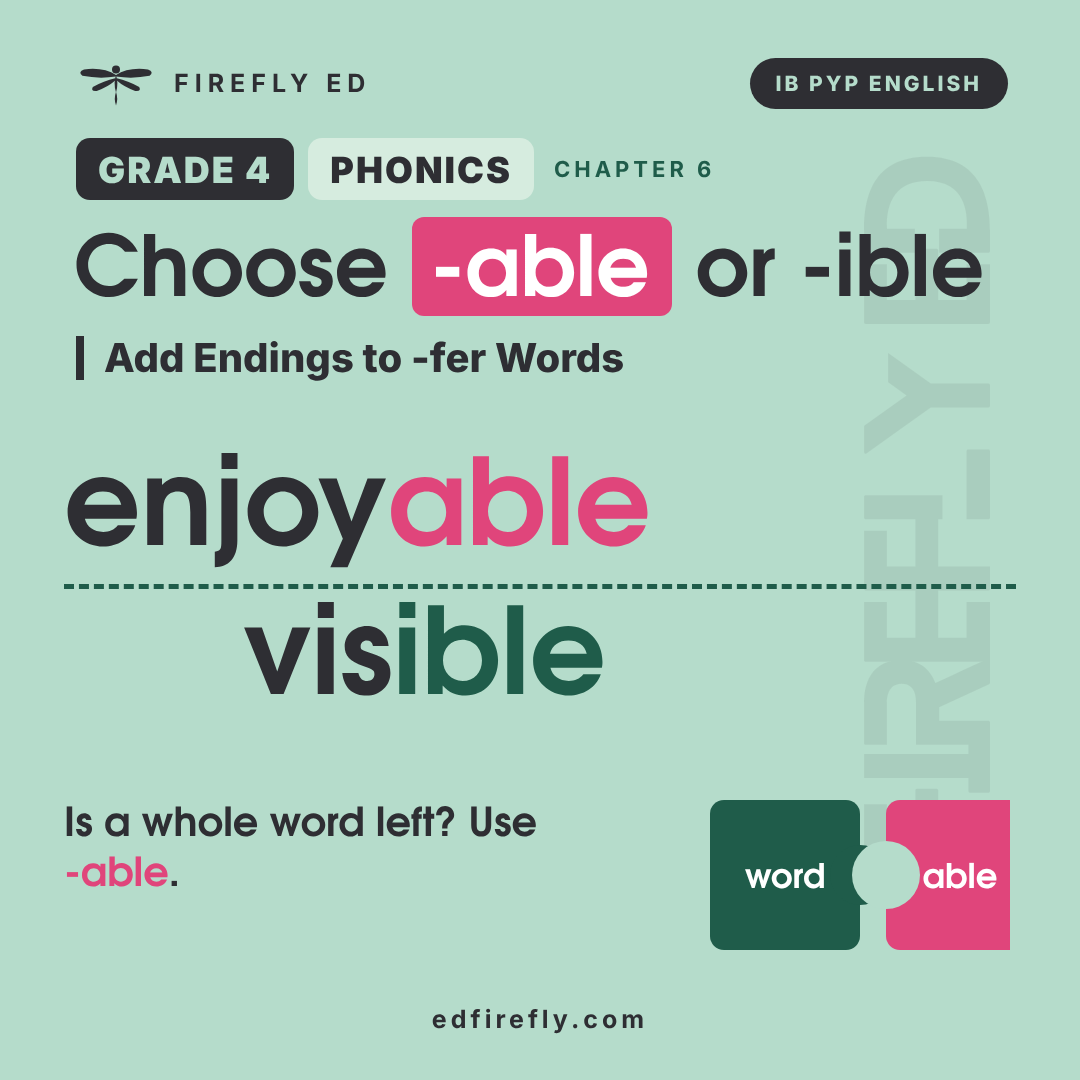
The ending -ible sounds the same as -able. It also means can be. Use the whole-word test:
In visible, terrible and possible, the part before the ending is not a whole English word (vis, terr, poss), so we use -ible. You met the root vis in Lesson 3.10.
To make the adverb, change the final e to y: terrible → terribly, possible → possibly. Some words break the test, such as sensible, responsible and flexible, so check in a dictionary.
See How It’s Done
Now Try It
1. Use the test: vis____ or wash____? Write the endings. ______________ ______________
terrible ______________ possible ______________ visible ______________ sensible ______________
3. Choose the word.
visible terribly edible flexible possible
a) Is it ______________ to finish the bulletin in two minutes?
b) Some mushrooms are not ______________, so never pick wild ones to eat.
c) The lighthouse was ______________ from far out at sea.
d) A gymnast needs a ______________ body.
e) The small print was ______________ hard to read.
4. Rule breakers.
These words have a whole word before -ible. Write them: sense → ______________ response → ______________
5. Write from dictation.
Listen as an adult reads a sentence aloud slowly. Write it, and then check each -ible or -ibly word.
a) possible b) edible c) visible d) flexible e) terribly
4. Rule breakers
sensible, responsible
5. Write from dictation
Dictation sentence: It was terribly windy, but the lighthouse was still visible, so the boats were possibly safe.
Reflect
2. Any real moment from the lesson that shows the learner was an inquirer. Examples: “I was an inquirer today when I used the whole-word test to choose -able or -ible.” “I was an inquirer today when I found words that break the rule.”
Lesson 6.11: Suffixes on -fer Words, and Tricky Words | Phonics | About 20 minutes
Term 2 | Level 2
Goal
“I can add suffixes to words ending in -fer, deciding whether to double the r, and spell six tricky words using memory aids.”
Words to know
suffix, stress, syllable, double, tricky word, memory aid
Wonder
Think about this question before you start. Say your ideas. You will come back to it at the end of the lesson.
Why does referring have two r letters, but reference has only one?
Let’s Learn
Part 1: -fer words
When you add a suffix that starts with a vowel (-ing, -ed, -ence, -ee, -able) to a word ending in -fer, say the new word aloud. If the stress is still on fer, double the r. If the stress moves to an earlier part of the word, keep one r.
Part 2: Tricky words
These six words are often spelled wrongly. The tricky letters are in pink. Use the memory aid, then look, say, cover, write and check.
See How It’s Done
Now Try It
1. Add -ed: prefer → ______________
Hint: Say it. Where is the stress?
2. Which word hides inside interrupt, meaning break? ______________
Time To Practise
Name: ______________________
1. One r or two?
Add the suffix. Say the word first.
refer + ing ______________ refer + ence ______________ prefer + ed ______________ prefer + ence ______________
transfer + ing ______________ refer + ee ______________ prefer + able ______________
2. Fix the spelling.
a) The reporter wanted to comunicate the news frequentley. ______________ ______________
b) Please do not interupt my explaination. ______________ ______________
c) I could not recognize the catagory of the advert. (British spelling) ______________ ______________
3. Look, say, cover, write, check.
Word
Write it from memory
Tick
communicate
explanation
frequently
interrupt
recognise
category
4. Use the words.
Write one sentence about the news or an advert that uses two of the tricky words.
Think about these questions. Talk about them with someone at home or at school.
1. Go back to the Wonder question: “Why does referring have two r letters, but reference has only one?” What do you think now?
2. I was reflective today when I ______________________________.
Being reflective means looking back at your work and thinking how to make it better. For example: I was reflective today when I looked back at my spelling and fixed the tricky letters.
Take action: Make a set of word cards for the six tricky words. Test a family member, then let them test you.
Next Steps
If this was easy, try: Write a short news report about a football match using all six tricky words and one -fer word.
If this was hard, go back to: Part 2 of Let’s Learn. Spell one tricky word at a time, saying the tricky letters aloud.
Notes for Parents and Teachers
Show notes for parents and teachers
These notes cover this lesson only. How every lesson runs is explained in How to Use This Material.
Let’s Learn
Say each word together.
Time To Practise
Task 5: Read the two sentences in the Answer Key slowly. The learner writes them and checks the tricky words.
a) communicate, frequently b) interrupt, explanation c) recognise, category
4. Sample answer: News presenters frequently interrupt a programme for important news.
5. Write from dictation
Dictation sentences: The reporter preferred to communicate clearly. She frequently gave an explanation, and nobody tried to interrupt her.
Reflect
2. Any real moment from the lesson that shows the learner was reflective. Examples: “I was reflective today when I looked back at my spelling and fixed the tricky letters.” “I was reflective today when I chose a memory aid that works for me.”
IB theme: How we express ourselves. This theme is about the ways we discover and express ideas, feelings and beliefs, and how we reflect on and enjoy what others create.
Central idea: People use words, pictures and sound to inform, persuade and entertain, and we can learn to judge what we read and see.
Each lesson also matches the national curriculum for England (Year 4) and the US Common Core (Grade 4). The Grade 4 Curriculum Map lists the full standards for every lesson.



Share your thoughts or ask something..