
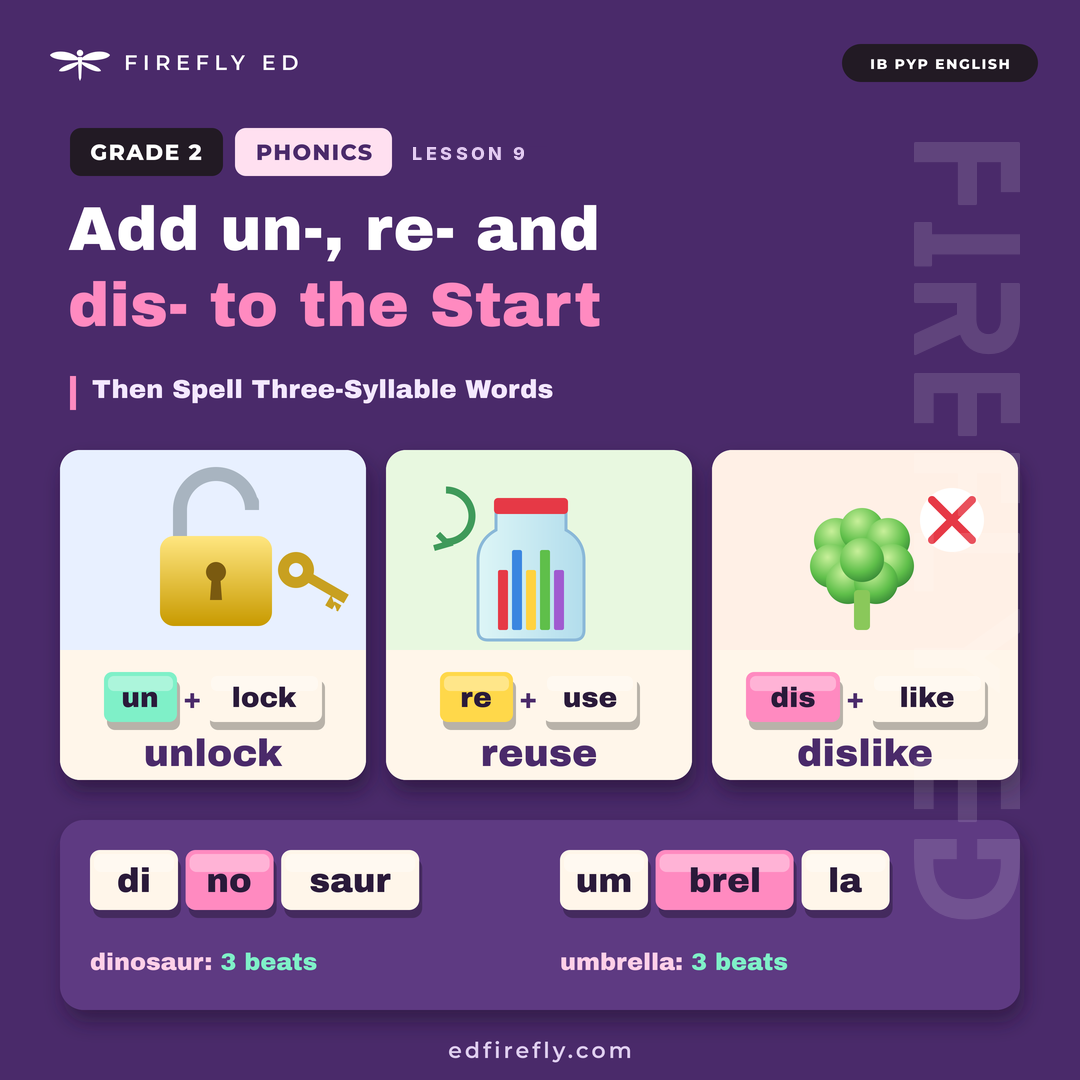
Term 3 | Level 3 | Phonics focus: prefixes un-, re- and dis-, three-syllable words, and a review of the year’s tricky words
Lesson 9 – Caring for Our Planet | Lessons – Index
Lessons
This page has the three phonics lessons of Lesson 9, Caring for Our Planet: Lessons 9.9, 9.10 and 9.11. The Lesson 9 page has the Lesson 9 overview, the Lesson 9 review and the PDF download.
Select a lesson to go straight to it. Each lesson ends with a link back to the top of the page.
- Lesson 9.9: Prefixes un-, re- and dis-
- Lesson 9.10: Three-Syllable Words
- Lesson 9.11: Tricky Words: Year Review
Lesson 9.9: Prefixes un-, re- and dis-
Phonics | About 20 minutes
Term 3 | Level 3
Goal
“I can add the prefixes un-, re- and dis- to words, explain how each prefix changes the meaning, and choose the right prefix.”
Words to know
prefix, un-, re-, dis-, root word, opposite
Wonder
Think about this question before you start. Say your ideas. You will come back to it at the end of the lesson.
How can a few letters at the start of a word change its meaning?
Let’s Learn
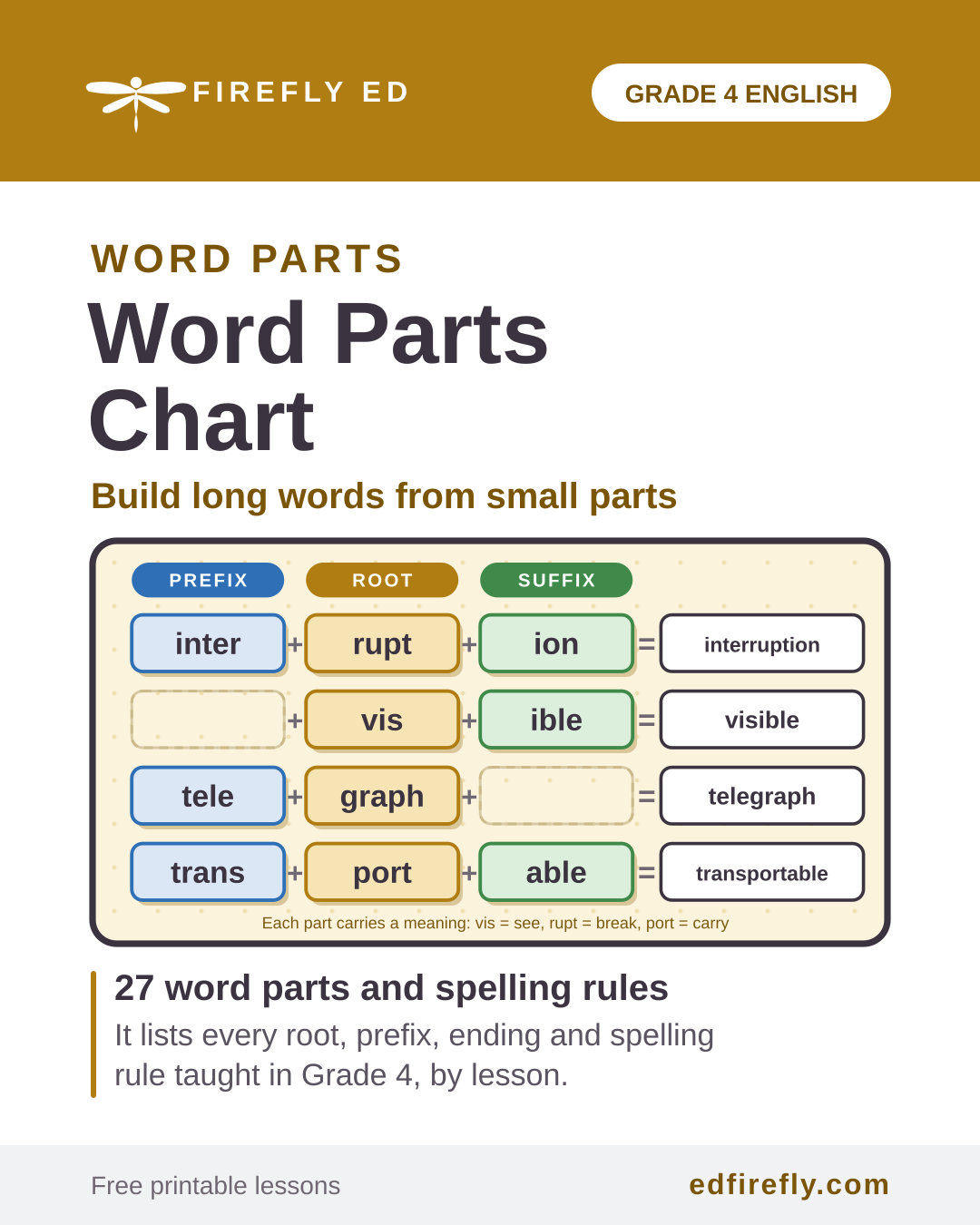
A prefix is a group of letters added to the start of a word. It changes the meaning of the word. The spelling of the root word does not change.
| Prefix | Meaning | Examples |
|---|---|---|
| un- | not, or the opposite | unhappy, unkind, unlock, untidy, unwrap |
| re- | again, or back | reuse, recycle, refill, rebuild, return |
| dis- | not, or the opposite | dislike, disagree, disappear, disobey, dishonest |
Watch out: if the root word starts with the same letter as the end of the prefix, keep both letters: un + necessary = unnecessary, dis + satisfied = dissatisfied.
See How It’s Done
Now Try It
1. What does rewrite mean?
Hint: What does re- mean?
2. Make the opposite of tidy.
Hint: Try un- and dis-. Which sounds right?
Time To Practise
Name: ______________________
1. Add the prefix.
a) un + lock = ______________ b) re + build = ______________ c) dis + appear = ______________
d) re + cycle = ______________ e) un + fair = ______________ f) dis + obey = ______________
2. un- or dis-?
Make the opposite. Write the new word.
a) kind → ______________ b) honest → ______________ c) wrap → ______________
d) agree → ______________ e) safe → ______________ f) like → ______________
3. What does it mean?
a) If you reuse a jar, you ______________________________
b) If a beach is untidy, it is ______________________________
c) If the litter disappears, it ______________________________
4. Complete the sentences.
Choose from: refill unplug disagree recycle unwrap
a) Please ______________ the charger when your tablet is full.
b) We ______________ our water bottles instead of buying new ones.
c) I ______________ with you, but I will listen to your reasons.
d) Rinse the tins before you ______________ them.
e) Can you ______________ your present carefully, so we can reuse the paper?
5. Listen and write the sentences.
Listen as an adult says each sentence twice. Then write it.
__________________________________________________________________
__________________________________________________________________
Reflect
Think about these questions. Talk about them with someone at home or at school.
1. Go back to the Wonder question: “How can a few letters at the start of a word change its meaning?” What do you think now?
2. I was a thinker today when I ______________________________.
A thinker thinks carefully to work things out. For example: I was a thinker today when I tried un- and dis- to see which one sounded right.
Take action: Look at labels on packaging at home. Can you find words with re-, such as recycle or reusable?
Next Steps
If this was easy, try: Find five more words with each prefix in a dictionary. Write a sentence for your favourite word from each list.
If this was hard, go back to: Task 1. Read each word sum aloud before you write it. Then cover the prefix and read the root word.
Notes for Parents and Teachers
Show notes for parents and teachers
These notes cover this lesson only. How every lesson runs is explained in How to Use This Material.
Let’s Learn
Cover the prefix on each word with your finger and read the root word first.
See How It’s Done
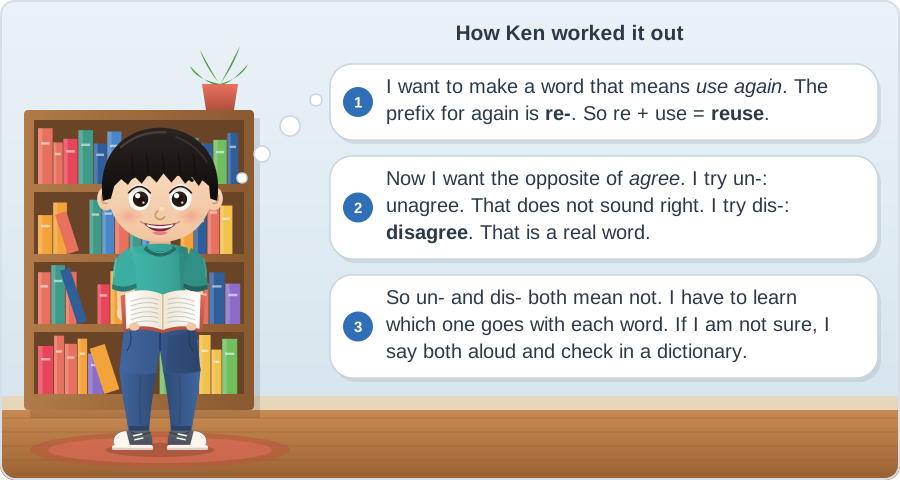
Write each word sum on paper as you go through Ken’s thoughts.
Time To Practise
- Task 5: Read each sentence from the Answer Key aloud twice.
Answer Key
Reveal Answers
Now Try It
1. To write again.
2. untidy
1. Add the prefix
a) unlock b) rebuild c) disappear d) recycle e) unfair f) disobey
2. un- or dis-
a) unkind b) dishonest c) unwrap d) disagree e) unsafe f) dislike
3. Meanings
Sample answers:
a) …use it again.
b) …not tidy, messy.
c) …goes away, so you cannot see it any more.
4. Sentences
a) unplug b) refill c) disagree d) recycle e) unwrap
5. Dictation
Do not throw it away. Reuse it, refill it or recycle it. It is unkind to the planet to waste things.
Look for: re- in reuse, refill and recycle, un- in unkind, and the root words spelt without changes.
Reflect
2. Any real moment from the lesson that shows the learner was a thinker. Examples: “I was a thinker today when I tried un- and dis- to see which one sounded right.” “I was a thinker today when I checked a word in a dictionary when I was not sure.”
Lesson 9.10: Three-Syllable Words
Phonics | About 20 minutes
Term 3 | Level 3
Goal
“I can clap and count syllables, split three-syllable words into parts, and spell long words one syllable at a time.”
Words to know
syllable, clap, beat, vowel, split, spelling voice
Wonder
Think about this question before you start. Say your ideas. You will come back to it at the end of the lesson.
How can you spell a really long word?
Let’s Learn
A syllable is a beat in a word. Every syllable has a vowel sound. Clap or tap as you say a word to count its syllables.
| Word | Syllables | Number |
|---|---|---|
| planet | plan | et | 2 |
| recycle | re | cy | cle | 3 |
| important | im | por | tant | 3 |
| dinosaur | di | no | saur | 3 |
To spell a long word: say it slowly, clap the syllables, then spell one syllable at a time. Check each syllable has a vowel.
Some syllables are said very quickly and softly, so they are hard to hear. In important, the last syllable sounds like tunt, but it is spelt tant. Say it in a “spelling voice” to help: im-por-TANT.
See How It’s Done
Now Try It
1. Clap elephant. How many syllables are there?
Hint: Say it slowly and clap each beat.
2. Split tomato into syllables.
Hint: Draw a line between each beat.
Time To Practise
Name: ______________________
1. Clap and write.
Say each word, clap the syllables and write the word.
Hint: Each word has three syllables. Spell one syllable at a time.
1. ______________ 2. ______________ 3. ______________ 4. ______________
2. Two or three?
Clap each word. Write it in the right column.
Words: garden | computer | rubbish | together | planet | animal | bottle | important
| 2 syllables | 3 syllables |
|---|---|
| __________ | __________ |
| __________ | __________ |
| __________ | __________ |
| __________ | __________ |
3. Build the words.
Put the syllables together and write the word.
a) re + cy + cle = ______________ b) fan + tas + tic = ______________
c) Sat + ur + day = ______________
d) bas + ket + ball = ______________ e) ad + ven + ture = ______________
4. Split the words.
Draw lines to split each word into syllables.
a) wonderful b) yesterday c) kangaroo d) understand
5. Listen and write the sentence.
Listen as an adult says the sentence twice. Then write it.
__________________________________________________________________
__________________________________________________________________
Reflect
Think about these questions. Talk about them with someone at home or at school.
1. Go back to the Wonder question: “How can you spell a really long word?” What do you think now?
2. I was knowledgeable today when I ______________________________.
Being knowledgeable means knowing things and using what you know. For example: I was knowledgeable today when I clapped each word before I spelt it.
Take action: Play a syllable game in the car or at dinner: name an animal with one, two, then three syllables. Who can find a four-syllable animal?
Next Steps
If this was easy, try: Find ten three-syllable words in a book about animals or the planet. Split each one and write a sentence with three of them.
If this was hard, go back to: Task 2. Clap each word with an adult three times before you choose a column.
Notes for Parents and Teachers
Show notes for parents and teachers
These notes cover this lesson only. How every lesson runs is explained in How to Use This Material.
Let’s Learn
Clap the syllables of everyone’s names at home together.
See How It’s Done
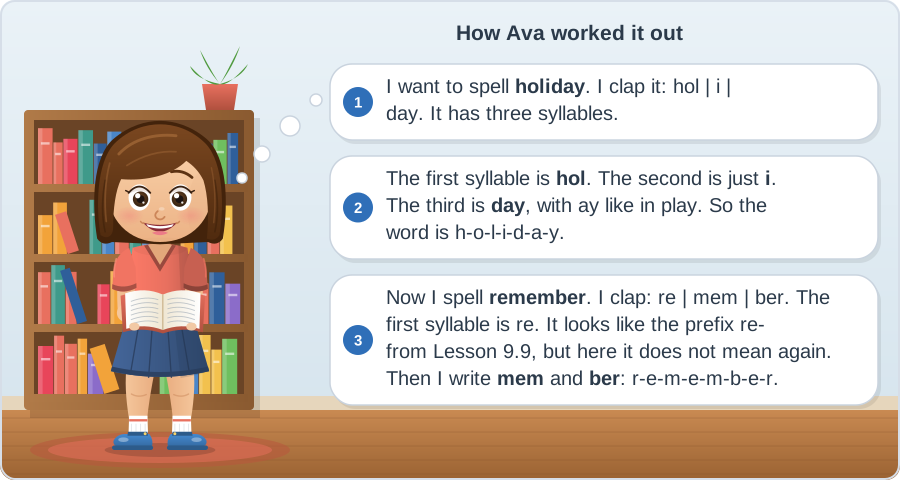
, clapping each syllable as you go through Ava’s thoughts.
Time To Practise
- Task 1: Point to each picture and name it first: di…, el…, um…, ba… (the full words are in the Answer Key).
- Task 5: Read the sentence from the Answer Key aloud twice.
Answer Key
Reveal Answers
Now Try It
1. Three: el | e | phant
2. to | ma | to
1. Pictures
1. dinosaur 2. elephant 3. umbrella 4. banana
2. Two or three
2 syllables: garden, rubbish, planet, bottle
3 syllables: computer, together, animal, important
3. Build
a) recycle b) fantastic c) Saturday d) basketball e) adventure
4. Split
a) won | der | ful b) yes | ter | day c) kan | ga | roo d) un | der | stand
Look for: three parts in each word, each with a vowel sound. Accept small differences in where the line goes, such as wond | er | ful.
5. Dictation
It is important to recycle rubbish, because together we can protect animals and the planet.
Look for: important, recycle, together, animals and protect spelt syllable by syllable.
Reflect
2. Any real moment from the lesson that shows the learner was knowledgeable. Examples: “I was knowledgeable today when I clapped each word before I spelt it.” “I was knowledgeable today when I split long words into syllables.”
Lesson 9.11: Tricky Words: Year Review
Phonics | About 20 minutes
Term 3 | Level 3
Goal
“I can spell Mr, Mrs, parents and Christmas, group the year’s tricky words into families, and find and fix spelling mistakes.”
Words to know
tricky word, word family, capital letter, proofread, review
Wonder
Think about this question before you start. Say your ideas. You will come back to it at the end of the lesson.
Which tricky words do you know best now, at the end of the year?
Let’s Learn
This lesson has four new tricky words, and a review of the tricky words from the whole year.
| New word | The tricky part |
|---|---|
| Mr | a short way to write Mister. It always has a capital M. In British English there is no full stop after it. |
| Mrs | a short way to write Missis, a title for a married woman. Capital M, no full stop. |
| parents | the a says air, as in hair: p-a-rents |
| Christmas | a festival, so it has a capital letter. It starts with Ch that says k, and the t is silent. |
The year’s tricky words
| Lesson | Words |
|---|---|
| 1 | door, floor, poor, find, kind, behind |
| 2 | child, children, wild, climb, most, only, both |
| 3 | old, cold, gold, hold, told, every, everybody, even |
| 4 | great, break, steak, pretty, beautiful, after |
| 5 | fast, last, past, father, class, grass, pass, plant, path, bath |
| 6 | hour, move, prove, improve, sure, sugar, eye |
| 7 | could, should, would, who, whole |
| 8 | any, many, clothes, busy, people, water, again, half, money |
Many tricky words come in families that share a pattern, such as find, kind, behind or could, should, would. Learning a family together makes them easier to remember.
See How It’s Done
Now Try It
1. Write Mister Patel the short way.
Hint: Capital M, and no full stop.
2. Name two other words in the same family as could.
Hint: Look at Lesson 7 in the table.
Time To Practise
Name: ______________________
1. The new words.
Look, say, cover, write, check.
Mr ______________ Mrs ______________ parents ______________ Christmas ______________
Use each one in a sentence.
__________________________________________________________________
__________________________________________________________________
2. Word families.
Finish each family with words from the table in Let’s Learn.
a) find, ______________, ______________ b) door, ______________, ______________
c) old, ______________, ______________, ______________ d) move, ______________, ______________
e) any, ______________ f) child, ______________
3. Find and fix the mistakes.
There are eight spelling mistakes in this report. Underline each one and write it correctly.
Our class has a beach clean every summer. Last year, mrs Lee and lots of parunts came to help. Evrybody wore old cloths and brought a bag. We picked up meny bottles and cans. It took an our, but it was grate fun. Mr Hill told us that the sea looks beutiful when it is clean.
1. ______________ 2. ______________ 3. ______________ 4. ______________
5. ______________ 6. ______________ 7. ______________ 8. ______________
4. My tricky words.
Ask an adult to test you on ten tricky words from the table, two from each of five different lessons. Write them here. Circle any you got wrong, and practise those again.
______________ ______________ ______________ ______________ ______________
______________ ______________ ______________ ______________ ______________
5. Listen and write the sentences.
Listen as an adult says each sentence twice. Then write it.
__________________________________________________________________
__________________________________________________________________
Reflect
Think about these questions. Talk about them with someone at home or at school.
1. Go back to the Wonder question: “Which tricky words do you know best now, at the end of the year?” What do you think now?
2. I was reflective today when I ______________________________.
Being reflective means looking back at your work and thinking how to make it better. For example: I was reflective today when I found the tricky words I still find hard.
Take action: Make a tricky word wall at home: write the words you still find hard on cards, and read them every morning for a week.
Next Steps
If this was easy, try: Write a short story that uses at least fifteen tricky words from the year. Underline them, and ask someone to check them.
If this was hard, go back to: Task 2. Do a), c) and d) first, with the table in Let’s Learn next to you. Then try the others.
Notes for Parents and Teachers
Show notes for parents and teachers
These notes cover this lesson only. How every lesson runs is explained in How to Use This Material.
Let’s Learn
Read the table of the year’s tricky words together, one lesson at a time.
See How It’s Done
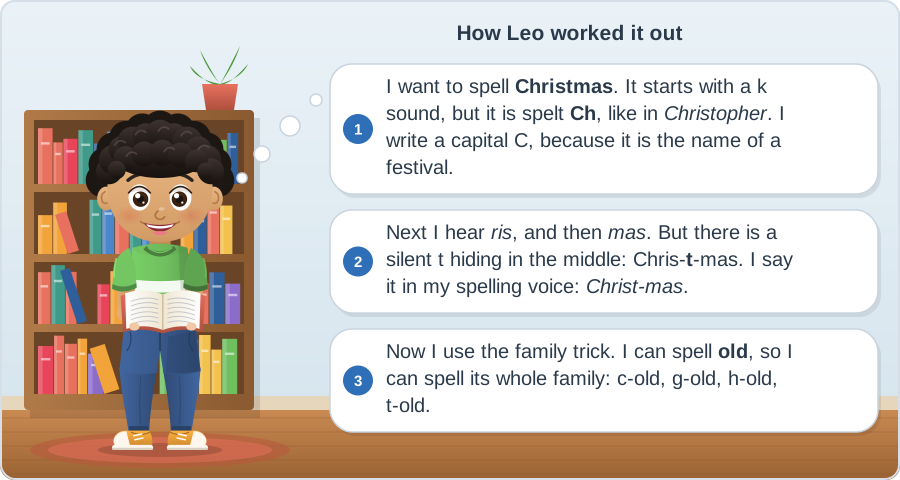
Write Christmas and the old family on paper as you go through Leo’s thoughts.
Time To Practise
- Task 5: Read each sentence from the Answer Key aloud twice.
Answer Key
Reveal Answers
Now Try It
1. Mr Patel
2. should, would
1. New words
Sample sentences: Mr Hill is our neighbour. Mrs Green teaches my class. My parents read to me at bedtime. We visit my cousins at Christmas.
Look for: capital letters for Mr, Mrs and Christmas.
2. Families
a) kind, behind b) floor, poor c) cold, gold, hold (or told) d) prove, improve e) many f) children (or wild)
3. Mistakes
1. Mrs 2. parents 3. Everybody 4. clothes 5. many 6. hour 7. great 8. beautiful
5. Dictation
Mr and Mrs Shah and my parents could see the whole beach. Everybody was busy, but we were sure it was worth it.
Look for: capital M in Mr and Mrs with no full stop, and the tricky words parents, could, whole, everybody, busy and sure.
Reflect
2. Any real moment from the lesson that shows the learner was reflective. Examples: “I was reflective today when I found the tricky words I still find hard.” “I was reflective today when I practised them again until I got them right.”
For Teachers: IB Details
Show IB and curriculum details
IB theme: Sharing the planet. This theme is about our rights and responsibilities, how we share the Earth’s resources with other people and living things, and how we can look after them.
Central idea: People’s actions affect the planet, and we can make choices that help to protect it.
| Lesson | Title | Strand | Key concept |
|---|---|---|---|
| 9.9 | Prefixes un-, re- and dis- | Reading and spelling | Connection |
| 9.10 | Three-Syllable Words | Reading and spelling | Connection |
| 9.11 | Tricky Words: Year Review | Reading and spelling | Connection |
Each lesson also matches the national curriculum for England (Year 2) and the US Common Core (Grade 2). The Grade 2 Curriculum Map lists the full standards for every lesson.
← Back to Lesson 9 – Caring for Our Planet | Lessons – Index
© 2026 Firefly Ed. All rights reserved. This page may be printed for personal, home and classroom use. It may not be sold, shared online or reproduced for commercial use without written permission. edfirefly.com


Share your thoughts or ask something..