
Term 2 | Level 2 | Phonics focus: s as in treasure, suffixes -ment, -ness, -ful, -less and -ly
Lesson 6 – Toys and Games Then and Now | Lessons – Index
Lessons
This page has the two reading lessons of Lesson 6, Toys and Games Then and Now: Lessons 6.1 and 6.2. The Lesson 6 page has the Lesson 6 overview, the Lesson 6 review and the PDF download.
Select a lesson to go straight to it. Each lesson ends with a link back to the top of the page.
Lesson 6.1: Toys Long Ago
Reading | About 20 minutes
Term 2 | Level 2
Goal
“I can read a history text, find how toys have changed and stayed the same, and explain why things changed.”
Words to know
history, past, then, now, change, material
Wonder
Think about this question before you start. Say your ideas. You will come back to it at the end of the lesson.
What toys did children play with before there were screens?
Let’s Learn
A history text gives facts about the past. To understand it, look for clues about when things happened and how they have changed.
- Time words tell you when: 100 years ago, long ago, in the past, today, now.
- Change words tell you what is different: but, however, instead, not common until.
- Some things stay the same. Look for words like still and always.
When you compare then and now, think about why things changed, such as new materials or new inventions.
See How It’s Done
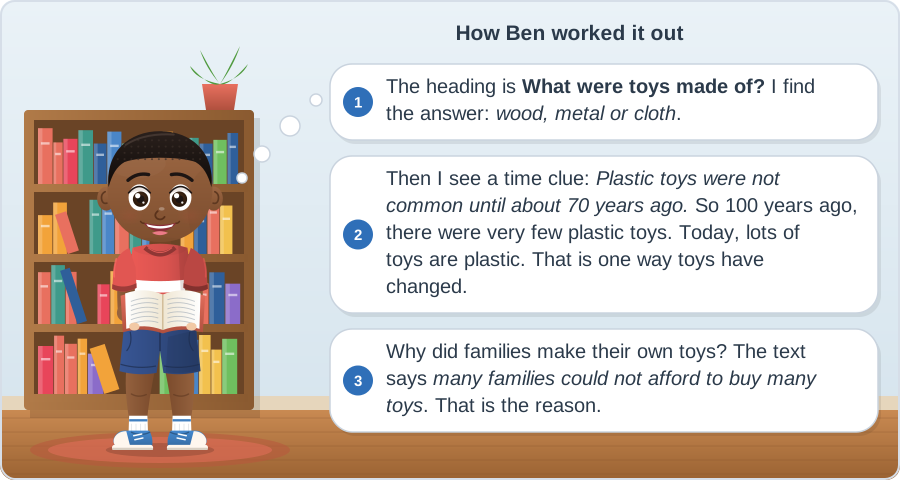
Read the second paragraph of the text in Time To Practise.
Now Try It
Use the text in Time To Practise.
1. Name three toys children played with 100 years ago.
Hint: Look at the first paragraph.
2. Why were streets safer for games 100 years ago?
Hint: Look under the heading Where did children play?
Time To Practise
Name: ______________________
1. Read the history text.
Toys 100 Years Ago
What did children play with?
About 100 years ago, children played with spinning tops, marbles, skipping ropes, kites and dolls. One popular game was to roll a big wooden hoop along the street and keep it going by tapping it with a stick. Some children had wind-up toys made of tin, such as a little car or a bird that hopped when you turned a key. Wooden trains and building blocks were popular too.
What were toys made of?
Most toys were made of wood, metal or cloth. Plastic toys were not common until about 70 years ago. Many families could not afford to buy many toys, so children often made their own. They sewed rag dolls from old clothes, carved boats from wood and turned a stick into a pretend horse.
Where did children play?
Children spent much of their free time playing outside, in the street, the park or the fields. There was much less traffic, so streets were safer for games such as hopscotch and tag. Homes did not have televisions, so in the evening families often played board games or card games together.
How have toys changed?
Today, many toys need batteries or electricity. Children can play games on computers, game consoles and tablets, and some toys can even talk. But some things have stayed the same. Plastic building bricks are a lot like the wooden blocks of long ago. Children today still fly kites, spin tops and play tag. People have always loved to play.
2. Then and now.
Fill in the table. Use facts from the text and what you know.
| 100 years ago | Today | |
|---|---|---|
| What toys were made of | ______________ | ______________ |
| Where children played | ______________ | ______________ |
| Games in the evening | ______________ | ______________ |
3. Think about it.
a) Write two things that have stayed the same.
__________________________________________________________________
b) Why do you think there were no tablet or computer games 100 years ago?
Hint: What do these games need to work?
__________________________________________________________________
c) Children long ago made their own toys. What does this tell you about them?
__________________________________________________________________
4. Your opinion.
Would you have liked to be a child 100 years ago? Write two sentences. Give a reason with because.
__________________________________________________________________
__________________________________________________________________
Reflect
Think about these questions. Talk about them with someone at home or at school.
1. Go back to the Wonder question: “What toys did children play with before there were screens?” What do you think now?
2. I was an inquirer today when I ______________________________.
An inquirer asks questions and finds things out. For example: I was an inquirer today when I asked an older person what toys they played with as a child.
Take action: Play a game from 100 years ago this week, such as hopscotch, marbles or a spinning top. How was it different from your usual games?
Next Steps
If this was easy, try: Find a picture of a toy from long ago in a book or museum website. Write three facts about it.
If this was hard, go back to: Task 2. Read one heading and its paragraph at a time with an adult. Fill in one row after each part.
Notes for Parents and Teachers
Show notes for parents and teachers
These notes cover this lesson only. How every lesson runs is explained in How to Use This Material.
Let’s Learn
Find the time words in the list together.
See How It’s Done
Read the second paragraph of the text aloud before Ben’s thoughts.
Answer Key
Reveal Answers
Now Try It
1. Any three of: spinning tops, marbles, skipping ropes, kites, dolls, hoops, wind-up tin toys.
2. There was much less traffic.
2. Then and now
Made of: wood, metal or cloth / often plastic, many need batteries or electricity
Where: outside, in the street, park or fields / inside more, on computers and tablets (accept outside too)
Evenings: board games or card games / television, computers, game consoles (accept board games)
3. Think about it
a) Children still fly kites, spin tops and play tag. People have always loved to play.
b) Sample answer: Those games need electricity and computers, and they had not been invented yet.
c) Sample answer: They were clever and creative, and good at using things they already had.
Look for: in b) and c), the answer is not written in the text. The learner uses what they know with clues from the text.
4. Opinion
Sample answer: I would have liked it because I could play outside all day. But I would miss my tablet games.
Reflect
2. Any real moment from the lesson that shows the learner was an inquirer. Examples: “I was an inquirer today when I asked an older person what toys they played with as a child.” “I was an inquirer today when I found clues in the text about how toys have changed.”
Lesson 6.2: Gran’s Spinning Top
Reading | About 20 minutes
Term 2 | Level 2
Goal
“I can track how a character’s feelings change through a story, using clues from what they say and do.”
Words to know
character, feelings, clue, change, frustrated, proud
Wonder
Think about this question before you start. Say your ideas. You will come back to it at the end of the lesson.
Can an old toy be as much fun as a new one?
Let’s Learn
In many stories, a character’s feelings change because of what happens to them.
To track a character’s feelings:
- Look at the beginning, the middle and the end.
- Find clues: what the character says, what they do and how they move. A sigh, folded arms or a cheer all tell you something.
- Ask: what made the feeling change?
Use exact feeling words: not just happy and sad, but bored, curious, frustrated, determined, proud, amazed.
See How It’s Done
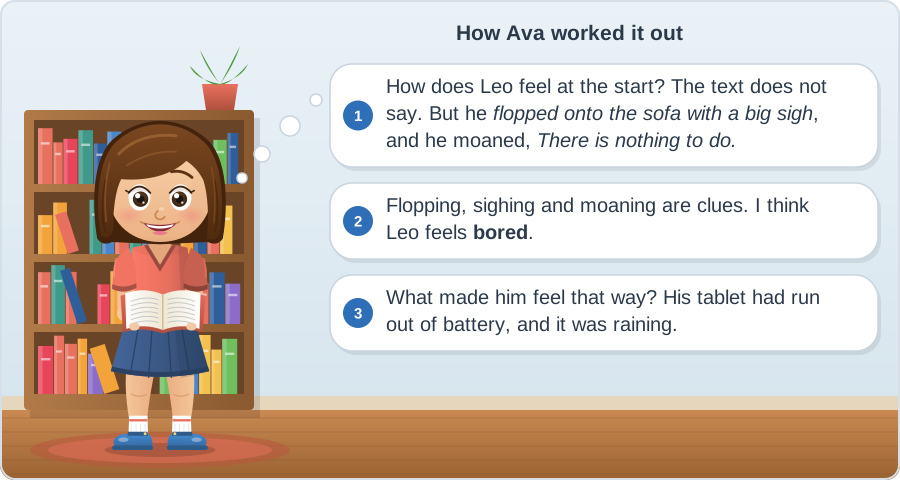
Read the first paragraph of the story in Time To Practise.
Now Try It
Use the story in Time To Practise.
1. Who made the spinning top for Gran?
Hint: Read what Gran says when she shows Leo the top.
2. “Leo’s mouth fell open.” How was he feeling at that moment?
Hint: What had he just seen Gran do?
Time To Practise
Name: ______________________
1. Read the story.
Gran’s Spinning Top
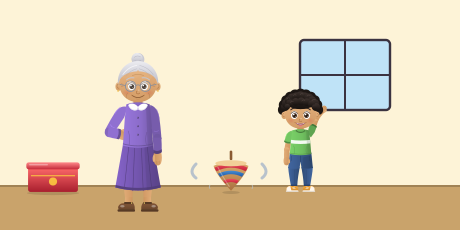
It was a rainy Sunday at Gran’s house, and Leo’s tablet had run out of battery. He flopped onto the sofa with a big sigh. “There is nothing to do,” he moaned.
Gran smiled and went to the cupboard. She came back with an old red tin box. Inside, wrapped in a soft cloth, was a wooden spinning top with a long piece of string.
“This was my favourite toy when I was your age,” said Gran. “My father carved it for me.”
Leo looked at it. “It is just a piece of wood,” he said. He tried to spin it with his fingers, but it wobbled and fell over straight away.
“Watch,” said Gran. She wound the string tightly round the top, held the end, and flicked her wrist. The top shot onto the floor and spun so fast that its stripes blurred into one colour. It hummed as it whirled across the room.
Leo’s mouth fell open. “Let me try!”
His first try landed upside down. His second try rolled under the table. Leo growled and folded his arms. “It is too hard!”
“It took me a whole summer to learn,” said Gran gently. “Try winding the string a bit tighter.”
Leo took a deep breath and tried again, and again. On the tenth try, the top landed on its point and spun, humming, across the floor. Leo leapt up and cheered.
When the rain stopped, he did not even notice. “Gran,” he said, “do you have any other old toys in that cupboard?”
2. Track Leo’s feelings.
| Part of the story | Leo feels… | Clue from the story |
|---|---|---|
| Beginning: on the sofa | ______________ | ______________________ |
| Middle: after two tries | ______________ | ______________________ |
| End: on the tenth try | ______________ | ______________________ |
Hint: Choose from: bored, amazed, frustrated, proud, curious.
3. Think about it.
a) At first, Leo said the top was “just a piece of wood”. Why did he change his mind?
__________________________________________________________________
b) Why do you think Gran kept the top for so many years?
__________________________________________________________________
c) “When the rain stopped, he did not even notice.” What does this tell you?
__________________________________________________________________
d) What do you think Gran wanted Leo to learn? Write it as one sentence.
__________________________________________________________________
Reflect
Think about these questions. Talk about them with someone at home or at school.
1. Go back to the Wonder question: “Can an old toy be as much fun as a new one?” What do you think now?
2. I was reflective today when I ______________________________.
Being reflective means looking back at your work and thinking how to make it better. For example: I was reflective today when I thought about why Leo felt bored and then excited.
Take action: Ask an older family member about a toy they loved as a child. Why was it special to them?
Next Steps
If this was easy, try: Write the next part of the story: Gran shows Leo another old toy. Show how Leo feels with clues, not feeling words.
If this was hard, go back to: Task 2. Read the story in three parts with an adult. After each part, act out how Leo feels before you write.
Notes for Parents and Teachers
Show notes for parents and teachers
These notes cover this lesson only. How every lesson runs is explained in How to Use This Material.
Let’s Learn
Act out bored, frustrated and proud together, using only your face and body.
See How It’s Done
Read the first paragraph of the story aloud before Ava’s thoughts.
Answer Key
Reveal Answers
Now Try It
1. Gran’s father
2. Amazed or surprised. He had just seen the top spin so fast that its stripes blurred.
2. Leo’s feelings
Beginning: bored. Clue: he flopped onto the sofa with a big sigh, or he moaned “There is nothing to do.”
Middle: frustrated. Clue: he growled and folded his arms, or he said “It is too hard!”
End: proud. Clue: he leapt up and cheered.
Look for: accept other fitting words, such as excited at the end, if the clue matches.
3. Think about it
a) He saw Gran make it spin fast and hum, so he saw it could be fun.
b) Sample answer: Her father made it for her, so it reminds her of him and of being a child.
c) Sample answer: He was having so much fun with the top that he forgot all about the rain and his tablet.
d) Sample answer: If you keep trying, you can learn something hard, and old toys can be fun too.
Reflect
2. Any real moment from the lesson that shows the learner was reflective. Examples: “I was reflective today when I thought about why Leo felt bored and then excited.” “I was reflective today when I remembered a time my own feelings changed during a day.”
For Teachers: IB Details
Show IB and curriculum details
IB theme: Where we are in place and time. This theme is about our place in space and time: personal histories, and how things in our lives have changed and stayed the same over time.
Central idea: Toys and games change over time, but people have always played and learned through play.
Each lesson also matches the national curriculum for England (Year 2) and the US Common Core (Grade 2). The Grade 2 Curriculum Map lists the full standards for every lesson.
← Back to Lesson 6 – Toys and Games Then and Now | Lessons – Index
© 2026 Firefly Ed. All rights reserved. This page may be printed for personal, home and classroom use. It may not be sold, shared online or reproduced for commercial use without written permission. edfirefly.com


Share your thoughts or ask something..