
Term 2 | Level 2 | Phonics focus: s as in treasure, suffixes -ment, -ness, -ful, -less and -ly
Lesson 6 – Toys and Games Then and Now | Lessons – Index
Lessons
This page has the two listening and speaking lessons of Lesson 6, Toys and Games Then and Now: Lessons 6.5 and 6.6. The Lesson 6 page has the Lesson 6 overview, the Lesson 6 review and the PDF download.
Select a lesson to go straight to it. Each lesson ends with a link back to the top of the page.
Lesson 6.5: Teach a Game: Explain the Rules
Oral | About 20 minutes
Term 2 | Level 2
Goal
“I can explain the rules of a game in order, with what you need, an if … then rule and how to win, so that someone else can play it.”
Words to know
rules, aim, steps, if … then, how to win, check
Wonder
Think about this question before you start. Say your ideas. You will come back to it at the end of the lesson.
What makes the rules of a game easy to understand?
Let’s Learn
When you explain the rules of a game, your listener should be able to play it straight away, without asking lots of questions.
| Part | What to say |
|---|---|
| name and aim | The game is called … The aim is to … |
| what you need | You need … |
| how to play, in order | First, … Next, … After that, … If …, then … |
| how to win | The winner is the first person to … |
| check | Do you have any questions? Can you tell me the first step? |
Show as well as tell: point, act out a move or use the real objects.
See How It’s Done
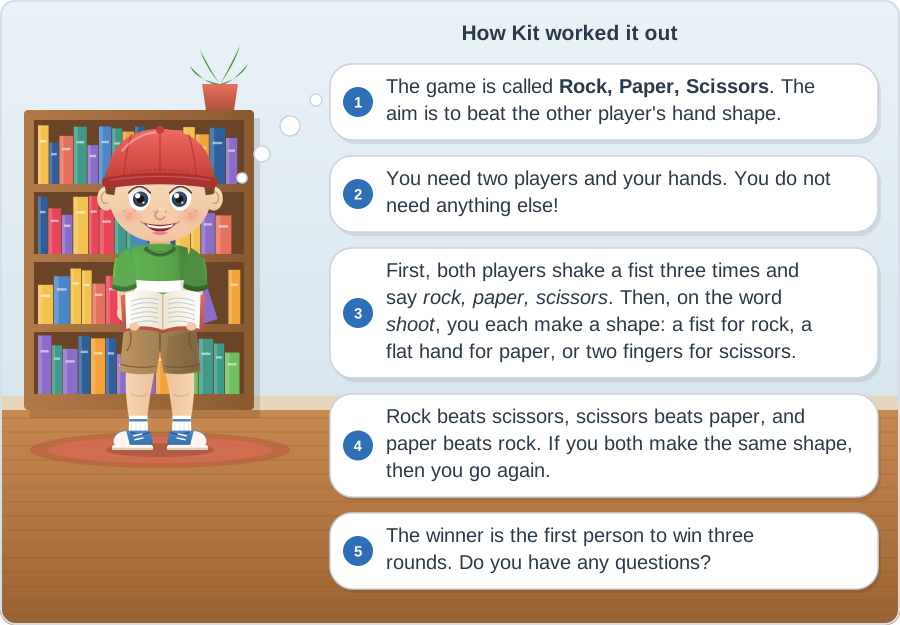
Read how Kit explains the game. Then play Rock, Paper, Scissors with an adult until someone wins three rounds.
Now Try It
1. In Rock, Paper, Scissors, what happens if both players make the same shape?
Hint: Listen for the if … then rule.
2. Why is it a good idea to show a move as well as tell it?
Hint: Think about a listener who has never played.
Time To Practise
Name: ______________________
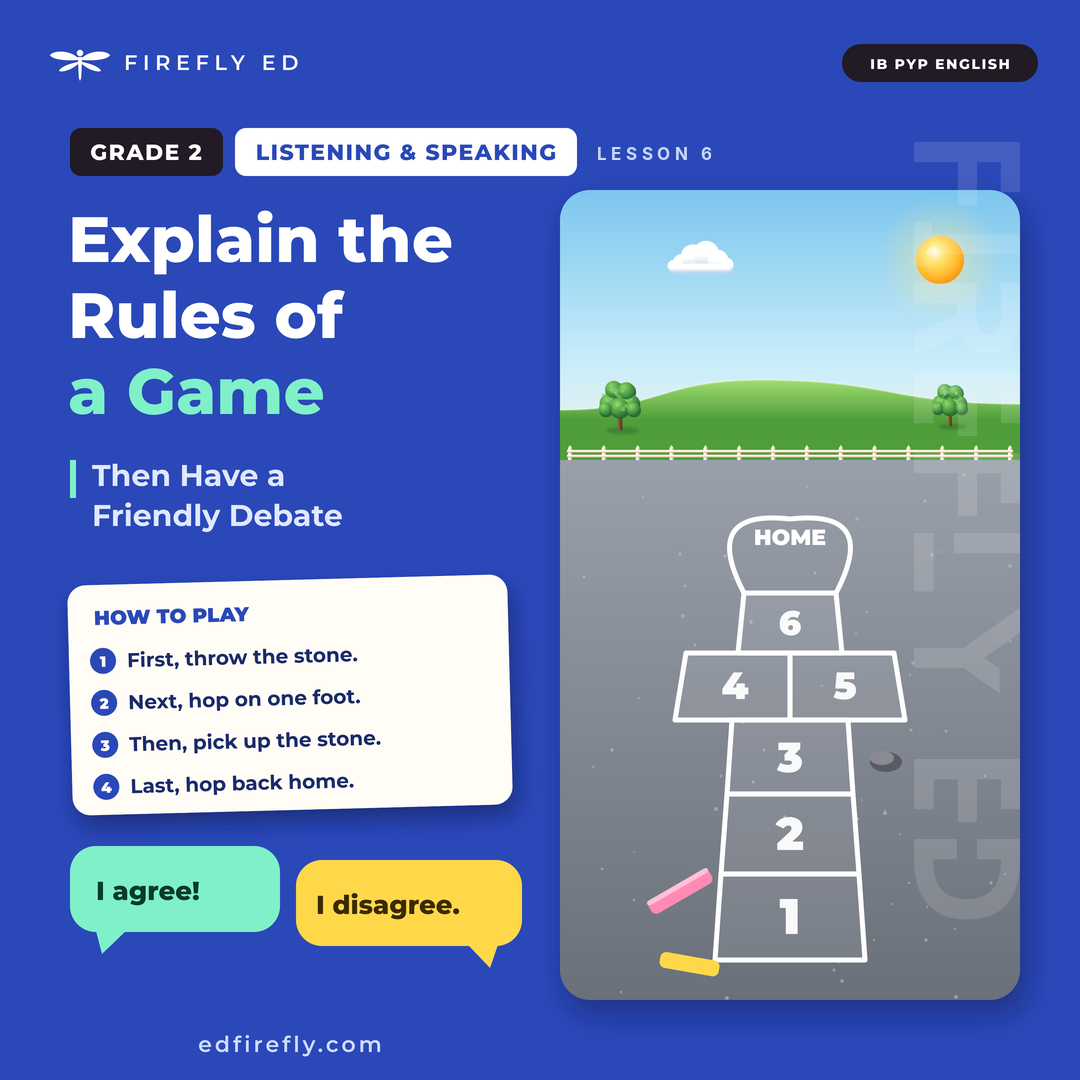
1. Put the hopscotch rules in order.
Number the steps 1 to 5.
____ Hop on one foot in single squares, and land with two feet in squares side by side.
____ Throw a small stone into square 1.
____ Turn round at home and hop back, picking up your stone on the way.
____ Draw a grid of squares numbered 1 to 6 with chalk, and find a small, flat stone.
____ Hop over the square with your stone in it and go all the way to home.
Write the rule for how to win: ______________________________________________
Hint: Each turn, the stone goes into the next square.
2. Plan how to explain a game.
Choose a game you know well: a playground game, a card game or a board game.
| Name and aim | ______________________________ |
| What you need | ______________________________ |
| First | ______________________________ |
| Next | ______________________________ |
| If … then … | ______________________________ |
| How to win | ______________________________ |
3. Teach the game.
Explain the game to someone at home who does not know it. Then play it together.
An adult listens to your whole explanation before asking questions. They tick each one they hear:
☐ name and aim ☐ what you need ☐ steps in order with time words ☐ an if … then rule ☐ how to win ☐ showed a move ☐ checked the listener understood
Could your listener play the game correctly? yes / mostly / not yet
Reflect
Think about these questions. Talk about them with someone at home or at school.
1. Go back to the Wonder question: “What makes the rules of a game easy to understand?” What do you think now?
2. I was a communicator today when I ______________________________.
A communicator shares ideas clearly by talking, writing or drawing. For example: I was a communicator today when I explained the rules in order so my listener could play.
Take action: Teach a game from long ago, such as hopscotch, to a friend or a younger child this week.
Next Steps
If this was easy, try: Invent a new game with your own rules. Explain it to two people and see if they play it the same way.
If this was hard, go back to: Task 2. Plan only the name, what you need, first, and how to win. Practise saying those four parts.
Notes for Parents and Teachers
Show notes for parents and teachers
These notes cover this lesson only. How every lesson runs is explained in How to Use This Material.
Let’s Learn
Think of a game you both know and name its aim together.
See How It’s Done
Read Kit’s explanation aloud and do the actions. Then play until someone wins three rounds.
Time To Practise
- Task 3: Listen to the whole explanation before asking questions. Tick each one you hear.
Answer Key
Reveal Answers
Now Try It
1. You go again.
2. Sample answer: Seeing the move makes it easier to understand than words alone.
1. Hopscotch
3 Hop on one foot in single squares, and land with two feet in squares side by side.
2 Throw a small stone into square 1.
5 Turn round at home and hop back, picking up your stone on the way.
1 Draw a grid of squares numbered 1 to 6 with chalk, and find a small, flat stone.
4 Hop over the square with your stone in it and go all the way to home.
How to win, sample answer: The winner is the first person to throw their stone into every square, from 1 to 6, and hop the grid without falling.
Look for: accept steps 3 and 4 the other way round if the learner can explain.
2 and 3. Teach a game
Look for: five or more ticks, and a listener who can play the game.
Reflect
2. Any real moment from the lesson that shows the learner was a communicator. Examples: “I was a communicator today when I explained the rules in order so my listener could play.” “I was a communicator today when I checked my listener understood by asking a question.”
Lesson 6.6: Old Toys or New Toys? A Friendly Debate
Oral | About 20 minutes
Term 2 | Level 2
Goal
“I can take a side in a friendly debate, give reasons, repeat the other side’s point and reply politely.”
Words to know
debate, side, reason, repeat the point, reply, polite
Wonder
Think about this question before you start. Say your ideas. You will come back to it at the end of the lesson.
Are old toys or new toys better? Can both sides be right?
Let’s Learn
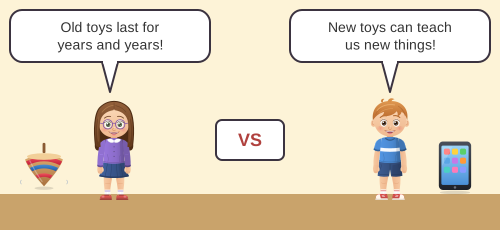
A debate is a discussion where people take sides and give reasons. In a friendly debate, everyone listens and stays polite, even when they disagree.
- Say your side: I think that … My side believes …
- Give reasons: because … For example, …
- Listen to the other side, then repeat their point before you answer: You said that …
- Reply politely: I understand that …, but … That is a good point. However, …
- Sum up at the end: So, overall, …
Repeating the other person’s point shows that you really listened.
See How It’s Done
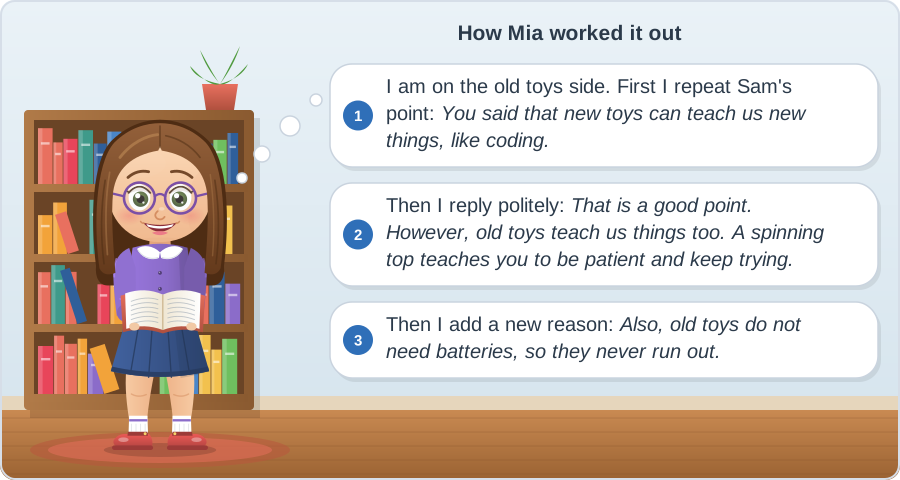
Sam says: “New toys are better, because they can teach us new things, like coding.”
Now Try It
1. Repeat this point before you answer: “Old toys are boring because they only do one thing.”
Hint: Start with You said that …
2. Which reply is polite? a) “That’s silly.” b) “I understand that, but you can play lots of games with one ball.”
Hint: Which one would you like to hear?
Time To Practise
Name: ______________________
1. Sort the reasons.
Write O for the old toys side or N for the new toys side.
a) They do not need batteries or charging. ____
b) You can play with friends who live far away. ____
c) They make you use your imagination. ____
d) They can talk, move and light up. ____
e) They are often made of wood, which can last for many years. ____
f) One tablet holds hundreds of games. ____
2. Plan your side.
My side: old toys / new toys (circle one)
Reason 1: because ______________________________________________
Reason 2: Also, ______________________________________________
A point the other side might make: ______________________________________________
My polite reply: I understand that ______________________, but ______________________
3. Have a friendly debate.
Debate with someone at home. They take the other side. Take turns. Before each reply, repeat the other person’s point.
An adult takes the other side. When it is your turn, they tick each one they hear:
☐ said their side clearly ☐ gave two reasons ☐ waited for their turn ☐ repeated the other point before replying ☐ replied politely with but or however ☐ summed up at the end
4. Think about it.
Did the debate change your mind at all? Which point from the other side was the best?
__________________________________________________________________
Reflect
Think about these questions. Talk about them with someone at home or at school.
1. Go back to the Wonder question: “Are old toys or new toys better? Can both sides be right?” What do you think now?
2. I was open-minded today when I ______________________________.
Being open-minded means listening to other ideas and other ways of doing things. For example: I was open-minded today when I repeated the other side’s point before I replied.
Take action: Next time you disagree with someone, try repeating their point before you give yours. Notice how they respond.
Next Steps
If this was easy, try: Hold a three-person debate with a judge who decides which side gave the best reasons. Swap sides and do it again.
If this was hard, go back to: Task 2. Plan one reason and one polite reply only. Practise the phrase I understand that …, but …
Notes for Parents and Teachers
Show notes for parents and teachers
These notes cover this lesson only. How every lesson runs is explained in How to Use This Material.
Let’s Learn
Look at the picture and talk about what Mia and Sam are saying.
See How It’s Done
Say Sam’s point aloud, then read Mia’s reply.
Time To Practise
- Task 3: Take the other side. Tick each one you hear when it is the learner’s turn.
Answer Key
Reveal Answers
Now Try It
1. You said that old toys are boring because they only do one thing.
2. b)
1. Sort
a) O
b) N
c) O
d) N
e) O
f) N
Look for: accept c) on both sides if the learner explains, as some new games also need imagination.
2 and 3. Debate
Sample answer: My side is old toys. Old toys are better because they never run out of battery. Also, they make you use your imagination. You said that new toys can talk and light up. I understand that, but a toy that does everything leaves nothing for you to imagine. So, overall, I think old toys are better.
Look for: five or more ticks.
4. Think
Answers will vary. Look for: the learner names a point from the other side fairly.
Reflect
2. Any real moment from the lesson that shows the learner was open-minded. Examples: “I was open-minded today when I repeated the other side’s point before I replied.” “I was open-minded today when I told Sam he had a good point, because I agreed with part of what he said.”
For Teachers: IB Details
Show IB and curriculum details
IB theme: Where we are in place and time. This theme is about our place in space and time: personal histories, and how things in our lives have changed and stayed the same over time.
Central idea: Toys and games change over time, but people have always played and learned through play.
| Lesson | Title | Strand | Key concept |
|---|---|---|---|
| 6.5 | Teach a Game: Explain the Rules | Listening and speaking | Connection |
| 6.6 | Old Toys or New Toys? A Friendly Debate | Listening and speaking | Perspective |
Each lesson also matches the national curriculum for England (Year 2) and the US Common Core (Grade 2). The Grade 2 Curriculum Map lists the full standards for every lesson.
← Back to Lesson 6 – Toys and Games Then and Now | Lessons – Index
© 2026 Firefly Ed. All rights reserved. This page may be printed for personal, home and classroom use. It may not be sold, shared online or reproduced for commercial use without written permission. edfirefly.com


Share your thoughts or ask something..