
Term 2 | Level 2 | Phonics focus: word endings: -cious, -tious, -cial and -tial
Chapter 4 – Our Changing Earth | Chapters – Index
Lessons
This page has the two writing lessons of Chapter 4, Our Changing Earth: Lessons 4.3 and 4.4. The chapter page has the chapter overview, the chapter review and the PDF download.
Tap a lesson to open it. Tap the lesson title again, or use the link at the end of the lesson, to close it.
Lesson 4.3: Explain It: How a River Changes the Land | Writing | About 20 minutes
Term 2 | Level 2
Goal
“I can write an explanation in paragraphs, using linking words such as another, also, for example and because.”
Words to know
explanation, erosion, linking word, paragraph, introduction, conclusion
Wonder
Think about this question before you start. Say your ideas. You will come back to it at the end of the lesson.
If you came back to a river after a hundred years, what might be different?
Let’s Learn
An explanation tells how or why something happens. It has an introduction, a paragraph for each main idea, and a conclusion.
Linking words join ideas so the reader can follow them. Use another and also to add a new idea. Use for example to give an example. Use because and so to explain a cause or an effect.
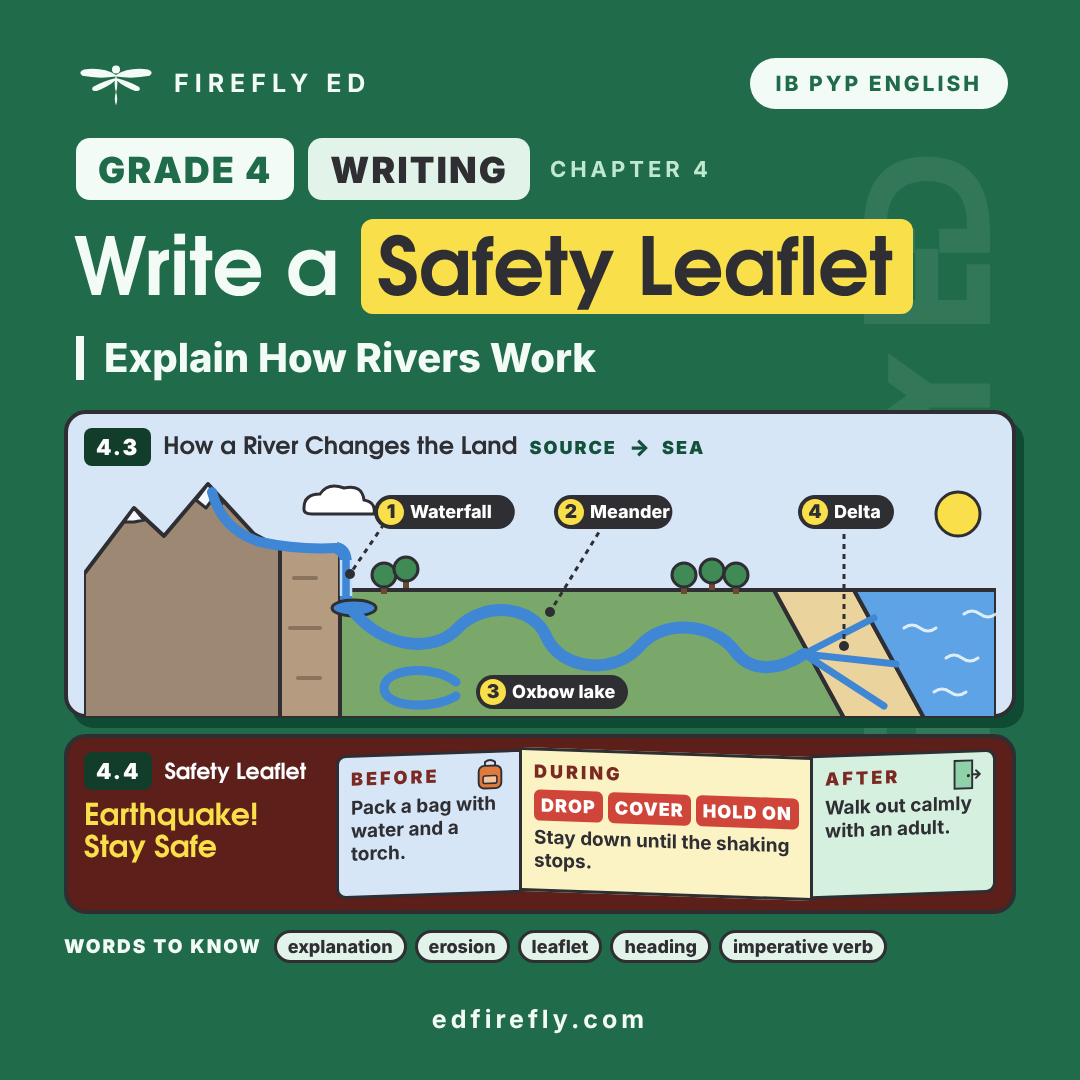
How a River Changes the Land
A river may look calm, but it is always at work. Over many years, it changes the shape of the land in several ways.
First, a river wears away rock and soil. This is called erosion. Fast water carries stones and sand, and they scrape the riverbed because they are pushed along by the current. For example, at a waterfall, the water wears away the soft rock underneath, so the waterfall slowly moves back up the valley.
Another way a river changes the land is by making bends. On the outside of a bend, the water flows fastest, so it wears the bank away. On the inside, the water is slow, and it drops sand. The bends grow bigger and loopier. Sometimes, a loop is also cut off when the river breaks through, and it becomes an oxbow lake.
Finally, a river builds new land. When it reaches the sea, it slows down and drops the sand and mud it was carrying. Over time, this can build a fan-shaped area of new land called a delta.
In conclusion, a river wears land away in some places and builds it up in others. Little by little, it shapes the land around it.
See How It’s Done
Now Try It
1. Find the linking word in the model that adds a new idea at the start of a paragraph.
______________
2. Add a linking word: The river slows down at the sea, ______ it drops sand and mud.
______________
Hint: Is this a cause and an effect?
Time To Practise
Name: ______________________
1. Choose the linking word.
Use each word once: another also for example because
a) Rivers carry stones ______________ the current is strong.
b) Wind can wear away rock. ______________, it shapes the tall rocks in deserts.
c) Ice is ______________ thing that can change the land.
d) Rivers make valleys. They ______________ make waterfalls.
2. Order the explanation.
Number the parts from 1 to 4.
____ Finally, the river drops sand and mud to build a delta.
____ A river changes the land in several ways.
____ In conclusion, a river wears land away and builds it up.
____ First, a river wears away rock and soil.
3. Plan your explanation.
Choose one: How the sea changes a coastline, How wind changes a desert, or How ice changes a mountain. Use a library book or a safe website to find facts.
| Part | My notes |
|---|---|
| Introduction | |
| Paragraph 1 | |
| Paragraph 2 | |
| Paragraph 3 | |
| Conclusion | |
4. Write your explanation.
Write your explanation in paragraphs. Use at least four linking words, and underline them.
__________________________________________________________________
__________________________________________________________________
__________________________________________________________________
__________________________________________________________________
__________________________________________________________________
__________________________________________________________________
5. Check your work.
☐ an introduction and a conclusion ☐ a new paragraph for each main idea ☐ four linking words ☐ at least one cause and one example
Reflect
Think about these questions. Talk about them with someone at home or at school.
1. Go back to the Wonder question: “If you came back to a river after a hundred years, what might be different?” What do you think now?
2. I was a communicator today when I ______________________________.
A communicator shares ideas clearly by talking, writing or drawing. For example: I was a communicator today when I used linking words so my reader could follow my ideas.
Take action: Visit a river, stream or beach with an adult. Look for signs that the water is wearing land away or building it up, and explain them to someone.
Next Steps
If this was easy, try: Draw a labelled diagram to go with your explanation, and add a caption.
If this was hard, go back to: Let’s Learn. Read the model aloud and point to each linking word. Say what job it does.
Notes for Parents and Teachers
Show notes for parents and teachers
These notes cover this lesson only. How every lesson runs is explained in How to Use This Material.
Let’s Learn
Look at the picture together, then read the model explanation.
Answer Key
Reveal Answers
Now Try It
1. Another (also accept First and Finally) 2. so
1. Choose the linking word
a) because b) For example c) another d) also
2. Order the explanation
3, 1, 4, 2
3 to 5. Answers will vary. Look for: an introduction, three paragraphs that each explain one way the land changes, a conclusion, and at least four linking words used correctly.
Reflect
2. Any real moment from the lesson that shows the learner was a communicator. Examples: “I was a communicator today when I used linking words so my reader could follow my ideas.” “I was a communicator today when I wrote each main idea in its own paragraph.”
Lesson 4.4: Write a Safety Leaflet: What to Do in an Earthquake | Writing | About 20 minutes
Term 2 | Level 2
Goal
“I can write a safety leaflet with a title, headings and clear instructions, so that readers know exactly what to do.”
Words to know
leaflet, heading, instruction, imperative verb, earthquake, aftershock
Wonder
Think about this question before you start. Say your ideas. You will come back to it at the end of the lesson.
If the ground started shaking right now, what would you do?
Let’s Learn
A leaflet is a short text, often folded, that gives people useful information. A safety leaflet tells readers what to do. It needs:
1. A clear title that says what it is about.
2. Headings that split the information into sections, such as Before, During and After.
3. Short instructions that start with a bossy verb (an imperative verb), such as drop, cover, hold, walk, pack.
4. Pictures that show the reader what to do.
Safety experts around the world teach three steps for an earthquake: Drop, Cover and Hold On. Drop down onto your hands and knees, so the shaking cannot knock you over. Cover your head and neck, under a strong table if there is one. Hold on until the shaking stops. Do not run outside while the ground is shaking.
After a big earthquake, there are often smaller shakes called aftershocks. That is why people are told to stay in an open space.
See How It’s Done
Now Try It
1. Underline the imperative verb: Pack a torch in your emergency bag.
2. Why does the leaflet use the headings Before, During and After?
__________________________________________________________________
Hint: Think about a reader who needs to find the right part fast.
Time To Practise
Name: ______________________
1. Find the features.
Tick each feature you can find in the model leaflet.
☐ a title ☐ headings ☐ imperative verbs ☐ pictures ☐ short instructions
2. Make it an instruction.
Rewrite each sentence so it starts with an imperative verb.
a) You should keep a torch by your bed. ________________________________________
b) It is a good idea to practise a drill. ________________________________________
c) People need to stay away from windows. ________________________________________
3. Put the steps in order.
Number the steps from 1 to 4.
____ Hold on until the shaking stops. ____ Drop to your hands and knees. ____ Walk out calmly to an open space. ____ Cover your head and neck.
4. Plan your leaflet.
Choose a hazard: a flood, a storm, a heatwave or a fire. Find safety advice from an official source, such as your local emergency service, with an adult.
| Part | My notes |
|---|---|
| Title | |
| Heading 1: Before | |
| Heading 2: During | |
| Heading 3: After | |
| Pictures I will draw |
5. Make your leaflet.
Fold a sheet of paper into three. Write your title on the front, then one heading and three or four instructions in each section. Add a picture for each section.
Reflect
Think about these questions. Talk about them with someone at home or at school.
1. Go back to the Wonder question: “If the ground started shaking right now, what would you do?” What do you think now?
2. I was caring today when I ______________________________.
Being caring means being kind and helping others. For example: I was caring today when I wrote clear steps that could help someone stay safe.
Take action: Practise Drop, Cover and Hold On with your family. Choose a safe spot in each room of your home.
Next Steps
If this was easy, try: Make a poster version of your leaflet for your classroom wall, with one big picture and three short instructions.
If this was hard, go back to: Let’s Learn. Read the leaflet aloud, and point to the title, each heading and each imperative verb.
Notes for Parents and Teachers
Show notes for parents and teachers
These notes cover this lesson only. How every lesson runs is explained in How to Use This Material.
Let’s Learn
Look at the model leaflet together.
Answer Key
Reveal Answers
Now Try It
1. Pack 2. So readers can quickly find what to do at each stage of the emergency.
1. Find the features
All five should be ticked.
2. Make it an instruction
a) Keep a torch by your bed. b) Practise a drill. c) Stay away from windows.
3. Put the steps in order
3, 1, 4, 2
4 and 5. Answers will vary. Look for: a clear title, three headings, short instructions that start with imperative verbs, safety advice that comes from a reliable source, and a picture for each section.
Reflect
2. Any real moment from the lesson that shows the learner was caring. Examples: “I was caring today when I wrote clear steps that could help someone stay safe.” “I was caring today when I shared safety advice with my family.”
For Teachers: IB Details
Show IB and curriculum details
IB theme: How the world works. This theme is about the natural world and its laws, how people and nature affect each other, and how people use science to understand the world.
Central idea: Forces inside the Earth and on its surface change the land, and people can prepare for those changes.
| Lesson | Title | Strand | Key concept |
|---|---|---|---|
| 4.3 | Explain It: How a River Changes the Land | Writing | Change |
| 4.4 | Write a Safety Leaflet: What to Do in an Earthquake | Writing | Responsibility |
Each lesson also matches the national curriculum for England (Year 4) and the US Common Core (Grade 4). The Grade 4 Curriculum Map lists the full standards for every lesson.
← Back to Chapter 4 – Our Changing Earth | Chapters – Index
© 2026 Firefly Ed. All rights reserved. This page may be printed for personal, home and classroom use. It may not be sold, shared online or reproduced for commercial use without written permission. edfirefly.com



Share your thoughts or ask something..