
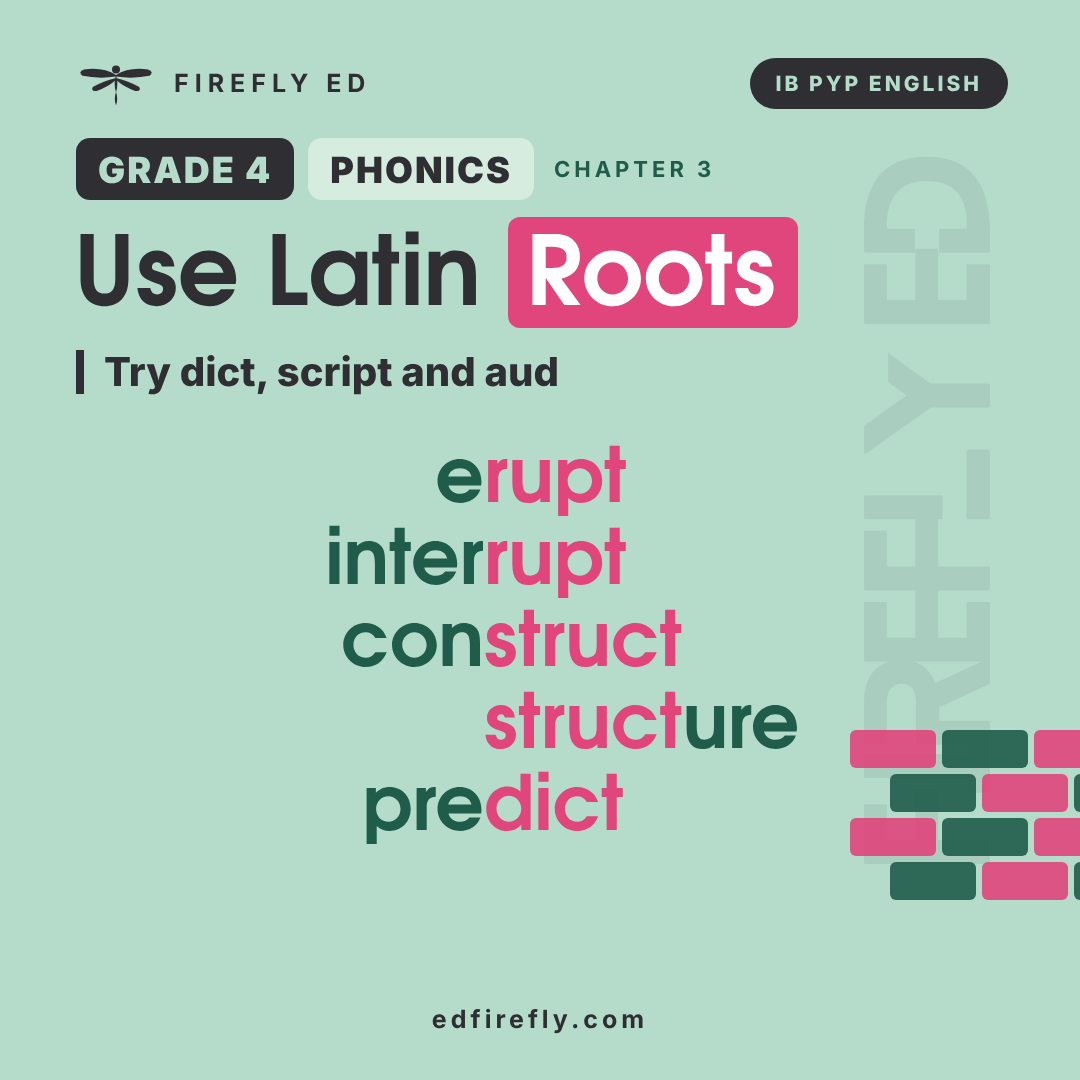
Term 1 | Level 1 | Phonics focus: Latin roots: dict, script, aud, vis, rupt and struct
Chapter 3 – Poems and Plays | Chapters – Index
Lessons
This page has the two writing lessons of Chapter 3, Poems and Plays: Lessons 3.3 and 3.4. The chapter page has the chapter overview, the chapter review and the PDF download.
Tap a lesson to open it. Tap the lesson title again, or use the link at the end of the lesson, to close it.
Lesson 3.3: Write a Poem With a Simile and a Metaphor | Writing | About 20 minutes
Term 1 | Level 1
Goal
“I can write a short poem in verses that uses at least one simile and one metaphor.”
Words to know
poem, verse, line, simile, metaphor, senses, rhyme
Wonder
Think about this question before you start. Say your ideas. You will come back to it at the end of the lesson.
If you could turn the weather into an animal, which animal would it be?
Let’s Learn
Poets start by noticing. They collect words from their senses, then shape them into lines and verses.
Four steps to a poem
1. Choose a subject. Pick something you can picture clearly.
2. Brainstorm. Write words for what you see, hear, smell, taste and feel.
3. Compare. Make a simile (like or as) and a metaphor (is or are).
4. Shape it. Write two verses of four lines. Rhyme is a choice, not a rule.
See How It’s Done
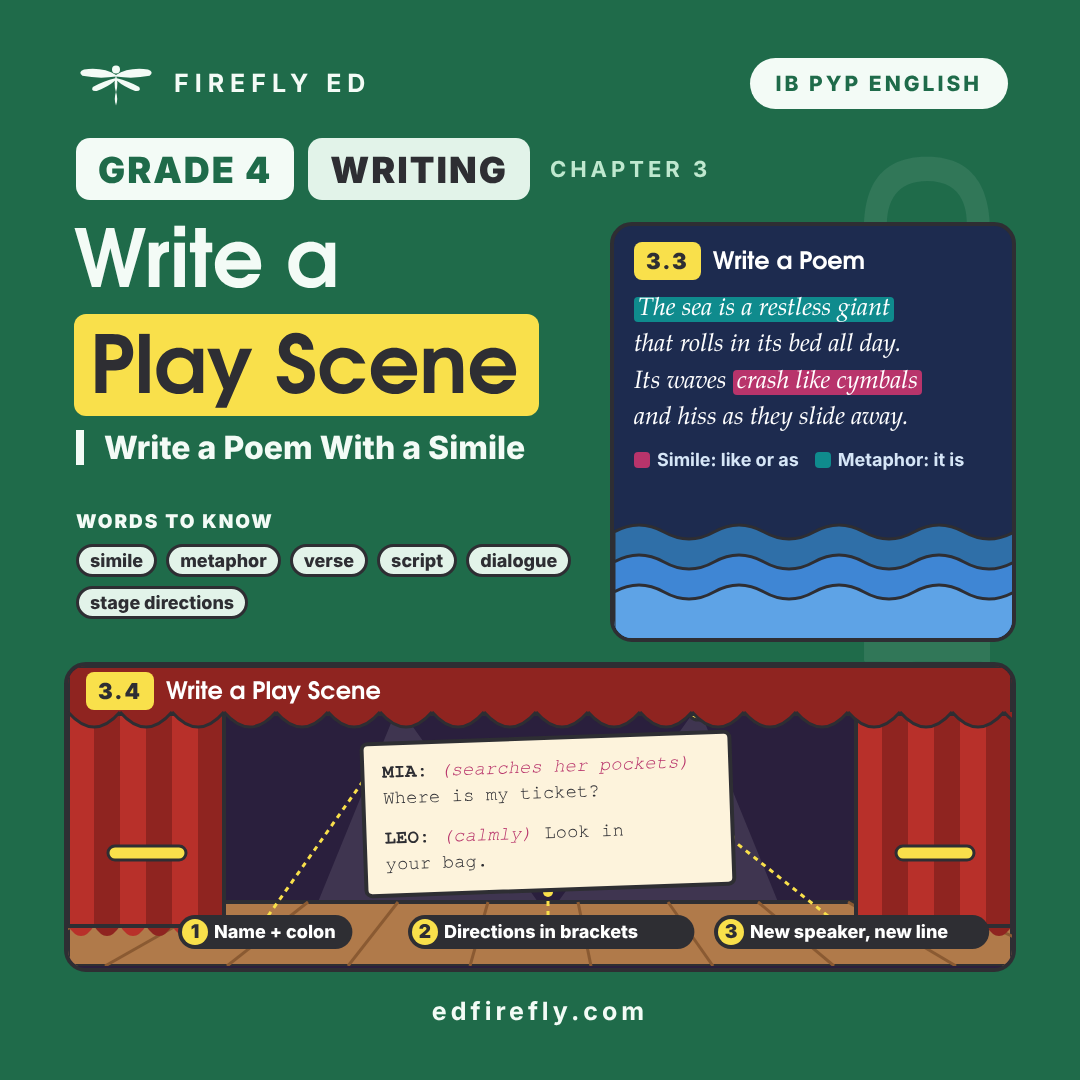
Model poem: The Sea
The sea is a restless giant
that rolls in its bed all day.
Its waves crash like cymbals
and hiss as they slide away.
It glitters in the morning,
grey-green and cold and wide,
and leaves me salty presents
of seaweed, left by the tide.
Now Try It
1. Finish this simile about rain: The rain tapped on the window like ______________.
Hint: What else makes a tapping sound?
2. Turn this simile into a metaphor: The sun is like a golden coin.
__________________________________________________________________
Hint: Take out the word like.
Time To Practise
Name: ______________________
1. Choose your subject.
My subject: ______________________
2. Brainstorm.
| Sense | My words |
|---|---|
| See | |
| Hear | |
| Smell or taste | |
| Feel | |
3. Make comparisons.
My simile: ______________ is like / as ______________
My metaphor: ______________ is ______________
4. Write your poem.
Write two verses, with four lines in each. Use your simile and your metaphor.
Word bank: whisper, glitter, crash, drift, sparkle, howl, shimmer, patter, tumble, swirl
Title: ______________________
__________________________________________________________________
__________________________________________________________________
__________________________________________________________________
__________________________________________________________________
__________________________________________________________________
__________________________________________________________________
__________________________________________________________________
__________________________________________________________________
5. Check your poem.
☐ My poem has a title and two verses.
☐ I used at least one simile and one metaphor.
☐ I used words from my senses.
☐ I read it aloud to hear the rhythm, and changed any line that sounded awkward.
Reflect
Think about these questions. Talk about them with someone at home or at school.
1. Go back to the Wonder question: “If you could turn the weather into an animal, which animal would it be?” What do you think now?
2. I was a risk-taker today when I ______________________________.
A risk-taker tries something new, even when it feels hard. For example: I was a risk-taker today when I tried a bold metaphor in my poem.
Take action: Read your poem to someone at home. Ask them which line they could picture best.
Next Steps
If this was easy, try: Write a third verse that uses a different sense, such as sound or touch.
If this was hard, go back to: Let’s Learn. Look at the brainstorm web again, then make one simile for your subject before you write.
Answer Key
Reveal Answers
Now Try It
1. Sample answers: tiny fingers, a drummer, a woodpecker. 2. The sun is a golden coin.
3. Make comparisons
Sample answers: The snow is as soft as a pillow. The snow is a white blanket over the town.
4. Write your poem
Look for: a title; two verses of four lines; at least one simile (with like or as) and one metaphor (is or are); words from the senses. Rhyme is not required.
Reflect
2. Any real moment from the lesson that shows the learner was a risk-taker. Examples: “I was a risk-taker today when I tried a bold metaphor in my poem.” “I was a risk-taker today when I read my poem aloud and changed a line.”
Lesson 3.4: Write a Scene: Dialogue and Stage Directions | Writing | About 20 minutes
Term 1 | Level 1
Goal
“I can write a short play scene with a cast list, a setting, dialogue and stage directions.”
Words to know
script, scene, cast, setting, dialogue, stage directions
Wonder
Think about this question before you start. Say your ideas. You will come back to it at the end of the lesson.
How do actors know what to say and what to do?
Let’s Learn
A play is written as a script. A script tells the actors what to say and what to do. A short part of a play is called a scene.
Rules for a script
• Write the name in capital letters, then a colon. Do not use quotation marks.
• Put stage directions in brackets. Write them in the present tense: (MIA searches her pockets.)
• Short stage directions can show how a line is said: (calmly), (shouting).
• Each new speaker starts on a new line.
See How It’s Done
Now Try It
1. Rewrite this story sentence as a line of a play: “I’m hungry,” moaned Leo.
__________________________________________________________________
Hint: Name, colon, a stage direction in brackets, then the words.
2. Write a stage direction that shows a character is excited.
__________________________________________________________________
Hint: What would an excited person do?
Time To Practise
Name: ______________________
1. Plan your scene.
Idea: Two friends find an old box in an attic. Inside is something surprising.
| Plan | My ideas |
|---|---|
| Title | |
| Cast (2 or 3 characters) | |
| Setting | |
| What is in the box? | |
| How does the scene end? | |
2. Write your scene.
Write at least eight lines, with at least three stage directions.
Word bank: whispers, gasps, laughs, opens the lid slowly, holds it up, steps back, (nervously), (excitedly)
Title: ______________________
Cast: __________________________________________________________
Setting: ________________________________________________________
__________________________________________________________________
__________________________________________________________________
__________________________________________________________________
__________________________________________________________________
__________________________________________________________________
__________________________________________________________________
__________________________________________________________________
__________________________________________________________________
3. Check your script.
☐ I wrote a title, a cast list and a setting.
☐ Each line of speech starts with a name and a colon.
☐ I did not use quotation marks.
☐ My stage directions are in brackets and in the present tense.
☐ The scene has a clear ending.
Reflect
Think about these questions. Talk about them with someone at home or at school.
1. Go back to the Wonder question: “How do actors know what to say and what to do?” What do you think now?
2. I was a communicator today when I ______________________________.
A communicator shares ideas clearly by talking, writing or drawing. For example: I was a communicator today when I wrote stage directions that tell the actors what to do.
Take action: Act out your scene with someone at home. Change any line that does not sound right when spoken.
Next Steps
If this was easy, try: Add a second scene that shows what happens next.
If this was hard, go back to: Let’s Learn. Look at the numbered parts of the script again, then copy the first three lines of The Lost Ticket before you write your own.
Answer Key
Reveal Answers
Now Try It
1. LEO: (moaning) I’m hungry. 2. Sample answer: (AVA jumps up and down, clapping her hands.)
2. Write your scene
Sample opening:
The Old Box
Cast: SAM; AVA, his friend
Setting: A dusty attic with a small window.
(SAM pulls an old wooden box from under a blanket.)
SAM: (whispering) Look at this!
AVA: (nervously) What if something jumps out?
Look for: a title, a cast list and a setting; names with colons and no quotation marks; at least three stage directions in brackets and in the present tense; an ending.
Reflect
2. Any real moment from the lesson that shows the learner was a communicator. Examples: “I was a communicator today when I wrote stage directions that tell the actors what to do.” “I was a communicator today when I set out my script so actors could follow it.”
For Teachers: IB Details
Show IB and curriculum details
IB theme: How we express ourselves. This theme is about the ways in which we discover and express ideas, feelings, beliefs and values, and how we enjoy and share stories, poems, plays and art.
Central idea: Poets and playwrights choose words, rhythm and structure to share feelings and ideas.
| Lesson | Title | Strand | Key concept |
|---|---|---|---|
| 3.3 | Write a Poem With a Simile and a Metaphor | Writing | Perspective |
| 3.4 | Write a Scene: Dialogue and Stage Directions | Writing | Form |
Each lesson also matches the national curriculum for England (Year 4) and the US Common Core (Grade 4). The Grade 4 Curriculum Map lists the full standards for every lesson.
← Back to Chapter 3 – Poems and Plays | Chapters – Index
© 2026 Firefly Ed. All rights reserved. This page may be printed for personal, home and classroom use. It may not be sold, shared online or reproduced for commercial use without written permission. edfirefly.com

Share your thoughts or ask something..