
Term 1 | Level 1 | Phonics focus: Latin roots: dict, script, aud, vis, rupt and struct
Chapter 3 – Poems and Plays | Chapters – Index
Lessons
This page has the two listening and speaking lessons of Chapter 3, Poems and Plays: Lessons 3.5 and 3.6. The chapter page has the chapter overview, the chapter review and the PDF download.
Tap a lesson to open it. Tap the lesson title again, or use the link at the end of the lesson, to close it.
Lesson 3.5: Read a Poem Aloud With Expression | Oral | About 20 minutes
Term 1 | Level 1
Goal
“I can read a poem aloud with expression, changing my speed, volume and pauses to match the meaning.”
Words to know
expression, pace, volume, pause, tone, emphasis
Wonder
Think about this question before you start. Say your ideas. You will come back to it at the end of the lesson.
How can your voice change the way a poem makes people feel?
Let’s Learn
Listen as an adult reads the poem twice: once flatly, then with expression. Which reading sounded better?
When you read a poem aloud, your voice does a lot of work. You can change:
• pace: how fast or slow you read
• volume: how loud or soft you are
• pauses: where you stop for a moment, such as at a comma or the end of a line
• emphasis: which words you say more strongly
• tone: the feeling in your voice, such as excited, calm or sad
Market Day
A poem written for this lesson
Hurry, hurry, the market is here!
Mangoes and melons, the stalls are a cheer!
A cart rattles by with a squeak and a bump,
The baker is laughing, his loaves soft and plump.
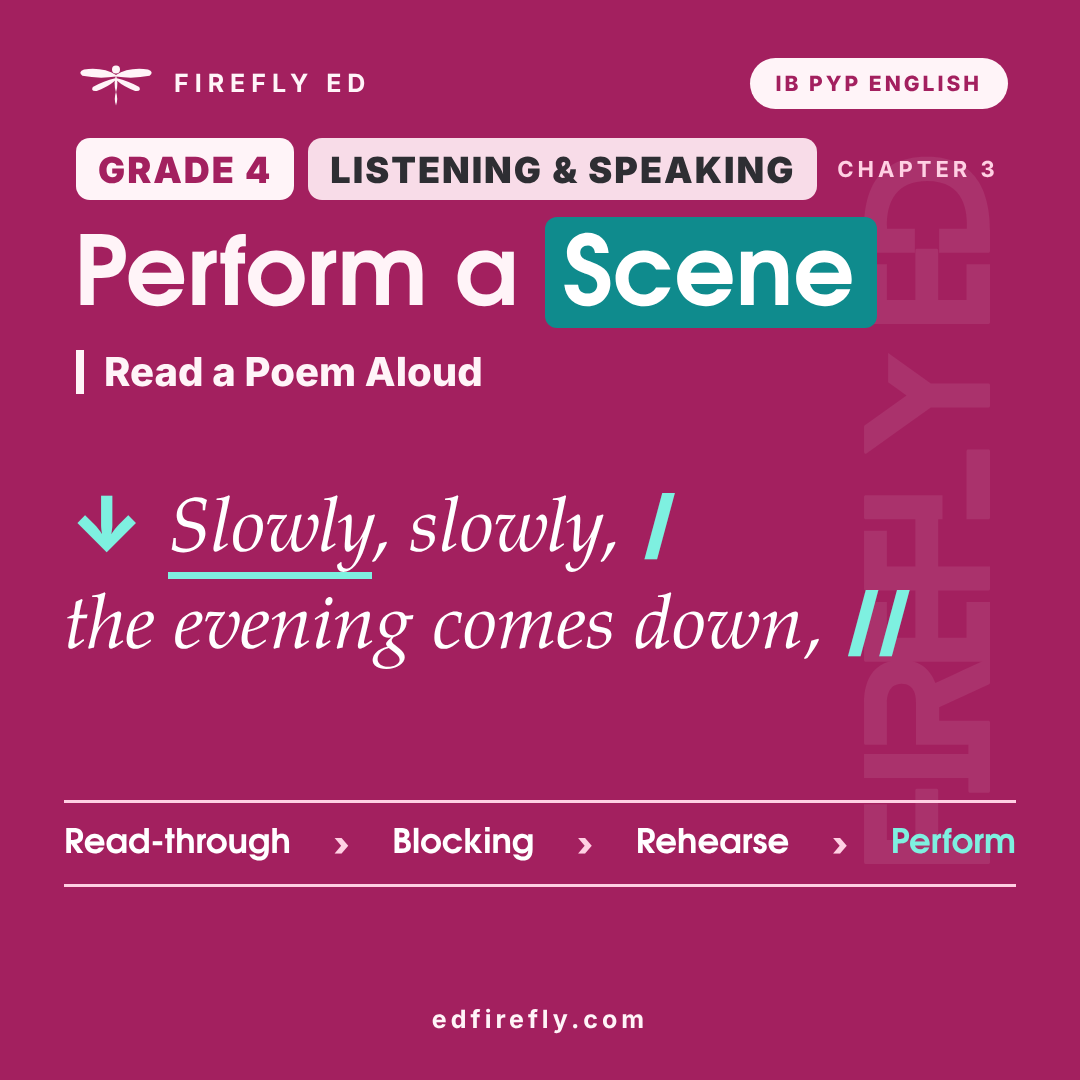
Slowly, slowly, the evening comes down,
The lamps make a necklace all over the town.
The stalls are packed up and the shutters are shut,
And somebody whispers, “Good night, little hut.”
See How It’s Done
Read the marked-up lines aloud, following the marks.
Marked-up lines:
↑ Hurry, hurry, / the market is here! //
Mangoes and melons, / the stalls are a cheer! //
Now Try It
1. Which word in the second verse tells you to slow down?
______________
Hint: Look at the first word of the verse.
2. Read the last line, “Good night, little hut,” in two ways: loudly and softly. Which way fits the poem better? Why?
__________________________________________________________________
Hint: What time of day is it?
Time To Practise
Name: ______________________
1. Mark up the second verse.
Copy the second verse. Add pause marks, underline two words to stress, and add an arrow for softer.
__________________________________________________________________
__________________________________________________________________
__________________________________________________________________
__________________________________________________________________
2. Read it three times.
Read the whole poem aloud to an adult three times. After each reading, listen to their tip. Then tick the boxes you did well by the third reading.
☐ I read every word correctly.
☐ I read the first verse faster and the second verse slower.
☐ I changed my volume.
☐ I paused at commas and at the ends of sentences.
☐ My tone matched the feeling of each verse.
3. Reflect.
Which reading was best? What did you change?
__________________________________________________________________
4. Try another poem.
Read “The Night Garden” from Lesson 3.1 aloud. What pace and tone will you use? Why?
__________________________________________________________________
Reflect
Think about these questions. Talk about them with someone at home or at school.
1. Go back to the Wonder question: “How can your voice change the way a poem makes people feel?” What do you think now?
2. I was a risk-taker today when I ______________________________.
A risk-taker tries something new, even when it feels hard. For example: I was a risk-taker today when I read the poem aloud with a loud, excited voice.
Take action: Read a poem aloud to someone at home, using what you learned. Ask them which part they liked best.
Next Steps
If this was easy, try: Record yourself reading the poem. Listen back and change one thing for a better reading.
If this was hard, go back to: Let’s Learn. Read only the first two lines, following the marks, before you try the whole poem.
Notes for Parents and Teachers
Show notes for parents and teachers
These notes cover this lesson only. How every lesson runs is explained in How to Use This Material.
Let’s Learn
Read the poem aloud twice: once flatly, then with expression. Ask the learner which sounded better.
Time To Practise
- Task 2: Listen to the learner read the whole poem three times. After each reading, give one tip. Tick the boxes the learner does well by the third reading.
Answer Key
Reveal Answers
Now Try It
1. Slowly 2. Softly, because it is evening, the market is closing and someone is whispering goodnight.
1. Mark up the second verse
Sample: ↓ Slowly, slowly, / the evening comes down, // The lamps make a necklace / all over the town. //
2 and 3. Read it three times
Look for: accurate reading, a clear change of pace and volume between the verses, pauses at punctuation, and a tone that matches each verse.
4. Try another poem
Sample answer: A slow pace and a calm, quiet tone, because the garden is sleeping and the wind is a whisper.
Reflect
2. Any real moment from the lesson that shows the learner was a risk-taker. Examples: “I was a risk-taker today when I read the poem aloud with a loud, excited voice.” “I was a risk-taker today when I tried a new way to read the last line.”
Lesson 3.6: Perform a Scene as a Cast | Oral | About 20 minutes
Term 1 | Level 1
Goal
“I can rehearse and perform a scene with others, speaking clearly and staying in character.”
Words to know
cast, rehearse, blocking, cue, project, in character
Wonder
Think about this question before you start. Say your ideas. You will come back to it at the end of the lesson.
What do actors do to make an audience believe the story?
Let’s Learn
A cast is the group of actors in a play. To perform well, a cast works as a team.
Tips for actors
• Project your voice: speak loudly enough for the back of the room.
• Face the audience, even when you speak to another character.
• Know your cue: the line just before yours.
• Stay in character: keep the character’s feelings on your face and in your body, even when you are not speaking.
The Lost Puppy
Cast: AVA; LEO, her friend; MRS SHAH, a neighbour
Setting: A street outside a row of houses, in the evening.
(AVA walks in slowly, holding an empty lead. She looks around.)
AVA: (calling) Biscuit! Biscuit! Where are you?
(LEO runs in, out of breath.)
LEO: I checked the park. He’s not there.
AVA: (close to tears) It’s getting dark. What if he’s scared?
(MRS SHAH opens her front door. She is holding a small, muddy puppy.)
MRS SHAH: (smiling) Is this the little explorer you’re looking for? He was in my vegetable patch.
AVA: (running to her) Biscuit! Oh, thank you, Mrs Shah!
LEO: (laughing) He looks like he’s been digging for treasure.
MRS SHAH: He found three of my carrots. You can tell him he is forgiven.
(They all laugh. AVA clips on the lead and hugs the puppy.)
See How It’s Done
Now Try It
1. What is Leo’s cue for his first line?
__________________________________________________________________
Hint: Look at the line just before Leo speaks.
2. How should Mrs Shah sound? Find the stage direction that tells you.
__________________________________________________________________
Hint: Look in the brackets before her first line.
Time To Practise
Name: ______________________
1. Cast the scene.
If there are only two of you, one actor can play Leo and Mrs Shah. Change your voice for each.
AVA: ______________ LEO: ______________ MRS SHAH: ______________
2. Mark your lines.
Underline your lines in the script. Circle your cues.
3. Plan the blocking.
Draw a simple plan of your stage. Mark where each actor starts with their first letter.
4. Rehearse and perform.
☐ We read the scene through together.
☐ We practised where to stand and move.
☐ I said my lines on cue.
☐ I projected my voice and faced the audience.
☐ I stayed in character.
5. Feedback: two stars and a wish.
Ask an adult for two things that went well and one thing to try next time.
★ __________________________________________________________
★ __________________________________________________________
Wish: _______________________________________________________
Reflect
Think about these questions. Talk about them with someone at home or at school.
1. Go back to the Wonder question: “What do actors do to make an audience believe the story?” What do you think now?
2. I was balanced today when I ______________________________.
Being balanced means taking care of your body and mind, with time to work, play and rest. For example: I was balanced today when I rehearsed hard and then took a short rest before we performed.
Take action: Perform the scene for family or friends. Ask your audience what they liked most.
Next Steps
If this was easy, try: Add one more character to the scene and write two lines for them. Perform it again.
If this was hard, go back to: Let’s Learn. Read only your own lines and your cues aloud three times before you rehearse with others.
Notes for Parents and Teachers
Show notes for parents and teachers
These notes cover this lesson only. How every lesson runs is explained in How to Use This Material.
Let’s Learn
Then read the scene through together.
Time To Practise
- Task 5: After the performance, give the learner two things that went well and one thing to try next time.
Answer Key
Reveal Answers
Now Try It
1. “Biscuit! Biscuit! Where are you?” 2. Kind and amused: the stage direction says (smiling).
3. Plan the blocking
Sample: A starts on the left, L enters from the right, and S stands at a door at the back.
4 and 5. Rehearse and perform
Look for: lines said on cue; a clear, loud voice; facing the audience; feelings that match the stage directions; staying in character while others speak.
Reflect
2. Any real moment from the lesson that shows the learner was balanced. Examples: “I was balanced today when I rehearsed hard and then took a short rest before we performed.” “I was balanced today when I took a break between rehearsals and came back ready.”
For Teachers: IB Details
Show IB and curriculum details
IB theme: How we express ourselves. This theme is about the ways in which we discover and express ideas, feelings, beliefs and values, and how we enjoy and share stories, poems, plays and art.
Central idea: Poets and playwrights choose words, rhythm and structure to share feelings and ideas.
| Lesson | Title | Strand | Key concept |
|---|---|---|---|
| 3.5 | Read a Poem Aloud With Expression | Speaking | Perspective |
| 3.6 | Perform a Scene as a Cast | Speaking | Connection |
Each lesson also matches the national curriculum for England (Year 4) and the US Common Core (Grade 4). The Grade 4 Curriculum Map lists the full standards for every lesson.
← Back to Chapter 3 – Poems and Plays | Chapters – Index
© 2026 Firefly Ed. All rights reserved. This page may be printed for personal, home and classroom use. It may not be sold, shared online or reproduced for commercial use without written permission. edfirefly.com



Share your thoughts or ask something..